Group
Group
 Group
Group


 Preferred Source

 Google Discover
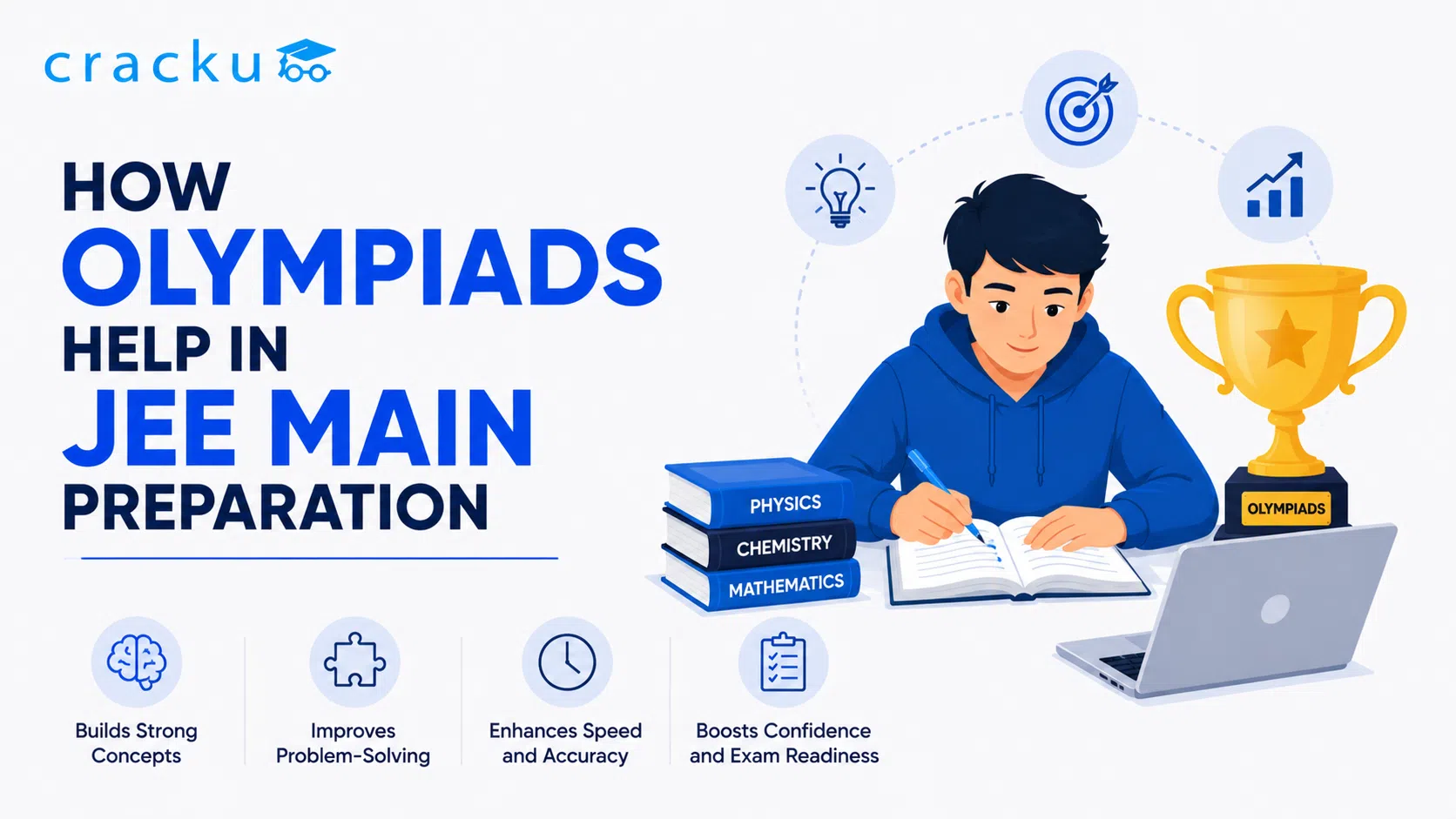
How Olympiads Help in JEE Main Preparation
Can solving one math problem today help in tomorrow’s JEE Main exam? Yes, it is, but today’s solving should be consistent and followed in the next and the next few years. This is not just for JEE but for your child’s future. If your child is already preparing for the Olympiad, this will help them with JEE too.
However, preparing for the Olympiad exam is also not an easy task. Students from Class 6 onwards can start with age-appropriate exams and slowly handle tougher questions every year. When preparation follows a proper plan, Olympiads become a strong base for future engineering entrance exams without adding unnecessary pressure.
Which Olympiads Are Helpful for JEE Main Aspirants?
Many students hear about Olympiads but do not know which ones actually help in engineering preparation. The right choice depends on the student's class and current understanding of concepts.
Olympiad | Best for Classes | Subject | How It Helps Later |
Science Olympiad | 6–10 | Physics, Chemistry, Biology | Improves scientific thinking and concept clarity |
Mathematics Olympiad | 6–12 | Mathematics | Builds logical problem-solving skills |
Physics Olympiad | 11–12 | Physics | Strengthens analytical questions |
Chemistry Olympiad | 11–12 | Chemistry | Develops conceptual understanding beyond textbooks |
Junior Science Olympiad | 8–10 | Integrated Science | Improves observation and application skills |
Students in Class 6 or 7 usually spend 30 to 45 minutes daily on concept learning.
By Class 8 or 9, practice can increase to around one hour.
Class 10 students who are preparing seriously may spend 60 to 90 minutes on Olympiad concepts without affecting theirschool studies.
The purpose is not to solve the hardest questions immediately. It is to improve step by step every academic year.
A student who starts early often develops:
- Better calculation speed
- Stronger reasoning ability
- Fewer conceptual mistakes
- Higher confidence in unfamiliar questions
- Better classroom understanding
Parents should also remember that every child learns differently. Comparing scores with others rarely improves performance. Consistency matters much more than early ranks.
Olympiads vs JEE Main: Similarities and Differences
In general, parents think Olympiads and entrance exams are the same. They are not. However, both develop many common academic skills.
Area | Olympiads | JEE Main |
Main goal | Deep concept learning | Speed with accuracy |
Question style | Analytical and challenging | Concept plus time management |
Difficulty | Can be higher for selected topics | Balanced across syllabus |
Time pressure | Moderate | High |
Focus | Thinking process | Correct answers within limited time |
Both exams expect students to understand concepts instead of memorising definitions.
For example:
A school textbook may ask for the formula of work done.
An Olympiad may ask why the formula changes in a practical situation.
A competitive engineering exam may ask the same concept inside a numerical problem that must be solved within two minutes.
This gradual increase in difficulty helps students become comfortable with different question formats.
Regular practice also improves accuracy while solving JEE questions because students become familiar with multi-step thinking.
Still, students should not spend all their study hours only on Olympiads.
School syllabus, revision, and board preparation continue to remain equally important.
How a JEE Foundation Course Complements Olympiad Preparation
Olympiads build concepts, and a structured JEE foundation course builds those concepts into long-term preparation.
Both work better when they support each other instead of competing for study time.
A well-designed foundation programme generally starts from Class 8, Class 9, or Class 10.
Instead of rushing through advanced chapters, students learn concepts in the sequence their school education follows.
A balanced programme usually includes:
- Mathematics concept classes
- Physics fundamentals
- Chemistry basics
- Weekly practice sessions
- Topic-wise assessments
- Doubt-solving support
For example, a structured programme may offer:
Feature | Learning Benefit |
120+ live classes | Regular concept building across the academic year |
250+ recorded lessons | Flexible revision before school exams |
5,000+ practice questions | Exposure to different difficulty levels |
200+ concept tests | Continuous progress tracking |
IIT faculty guidance | Better understanding of competitive approaches |
Students preparing for Olympiads often ask difficult "why" questions.
Foundation classes explain those concepts systematically before moving on to entrance-level applications.
This reduces confusion during higher classes when JEE Advanced preparation becomes more intensive.
Parents should also avoid enrolling children in multiple coaching programmes at the same time.
One structured programme with consistent practice usually produces better results than several overlapping courses.
Can Olympiad Preparation Improve JEE Main Scores?
Yes, but only when students prepare with balance.
Olympiads improve several skills that later become useful in competitive examinations.
These include:
- Reading lengthy questions patiently
- Identifying hidden concepts
- Avoiding guesswork
- Building logical thinking
- Improving confidence during difficult papers
Consider two Class 11 students.
One has solved concept-based questions since Class 8.
The other starts competitive preparation only after board exams.
The first student usually spends less time understanding new chapters because the basic thinking process is already developed.
That does not automatically guarantee higher marks.
Regular revision remains equally important.
Students should also include:
- Weekly chapter revision
- Monthly performance review
- Previous year practice
- Timed practice sessions
- Error notebook maintenance
Adding JEE Mock Tests gradually after completing major syllabus portions helps students understand where concepts break under exam pressure.
Parents may notice temporary score fluctuations.
That is completely normal during preparation.
The focus should remain on reducing repeated mistakes rather than chasing every weekly score.
Students also benefit from maintaining organised JEE study material instead of collecting too many books.
One notebook containing formulas, mistakes, and revision points often becomes more valuable than several unread guides.
Common Mistakes Students Make While Preparing for Olympiads
Students work hard but lose marks because of avoidable mistakes.
1. Starting with very difficult books
Advanced books without strong basics often reduce confidence.
Build concepts first. Increase difficulty gradually.
2. Ignoring school learning
Olympiad preparation should strengthen classroom understanding, not replace it.
Both should progress together.
3. Solving questions without analysis
Completing many questions is useful only if mistakes are reviewed carefully.
Spend time understanding every incorrect answer.
4. Following too many resources
One good book for each subject is often enough in the beginning.
Avoid changing books every month.
5. Studying without a timetable
Students in Class 8 or 9 usually benefit from:
- 45–60 minutes of Olympiad practice
- Daily school revision
- One weekly test
- One weekly error analysis session
6. Ignoring health and breaks
Long study hours without sleep reduce concentration. Regular breaks, outdoor activity, and proper sleep improve learning quality.
Also Read: Why Every JEE Aspirant Should Participate in Olympiads
Conclusion
Also, there is another benefit: Institutes like IIT Madras and IIT Kanpur have already launched Olympiad-based admission routes for selected undergraduate programmes. Starting early allows children to understand concepts instead of depending only on memorisation. With steady practice, balanced school studies, and a structured JEE foundation course, students develop confidence before entering senior secondary classes.
Parents should focus on progress rather than rankings, while students should learn patiently and improve every year. Small improvements made from Class 6, 7, or 8 often become a strong advantage when competitive engineering preparation reaches its most demanding stage.