

 Group
 Group


 Preferred Source

 Google Discover
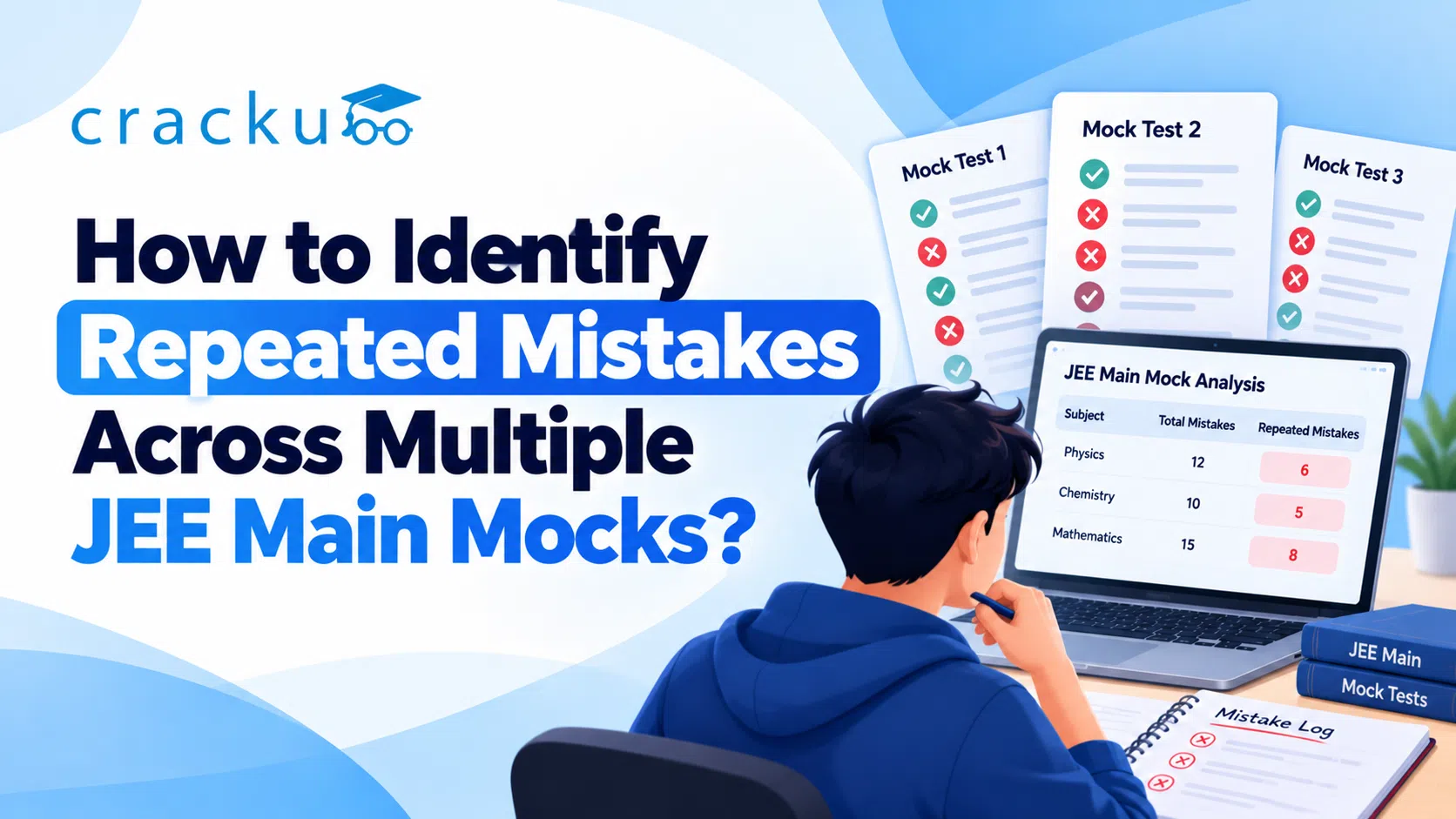
Taking multiple tests is useful for JEE Main preparation, but attempting more papers will not automatically improve your score. If you keep making the same errors in different tests, you may lose marks even when you understand the concepts. The key is to identify what goes wrong, find patterns in your answers, and work on those areas before your next attempt.
Reviewing your performance across several tests can help you recognise weak concepts, calculation errors, poor question selection, and time management problems. Instead of treating every test as a separate result, use your mistakes to understand where you need to improve.
How to Identify Repeated Mistakes Across Multiple JEE Main Mocks?
Start by reviewing your last three to five tests rather than looking at only your latest score. Compare the questions you answered incorrectly, the questions you left unattempted, and the questions that took longer than expected. You may notice that the same types of errors appear repeatedly.
For example, you might lose marks in questions involving lengthy calculations, misunderstand questions with similar-looking options, or forget formulas under time pressure. These patterns are easier to recognise when you compare several tests together.
Follow these steps to identify recurring mistakes:
- Review every incorrect answer and note why you got it wrong.
- Check whether you made a similar mistake in an earlier test.
- Identify the chapters and question types where errors occur most frequently.
- Record whether the problem was conceptual, calculation-based, or related to time management.
- Compare your performance after revising the topics to see whether the errors decrease.
Do not focus only on your total score. Two tests with similar marks can reveal very different problems. One may show weak conceptual understanding, while the other may reveal that you know the material but struggle to manage time.
How to Identify Repeated Errors in Physics, Chemistry and Maths
Each subject requires a slightly different approach when reviewing mistakes. Separating errors by subject helps you decide whether you need to revise concepts, practise calculations, memorise important information, or improve your question-solving approach.
Physics
In Physics, repeated errors often occur in numerical calculations, formula selection, unit conversions, and the application of concepts. You may know the correct formula but use the wrong values or miss a condition given in the question.
Review your incorrect answers and check whether you repeatedly struggle with topics such as Mechanics, Current Electricity, or Modern Physics. If the same type of calculation causes problems across multiple tests, practise similar questions and write down the steps where you usually go wrong.
Chemistry
Chemistry mistakes may involve forgotten reactions, incorrect assumptions about a concept, confusion between similar compounds, or missing details from NCERT. In Physical Chemistry, check calculation errors and formula application. In Organic Chemistry, review reaction mechanisms and reagent selection. In Inorganic Chemistry, identify factual information that you repeatedly forget.
When reviewing a JEE Mains mock test, note whether you selected an incorrect option because you did not remember the concept or because you misread the question. These require different solutions.
Mathematics
In Mathematics, recurring errors often involve lengthy calculations, incorrect algebraic steps, formula confusion, or choosing an inefficient solving method. You may also spend too much time on one question and rush through easier questions later.
Check whether your mistakes occur in particular topics, such as Calculus, Coordinate Geometry, or Algebra. Practise the relevant question types and compare your solutions with the correct method. The aim is not just to solve more questions but to solve them accurately and efficiently.
How to Find Patterns in Wrong Answers and Negative Marking
Wrong answers can reveal more than a low score. They can help you understand whether you are making avoidable errors, attempting questions without sufficient confidence, or spending too much time on difficult problems.
Start by grouping your incorrect answers into categories. A simple classification makes it easier to identify the biggest source of lost marks.
| Error category | What to look for | What to improve |
|---|---|---|
| Conceptual errors | Repeatedly misunderstanding the same concept | Revise theory and solve basic questions |
| Calculation errors | Arithmetic, signs, units, or algebra mistakes | Practise calculations and check intermediate steps |
| Question-reading errors | Missing words such as incorrect, except, or not | Read the question carefully before solving |
| Formula errors | Using the wrong formula or forgetting conditions | Revise formulas and practise application |
| Guesswork | Incorrect answers from uncertain attempts | Improve concept clarity and attempt selection |
| Time pressure | Rushed answers near the end of a test | Practise time allocation and question prioritisation |
Also track negative marks separately. Under the standard JEE Main marking scheme, a correct answer earns four marks and an incorrect answer to a question with negative marking loses one mark. Check the official instructions for your exam session before applying the scheme.
For example, if you repeatedly lose marks because you attempt questions without being able to eliminate any options, your problem may be question selection rather than subject knowledge. Reviewing this pattern can help you make more informed decisions in future tests.
How to Fix Recurring Mistakes Before JEE Main 2027
Once you identify your repeated mistakes, work on them systematically. Trying to correct every weakness at once can make revision difficult, so begin with errors that occur frequently or cost you the most marks.
Use this approach to improve:
- Prioritise recurring errors: Start with mistakes that appear in several tests, especially those involving concepts you should already know.
- Revise the underlying concept: Revisit the relevant chapter, formula, reaction, or solving method instead of memorising only the correct answer.
- Practise similar questions: Solve a small set of questions based on the same concept to check whether you can apply it correctly.
- Reattempt incorrect questions: After a short gap, solve the original questions without looking at the solutions.
- Test the improvement: Attempt another practice paper and check whether the same error occurs again.
Set aside time for error correction alongside your regular revision. For example, after reviewing a test, you could spend the next study session revising one weak concept and solving related questions. During your next test, check whether you can apply what you learned under timed conditions.
Avoid judging your progress from one improved score alone. Look for a consistent reduction in repeated mistakes across several tests.
How to Use a Mistake Log to Improve JEE Main Mock Test Scores
A mistake log is a simple record of errors made during practice tests. It helps you track recurring problems without having to review every paper from scratch.
You can maintain it in a notebook or spreadsheet. Record enough information to understand the mistake and decide what to do next.
| Test | Subject or chapter | Type of mistake | Reason | Corrective action |
|---|---|---|---|---|
| Test 1 | Physics – Mechanics | Calculation | Incorrect sign | Practise sign conventions |
| Test 2 | Physics – Mechanics | Calculation | Repeated sign error | Solve similar numerical questions |
| Test 2 | Chemistry – Organic | Conceptual | Confused reaction mechanism | Revise the reaction and its conditions |
| Test 3 | Maths – Calculus | Time management | Spent too long on one question | Practise question selection |
The entries above are illustrative. Record your own errors and update the log after every test.
Review your mistake log weekly. Look for chapters where errors keep appearing, corrective actions that have not worked, and mistakes that no longer occur. Give more attention to recurring problems than to isolated errors that are unlikely to happen again.
You can also add a status column, such as Not revised, Practising, or Improved. This makes it easier to decide what needs attention before the next test.
The most useful mistake log is one that changes your study plan. If the same error appears repeatedly, it should lead to a specific action, such as revising a concept, practising a question type, or changing your approach to time management.
Common Mistakes Students Repeat in JEE Main Mock Tests
Students often review their scores but overlook the reasons behind them. Avoid these common mistakes when analysing your performance:
- Checking only the final score: Your total marks do not show which concepts or habits are costing you marks.
- Reading solutions without reattempting questions: Understanding a solution is different from solving the question independently.
- Ignoring unattempted questions: Some questions remain unanswered because of weak concepts, while others are skipped because of poor time allocation.
- Repeating tests without correcting errors: More practice may not solve a problem if you continue using the same incorrect approach.
- Changing your strategy after every test: Make changes based on repeated evidence rather than one unusually difficult or easy paper.
- Ignoring subject-wise performance: A reasonable overall score can hide persistent weaknesses in one subject.
- Keeping an incomplete mistake log: Recording an error without noting its cause or corrective action makes it difficult to learn from it.
The objective is to make each practice test more useful than the previous one. Identify the mistakes that repeat, understand why they happen, and check whether your corrective actions work.
By following this process consistently, you can use your test results to guide revision, improve accuracy, and make better decisions during the actual JEE Main examination.
How to Identify Repeated Mistakes Across Multiple JEE Main Mocks: Conclusion
Identifying repeated mistakes across multiple JEE Main tests can help you understand why your scores are not improving. By reviewing incorrect answers, tracking subject-wise performance and recognising patterns in calculation errors, weak concepts and negative marking, you can focus your revision on the areas that need the most attention.
Before JEE Main 2027, maintain a mistake log and review it regularly alongside your revision and practice tests. Reattempt incorrect questions, work on recurring weaknesses and measure your progress across multiple tests. A consistent review process can help you improve accuracy, manage time more effectively and approach the actual examination with greater confidence.