91- 6303239042



 Group
Group
 Group
Group


 Preferred Source

 Google Discover
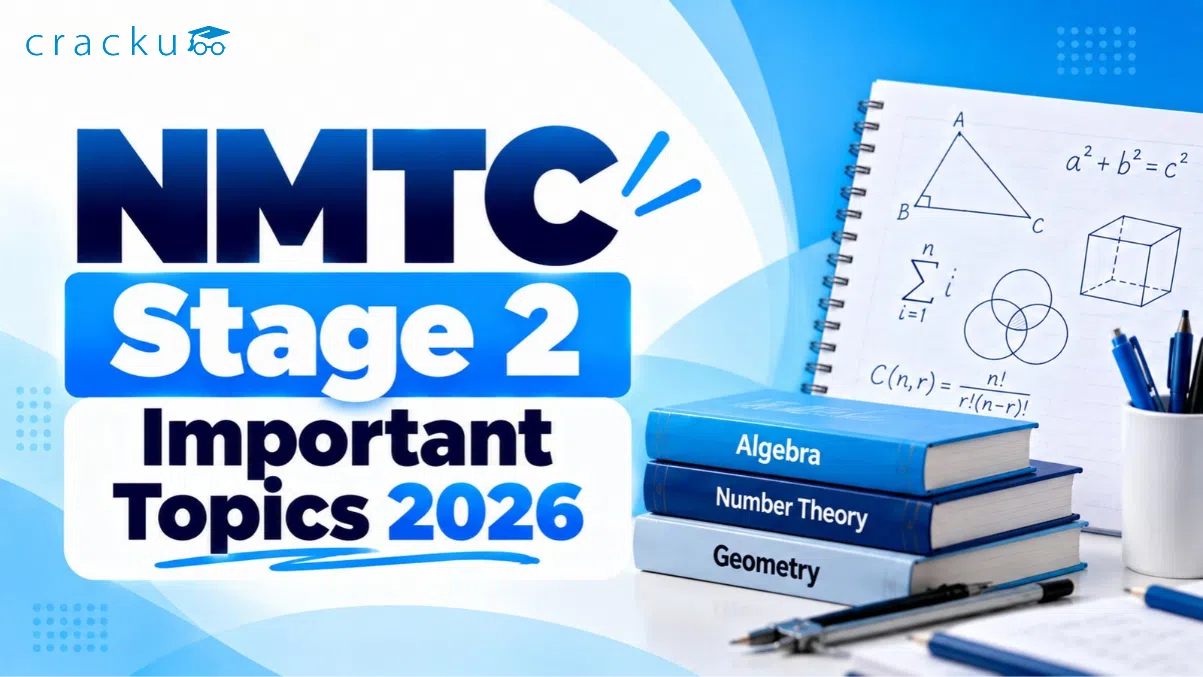
NMTC Stage 2 Important Topics 2026
The NMTC stage 2 important topics 2026 can help students narrow their preparation time and revision. Students while analysing the NMTC PYQs can make a list of most frequently asked topics and prioritise them rather than studying each topic line by line. This can save time for your preparation, and you can use this time in practice and mock tests. Start with topics already studied during school exam preparation. Then focus on areas where recent questions appeared repeatedly in the NMTC exam. The table below gives practical topics to prioritise during NMTC 2026 preparation.
NMTC Level | Classes | Important Topics |
Primary / Gauss | 5-6 | Fractions, percentages, ratios, divisibility, basic algebra, geometry, mensuration |
Sub-Junior / Kaprekar | 7-8 | Arithmetic applications, algebra, factorisation, geometry, number theory, mensuration |
Junior / Bhaskara | 9-10 | Algebra, sequences, geometry, number theory, combinatorics, inequalities |
Inter / Ramanujan | 11-12 | Advanced algebra, number theory, geometry, combinatorics, inequalities |
NMTC Stage 2 Syllabus and Important Topics
Understanding the NMTC exam syllabus might look like a textbook; the questions will check your analytical skills. Knowing the syllabus is one thing but knowing the important topics gives you the edge over others. By analysing the NMTC previous year papers students can understand which topics are most important. However, this exam is conducted in 4 levels covering Classes 5 to 12. The NMTC exam is conducted in two stages. Stage 1 is a preliminary stage, and stage 2 is the final stage. The syllabus for NMTC stage 2 is similar to stage 1, but the exam pattern changes. Students must start brushing up on their Mathematics concepts as soon as possible. But before you do, check the following the NMTC syllabus and important topics to ensure you are on the right path.
Classes | Syllabus | Important Topics |
5th & 6th | Arithmetic | Fractions, percentages, profit and loss, divisibility tests |
Number Skills | LCM, HCF, ratio and proportion, calendar problems | |
Mensuration | Triangles, quadrilaterals, circles and related measurements | |
Algebra | Addition, subtraction, multiplication and division expressions | |
Geometry | Straight lines, parallel lines, angles and polygons | |
7th & 8th | Arithmetic | Square roots, cube roots, averages, allegation |
Applications | Time and work, time and distance, races, circular travel | |
Mensuration | Cubes, cuboids, spheres, cones, cylinders, pyramids | |
Algebra | Linear and quadratic equations, identities, factorisation | |
Advanced Algebra | Laws of indices and basic surds | |
Geometry | Triangle inequalities, parallelograms, trapezoids, Pythagoras theorem | |
Number Theory | Prime numbers, composite numbers, divisibility | |
9th & 10th | Algebra | Quadratic equations, higher-degree equations, remainder theorem |
Advanced Algebra | Logarithms, sequences, series, induction, inequalities | |
Geometry | Circle theorems, chords, arcs, cyclic quadrilaterals | |
Geometry Applications | Tangents, alternate segment theorem, Apollonius theorem | |
Number Theory | Modular arithmetic, greatest and least integer functions | |
Combinatorics | Counting principle, permutations, combinations | |
Problem Solving | Inclusion-exclusion principle, pigeonhole principle | |
11th & 12th | Algebra | Polynomials, inequalities, C-S inequality, functional equations |
Geometry | Trigonometric, vector, coordinate, and complex-number methods | |
Number Theory | Fermat theorem, Wilson theorem, Diophantine equations | |
Combinatorics | Counting techniques and recurrence relations |
How to Prepare Important Topics for NMTC Stage 2 2026?
Preparing for NMTC requires more than memorising formulas. Students need to first understand the basic concept. Then progressively start solving a few questions that resemble the actual exam type. The NMTC focuses on logical reasoning, creativity and mathematical problem-solving, covering areas such as Number Theory, Algebra, Geometry and Combinatorics.
- Understand the Syllabus: Start by covering the main areas of the syllabus.
- Build Strong Fundamentals: Focus on understanding basic concepts and theorems rather than simply memorising formulas.
- Make simple one-pager notes and revise them daily: Make one-pager notes for formulas and shortcuts and practise them daily in real questions.
- Solve Previous-Year Papers: Regularly practise previous NMTC questions to understand the exam pattern and difficulty.
- Practice Daily: Dedicate around 1–2 hours every day to focused problem-solving.
- Analyse Your Mistakes: Maintain a mistake notebook and write the concepts or approaches you struggled with.
- Increase Difficulty Gradually: Start with basic problems and progressively move towards more challenging questions.
Also Read: NMTC Stage 2 Preparation Strategy 2026, Important Topics
How to Prepare for NMTC Stage 2 Using Previous Year Papers?
Students must not consider the NMTC Stage 2 previous year papers as ordinary practice papers. The NMTC PYQs reflect question depth, concept combinations, and marking patterns, and they test your skill for decision-making under actual exam conditions. You must begin your exam preparation with NMTC previous papers only after completing the basic concepts of each chapter.
Your objective of solving PYQs must not be limited to finding the correct answer, but it is also important to know how you have approached and solved the question, where you have lost time, and why you made a mistake. A proper NMTC preparation strategy must include all the study components mentioned below:
Step | What to Do |
Collect Papers | Collect all NMTC previous-year papers and solutions. |
Start Topic-Wise | Solve questions from different topics such as Algebra, Geometry and Number Theory. |
Solve Without Help | Try solving each question yourself before checking the solution. |
Use a Timer | Practise papers within the given time to improve speed and accuracy. |
Check Solutions | Compare your method with the detailed solution. |
Note Mistakes | Write down difficult questions and common mistakes. Also write down the steps that you missed in the actual test. |
Reattempt Questions | Solve incorrect or difficult questions again after a few days. |
Take Full Tests | Attempt complete previous-year papers like a real exam. |
How to Improve Problem-Solving Skills for NMTC Stage 2?
Having good problem-solving skills is important for NMTC Stage 2, especially because the stage includes subjective questions. Students can improve these skills by regularly practising difficult and challenging questions. When stuck on a question, do not check the solution immediately. First, understand the given information, find what needs to be done, make steps in the mind, and think about possible ways to solve it. Breaking a difficult question into smaller parts can make it easier. After checking the solution, understand the method and try solving the question again on your own.
Step | What to Do |
Read | Read the question carefully and understand all its parts. |
Understand | Identify what is given, what is asked and how to approach it. |
Identify Concept | Choose the correct formula, concept or method. |
Plan | Decide the steps you need to follow. |
Solve | Solve the question step by step. |
Check | Check your calculations, steps and final answer. |
Review | Find your mistakes and learn from them. |
Common Mistakes to Avoid While Preparing Important Topics for NMTC Stage 2
Unlike stage 1 of the NMTC exam, stage 2 requires a student to write down a full descriptive answer for the question in step-by-step format. Therefore, students need to avoid certain mistakes and change their approach towards the questions. NMTC preparation can become ineffective when students keep adding material instead of improving existing preparation. Avoid these common NMTC preparation mistakes:
- Do Not Go with Complete Syllabus: Only study important topics. Use that time to strengthen topics that are already partly prepared.
- Do not Relay on Different Materials: Too many resources create unfinished practice and unorganised revision.
- Do Not Ignore Important Topics Due to Difficulty: Give extra time to difficult topics and practise them regularly to improve your understanding.
- Do not finish a paper without analysing Mistakes: A wrong answer becomes useful only after finding its reason.
- Do not memorise complete solutions: NMTC can test the same concept through a different question structure, so don't try to memorise the solution; try to analyse the solution.
- Do not spend too long on one practice question: Mark difficult problems and return after completing other work.
- Do not revise only favourite topics: Include weak but familiar topics in the final revision schedule.
NMTC Stage 2 Important Topics 2026: Conclusion
Understanding the NMTC Stage 2 important topics 2026 can help you organise your preparation and make revision more focused. Build strong foundations in the areas relevant to your level, including arithmetic, algebra, geometry, number theory and combinatorics. Use important topics to guide your priorities while maintaining a basic understanding of the full syllabus.
Consistent practice with NMTC Stage 2 previous year papers can strengthen your reasoning and help you apply concepts to unfamiliar questions. Write clear, step-by-step solutions, review mistakes and reattempt difficult problems regularly. A balanced NMTC preparation strategy that combines concept revision, independent problem-solving and timed practice can help you approach the exam with greater confidence.
Suggested slug