Combination of Resistors

Rarely Tested

Combination of Resistors

## Resistors in Series

### Formula

$$R_{eq}=R_1+R_2+R_3+...$$

### Terminologies

- Req β†’ Equivalent resistance.

- R₁,Rβ‚‚... β†’ Individual resistances.

### Conditions / Special Cases

Current remains same:

$$I_1=I_2=I_3$$

Potential difference divides:

$$V=V_1+V_2+V_3$$

### Usage

- Used in series circuit analysis.

---

## Resistors in Parallel

### Formula

$$\frac{1}{R_{eq}}=\frac{1}{R_1}+\frac{1}{R_2}+...$$

### For Two Resistors

$$R_{eq}=\frac{R_1R_2}{R_1+R_2}$$

### Conditions / Special Cases

Potential difference remains same:

$$V_1=V_2=V_3$$

Current divides:

$$I=I_1+I_2+I_3$$

### Usage

- Used in parallel circuit analysis.
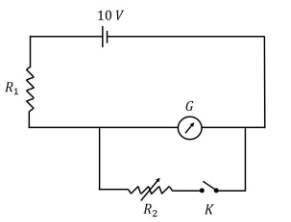
Question 1

As shown in the figure, the resistance of a galvanometer $$G$$ can be found by the half-deflection method. Here the resistance $$R_2$$ is adjusted such that when the key $$K$$ is closed the deflection in the galvanometer becomes half of the value as compared to when $$K$$ is open. Half-deflection is obtained at $$R_2=4\,\Omega$$ and thus the galvanometer resistance is found to be $$6\,\Omega$$. In this half-deflection condition the current (in mA) through the resistor $$R_1$$ is:

image

Go back to topics

Join CAT 2026 course by 5-Time CAT 100%iler

Start your IIM journey with the right preparation and crack CAT 2026.