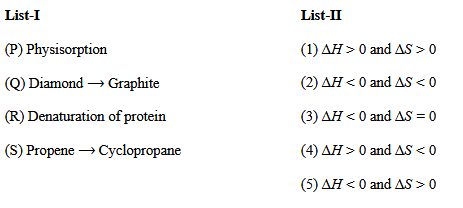
To decide the correct match we only have to figure out the signs of $$\Delta H$$ (enthalpy change) and $$\Delta S$$ (entropy change) for each process in List-I and then pick the List-II entry that has the same pair of signs.
Case P : condensation / freezing type process
During condensation or freezing the system releases heat to the surroundings, so $$\Delta H \lt 0$$ (exothermic).
Liquid or solid is more ordered than vapour, so entropy decreases, i.e. $$\Delta S \lt 0$$.
Hence $$\Delta H \lt 0, \; \Delta S \lt 0$$ → List-II (2).
Case Q : isothermal free expansion of an ideal gas into vacuum
For an ideal gas expanding freely and isothermally, internal energy does not change; therefore $$\Delta H = 0$$ because $$\Delta H = \Delta U + \Delta (pV)$$ and at constant $$T$$ for an ideal gas $$\Delta U = 0$$, $$\Delta (pV)=0$$.
However the gas occupies a larger volume after expansion, hence disorder increases and $$\Delta S \gt 0$$.
Therefore $$\Delta H = 0, \; \Delta S \gt 0$$ → List-II (5).
Case R : combustion reaction that produces gaseous products
Combustion reactions are strongly exothermic, so $$\Delta H \lt 0$$.
If the number of moles of gaseous products exceeds that of the reactants (e.g. $$2CO + O_2 \rightarrow 2CO_2$$ performed at high temperature where $$CO_2$$ is gaseous), randomness increases and $$\Delta S \gt 0$$.
Thus $$\Delta H \lt 0, \; \Delta S \gt 0$$ → List-II (1).
Case S : vaporisation / sublimation process
To convert a liquid or solid into vapour, heat must be supplied, so $$\Delta H \gt 0$$ (endothermic).
The gaseous state is far more disordered than the condensed state, so $$\Delta S \gt 0$$.
Hence $$\Delta H \gt 0, \; \Delta S \gt 0$$ → List-II (4).
Collecting the matches:
(P)→(2), (Q)→(5), (R)→(1), (S)→(4).
The option that contains this combination is Option C.
Therefore the correct answer is:
Option C which is: (P)→(2), (Q)→(5), (R)→(1), (S)→(4).
 91- 6303239042