Choose the word similar in meaning to the word, "tirade."
CUET PG 2023 Question Paper COQP12 Shift-2
Read the following passage and answer the required questions:
I walked into a popular restaurant recently and heard someone talking in a very loud voice. I was intrigued because this is a good restaurant which most people enjoy eating at very much. The staff are helpful and courteous, the food is delicious, and the people who come there are, for the most part, regulars. You can thus imagine my surprise when I heard a loud, angry voice booming from a table nearly. Now. I'm a curious person by nature, so I walked over to the nearest table I could get to. I walked over to the nearest table I could get to. I saw a guest frantically, gesticulating both at the server as well as his food. His body language was screaming anger and indignation, as were his facial expressions. He was very loudly telling the server how he was paying for good food and therefore he demanded nothing but the best, as well as the highest order of respect. He mentioned that he was a food critic on an online forum and that he would write an honest review of the restaurant. I zoned out of his tirade and looked around at the other people there to grab a (usually) happy lunch. Nearly everyone was staring at the guest, some with a look of disbelief. Would you like dealing with someone as aggressive as him? There is an important difference between being aggressive and being assertive. While aggressive communication makes people withdraw from you and want to avoid you assertiveness makes people want to follow you. Add to this the art of persuasion and you have a winning combination.
Solution
A tirade is a long, angry speech of criticism or accusation. Therefore, Option is the correct answer.
The story narrated in the passage teaches us to be:
Solution
Option D is the correct answer.
The last sentence in the passage, 'Add to this the art of persuasion, and you have a winning combination.' implies that we need to be persuasive.
The sentence 'While aggressive communication makes people withdraw from you' implies that we should not be assertive. Hence, Option B is incorrect.
Options A and C could not be inferred from the passage.
Note: The passage has certain grammatical errors and typos in the original CUET paper.
Which of the following is /are correct as per the passage:
A. The guest in the restaurant was treating the waiter.
B. The guest in the restaurant was demanding only good food.
C. Everyone present in the restaurant considered the guest as an aggressive person.
D. The guest was aggressive as well as assertive.
Choose the correct answer from the options given below:
Solution
Note: The question options have errors in the original CUET paper.
The correct answer is Option D
The passage mentions that nearly everyone in the restaurant stared at the guests, some in disbelief. This indicates that the guest's behaviour was noticeable and perceived as aggressive by others present. Therefore, Statement C is correct.
Statement A. The passage does not explicitly state whether the guest was treating the waiter. It only describes the guest's behaviour and interaction with the waiter, focusing on the guest's demands and demeanour. Therefore, option A cannot be considered correct.
Statement B. While it's true that the guest demanded good food, the passage also emphasizes that he demanded the highest order of respect from the waiter. The focus is not solely on the quality of the food but also on the guest's insistence on being treated with respect. Thus, statement B is not entirely accurate.
Statement D. The passage describes the guest's behaviour as loud, angry, and demanding, which aligns with aggression. However, it also mentions that there's an important difference between being aggressive and being assertive. While the guest's behaviour may be perceived as aggressive, there's no indication that he was exhibiting assertiveness in a positive manner. Therefore, statement D, stating that the guest was both aggressive and assertive, is not entirely accurate.
Match List I with List II

Choose the correct answer from the options given below.
Solution
From the passage, we can infer that:
Aggressive behaviour can cause people to withdraw, while assertiveness can inspire people to follow. Persuasiveness can be a winning element in communication, and politeness is often seen as a refined quality.
Therefore,
- Aggressiveness matches with People withdraw from you
- Assertiveness matches with People follow you
- Persuasiveness matches with A winning element
- Politeness matches with Refined
What does 'winning combination' in the story include?
Solution
The 'winning combination' mentioned in the passage is inferred from the sentence: "While aggressive communication makes people withdraw from you and want to avoid you, assertiveness makes people want to follow you. Add to this the art of persuasion, and you have a winning combination."
So, based on the passage's statement, the winning combination includes being assertive and persuasive, making option c) Assertive and Persuasive the correct answer.
Read the passage below and answer the questions that follow:
Did you know that your daily habits can turn genes on or off. It's known as gene expression or epigenetics. Gene expression is a process in which certain genes are turned on or off during one's lifetime. The human body contains approximately 100 trillion cells. Within each cell is the nucleus. Inside every nucleus of every cell are our genes. Experts estimate that the average human has over 20,000 genes. Some of these genes came from our mothers and some from our fathers. Believe it or not, your daily habits can turn genes on or off. Bad habits can turn off good genes and turn on bad genes. This could mean opening the door to cancer, diabetes, various addictions, brain damage, heart diseases, etc. Bad habits can create long-term stress in the form of financial problems, job loss, health issues, etc. Long - term stress increases the production of cortisol, a stress hormone. Like a domino effect, cortisol switches on a series of bad genes that can lead to heart disease, cancer and immunological disorders.
Some of the bad habits that turn bad genes on include:
• Excessive alcohol consumption.
• Drug use.
• Not eating healthy or eating too much junk food can change your DNA.
• Lack off daily aerobic exercise.
• Consuming too much much sugar.
• Not exercising our brains by reading or learning new skills.
• Negative emotions and negative thinking.
Conversely, good habits can turn bad genes off and turn good genes on. The by product of good habits is reduced stress resulting from financial independence, happiness, good health, etc. Some of these good habits include:
• Daily reading or learning new skills, which can turn on genes that increase your IQ.
• Daily aerobic exercise, which can turn on genes that prevent heart disease, asthma and other immunological disorder.
• Meditation, which can turn off bad genes that contribute to the onset of various types of diseases and turn on good genes that prevent such disease.
• Positive thinking and positive emotions alter the brain's chemistry which increases or decreases gene expression.
Habits are not harmless. They can alter your DNA by changing your genome. This is important but not just for
Match List I with List II

Choose the correct answer from the options given below:
Solution
Option A is the correct answer.
- Gene Expression (A) matches with A process of lifetime (III). This could be inferred from the sentence, 'Gene expression is a process in which certain genes are turned on or off during one's lifetime.'
- Cortisol (B) matches with Turns on a series of bad genes (II). This could be inferred from the sentence, 'Long-term stress increases the production of cortisol, a stress hormone. Like a domino effect, cortisol switches on a series of bad genes that can lead to heart disease, cancer and immunological disorders.
- Reduced stress matches with A by product of good habits (IV). This could be inferred from the sentence,' The by product of good habits is reduced stress resulting from financial independence, happiness, good health, etc.'
- DNA (D) matches with Changing of genome (I). This could be inferred from the sentence, 'Habits are not harmless. They can alter your DNA by changing your genome.'
Choose the statement that are true with regard to your DNA.
A. It results into immunological disorder.
B. The altered DNA gets passed on the our children.
C. Habits are harmful.
D. The DNA has the ability to change the genome.
E. The DNA can make your children better or worse.
Choose the correct answer from the options given below:
Solution
Statement A is true, as the passage mentions that bad habits can lead to immunological disorders.
Statement B states: “The altered DNA gets passed on to our children.” While the passage does not directly state this, it discusses the concept of gene expression or epigenetics, which involves changes in gene activity that do not involve alterations to the genetic code but still get passed down to at least one successive generation.
Statement C is partially true. The passage mentions that bad habits can be harmful, but it also states that good habits can have positive effects. So, saying “habits are harmful” is too broad and not entirely accurate according to the passage.
Statement D is true. The passage mentions that habits can alter your DNA by changing your genome.
Statement E, "The DNA can make your children better or worse", is true. While the passage does not directly state this, it does discuss how our habits can alter our DNA and potentially lead to various health issues. If we consider the broader context of genetics, it is known that parents pass on their genes to their offspring. Therefore, if our habits have altered our DNA for better (through good habits) or for worse (through bad habits), these changes could potentially influence the genetic makeup of our children.
So, the statements A, B, D, and E are consistent with the information provided in the passage, making option D the correct answer.
Epileptics is a process:
Solution
Note: The question should have been 'epigenetics' instead of 'epileptics' to find the correct answer
Option D is the correct answer.
We can infer this from the sentence, 'Did you know that your daily habits can turn genes on or off? It's known as gene expression or epigenetics.'
Financial problems, job loss, health issues etc. are caused by:
Solution
The correct answer is option C.
We can infer this from the sentence, 'Bad habits can create long-term stress in the form of financial problems, job loss, health issues, etc.'
Note: The answer options had typographical errors in the original CUET question paper.
Consuming too much sugar implies:
Solution
Option A is the correct answer.
The passage mentioned that 'Bad habits can turn off good genes and turn on bad genes. Consuming too much sugar is an example of such a bad habit.
Option B is incomplete and wrong.
Options C and D are not inferred directly from the passage.
Read the passage below and answer the questions that follow:
The wise old Wazir was famous for his judgement and people came to him for justice from all parts of the country. One day two men came to his court and claimed ownership of an extraordinarily good-looking horse. It was a black beauty indeed. One of the men was tall, very well-dressed and soft-spoken. The Wazir heard them patiently and asked them to leave the horse and come to him next morning. Both the men came the next morning. The Wazir asked his soldiers to give the horse to the tall man and to arrest the other man. The tall man wanted to know how the Wazir had learnt the truth. "Very simple", said he, "Firstly, a man of your appearance and manners could not have been the thief. Still, I wanted to be sure, just after you had left the court. I asked one my soldiers to leave the horse free and to see whom it followed. It went after you. This hint was enough for me."
Which of the following is/are correct as per the given statement:
People came to which from all places because he was ___________ .
A. very famous
B. an old judge
C. an old Wazir
D. a very patient listener
E. a wise judge
Choose the correct answer from the options given below:
Solution
Option C is the correct answer.
In the given context of the passage, it is mentioned that people came from all places to seek the Wazir’s judgement. The Wazir was known for his wisdom and fair judgement, which is why he was sought after by people from various regions. This implies that he was a ‘wise judge’ (Statement E).
The other characteristics such as being ‘very famous’ (Statement A), an ‘old judge’ (Statement B), an ‘old Wazir’ (Statement C), or a ‘very patient listener’ (Statement D) are not explicitly stated in the context. Therefore, these statements do not form the basis for people seeking his judgment. Hence, the correct answer is ‘E only’ (Option C). This is because people were drawn to him due to his reputation as a wise judge and not necessarily because of the other characteristics mentioned in the statements.
This story proves that:
A. the court was quite were very smart
B. the judge was very clever
C. the horse was very clever
D. the horse was a real beauty
E. the judge was indeed quite wise and intelligent
Choose the correct answer from the options given below:
Solution
The correct answer is option D (which is point E only).
The story demonstrates the wisdom and intelligence of the judge, who used a clever method to determine the true owner of the horse.
The other statements do not directly relate to the main point of the story. The beauty of the horse (Statement D) is mentioned, but it’s not what the story proves. The cleverness of the court (Statement A) or the horse (Statement C) is not demonstrated in the story. While the judge (Statement B) used a clever method, the emphasis of the story is more on his wisdom and intelligence (Statement E). Therefore, the answer is E only.
With the Wazir's wisdom, the tall man was -
A. consoled
B. impressed
C. embarrassed
D. undecided
E. confused
Choose the correct answer from the options given below:
Solution
The correct answer is Option D.
The story suggests that the tall man was impressed by the Wazir’s wisdom in determining the horse's true owner.
The other options (A, C, D, E) are not supported by the details of the story. The tall man was not consoled, embarrassed, undecided, or confused, according to the information provided. Therefore, the answer is Option D, which states B only.
Choose the correct option:
The Wazir discovered the real owner of the horse
A. by arresting the other man
B. from the appearance and good manners of the tall man
C. by patiently listening to the case of theft
D. by knowing whom the horse followed
E. by leaving the horse free
Solution
Option B is the correct answer.
Arresting the Other Man (Statement A): The other man's arrest was a consequence of the Wazir’s discovery, not the method of discovery itself. Therefore, statement A is incorrect.
From the Appearance and Good Manners of the Tall Man (Statement B): While the Wazir did note the tall man’s appearance and manners, he did not base his decision solely on these observations. He used them as initial impressions but sought further evidence to make his judgement. Therefore, statement B is incorrect.
By Patiently Listening to the Case of Theft (Statement C): Although the Wazir patiently listened to the case, the listening itself did not reveal the true owner. The discovery was made by observing whom the horse followed. Therefore, statement C is incorrect.
Knowing Whom the Horse Followed (Statement D): This is the key piece of evidence that led the Wazir to the real owner. The horse chose to follow the tall man, indicating a familiarity and bond that typically exists between a pet and its owner.
Leaving the Horse Free (Statement E): The Wazir left the horse free, but this action alone didn’t reveal the true owner. It was a method of gathering more information.
While both actions (D and E) were part of Wazir’s process, the actual discovery of the real owner came from knowing whom the horse
followed (Statement D). Therefore, the correct answer is Option b) D only.
Which of the following best describes the other man?
Solution
Option A is the correct answer.
Although the passage doesn't explicitly describe the other man, it could be inferred from the story that the tall man was described as well-dressed and soft-spoken, implying that the other man had contrasting characteristics.
The story does not provide information about the other man’s build or manners, so options b), c), and d) are less likely.
For the following questions answer them individually
Match List I with List II

Choose the correct answer from the options given below:
Solution
The correct answer is option C.
- A. Retreat matches with II. Advance. These are antonyms; ‘retreat’ means to move back or withdraw, while ‘advance’ means to move forward.
- B. Vivacious matches with I. Languid. These are antonyms; ‘vivacious’ means lively and energetic, while ‘languid’ refers to displaying a disinclination for physical exertion or effort; slow and relaxed.
- C. Evidence matches with III. Confutation. ‘Evidence’ supports a claim or argument, while ‘confutation’ refers to the action of proving a statement or theory to be wrong or false.
- D. Exult matches with IV. Lament. These are antonyms; ‘exult’ means showing elation or jubilation, especially as the result of a success, while ‘lament’ is an expression of grief or sorrow.
Match List I with List II

Choose the correct answer from the options given below:
Solution
Option B is the correct answer.
-
Schism—Split: The term ‘Schism’ refers to a division or split, especially one into two groups, caused by a disagreement about ideas, particularly in a religious organization. This is why it matches ‘Split’ from List II.
-
Quixotic—Unrealistic: ‘Quixotic’ is an adjective that describes someone who is overly idealistic, unrealistic, or impractical. It’s often used to describe people who pursue noble ideals but in an infeasible or unrealistic way. Hence, it matches ‘Unrealistic’ from List II.
-
Relegate—Demote: ‘Relegate’ is a verb that means to assign an inferior rank or position to someone or something. It involves lowering someone or something in rank or position. Therefore, it matches with ‘Demote’ from List II.
-
Incognito—Secretly: ‘Incognito’ is an adjective that describes someone who avoids recognition, usually by changing their name or appearance. It’s often used when someone wants to remain anonymous or secret. Therefore, it matches ‘Secretly’ from List II.
Choose the option which can substitute the underlined group of words correctly, without changing the meaning of the sentence.
'Holding the fatal telegram in her closed first, the distraught mother fell back on the couch.'
Solution
Option B is the correct answer.
The original sentence is: "Holding the fatal telegram in her closed first, the distraught mother fell back on the couch."
Using Option B would make it "The distraught mother fell on the couch."
"Fell on" means to collapse or drop onto a surface, which accurately reflects what the mother did in the context of the sentence. The telegram caused her distress, leading her to collapse onto the couch. This option effectively conveys the same meaning as the original sentence without altering it significantly. Thus, option B is the appropriate substitution.
Note: There is typographical error in the question in the original CUET question paper
Pick out the incorrect statement(s) and choose the option given below.
A. It is very difficult to break through the layers surrounding a mystery
B. You achieve a break through
C. If something breaks through, it appears in a place where it was previously hidden
D. It was a cloudy day but the sun broke through in the afternoon
Choose the correct answer from the options given below:
Read the given sentence to find out whether there is any error in it. The number of that part is the answer.
(ignore the errors of punctuation, if any)
1. The principal was
2. convinced with
3. his innocence
4. in the act.
Solution
Option B is the correct answer.
The error in part 2 should be corrected. "Convinced with" is incorrect and should be "convinced of." Therefore, the correct sentence is "The principal was convinced of his innocence in the act." The answer is 2.
Match the List I with the one word substitution in List II

Choose the correct answer from the options given below:
Solution
Option B is the correct answer.
A. Beneath the skin: The one-word substitution for this is “Subcutaneous.” The term “subcutaneous” refers to something located or occurring under the skin.
B. Too old for work: The appropriate word here is “Superannuated”.The word “superannuated” is used to describe someone who is retired or no longer fit for work due to old age.
C. Wise and full of deep knowledge: The single word that fits is “Sapient”.The term “sapient” refers to someone who is wise, knowledgeable, and possessing great wisdom.
D. One who lives in a cave: The term for this is “Troglodyte”.It describes a person who dwells in a cave or a dark, secluded place. In a broader sense, it can also refer to someone who is reclusive or prefers solitude.
Pick out the correct statements from the sentences given below:
A. She despised none of her lovers
B. She did not despise any of her lovers
C. She seldom or ever has sweet talks with her son
D. She seldom or never has sweet talks with her son
E. He ran fast tremendously
Choose the most appropriate answer from the options given below:
Solution
Option C is the correct answer.
A. She despised none of her lovers: This means that she didn’t dislike any of her lovers.
B. She did not despise any of her lovers: This is another way of expressing the same idea as in A.
C. She seldom or ever has sweet talks with her son: This sentence is a bit confusing. The word “ever” seems redundant here. It would make more sense without it: “She seldom has sweet talks with her son.”
D. She seldom or never has sweet talks with her son: This sentence means that she rarely or almost never engages in sweet conversations with her son.
E. He ran fast tremendously: This sentence is grammatically incorrect. The correct form would be: “He ran tremendously fast.”
Therefore, The correct statements are A,B and D
Choose the right option of indirect speech:
He said, "The country passed through a crisis ten years ago."
Solution
Option B is the correct answer.
When transforming direct speech to indirect speech, you typically shift the verb tenses back one step in time, especially when reporting something that occurred in the past.
In the original direct speech, "passed" is in the past tense. When converting it to indirect speech, we shift the tense of the verb "passed" to its past perfect form "had passed" to indicate that the crisis occurred before the time of the reporting.
So, "ten years ago" becomes "ten years before" to maintain the same relative time frame. Therefore, the correct indirect speech version is:
b) He said that the country had passed through a crisis ten years before.
Match List I with List II

Choose the correct answer from the options given below:
Solution
Option B is the correct answer.
- Tut! - III. Slight disapproval: Tut is an exclamation used to express mild disapproval or annoyance.
- Ahem! - I. Express doubts: “Ahem!” is often used to get someone’s attention or to subtly express doubt or hesitation before making a statement.
- Preto! - IV. While performing a magic trick: This mysterious-sounding word could be uttered by a magician during a performance to add an element of intrigue.
- Ahoy! - II. Cry of greeting: Sailors and seafarers traditionally use “Ahoy!” as a friendly greeting or to attract attention across distances.
A number of sentences are given below which, when properly sequenced. from a coherent paragraph. Each sentence is labelled with a letter. Choose the most logical order of sentences from among the given choices to construct a coherent paragraph.
A. It was with this invincible spirit that Netaji opposed Wavell's offer
B. "Japan" surrender is not India's surrender" he said.
C. The revolutionary spirit of Netaji was never dampened ever after the surrender of Japan
D. He knew that a war of liberation demanded great spirit sacrifice, courage and patience
Solution
Option B is the correct answer.
The most logical order of sentences to construct a coherent paragraph is:
C. The revolutionary spirit of Netaji was never dampened ever after the surrender of Japan. This sentence sets the stage by highlighting Netaji’s unwavering commitment to India’s cause, even in challenging circumstances.
B. “Japan” surrender is not India’s surrender," he said. This statement reinforces Netaji’s perspective that India’s fight for independence was distinct from Japan’s surrender. It connects to the introduction by emphasizing the need to separate the two events.
D. He knew that a war of liberation demanded great spirit, sacrifice, courage, and patience. This sentence builds on the previous one by explaining Netaji’s understanding of the essential qualities required for a successful struggle for freedom. It connects to the introduction by reinforcing Netaji’s unwavering determination.
A. It was with this invincible spirit that Netaji opposed Wavell’s offer.
This final sentence ties everything together by illustrating how
Netaji’s refusal to accept Lord Wavell’s proposal exemplified his unyielding commitment to India’s cause.
Therefore, the correct order is C, B, D, A.
A number of sentences are given below which, when properly sequenced. from a coherent paragraph. Each sentence is labelled with a letter. Choose the most logical order of sentence from among the given choices to construct a coherent paragraph.
A. India has a near-unique record of strategic matters.
B. But India's four wars all indecisive that is to say, they led to no political objective despite the lives lost.
C. After world War II, it is one of the two countries that has fought four wars.
D. The other, of course, is China.
Solution
Option A is the correct answer.
Sentence C introduces the context that India has been involved in multiple wars. Sentence A highlights India’s strategic significance.Sentence D specifies the second country involved in multiple wars, and sentence B explains that despite the wars, India did not achieve clear political objectives.
Therefore, the correct sequence is A, C, D, B
In the following question, the first and the last part of the sentence are numbered as 1 and 6. The rest of sentences is split into four parts and named P, Q, R and S. These four parts are not given in their proper order. Read the sentences and find out which combination is connect.
1. Those that have seen the Hindus
P. have naturally no more doubt
Q. of the existence of other person
R. among them in their own country
S. of their existence than own country
6. whom they have met
Solution
Option A is the correct answer.
Option A arranges the sentence parts as follows:
- Those that have seen the Hindus
- P. have naturally no more doubt
- S. of their existence than own country
- Q. of the existence of other person
- R. among them in their own country
- whom they have met
When we put these together, the sentence reads:
“Those that have seen the Hindus have naturally no more doubt of their existence than own country of the existence of other person among them in their own country whom they have met.”
This sentence means that people who have seen Hindus in their own country have as much certainty of their existence as they do of the existence of any other person they have met in their own country. This makes logical sense and is grammatically correct, which is why option A is the correct answer. The other options do not form a coherent sentence when arranged in the given order.
The exact meaning of the underlined phrasal verb is:
'Mahendra doesn't phone me any more.
He was cottoned on to the fact that
I am not interested in his ideas'
A. Understand
B. Realise
C. Chagrined
D. Pacified
Choose the correct answer from the options given below:
Solution
The correct answer is Option A.
“Cottoned on to”: This informal expression means to realize or become aware of something. It implies that someone has understood a situation, fact, or idea. In the context provided, Mahendra has grasped the fact that the speaker is not interested in his ideas.
In the given sentence, a group of words has been underlined. Pick out the one which can substitute the underlined group of words correctly, without changing the meaning of the sentence.
All of the candidates except Manindra and I intends on choosing cricket as hobby.
Solution
Option C is the correct option.
The original sentence contains an error in the subject-verb agreement. The correct form should be “intend” (plural) instead of “intends” (singular) because the subject “candidates” is plural.
Additionally, the pronoun “I” should be replaced with the objective form “me” in this context.
So the revised sentence would be: “All of the candidates except Manindra and me intend to choose cricket as a hobby.
Match the statements in List I with their one word substitution in List II

Choose the correct answer from the options given below:
Solution
Option A is the correct answer.
- A: The central part of a wheel → II: Hub
- B: Without a body → I: Incorporeal
- C: A great work of art → IV: Magnum opus
- D: A lie told on purpose → III: Perjury
The ratio of investments of two partners P and Q is 9 : 10 and the ratio of their profits is 4 : 5. If P invested the money for 8 months, then for how much time Q invested his money.
Solution
 Share
Share
Assume the P and Q investments are $$9x$$ and $$10x$$ respectively.
And their profits are $$4y$$ and $$5y$$ respectively.
Given that P invested for 8 months
So, $$8\times9x=4y$$
or, $$72x=4y$$
$$y=18x$$ . . . (1)
Now assume that Q invested for $$m$$ months
So, his profit $$5y=m\times10x$$ . . . (2)
put eqn (1) in (2) we get
$$5\times18x=m\times10x$$
$$90x=m\times10x$$
$$m=9$$
Hence, the answer is 9 months.
If the compound interest on a certain sum at 10% per annum for 3 years is ₹33,100, find the simple interest on the same sum at the same rate and for the same period ?
Solution
Let us say the sum is X.
Compound interest at 10% for three years will be, $$((1.1)^{3}-1)X$$=$$0.331X$$
We are told, 0.331X=33100, X=100000
Simple interest on the same sum will be (100000)((10/100)(3))=30,000.
Hence, the answer is 30,000.
A sum of money becomes ₹13,380 after 3 years and ₹20,070 after 6 years on compound Interest. Find the sum?
Solution
Let us assume that the interest rate is r. And the principal amount is P.
The sum after three years would be, $$P\left(1+\frac{r}{100}\right)^3$$, we are told that this value is 13380.
Similarly, the sum after six years would be, $$P\left(1+\frac{r}{100}\right)^6$$, we are told that this value is 20,070.
Let us divide the latter by the former, we get,
$$\frac{P\left(1+\frac{r}{100}\right)^6}{P\left(1+\frac{r}{100}\right)^3}=\frac{20070}{13380}=1.5$$
Therefore, $$\left(1+\frac{r}{100}\right)^3=1.5$$
Substituting this value in the first equation we have, $$P\left(1.5\right)=13380$$
We get P = 8920.
Hence, the answer is Option D.
A vendor bought Apples at 8 for ₹12 and sold them at 6 for ₹10. Find his gain or loss percent?
Solution
Let us say the vendor bought 24 apples. Since he is buying them at a rate of 8 apples for 12 rupees, the total price he would have paid is 36 rupees.
While selling these 24 apples, he is selling them at a rate of 6 apples for 10 rupees. The total money he would receive from the sale is 40 rupees.
Profit made is 4 rupees.
Profit percentage will be (4/9)(100)=11.11%
After getting two successive discounts, a trouser with a list price of ₹300 is available at ₹210. If the second discount is 12.5% find the first discount?
Solution
We are given that the list price of the trouser is ₹300, and after two successive discounts, the final price is ₹210. The second discount is 12.5%.
Let the first discount be x%
After the first discount, the price becomes $$300\times\left(1-\dfrac{x}{100}\right)$$
After applying the second discount of 12.5%, the price becomes $$300\times\left(1-\dfrac{x}{100}\right)\times\ 0.875\ =\ 210$$
Upon solving, we get x = 20
P scored 30% marks and failed by 30 marks, Q scored 40% marks and obtained 40 marks more than those required to pass. The pass percentage is:
Solution
Let us assume the total amount of marks is X.
If P scores 30% of the marks, P will score 0.3X. And we are told that this is 30 marks less than the passing marks.
So, Passing marks will be 0.3X+30.
And at the same time, we are told that with 40% of the marks, Q got 40 more marks than the passing marks.
So, Passing marks will be 0.4X-40
Equating the two equations, we get X = 700.
Passing marks will be 240.
The percentage required to pass will be 240/700. Which is 12/35 or 34.28%.
Aman spends 50% of his income. If income increases by 20% and expenses increases by 10%, his saving will increases by:
Solution
Let the income of the person be 2S; if he spends 50% of it, then he is saving 2S - S = S.
If his income increases by 20%, then the income becomes $$2S\ +\ \dfrac{20}{100}\left(2S\right)\ =\ \dfrac{12}{5}S$$
Initially, his expenses were S, and if they increase by 10%, the expenses become $$S\ +\ \dfrac{10}{100}\left(S\right)\ =\ \dfrac{11}{10}S$$
So, his savings in the second case = $$\dfrac{12}{5}S\ -\ \dfrac{11}{10}S\ =\ \dfrac{\left(24\ -\ 11\right)}{10}S\ =\ \dfrac{13}{10}S$$
The savings increased by a percentage of $$\dfrac{\left(\ \dfrac{13}{10}S\ -\ S\right)}{S}\times\ 100\ =\ \dfrac{3}{10}\ \times\ 100\ =\ 30\%$$
Hence, the correct answer is option B.
A pump can fill a tank with water in 2 hours. Because of a leak, it took 2 hours and 20 minutes to fill the tank. The leak can drain all the water of the tank in:
Solution
Let the volume of the tank be 6V litres.
If the pump takes 2 hours to fill the tank, then the capacity of the pump is $$\dfrac{6V}{2}=\ 3V\ $$litres/hour.
In 2 hours 20 minutes $$\ =\ 2\ +\ \dfrac{20}{60}\ =\ \dfrac{7}{3}$$ hours, the water produced by the pump is $$3V\ \times\ \dfrac{7}{3}\ =\ 7V$$.
We know that the tank has a volume of 6V litres. So, the leak in $$\dfrac{7}{3}\ $$hours removed 7V - 6V = V litres of water. So, in 1 hour, the leak removes $$\dfrac{3V}{7}$$ litres.
The capacity of the leak is $$\dfrac{3V}{7}$$ litres/hour. So, the time taken for the leak to empty the whole tank is
$$6V\ \times\ \dfrac{7}{3V}\ =\ 14$$ hours.
Hence, the correct answer is option A.
By walking at 3/4 of her usual speed, a lady reaches her office 30 minutes later than her usual time. Find the usual time taken by her to reach her office?
Solution
Let the speed of the lady be 4S and the time taken to reach the office be T.
So, the distance can be calculated as 4S * T = 4ST.
In the second case, when she walks at 3/4 of her speed, the speed of the lady becomes 3S. The time taken is given as T + 30.
So, the distance covered in this case is 3S * (T + 30) = 3ST + 90S.
We know that the distance to the office remains constant and must be the same in both cases.
Equating them, we get,
4ST = 3ST + 90S
ST = 90S
T = 90 minutes.
So, the usual time taken by the lady is 90 minutes.
Hence, the correct answer is option C.
The average speed of a car is one-third of the speed of a bus. The bus covers 1125 km in 15 hours. How much distance will the car cover in 30 minutes?
Solution
Given that the bus covers 1125 km in 15 hours
So, the speed of the bus is $$\dfrac{1125}{15}=75$$
Given that avg. speed of car is one-third that of the bus
So, avg speed of car is = $$\dfrac{75}{3}=25$$
The distance it will cover in 30 min or half hour is $$25\times\dfrac{1}{2}=12.5$$ km
Hence, the answer is Option B
A 200 m long train is running with a speed of 50 km/h. In what time will it pass a man who is running at 5 km/h in the direction opposite to that in which the train is going ?
Solution
Firstly, we can solve this question by assuming that the length of the man is negligible and that only the length of the train matters.
If the man and the train move in opposite directions, the relative velocity will increase.
200m is 0.2km. The speed of the train is 50 kmph, and that of the man is 5 kmph.
Effective relative velocity will be 55 kmph.
Time taken to cover 0.2km will be 0.2/55=1/275 hours.
An hour has 3600 seconds. 3600/275=144/11 seconds.
Hence, the answer is Option C.
P can do a piece of work in 10 days; B in 15 days. They work for 5 days. The rest of the work finished by R in 2 days. If they get ₹1,500 for the whole work, the sum of the daily wages of B and R is:
Solution
P and B can do the work in 10 and 15 days, respectively.
Let the total units of work be LCM(10,15) = 30 units.
So, P can do 30/10= 3 units per day
B can do 30/15 = 2 units per day
If they work together, they would do 3+2 =5 units per day.
Therefore, in 5 days, they will do $$5\times\ 5=25\ $$units
Then Work left = 30-25 = 5 units.
R can do this work in 2 days, therefore he does 5/2 = 2.5 units per day.
If they are getting Rs.1500 for 30 units of work, then they get $$\ \frac{\ 1500}{30}=Rs.\ 50$$ per unit.
B and R will do 2 + 2.5 = 4.5 units per day.
Therefore, they will earn $$4.5\times\ 50$$= Rs. 225
P and Q working separately can do a piece of work in 9 and 12 days, respectively. Beginning with P, they work alternately for a day. In how many days will the work be completed?
Solution
Let us say the work is 36 units big.
This means that P, who can finish the work in 9 days, does 4 units a day, and Q, who can finish the work in 12 days, does 3 units a day.
Working alternatively means that every two days (4+3) units of work will be done.
So, 5 cycles of this will ensure 35 units of work is completed, 5 cycles means 10 units of work.
The last unit is completed by the person who starts work first, which is P. P does 4 units a day so that P can finish 1 unit in 0.25 days.
Hence, the answer will be 10.25 days.
A and B can do a piece of work in 10 days. B and C together can do it in 15 days. If A is twice as good a workman as C. Find what time B alone can do it?
Solution
Assume that A, B and C can do $$a$$, $$b$$ and $$c$$ units of work per day.
So, the total work is $$10\times\left(a+b\right)=10a+10b$$ . . . (1)
Similarly, the total work is $$15\times\left(b+c\right)=15b+15c$$ . . . (2)
Equate eqn(1) and eqn (2) we get
$$10a+10b=15b+15c$$
Given that A is twice as good a workman as C or $$a=2c$$
Putting in above equation we get
$$20c+10b=15b+15c$$
or, $$5c=5b$$
or, $$b=c$$
So, the efficiency of B and C is the same
If they together complete the work in 15 days, B alone will complete it in 30 days.
The average of ten numbers is 8. If each numbers is multiplied by 15, then average of the set of numbers is:
Solution
The average of ten numbers is 8. If each number is multiplied by 15, then the average of the set of numbers is:
Let us assume the numbers are $$x_1,x_2,......x_{10}$$
Thus, $$\dfrac{x_1+x_2+x_3+....x_{10}}{10}=8$$
Each number is multiplied by 15, So the average will also be 15 times.
$$\dfrac{15\left(x_1+x_2+x_3+....x_{10}\right)}{10}=15\times\ 8\ =\ 120$$
The average weight of 10 men is increased by 1.5 kg when one of them, who weighs 70 kg is replaced by a new man. The weight of the new man is:
Solution
The average of the men is solely changing due to the change in the weight of the person being replaced. No other person in the group is coming in or going out.
This means the change in the average of 1.5kg, which is calculated over 10 men, is solely due to the heavier person coming in.
The change in average is 1.5kg, which means the change in the total amount of weight will be 15 kg.
This means the new man coming in is 15kgs heavier than the old man. The old man weighs 70kgs, this means the new man will weight 85kgs.
A, B, C and D are four consecutive even numbers respectively and their average is 61. What is the product of A and D ?
Solution
Let the four consecutive even numbers be A, B, C and D.
Since they are consecutive even numbers, we can express them in terms of A as:
B = A + 2
C = A + 4
D = A + 6
We are given that their average is 61.
Hence, ( A + B + C + D)/4 = 61
Or, A + B + C + D = 244
Replacing B, C and D
A + A + 2 + A + 4 + A + 6 = 244
4A = 232
A = 58
Hence, B, C and D are respectively 60, 62 and 64.
We need to find A * D
Hence, 58 * 64 = 3712
In what ratio must water be mixed with milk to gain $$16\frac{2}{3}\%$$ on selling the mixture at cost price?
Solution
Let the cost price of 1 litre of milk be C
Now, assume that we mix x litres of milk with y litres of water.
The total cost price of the mixture = C × x (water is free).
The selling price must be 16.67% more than the cost price, i.e. 7/6 of the cost price
For the mixture to sell at the cost price per liter, the selling price should be equal to the cost price per liter.
Solving the equation, we get, x : y = 6 : 1
Four unbiased coins are tossed. What is the probability of getting atmost three heads?
Solution
To find the probability of getting at most three heads, we will use the complement rule (P(not A)
At most three heads means we can get 0, 1, 2, or 3 heads.
The complement of this event is getting exactly 4 heads.
Since four unbiased coins are tossed, the total number of possible outcomes is:
2^4 = 16
The only way to get 4 heads is HHHH, which is 1 outcome.
P(exactly 4 heads)=1/16
P(at most 3 heads)=1−P(exactly 4 heads)
=1−1/16 = 15/16
In how many ways can the letters of the word 'DETAIL' be arranged so that the vowels occupy only the odd positions ?
Solution
DETAIL is a six-letter word with three vowels and three consonants.
This means there will be three odd places and three even places.
This means we must fit the three vowels in the three odd places. And the three consonants can fit into the three even places.
The number of ways to arrange three items in three places will be 3!.
We can arrange three vowels in three odd places in 3! ways, and three consonants in three even places in 3! ways.
Total ways to arrange it will be (3!)(3!)=36.
Which of the following statements is true based on the following diagram?

Solution
In triangles, the length of the sides is proportional to the sine of the angle opposite to the.
The angle opposite AB is 55 degrees while the angle opposite BC will be 45 degrees.
Since sin 55 > sin 45, AB>Bc
Therefore, Option A is the correct answer.
The heights of two right circular cones are in the ratio 1 : 2 and the perimeters of their bases are in the ratio 3 : 4. Find the ratio of their volumes?
Solution
The volume of a cone can be written as $$\pi r^2h$$.
Where r is the radius of the base of the cone and h is the height of the cone.
The heights of two right circular cones are in the ratio 1 : 2,
Let us say, H1 is 1X and H2 is 2X
Perimeters of their bases are in the ratio 3 : 4,
Let us say, $$\2pi r_1$$ is 3Y and $$\2pi r_1$$ is 4Y.
$$r1=\frac{3Y}{2\pi\ }$$ and $$r2=\frac{4Y}{2\pi\ }$$
Volume of cone 1 will be, $$\pi\left(\frac{3Y}{2\pi\ }\right)^2\left(X\right)$$
Volume of cone 2 will be, $$\pi\left(\frac{4Y}{2\pi\ }\right)^2\left(2X\right)$$
The ratio will hence be 9:32.
If the surface areas of two spheres are in the ratio of 4 : 25, then the ratio of their volumes is:
Solution
The surface area of a sphere is, A = $$4\pi r^2$$
Let the radii of the two spheres be a and b. Given that their surface areas are in the ratio:
A1:A2= $$\dfrac{4}{25}$$
Substituting the formula for surface area:
$$4\pi a^2$$:$$4\pi b^2$$ = 4:25
Canceling 4π from both sides:
$$a^2:b^2=4:25$$
Taking the square root on both sides:
a:b = 2:5
Now, the volume of a sphere is V = $$\dfrac{4}{3}\pi r^3$$
The ratio of their volumes is:
V1:V2= $$a^3:b^3$$ = 8:125
If $$a^{2} + b^{2} + \dfrac{1}{a^{2}} + \dfrac{1}{b^{2}} = 4$$ then the value of $$a^{2} + b^{2}$$
Solution
Let's rewrite the equation:
$$a^2+\dfrac{1}{a^2}+b^2+\dfrac{1}{b^2}=4$$
We know that $$x^2+\dfrac{1}{x^2}\ge\ 2$$
If we compare, we get,
$$a^2+\dfrac{1}{a^2}=\ 2$$ and $$b^2+\dfrac{1}{b^2}=\ 2$$
This is possible when $$a^2=1\ \&\ b^2=1$$
Hence, $$a^2+b^2\ =\ 1\ +\ 1\ =\ 2$$
$$a + b + c = 6, a^{2} + b^{2} + c^{2} = 14$$ and $$a^{3} + b^{3} + c^{3} = 36$$, then the value of abc is:
Solution
a + b + c = 6
Squaring on both sides:
$$a^2+b^2+c^2+2\left(ab\ +\ bc\ +\ ca\right)=36$$.
$$a^{2} + b^{2} + c^{2} = 14$$
This gives: ab + bc + ca = 11.
$$a^3+b^3+c^3-3abc=\left(a+b+c\right)\left(a^2+b^2+c^2-ab-bc-ca\right)$$
Putting in all the given values, we get:
36 - 3abc = 6(14 - 11)
abc = 6.
Below question contains two equations as I and II. You have to solve both equations and determine the relationship between them and choose correct option:
I. $$2x^{2} + 3x - 35 = 0$$
II. $$4y^{2} + 10y - 104 = 0$$
Solution
$$2x^{2} + 3x - 35 = 0$$
This can be written as
$$2x^2+10x-7x-35=0$$
$$2x\left(x+5\right)-7\left(x+5\right)=0$$
$$\left(2x-7\right)\left(x+5\right)=0$$
Thus, x = 7/2 or -5
Similarly, for $$4y^{2} + 10y - 104 = 0$$
This can be written as
$$4y^2-16y+26y-104=0$$
$$4y\left(y-4\right)+26\left(y-4\right)=0$$
y = 4 or -26/4
Therefore, x and y are unequal, and no relation can be established between them.
A square is inscribed in a circle of diameter 2a and another square is circumscribing circle. The difference between the areas of outer and inner squares is:
Solution
The given information can be shown in an image as follows,
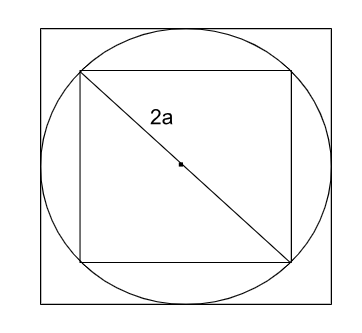
We can see that for the outer square, the length of the side is equal to the diameter of the circle. So, the side of the outer square is 2a, and the area of the outer square is $$2a\ \times\ 2a\ =\ 4a^2$$
We can see that for the inner square, the length of the diagonal is equal to the diameter of the circle. So, the area of the inner square is $$\dfrac{1}{2}\ \times\ 2a\ \times\ 2a\ =\ 2a^2$$.
So, the difference between the areas of the outer and the inner squares = $$4a^2\ -\ 2a^2\ =\ 2a^2$$
Hence, the correct answer is option B.
If PQ and RS are two diameters of a circle of radius r and they are mutually perpendicular, then what is the ratio of the area of the circle to the area of the $$\triangle PRS$$?
Solution
If PQ and RS are two diameters of a circle of radius r, then they are mutually perpendicular.
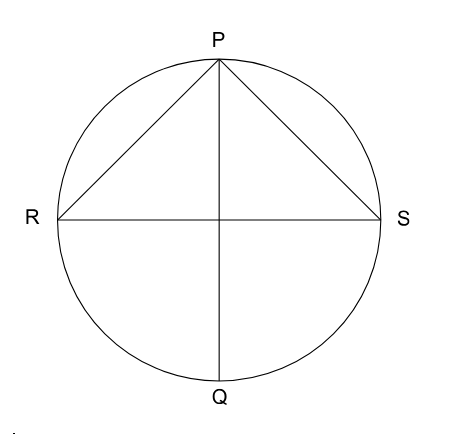
RS = 2r (Where r is the radius of the circle)
RP = RS = $$r\sqrt{2}$$
Area of circle = $$\pi r^2$$
Triangle SPR is a right-angled triangle, right-angled at P. (Angle RPS is 90 degrees as RS is the diameter)
Area of $$\triangle PRS$$ = $$\dfrac{1}{2}\times PR\times\ PS$$ = $$\dfrac{1}{2}\times r\sqrt{2}\times\ r\sqrt{2}$$ = $$r^2$$
Thus, the ratio is $$\pi r^2$$:$$r^2$$ = $$\pi:1$$
Find the value of $$\dfrac{1}{4 \times 5} + \dfrac{1}{5 \times 6} + \dfrac{1}{6 \times 7} + ....... + \dfrac{1}{10 \times 11}$$:
Solution
The value of $$\dfrac{1}{4 \times 5} + \dfrac{1}{5 \times 6} + \dfrac{1}{6 \times 7} + ....... + \dfrac{1}{10 \times 11}$$:
The terms can be written as
$$\Sigma\ \dfrac{1}{\left(n+3\right)\left(n+4\right)}$$
=> Where sigma means the summation of all terms where n = 1 to n = 7
$$\Sigma\ \dfrac{1}{\left(n+3\right)\left(n+4\right)}$$
=> $$\Sigma\ \dfrac{\left(n+4\right)-\left(n+3\right)}{\left(n+3\right)\left(n+4\right)}$$
=> $$\Sigma\ \left[\dfrac{1}{\left(n+3\right)}-\dfrac{1}{\left(n+4\right)}\right]$$
=> $$\dfrac{1}{4}-\dfrac{1}{5}$$ + $$\dfrac{1}{5}-\dfrac{1}{6}$$ + .....$$\dfrac{1}{10}-\dfrac{1}{11}$$
=> All other terms will get cancelled, and only 1/4 and -1/11 will left.
Thus, $$\dfrac{1}{4}-\dfrac{1}{11}=\dfrac{7}{44}$$
If $$x$$ is an integer such that $$x +\frac{1}{x} = \frac{17}{4}$$, then the value of $$x - \frac{1}{x}$$:
Solution
We know that $$\left(a\ +\ b\right)^2\ -\ \left(a\ -\ b\right)^2\ =\ 4ab$$
So,
$$\left(x\ +\ \frac{1}{x}\right)^2\ -\ \left(x\ -\ \frac{1}{x}\right)^2\ =\ 4\times\ x\ \times\ \frac{1}{x}\ =\ 4$$
$$\left(x\ -\ \frac{1}{x}\right)^2\ =\ \left(\frac{17}{4}\right)^2\ -\ 4$$
$$\ \left(x\ -\ \frac{1}{x}\right)^2\ =\ \frac{\left(289\ -\ 64\right)}{16}\ =\ \frac{225}{16}$$
$$\ x\ -\ \frac{1}{x}\ =\ \frac{15}{4}$$
Hence, the correct answer is option B.
A bag contains one-rupee, 50-paise and 25-paise coins in the ratio 5:6:8. If the total amount of money in the bag is ₹250, find the number of 50-paise coins in the bag?
Solution
Let the number of 1-rupee coins, 50-paise coins, and 25-paise coins in the bag be 5x, 6x, and 8x respectively, where x is a common factor.
The total value of the coins is ₹250.
The value of 1-rupee coins = 5x × 1 = 5x rupees.
The value of 50-paise coins = 6x × 0.50 = 3x rupees.
The value of 25-paise coins = 8x × 0.25 = 2x rupees.
The total value is the sum of all these values:
5x + 3x + 2x = 250
10x = 250
x = 25
Number of 50-paise coins = 6 × 25 = 150
A sum of money is divided among P, Q, R and S in the ratio of 3 : 4 : 9 : 10 respectively. If the share of R is ₹2,580 more than the share of Q, then what is the total amount of Q and S together?
Solution
Assume the money with P, Q, R and S to be $$3x$$, $$4x$$, $$9x$$ and $$10x$$ respectively.
So, the difference between R and Q is $$9x-4x=5x=2580$$
or, $$x=516$$.
So, the total amount with Q and S together is $$4x+10x=14x=7224$$
Hence, the answer is 7224.
A bag contains 6 blue, 4 red, 3 yellow and 2 green marbles. If 4 marbles are picked up at random, what is the probability that atleast one of them is red?
Solution
Given that the total number of marbles is 15 and we have to select 4 of them
Probability of Selecting atleast one red marble = 1 - Probability of selecting no red marble
P(No red marble) = $$\dfrac{^{11}C_4}{^{15}C_4}=\dfrac{330}{1365}$$
So, P(Atleast one red marble) = $$1-\dfrac{330}{1365}=\dfrac{1035}{1365}=\dfrac{69}{91}$$
Hence, the answer is $$\dfrac{69}{91}$$
A merchant has 500 kg of sugar, some part of which he sells at 8% profit and rest at 18% profit. He gains 14% on the whole. The quantity sold at 18% profit is:
Solution
He sold X quantity at 8% profit and (500-X) at 18% profit.
Total money received after sale will be,
(1.08)(X)+1.18(500-X)=1.14(500)
1.08X+590-1.18X=570
20=0.1X
X will be 200kg.
Hence, the quantity sold at 18% profit will be 300kg.
In how many ways a committee of 5 members be selected from 7 men and 5 ladies, consisting of 3 men and 2 ladies?
Solution
The number of ways to select a committee of 5 members consisting 3 men and 2 women are,
Selecting 3 men out of the 7 men in $$^7C_3\ =\ 35$$ ways
Selecting 2 women out of the 5 women in $$^5C_2\ =\ 10$$ ways
Total number of ways = 35 * 10 = 350 ways.
Hence, the correct answer is option D.
Choose the odd group in the following :
Solution
To find the odd group, let us check each option-
A) 2, 3, 5, 7 → All are prime numbers.
B) 17, 19, 23, 29 → All are prime numbers.
C) 53, 59, 61, 67 → All are prime numbers.
D) 37, 41, 43, 49 → 49 is not a prime number (since 49=7*7)
Since all other groups consist entirely of prime numbers, the odd group is D) 37, 41, 43, 49, because 49 is not a prime number.
Choose the number which is different from others in the group :
13. 17, 23, 63, 71
Solution
63 is the only number in the group of given numbers that is not prime.
71, 23, 17, 13, all of them are prime numbers.
Which of the following best represented by the figure below.

A. Furniture, Table, Cahir
B. Polygon, Rectangle, Square
C. Year, Week, Day
D. Bouquet, Flowers, Petals
E. Vehicle, Bus, Car
Choose the most appropriate answer from the options given below:
A walks 15 m in front and 15 m to the right then every time turning to his left, he walks 10, 20 and 30 m respectively. How far is he now from his starting point?
Solution
_lEQ6yxr.png)
The person started walking from S and stopped at E.
To calculate SE, we need to find the length of hypoteneuse in the triangle SAE where SA = 5 m and AE = 30 - 15 - 10 = 5 m.
Length of SE = $$\sqrt{\ 5^2+5^2}=5\sqrt{\ 2}$$ m.
P, Q, R, S, T, U, V, W are sitting around a round table in the same order, at equal distances. Their positions are clockwise. If V sits in the north, then what will be the position of S?
Who is the grand mother of D?
Given:
A. A is the mother of B
B. C is the son of A
C. D is the brother of E
D. E is the daughter of B
Choose the correct answer from the options given below:
If in certain code:
'bir le nac' means 'green and tasty'
'pic nac hor' means 'tomato is green'
'coc bir hor' means 'food is tasty'
Which of the following means 'tomato is testy' in that code?
Choose a number to replace question mark which can establish the relationship between the number on either side of::
Given 9 : 80 :: 100 : ?
Solution
80 = $$9^2-1$$
? = $$100^2-1=9999$$.
Given set: (2 1, 51, 15)
Select the pair from following in which the numbers are similarly related as in the given set.
Choose pair of words that will fill blanks so that the sentence becomes true and sensible _____________ is to Cork as Box is to ____________.
Choose a word for I from (A), (B), (C), (D) as well as a word for II from (P), (Q), (R), (S) to establish the similar relationship between the words on either side of :: in "I : Gum :: Worm : II"
I. (A) Bottle (B) Brand (C) Loaf (D) Tree
II. (P) Silk (Q) Insect (R) Cocoon (S) Thread
Choose the correct combination from the following:
Statement: Should the consumption of aerated drinks be banned in India?
Arguments: I. Yes, this is the only way to reduce the risk of exposing people to some diseases
II. No, there is no confirmed evidence that such products have adverse effects on human body
Which of the above argument(s) hold strong for the statement ?
In a certain code, DESK is written as # $ 52, RIDE is written as % 7 # $. How is RISK written in that code?
If in a certain code, O is written as E, A as C, M as I, S as O, N as P, E as M, I as A, P as N and C as S, then how will COMPANIES be written in that code?
Statement: A tells B that, "In my absence, I request you to look after the affairs of our company."
Assumptions: I. B may not accept the request of A.
II. B has expertise to handle the affairs of the company.
Which of the above assumption(s) is/are implicit in the statement?
Which of the following month pair starts on some day in a year?
Two positions of a dice are shown below. What number will be at the bottom, when number 1 is on the top?

How many triangles and square are there in the given figure?

Identify the mirror of the given word with respect to XX'

A class stands in a single line. One student is seventeenth in order from both the ends. What is the strength of the class?
Following pie chart give the percentage of people working in the right shift from various industries and the percentage in the respective brackets indicate the percentage of females out of number of people working in the right shift. Total number of people 40250.

What is the percent of women working in sports industry of the total number of people working in the right shifts from all industries together?
What is the respective ratio of men to the women working in right shifts from the call centre industry?
What is the difference between the total number of men and the total number of women working in right shifts from all industries together?
What is the approximate average number of females working in right shifts from all the industries together?
What is the total number of men working in right shifts from all the industries together?
The amount of production and sales by a company over the years (in lac units) is shown below.

What is the difference of sales of 2003 (in thousand units).
Total sales of 2001 and 2002 together are approximately what percentage of sales in 2004?
In which year the percentage of sales to production is maximum?
What is the approximate percentage increase in production from 2003 to 2004?
What is the percentage drop in sales from 2002 to 2003?
The following bar chart represents the value of exports and imports (in crores) of a country in the given period :

In which year is the difference between the exports and the imports closest to ₹100 crores?
The value of exports in 2016 was what percentage of the average value of imports in the years 2014, 2015 and 2017?
What is the percentage of exports value of the value of imports in the year 2014?
What is the approximate difference (in ₹ crores) between the average exports and average imports during the given years?
What is the percentage increase in the value of exports in 2016 over 2015?

