What is the area of an equilateral triangle whose inscribed circle has radius R?
CMAT Geometry Questions
If a is the length of equilateral triangle, height is $$\frac{\sqrt{3}a}{2}$$
Inradius = $$\frac{\sqrt{\ 3}a}{2}\left(\frac{1}{3}\right)=\frac{a}{2\sqrt{3}}$$
It is given, R = $$\frac{a}{2\sqrt{3}}$$
Area of triangle = Inradius * semiperimeter = $$R\left(\frac{3a}{2}\right)$$ = $$\frac{3R}{2}\left(2\sqrt{3}R\right)=3\sqrt{3}R^2$$
The answer is option D.
In the following diagram, if the shaded area is one half the area of triangle ABC and angle ABC is right angle then the length of line segment AD is
In the question, it is given that area of triangle ABC is 2 times the area of triangle ABD.
$$\frac{1}{2}x\left(y+z\right)=2\left(\frac{1}{2}xy\right)$$
y + z = 2y
y = z
Triangles ABC and ABD are right-angled triangles.
$$W^2=x^2+4y^2$$
$$W^2=x^2+y^2+3y^2$$
$$AD^2=x^2+y^2$$
$$AD^2=W^2-3y^2$$
$$AD=\sqrt{\ W^2-3y^2}$$
The answer is option C.
The least number of square tiles required to pave the floor of a room 15 m 91 cm and 9 m 46 cm broad is
Let the number of square tiles be n and the area of each square tile be $$x^2$$
Length = 1591 cm
Breadth = 946 cm
x is the H.C.F of 1591 and 946.
$$1591$$ = $$43\times37$$
$$946$$ = $$43\times2\times11$$
x = 43
Hence, all the dimensions can be covered in squares of dimensions 43 cm.
n(43)(43) = (1591)(946)
n = 37*22 = 814
The answer is option A.
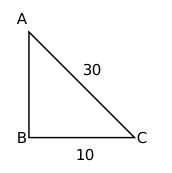
If a 30 meter ladder is placed against a wall such that it just reaches the top of the wall, if the horizontal distance between the wall and the base of the ladder is 1/3rd of the length of ladder, then the height of wall is :
AC is ladder, C is base of ladder, AB is wall
Given AC = 30 m and BC = $$\frac{1}{3}AC$$ = $$\frac{1}{3}\left(30\right)$$ = 10 m
Applying pythagoras theorem,
$$AB^2+\ BC^2=\ AC^2$$
$$AB^2$$ = $$30^2-10^2$$ = 800
AB = $$20\sqrt{\ 2}$$
Answer is option B.
A copper wire having length of 243m and diameter 4 mm was melted to form a sphere. Find the diameter of the sphere :
Volume of copper wire melted will be equal to volume of sphere.
Volume of copper wire = Area $$\times\ $$ length = $$\pi\ \left(\frac{2}{10}\right)^2\times\ 24300\ cm^3$$
Let the radius of sphere be r
$$\frac{4}{3}\pi\ r^{3\ \ }=\ \pi\ \left(\frac{2}{10}\right)^2\times\ 24300\ cm^3$$
$$r^3$$ = 729
r = 9 cm
Diameter of sphere = 2(9) = 18 cm
Answer is option B.
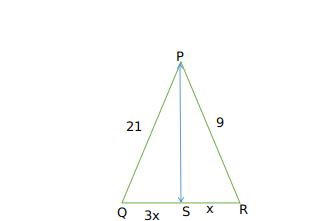
In triangle PQR. PS is perpendicular to QR and S divides QR in the ratio of 3 : 1 internally. If PQ=21 and PR =9,find QR.
we have :
Triangles PSR and PSQ are right triangles
so using pythaghoras theorem
we get
441 = $$PS^2+9x^2$$
81 =$$PS^2+x^2$$
subtracting we get
360=$$8x^2$$
$$x^2\ =45$$
x=$$3\sqrt{\ 5}$$
QR = 4x = $$12\sqrt{\ 5}$$
A roller is 4m long and has a diameter of 0.7m. It takes exactly 2000 rotations of the roller to level a road. If the cost of using the roller is Rs.4 per square metres, then the total cost of levelling the roadis :
Assume, $$\pi=\frac{22}{7}$$
Curved Surface area of roller = $$2\pi\ rh$$
Cost = Area covered* cost per meter square
so we get total cost = $$2\times\ \frac{22}{7}\times\ \frac{7}{20}\times\ 4\times\ 4\times\ 2000$$
=Rs 70,400
In a $$\triangle ABC,D,E$$ and $$F$$ are the mid-points of the sides AB, BC and CA respectively. Then the ratio of the area of a $$\triangle DEF$$ and the area of a $$\triangle ABC$$ is:
We are given :
Now In triangle ABC
using the mid point theorem
we get DE || BC and DE = $$\frac{1}{2}\left(BC\right)$$
Now ADE is similar to ABC
So Area of ADE : Area of ABC = (DE/BC)^2 = 1:4
Similarly Area of BDF :Area of ABC = 1:4
and Area of CEF : Area of ABC = 1:4
Now we can say if area of ABC = 4A
then area of ADE = area of BFD = area of CEF = a
Therefore area of DEF = 4a-3a =a
so area of DEF : area of ABC = 1:4
Which of the following sets of numbers can be used as the lengths of the sides of a triangle ?
In a triangle, the sum of two sides is always greater than the third side.
In the last two options, sum of first two sides is less than third side, and in first two options sum is equal to third side, hence these three are not possible.
Thus, possible lengths of triangle = [5,7,9]
=> Ans - (B)
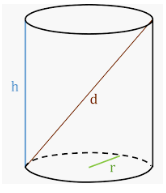
What is the farthest distance between two points on a cylinder of: HEIGHT 8 and RADIUS 8 ?
Height of cylinder = 8 units and radius = 8 units
=> Farthest distance = hypotenuse = $$\sqrt{(8)^2+(16)^2}$$
= $$8\sqrt{5}$$ units
=> Ans - (A)
In a triangle ABC, AD is the bisector of angle A. If AC =4.2 cm, DC = 6 cm, BC =10 cm, find AB.
In a triangle, the angular bisector divides the side which it intersects in the ratio of other two sides.
So, In the triangle ABC, the angular bisector AD divides the side BC in the ration of AB and AC
$$\Rightarrow$$ BD : DC = AB : AC
Given BC = 10 cm and DC = 6 cm
$$\Rightarrow$$ BD = BC - DC = 10 - 6 = 4 cm
Then $$AB =\frac{BD}{DC}\times AC = \frac{4}{6}\times 4.2 = 2\times 1.4 = 2.8$$ cm
The maximum value of 3 $$cosx+4 sinx+8$$ is
Let us consider the fucntion f(x) = $$a\cos x + b\sin x + c$$
The range of f(x) if given as $$c - \sqrt{a^2 + b^2} \leq f(x) \leq c + \sqrt{a^2 + b^2}$$
Then the maximum value of 3 $$cosx+4 sinx+8$$ is = 8 + $$\sqrt{3^2 + 4^2}$$
= 8 + 5 = 13
The length, breadth and height of a rectangular cuboid are in the ratio 1: 2 : 3. If the length, breadth and height are increased by 100% each then what would be the increase in the volume of the cuboid ?
Given the length, breadth and height of a rectangular cuboid are in the ratio 1: 2 : 3.
Let the length, breadth and height be k, 2k, and 3k units where 'k' is a constant.
Volume of the cuboid(V') = $$l\times b\times h$$ units = $$k\times 2k\times 3k$$ = $$6k^3$$ units
Given the length, breadth and height are increased by 100% each .
Then the new length, breadth and height will be doubled.
So new length, breadth and height of the rectangular cuboid are 2k, 4k, and 6k units.
New Volume of the cuboid (V') = $$2k\times 4k\times 6k = 48k^3$$ units.
Increase in the volume of the cuboid = V' - V = $$48k^3 - 6k^3 = 42k^3 = 7 [6k^3] = 7V$$
Therefore the volume has increased 7 times the initial volume.
It costs Rs. 6000/- and Rs. 6,100- respectively to paint the 4 walls of 2 square halls, of the same height. If the length of one hall exceeds the length of the other by 1 m and the cost of painting is Rs. 5 per sq.m., what is the height of the two walls ?
let the length of the halls be 'a' and 'a+1' m respectively and height of the halls be 'h' m.
Area of 4 walls of first square hall (A1) = $$(4\times a\times h) m^2$$
Given, cost of painting is Rs. 5 per sq.m
$$\Rightarrow$$ cost of painting 4 walls of the first square hall = A1 * 5 = $$4\times a\times h\times 5 = Rs. 20*a*h$$.
Given that this cost of painting = Rs. 6000
$$\Rightarrow$$ 20*a*h = 6000...........(1)
Similarly,
Area of 4 walls of second square hall (A2) = $$(4\times a+1\times h) m^2$$
$$\Rightarrow$$ cost of painting 4 walls of the second square hall = A2 * 5 = $$4\times a+1\times h\times 5 = Rs. 20*(a+1)*h$$.
Given that this cost of painting = Rs. 6100
$$\Rightarrow$$ 20*(a+1)*h = 6100............(2)
Dividing (2) with (1), we get
$$\frac{a+1}{a} = \frac{6100}{6000}$$
$$\Rightarrow 1 + \frac{1}{a} = \frac{61}{60}$$
$$\Rightarrow a = 60$$
Substituting this value in equation (1), we get
20*60*h = 6000
$$\Rightarrow$$ h = 5 m.
So, the height of the two walls is 5 m.
A rectangular box of width(a), length(b), and height(c) has a solid cylinder of height 'c' and of diameter 'a' placed within it. If a= 6, b =8 and c =10, how much volume is left in the rectangular box ?
Volume left out in the rectangular box = Total volume of the rectangular box - Volume of the cylinder placed within it.
Total volume of the rectangular box of width(a), length(b), and height(c) is given as (V) = $$a\times b\times c$$ cubic units.
= $$6\times 8\times 10$$
= 480 cubic units.
Volume of the solid cylinder of height 'c' and of diameter 'a' is given by (V') = $$\frac{\pi}{4}*a^2*c$$ cubic units.
= $$\frac{\pi}{4} * 6^2 * 10$$
= 90$$\pi$$ cubic units.
Therefore left out volume = 480 - 90$$\pi$$ cubic units.
Three solid cubes of sides 1 cm, 6 cm and 8 cm are melted to form a new cube. Find the surface area of the cube so formed.
Whenever some cubes are melted to form a single larger cube, the total volume always remains constant.
So, Sum of the volumes of three small cubes = Volume of the larger cube.
Let the side of the lager cube so formed be 'a' cm.
Then $$1^3 + 6^3 + 8^3 = a^3$$
$$\Rightarrow a^3 = 729$$
$$\Rightarrow a = 9$$ cm.
Surface area of cube so formed = 6*$$a^2$$ = $$6\times 9^2 = 6\times 81 = 486 cm^2$$
In a building there are 30 cylindrical pillars. The radius of each pillar is 35 cm and height is 5 m. Find out the cost of painting the curved surface of half the number of pillars. The rate of painting is Rs. 10 per $$m^2$$.
Curved surface area of cylindrical pillar is given as A = 2$$\pi$$rh, where 'r' is base radius and 'h' is height of the cylinder.
So curved surface area of each pillar A = $$2\times \pi\times 0.35\times 5 = 11 m^2$$
Given there are 30 cylindrical pillars.
The curved surface area of half the number of pillars = 15 * A = 165 $$m^2$$.
Given rate of painting is Rs. 10 per $$m^2$$
The cost of painting curved surface of half the number of pillars = Curved surface area * rate of painting
= $$165\times 10$$
= Rs. 1650.
How many iron balls, each of radius 1 cm, can be made from a sphere whose radius is 8 cm?
Volume(V) of the sphere with radius R=8 cm is given by V= $$\frac{4}{3} \pi R^{3}$$.
= $$\frac{4}{3} \pi(8^{3})$$= $$\frac{4}{3} \pi (512) cm^{3}$$.
and Volume (v) of each iron ball with radius r= 1cm is given by v= $$\frac{4}{3} \pi r^{3}$$.
= $$\frac{4}{3} \pi (1^{3})$$= $$\frac{4}{3} \pi cm^{3}$$.
Let say 'n' iron balls each of volume 'v' are required to form a sphere of volume 'V'.
=> Total volume of 'n' iron balls = Volume of the sphere
=> $$n\times v$$ = V
=> n= $$V\div v$$ = $$\frac{4}{3} \pi (512)\div \frac{4}{3} \pi$$ = 512.
Hence 512 iron balls are required in total to form the sphere.
In a circle of radius 6 cm, arc AB makes an angle of 114° with centre of the circle O.
What is angle ABO?
In $$\triangle$$AOB, AO = OB (Equal radii)
∴ $$\triangle$$AOB is isosceles.
∴ ∠ABO = ∠BAO = (180°-114°)/2 = 33°
Hence, option D.
In the figure, PQ is a diameter of the circle. Angle PQS = $$35^\circ$$. Find angle QRS.
SInce PQ is the diameter, the angle subtended by it at R is 90 deg. i.e., $$\angle$$ PRQ = 90 deg.
Let $$\angle$$ RPQ = $$\theta$$, then $$\angle$$RQP = 90 - $$\theta$$
As the angles subtended by a chord in same segment are equal, $$\angle$$RPQ = $$\angle$$RSQ = $$\theta$$
In triangle RSQ, $$\angle$$QRS + $$\angle$$RSQ + $$\angle$$RQS = 180
$$\Rightarrow$$ $$\angle$$QRS + $$\theta$$ + 35 + 90 - $$\theta$$ = 180
$$\Rightarrow$$ $$\angle$$QRS = 180 - 125 = 55 deg.
Hence $$\angle$$QRS = 55 deg.
The length of the minute of a watch is 42 mm. The area swept by it in 30 minutes (in $$mm^2$$) by taking π as 3.14 is:-
60 minutes = 360 degrees or 2$$\pi$$ radians.
$$\Rightarrow$$ 1 minute = 60 degrees.
$$\Rightarrow$$ 30 minutes = 180 degrees or $$\pi$$ radians.
Therefore area (A) swept by minute hand of length 42 mm in 30 minutes = area of semi-circle of radius (r = 42 mm) .
$$\Rightarrow A = \pi r^2\div 2 = 3.14\times 42^2\div 2 = 2769.5 mm^2$$.
The area of a triangle metal plate with base 88 cm and altitude 64 cm is to be reduced to one-fourth of its original area by making a hole of circular shape at the center. The radius of this hole will be:-
Area of triangular metal plate with base(b) = 88 cm and altitude(h) = 64 cm is given as A = $$\frac{1}{2} b\times h = \frac{1}{2} 88\times 64 = 2816 cm^2$$
Given this area is to be reduced to one-fourth by making a hole in the shape of circle
$$\Rightarrow$$ Reduction in the area of the triangle = Area of the circular hole
$$\Rightarrow\frac{3}{4}\times A=\pi r^2$$
$$\Rightarrow \frac{\frac{3}{4}\times 2816}{\pi} = r^2$$
$$\Rightarrow r = \sqrt672 = 4\sqrt42 $$
So, the radius of the circular hole = $$4\sqrt42$$ cm.
The length of a room exceeds its breadth by 2 meters. If the length be increased by 4 meters and the breadth decreased by 2 meters, the area remains the same. Find the surface area of its walls if the height is 3 meters.
Let the breadth(b) of the room be 'x' metres.
then, length(l) of the room = x+2 metres.
Area(A) = $$l\times b$$ = x(x+2) $$m^2$$
Given, length is increased by 4 meters and the breadth decreased by 2 meters
Then, new length(l') of the room = x+6 metres
new breadth(b') of the room = x-2 metres
New Area(A') of the room = $$l'\times b'$$ = (x+6)(x-2) $$m^2$$
Also given that, A = A'
$$\Rightarrow x(x+2) = (x+6)(x-2)$$
$$\Rightarrow x^2+2x = x^2+4x-12$$
$$\Rightarrow 2x = 12$$
$$\Rightarrow x = 6$$
Therefore the length of the room (l) = 8 metres
and breadth of the room (b) = 6 metres
and given height of the room (h) = 3 metres
Since the room will be in the shape of a cuboid, Surface area = 2 ($$l\times b+b\times h+l\times h$$)
But the Surface area of Walls = Total Surface area - Area of Roof and Floor = 2 ($$l\times b+b\times h+l\times h) - 2 (l\times b) = 2 (8\times 3+6\times 3) = 84 m^2$$
Hence, Surface Area of walls = 84 $$m^2$$.
If the height of a right circular cone is increased by 200% and the radius of the base is reduced by 50%, then the volume of the cone.
The Volume of the right circular cone of base radius 'r' and height 'h' is given by 'V' = $$\frac{1}{3} \pi r^2h$$
Given 'h' has been increased by 200%
$$\Rightarrow$$ New height h' = h[1 +$$\frac{200}{100}$$] = 3h
also,radius of the base is reduced by 50%
$$\Rightarrow$$ New base radius r' = r[1 - $$\frac{50}{100}$$] = $$\frac{r}{2}$$
New Volume of the cone with new base radius r' and new height h' is given by V' = $$\frac{1}{3} \pi r'^2h'$$ = $$\frac{1}{3} \pi (\frac{r}{2})^2(3h) = \frac{3V}{4}$$.
Change in Volume = $$\frac{New Volume - Old Volume}{Old Volume}\times 100 = \frac{\frac{3V}{4} - V}{V}\times 100 = -25$$
Hence the new volume decreased by 25 %.