In a class of 150 students, 75 students chose physics, 111 students chose mathematics and 40 students chose chemistry. All students chose at least one of the three subjects and at least one student chose all three subjects. The number of students who chose both physics and chemistry is equal to the number of students who chose both chemistry and mathematics, and this is half the number of students who chose both physics and mathematics. The maximum possible number of students who chose physics but not mathematics, is
CAT Venn Diagrams Questions
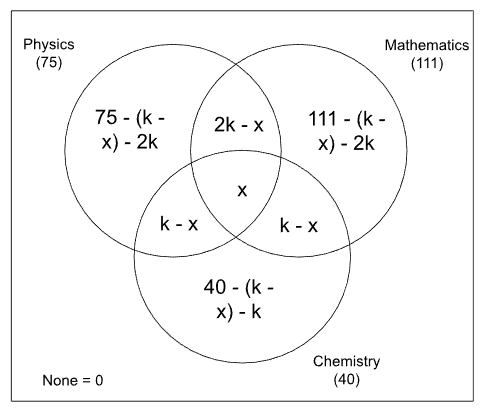
Based on the information provided, we can make the following diagram;
We know that the sum of all entries in the Venn diagram should be $$150$$. Therefore,
$$111+ 75-2k + 40 - (k-x) - k + 0 = 150$$
$$76 = 4k-x$$, where $$x\geq 1$$
We must maximise the number of students who chose Physics but not Mathematics. This number is equal to $$75-2k$$. To maximise this we must minimise $$k$$.
We have $$4k = 76+x$$ or $$k = 19 + \dfrac{x}{4}$$
Since $$x$$ and $$k$$ are both integers, $$x$$ should be divisible by $$4$$. To minimise $$k$$, we will take the minimum value of $$x$$, which is $$4$$.
Therefore, $$k = 19 + \dfrac{4}{4} = 20$$.
Thus, the maximum possible number of students who chose physics but not mathematics, is $$75-2*20 = 35$$.
In a class of 100 students, 73 like coffee, 80 like tea and 52 like lemonade. It may be possible that some students do not like any of these three drinks. Then the difference between the maximum and minimum possible number of students who like all the three drinks is
Let n, s, d and t be the number of students who likes none of the drinks, exactly one drink, exactly 2 drinks and all three drinks, respectively.
It is given,
n + s + d + t = 100 ...... (1)
s + 2d + 3t = 73 + 80 + 52
s + 2d + 3t = 205 ...... (2)
(2)-(1), we get
d + 2t - n = 105
Maximum value t can take is 52, i.e. t = 52, d = 1 and n = 0
Minimum value t can take is 5, i.e. t = 5, d = 95 and n = 0 (This also satisfies equation (1))
Difference = 52 - 5 = 47
The answer is option A.
Students in a college have to choose at least two subjects from chemistry, mathematics and physics. The number of students choosing all three subjects is 18, choosing mathematics as one of their subjects is 23 and choosing physics as one of their subjects is 25. The smallest possible number of students who could choose chemistry as one of their subjects is
Now 23 students choose maths as one of their subject.
This means (MPC)+ (MC) + (PC)=23 where MPC denotes students who choose all the three subjects maths, physics and chemistry and so on.
So MC + PM =5 Similarly we have PC+ MP =7
We have to find the smallest number of students choosing chemistry
For that in the first equation let PM=5 and MC=0. In the second equation this PC=2
Hence minimum number of students choosing chemistry will be (18+2)=20 Since 18 students chose all the three subjects.
A club has 256 members of whom 144 can play football, 123 can play tennis, and 132 can play cricket. Moreover, 58 members can play both football and tennis, 25 can play both cricket and tennis, while 63 can play both football and cricket. If every member can play at least one game, then the number of members who can play only tennis is
Assume the number of members who can play exactly 1 game = I
The number of members who can play exactly 2 game = II
The number of members who can play exactly 3 game = III
I+2II+3III=144+123+132=399....(1)
I+II+III=256......(2)
subtracting (1) from (2), we get
=> II+2III=143.....(3)
Also, II+3III=58+25+63=146 ......(4)
subtracting (3) from (4), we get
=> III = 3 (From 3 and 4)
=> II =137
=> I = 116
The members who play only tennis = 123-58-25+3 = 43
For two sets A and B, let AΔB denote the set of elements which belong to A or B but not both. If P = {1,2,3,4}, Q = {2,3,5,6}, R = {1,3,7,8,9}, S = {2,4,9,10}, then the number of elements in (PΔQ)Δ(RΔS) is
P = {1,2,3,4} and Q = {2,3,5,6,}
PΔQ = {1, 4, 5, 6}
R = {1,3,7,8,9} and S = {2,4,9,10}
RΔS = {1, 2, 3, 4, 7, 8, 10}
(PΔQ)Δ(RΔS) = {2, 3, 5, 6, 7, 8, 10}
Thus, there are 7 elements in (PΔQ)Δ(RΔS) .
hence, 7 is the correct answer.
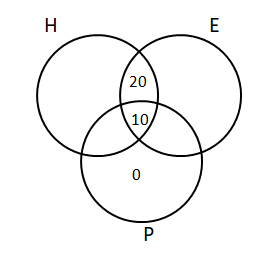
Each of 74 students in a class studies at least one of the three subjects H, E and P. Ten students study all three subjects, while twenty study H and E, but not P. Every student who studies P also studies H or E or both. If the number of students studying H equals that studying E, then the number of students studying H is
Let us draw a Venn diagram using the information present in the question.
It is given that the number of students studying H equals that studying E.
Let 'x' be the total number of students who studied H, and H and P but mot E.We can also say that the same will be the number of students who studied E, and E and P but not H.Therefore,
x + 20 + 10 + x = 74
x = 22
Hence, the number of students studying H = 22 + 10+ 20 = 52
If among 200 students, 105 like pizza and 134 like burger, then the number of students who like only burger can possibly be
It has been given that among 200 students, 105 like pizza and 134 like burger.
The question asks us to find out the number of students who can be liking only burgers among the given values.
The least number of students who like only burger will be obtained when everyone who likes pizza likes burger too.
In this case, 105 students will like pizza and burger and 134-105 = 29 students will like only burger. Therefore, the number of students who like only burger cannot be less than 29.
The maximum number of students who like only burger will be obtained when we try to separate the 2 sets as much as possible.
There are 200 students in total. 105 of them like pizza. Therefore, the remaining 95 students can like only burger and 134-95 = 39 students can like both pizza and burger. As we can see, the number of students who like burger cannot exceed 95.
The number of students who like only burger should lie between 29 and 95 (both the values are included).
93 is the only value among the given options that satisfies this condition and hence, option D is the right answer.
If A = {$$6^{2n} -35n - 1$$}, where $$n$$ = 1,2,3,... and B = {35($$n$$-1)}, where $$n$$ = 1,2,3,... then which of the following is true?
If we carefully observe set A, then we find that $$6^{2n} -35n - 1$$ is divisible by 35. So, set A contains multiples of 35. However, not all the multiples of 35 are there in set A, for different values of $$n$$.
For $$n = 1$$, the value is 0, for $$n = 2$$, the value is 1225 which is the 35th multiple of 3.
If we observe set B, it consists of all the multiples of 35 including 0.
So, we can say that every member of set A will be in B while every member of set B will not necessarily be in set A.
Hence, option A is the correct answer.
A survey was conducted of 100 people to find out whether they had read recent issues of Golmal, a monthly magazine. The summarized information regarding readership in 3 months is given below:
Only September: 18;
September but not August: 23;
September and July: 8;
September:28;
July: 48;
July and August: 10;
none of the three months: 24
What is the number of surveyed people who have read exactly two consecutive issues (out of the three)?

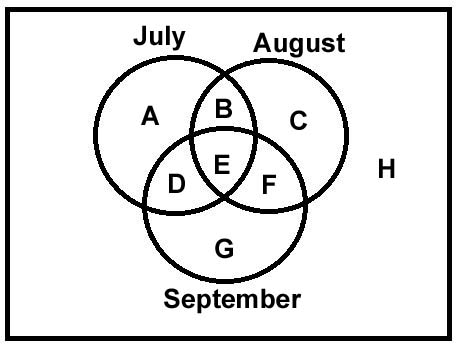
Let the areas be labelled as shown in the diagram above.
The number of people corresponding to "none of the three months" is 24. So, H is 24.
Only September is 18. So, G = 18
September but not August is 23. So, G + D = 23.
Hence, D = 23 - 18 = 5.
We know that September and July is 8. So, D + E = 8
This implies E = 3.
September = 28. So, D + E + F + G = 28.
So, F = 28 - 5 - 3 - 18 = 2.
July and August = 10.
So, B + E = 10.
E = 3. So, B = 7.
July = 48.
So, A + B + D + E = 48
A = 48 - 7 - 5 - 3 = 33.
There are 100 people in total. So, C = 100 - A - B - D - E - F - G - H = 100 - 33 - 7 - 5 - 3 - 2 - 18 - 24 = 8
So, number of people who read exactly two consecutive issues = (July & August) + (August & September) = B + F = 7 + 2 = 9
Help Distress (HD) is an NGO involved in providing assistance to people suffering from natural disasters. Currently, it has 37 volunteers. They are involved in three projects: Tsunami Relief (TR) in Tamil Nadu, Flood Relief (FR) in Maharashtra, and Earthquake Relief (ER) in Gujarat. Each volunteer working with Help Distress has to be involved in at least one relief work project.
- A Maximum number of volunteers are involved in the FR project. Among them, the number of volunteers involved in FR project alone is equal to the volunteers having additional involvement in the ER project.
- The number of volunteers involved in the ER project alone is double the number of volunteers involved in all the three projects.
- 17 volunteers are involved in the TR project.
The number of volunteers involved in the TR project alone is one less than the number ofvolunteers involved in ER project alone.
Ten volunteers involved in the TR project are also involved in at least one more project.
Based on the information given above, the minimum number of volunteers involved in both FR and TR projects, but not in the ER project is:
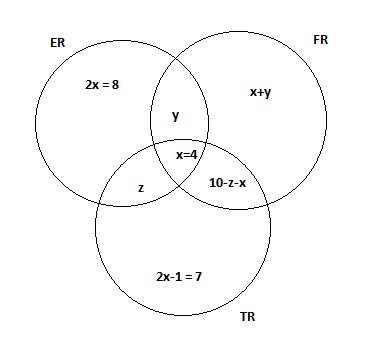
Total number of volunteers are 37
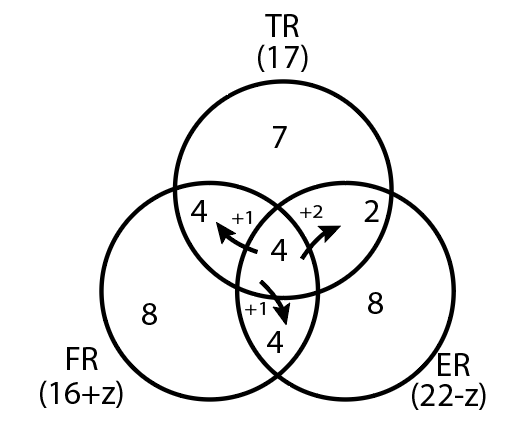
=> 2x+y+x+y+x+y+z+10-z-x+2x-1=37
=> 5x+2y+9=37
=> 5x+2y=28
Also we know that 3x + 2y = 20.
We get x=4, => y=4
We need to find the minimum value of 6-z, and it is given FR get the most number of volunteers, We get that z cannot be more than 2 because if it is 3 or above ER will have the maximum number of volunteers.
Help Distress (HD) is an NGO involved in providing assistance to people suffering from natural disasters. Currently, it has 37 volunteers. They are involved in three projects: Tsunami Relief (TR) in Tamil Nadu, Flood Relief (FR) in Maharashtra, and Earthquake Relief (ER) in Gujarat. Each volunteer working with Help Distress has to be involved in at least one relief work project.
- A Maximum number of volunteers are involved in the FR project. Among them, the number of volunteers involved in FR project alone is equal to the volunteers having additional involvement in the ER project.
- The number of volunteers involved in the ER project alone is double the number of volunteers involved in all the three projects.
- 17 volunteers are involved in the TR project.
The number of volunteers involved in the TR project alone is one less than the number ofvolunteers involved in ER project alone.
Ten volunteers involved in the TR project are also involved in at least one more project.
Which of the following additional information would enable to find the exact number of volunteers involved in various projects?
We can get the information mentioned in options B and C using the data given in the passage.
But, we need the information in option A to find the exact number of volunteers in various projects.
Hence, option A is the answer.
Help Distress (HD) is an NGO involved in providing assistance to people suffering from natural disasters. Currently, it has 37 volunteers. They are involved in three projects: Tsunami Relief (TR) in Tamil Nadu, Flood Relief (FR) in Maharashtra, and Earthquake Relief (ER) in Gujarat. Each volunteer working with Help Distress has to be involved in at least one relief work project.
- A Maximum number of volunteers are involved in the FR project. Among them, the number of volunteers involved in FR project alone is equal to the volunteers having additional involvement in the ER project.
- The number of volunteers involved in the ER project alone is double the number of volunteers involved in all the three projects.
- 17 volunteers are involved in the TR project.
The number of volunteers involved in the TR project alone is one less than the number ofvolunteers involved in ER project alone.
Ten volunteers involved in the TR project are also involved in at least one more project.
After some time, the volunteers who were involved in all the three projects were asked to withdraw from one project. As a result, one of the volunteers opted out of the TR project, and one opted out of the ER project, while the remaining ones involved in all the three projects opted out of the FR project. Which of the following statements, then, necessarily follows?
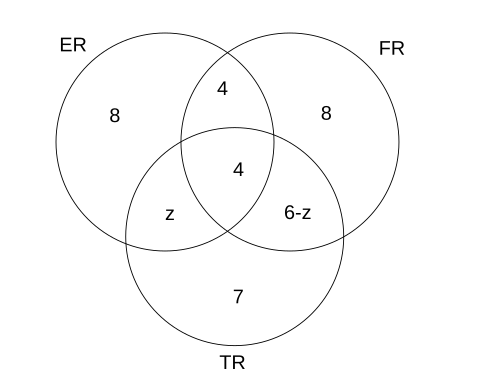
FR is greater than ER, thus z is 4,5,6.
If z=4,
FR=20, ER= 18
If z=5,
FR=21, ER= 17
If z=6,
FR=22, ER= 16
Now even if we transfer one of the volunteers opted out of the TR project thus he will now be handling FR and ER, and one opted out of the ER project will be handling TR and FR, while the remaining ones involved in all the three projects opted out of the FR project.
The worst-case scenario will be when z=4. Now 2 are out of FR, 1 from ER and 1 from TR.
FR=20-2=18 and ER=18-1=17
So we can see that even if volunteers are withdrawn, the number of volunteers in FR are more as in, total if we calculate comes out to be more. Hence option B.
Help Distress (HD) is an NGO involved in providing assistance to people suffering from natural disasters. Currently, it has 37 volunteers. They are involved in three projects: Tsunami Relief (TR) in Tamil Nadu, Flood Relief (FR) in Maharashtra, and Earthquake Relief (ER) in Gujarat. Each volunteer working with Help Distress has to be involved in at least one relief work project.
- A Maximum number of volunteers are involved in the FR project. Among them, the number of volunteers involved in FR project alone is equal to the volunteers having additional involvement in the ER project.
- The number of volunteers involved in the ER project alone is double the number of volunteers involved in all the three projects.
- 17 volunteers are involved in the TR project.
The number of volunteers involved in the TR project alone is one less than the number ofvolunteers involved in ER project alone.
Ten volunteers involved in the TR project are also involved in at least one more project.
After the withdrawal of volunteers, as indicated in the previous question, some new volunteers joined the NGO. Each one of them was allotted only one project in a manner such that, the number of volunteers working in one project alone for each of the three projects became identical. At that point, it was also found that the number of volunteers involved in FR and ER projects was the same as the number of volunteers involved in TR and ER projects. Which of the projects now has the highest number of volunteers?
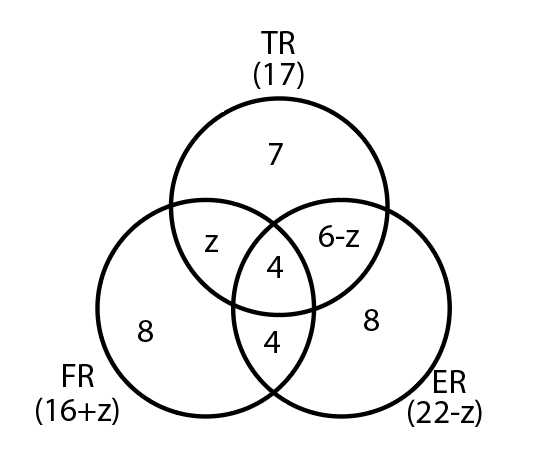
Consider p volunteers be added to TR project and q be added to each of FR and ER projects.
Then, 7 + p = 8 + q => p = q + 1
Also, Number of volunteers working on TR = 7 + q + 1 + 4 + 5 = 17 + q
Number of volunteers working on FR = 17 + q
Number of volunteers working on ER = 18 + q.
So if we take any values we get ER greater than both FR and TR.
DIRECTIONS for the following two questions: Answer the questions on the basis of the information given below.
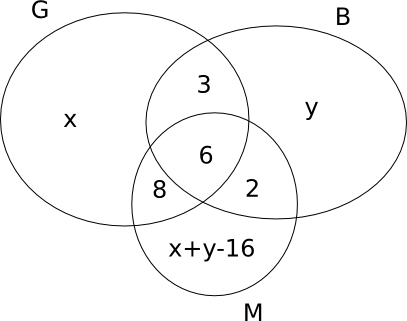
New Age Consultants have three consultants Gyani, Medha and Buddhi. The sum of the number of projects handled by Gyani and Buddhi individually is equal to the number of projects in which Medha is involved. All three consultants are involved together in 6 projects. Gyani works with Medha in 14 projects. Buddhi has 2 projects with Medha but without Gyani, and 3 projects with Gyani but without Medha. The total number of projects for New Age Consultants is one less than twice the number of projects in which more than one consultant is involved.
What is the number of projects in which Gyani alone is involved?

The total number of projects = 2(3+6+8+2) - 1 = 38 - 1 = 37
So, 19 + 2(x+y) - 16 = 37
=> x+y = 17
The number of projects in which Medha alone is involved is 17-16 = 1
But the number of projects in which Gyani alone is involved cannot be uniquely determined
DIRECTIONS for the following two questions: Answer the questions on the basis of the information given below.
New Age Consultants have three consultants Gyani, Medha and Buddhi. The sum of the number of projects handled by Gyani and Buddhi individually is equal to the number of projects in which Medha is involved. All three consultants are involved together in 6 projects. Gyani works with Medha in 14 projects. Buddhi has 2 projects with Medha but without Gyani, and 3 projects with Gyani but without Medha. The total number of projects for New Age Consultants is one less than twice the number of projects in which more than one consultant is involved.
What is the number of projects in which Medha alone is involved?

The total number of projects = 2(3+6+8+2) - 1 = 38 - 1 = 37
So, 19 + 2(x+y) - 16 = 37
=> x+y = 17
The number of projects in which Medha alone is involved is 17-16 = 1
But the number of projects in which Gyani alone is involved cannot be uniquely determined
Shyam visited Ram during his brief vacation. In the mornings they both would go for yoga. In the evenings they would play tennis. To have more fun, they indulge only in one activity per day, i.e. either they went for yoga or played tennis each day. There were days when they were lazy and stayed home all day long. There were 24 mornings when they did nothing, 14 evenings when they stayed at home, and a total of 22 days when they did yoga or played tennis. For how many days Shyam stayed with Ram?
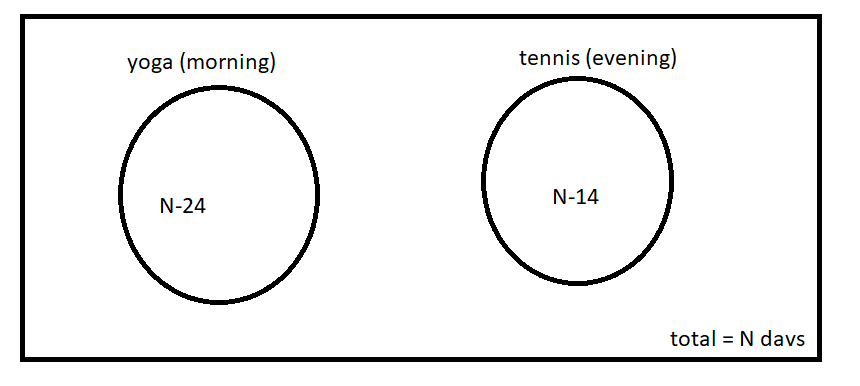
Let the number of total days=N
They played tennis for=N-14 days
They did yoga for =N-24 days

And the question says that total days when they did yoga or played tennis are 22
which means
N-14 + N-24 = 22
2N - 38 = 22
2N = 60
N = 30
Hence total days they stayed together were 30
On her walk through the park, Hamsa collected 50 coloured leaves, all either maple or oak. She sorted them by category when she got home, and found the following:
The number of red oak leaves with spots is even and positive.
The number of red oak leaves without any spot equals the number of red maple leaves without spots.
All non-red oak leaves have spots, and there are five times as many of them as there are red spotted oak leaves.
There are no spotted maple leaves that are not red.
There are exactly 6 red spotted maple leaves.
There are exactly 22 maple leaves that are neither spotted nor red.
How many oak leaves did she collect?
6+x+22+x+6y/5 = 50
=> 5x + 3y = 55
Since y/5 is even, y should be a multiple of 10
The only possible value is 10
So, y = 10 and x = 5
No. of oak leaves = 17
In a survey of political preference, 78% of those asked were in favor of at least one of the proposals: I, II and III. 50% of those asked favored proposal I, 30% favored proposal II, and 20% favored proposal III. If 5% of those asked favored all three of the proposals, what percentage of those asked favored more than one of the 3 proposals.
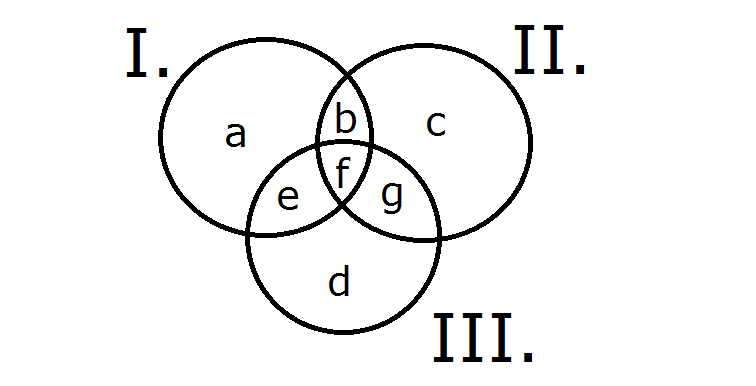
Let the distribution of votes for each of the proposal be as given below.
From the information given, we know that
a+b+c+d+e+f+g = 78 --- (1)
a+b+e+f = 50 ---- (2)
b+c+f+g = 30 ---- (3)
e+f+g+d = 20 ---- (4) and
f = 5 --- (5)
We need to find b+e+g+f = ?
In the above equations, (2)+(3)+(4) - (1) implies
(a+b+e+f)+(b+c+f+g)+(e+f+g+d) - (a+b+c+d+e+f+g) = 50+30+20-78 = 22
Or, b+e+g+2f=22.
As, f = 5, it implies that b+e+g+f=17

What is the maximum percentage of people who can watch all the three channels?
Let a be the number who watch only one channel, b be the number who watch only 2 channels and c be the number who watch all channels.
a+b+c = 100
a+2b+3c = 80+22+15 =117
Subtracting both equations,
b+2c = 117-100 = 17
Maximum c occurs when b = 0
2c = 17
c = 8.5
If 5% of people watched DD and CNN, 10% watched DD and BBC, then what percentage of people watched BBC and CNN only?
Applying AUBUC formula
Let x be the number who watch BBC and CNN and y be the number who watch all three channels.
100 = 80+22+15-(10+5+x)+y
x-y = 2
Hence only 2% people watch BBC and CNN only.
Referring to the previous question, what percentage of people watched all the three channels?
Applying AUBUC formula
Let x be the number who watch BBC and CNN and y be the number who watch all three channels.
100 = 80+22+15-(10+5+x)+y
x-y = 2
We cannot find the exact value of y.
Hence, the answer is "cannot be determined".
In a locality, two-thirds of the people have cable TV, one-fifth have VCR, and one-tenth have both. What is the fraction of people having atleast one among cable -TV and VCR?

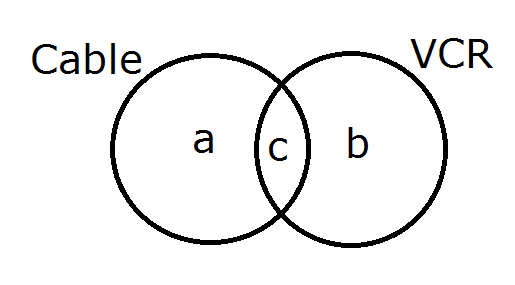
Let the distribution of people having cable TV and VCR be as given in the diagram above.
Hence, $$a+c =\frac{2}{3}$$
$$b+c=\frac{1}{5}$$
and $$c=\frac{1}{10}$$
We need to find $$a+b+c=?$$
This equals $$(a+b)+(b+c)-c = \frac{2}{3}+\frac{1}{5}-\frac{1}{10}$$
Which equals $$\frac{20+6-3}{30}=\frac{23}{30}$$
Fifty college teachers are surveyed as to their possession of colour TV, VCR and tape recorder. Of them, 22 own colour TV, 15 own VCR and 14 own tape recorders. Nine of these college teachers own exactly two items out of colour TV, VCR and tape recorder; and, one college teacher owns all three. How many of the 50 teachers own none of the three, colour TV, VCR or tape recorder?
Number of people owning exactly 2 articles = 9
Number of people owning exactly 3 articles = 1
Applying AUBUC formula, we get
AUBUC = 22+15+14 - 9 -2*(1)=40
Number of people who do not own any article = 50-40 = 10
There are 3 clubs A, B & C in a town with 40, 50 & 60 members respectively. While 10 people are members of all 3 clubs, 70 are members in only one club. How many belong to exactly two clubs?
We know that x + y + z = T and x + 2y + 3z = R, where
x = number of members belonging to exactly 1 set = 70
y = number of members belonging to exactly 2 sets
z = number of members belonging to exactly 3 sets = 10
T = Total number of members
R = Repeated total of all the members = (40+50+60) = 150
Thus we have two equations and two unknowns. Solving this we get y = 25
So, 25 people belong to exactly 2 clubs.
There were a hundred schools in a town. Of these, the number of schools having a play - ground was 30, and these schools had neither a library nor a laboratory. The number of schools having a laboratory alone was twice the number of those having a library only. The number of schools having a laboratory as well as a library was one-fourth the number of those having a laboratory alone. The number of schools having either a laboratory or a library or both was 35.
How many schools had none of the three viz., laboratory, library or play - ground?
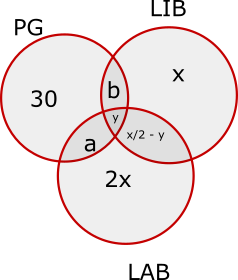
The diagram for this question has been shown:
Total number of schools having either or LAB or LIB or both = a+b+x/2 - y + y + 3x = 7x/2 + a + b = 35
Here a = b = y = 0
7x/2 = 35
x = 10
Total number of schools having at least one of PG, LIB or LAB = 30+2x+x+x/2 = 30+3x+x/2 = 30+30+5 = 65
Number of schools having neither of the three = 100-65 = 35
There were a hundred schools in a town. Of these, the number of schools having a play - ground was 30, and these schools had neither a library nor a laboratory. The number of schools having a laboratory alone was twice the number of those having a library only. The number of schools having a laboratory as well as a library was one-fourth the number of those having a laboratory alone. The number of schools having either a laboratory or a library or both was 35.
What was the ratio of schools having laboratory those having library?
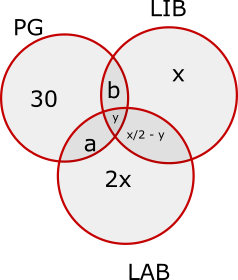
The diagram for this question has been shown:
Total number of schools having either or LAB or LIB or both = a+b+x/2 - y + y + 3x = 7x/2 + a + b = 35
It has been given that the schools having playground don't have a Library or Laboratory.
Hence a = b = y = 0
7x/2 = 35
x = 10
Required ratio = 25:15 = 5:3
Frequently Asked Questions
Venn Diagrams are part of logical reasoning and data interpretation. In CAT 2026, they test your ability to visualize overlapping data and solve set-based problems efficiently.
The difficulty is usually moderate. CAT 2026 may include both direct set-based questions and complex multi-set problems requiring logical deductions.
Focus on sets, union, intersection, complements, and 2-set/3-set problems. Understanding logical relationships is key for CAT 2026 LRDI preparation.
Start with basic concepts, practice different types of problems, and gradually move to mixed LRDI sets. Regular mock practice is essential.
Yes, previous year CAT questions help you understand patterns, question framing, and difficulty level, making them crucial for preparation.
Platforms like Cracku offer structured practice questions, topic-wise tests, and detailed solutions, making it highly useful for CAT 2026 preparation.
Aim for at least 30-40 full-length mocks along with sectional tests. Platforms like Cracku provide quality mock tests aligned with CAT 2026 expectations.
Use diagrams for visualization, avoid assumptions, and systematically fill regions. Practice helps improve speed and accuracy over time.