A cafeteria offers 5 types of sandwiches. Moreover, for each type of sandwich, a customer can choose one of 4 breads and opt for either small or large sized sandwich. Optionally, the customer may also add up to 2 out of 6 available sauces. The number of different ways in which an order can be placed for a sandwich, is
CAT Probability, Combinatorics Questions
Number of ways to choose a sandwich = $$^5C_1$$ ways
Number of ways to choose a bread = $$^4C_1$$ ways
Number of ways to choose bread size = $$^2C_1$$ ways
Number of ways to choose sauces = $$^6C_0+^6C_1+^6C_2=1+6+15=22$$ ways
So, number of different ways = $$^5C_1\times\ ^4C_1\times\ ^2C_1\times\ 22=5\times\ 4\times\ 2\times\ 22=880$$ ways.
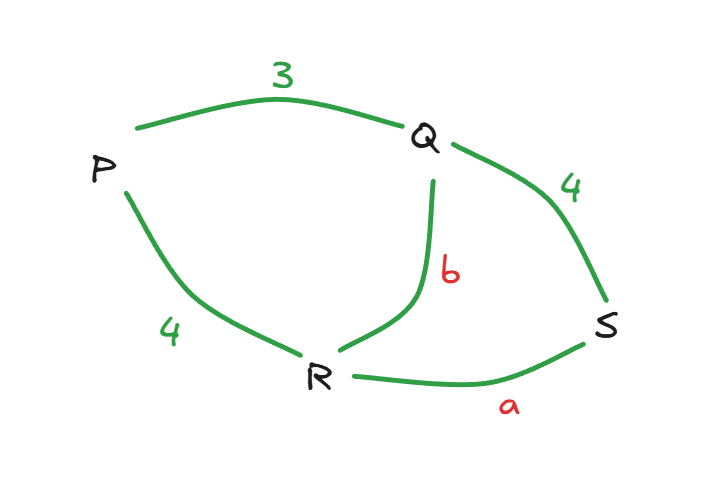
P, Q, R and S are four towns. One can travel between P and Q along 3 direct paths, between Q and S along 4 direct paths, and between P and R along 4 direct paths. There is no direct path between P and S, while there are few direct paths between Q and R, and between R and S. One can travel from P to S either via Q, or via R, or via Q followed by R, respectively, in exactly 62 possible ways. One can also travel from Q to R either directly, or via P, or via S, in exactly 27 possible ways. Then, the number of direct paths between Q and R is
Let's take the number of paths between Q and R to be b and the number of paths between R and S to be a
We are given the paths from P to S through R (which would be 4a), the paths from P to S through Q (which would be 12) and the paths from P to Q to R to S, which would be 3ab) is equal to 62
Giving the relation 4a+12+3ab = 62
Or 4a+3ab = 50
The paths from Q to R directly (which would be b), through P( which would be 12) and through S (which would be 4a) are 27
Giving the relation b+12+4a = 27
Or 4a+b = 15
Subtracting this equation from the first one we got, we get 3ab-b=35, or b(3a-1)=35
b can be 1, 3, 5 or 7
Substituting these values in the second equation, we see that it can not be 1 or 5, leaving only 3 or 7 as the possible values.
Substituting b as 3 in the first equation would give 13a=50, which is not true.
Substituting bas 7 in the first equation would give 25a= 50, which would give a=2
We are asked the number of paths from Q to R, which is b=7
Therefore, 7 is the correct answer.
The number of ways of distributing 20 identical balloons among 4 children such that each child gets some balloons but no child gets an odd number of balloons, is
Let the number of balloons each child received be 2a, 2b, 2c and 2d
2a + 2b + 2c + 2d = 20
a + b + c + d = 10
Each of them should get more than zero balloons.
Therefore, total number of ways = $$(n-1)_{C_{r-1}}=(10-1)_{C_{4-1}}=9_{C_3}=84$$
The arithmetic mean of all the distinct numbers that can be obtained by rearranging the digits in 1421, including itself, is
The number of 4-digit numbers possible using 1,1,2, and 4 is $$\frac{4!}{2!}=12$$
Number of 1's, 2's and 4's in units digits will be in the ratio 2:1:1, i.e. 6 1's, 3 2's and 3 4's.
Sum = 6(1) + 3(2) + 3(4) = 24
Similarly, in tens digit, hundreds digit and thousands digit as well.
Therefore, sum = 24 + 24(10) + 24(100) + 24(1000) = 24(1111)
Mean = $$\frac{24\left(1111\right)}{12}=2222$$
The answer is option A.
The number of integers greater than 2000 that can be formed with the digits 0, 1, 2, 3, 4, 5, using each digit at most once, is
Case 1: 4-digit numbers
Given digits - 0, 1, 2, 3, 4, 5
_, _, _, _
As the numbers should be greater than 2000, first digit can be 2, 3, 4 and 5.
For remaining digits, we need to arrange 3 digits from the remaining 5 digits, i.e. 5*4*3 = 60 ways
Total number of possible 4-digit numbers = 4*60 = 240
Case 2: 5-digit numbers
_, _, _, _, _
First digit cannot be zero.
Therefore, total number of cases = 5*5*4*3*2 = 600
Case 3: 6-digit numbers
_, _, _, _, _, _
First digit cannot be zero.
Therefore, total number of cases = 5*5*4*3*2*1 = 600
Total number of integers possible = 600 + 600 + 240 = 1440
The answer is option A.
The number of ways of distributing 15 identical balloons, 6 identical pencils and 3 identical erasers among 3 children, such that each child gets at least four balloons and one pencil, is
This question is an application of the product rule in probability and combinatorics.
In the product rule, if two events A and B can occur in x and y ways, and for an event E, both events A and B need to take place, the number of ways that E can occur is xy. This can be expanded to 3 or more events as well.
Event 1: Distribution of balloons
Since each child gets at least 4 balloons, we will initially allocate these 4 balloons to each of them.
So we are left with 15 - 4 x 3 = 15 - 12 = 3 balloons and 3 children.
Now we need to distribute 3 identical balloons to 3 children.
This can be done in $$^{n+r-1}C_{r-1}$$ ways, where n = 3 and r = 3.
So, number of ways = $$^{3+3-1}C_{3-1}=^5C_2=\frac{5\times\ 4}{2\times\ 1}=10$$
Event 2: Distribution of pencils
Since each child gets at least one pencil, we will allocate 1 pencil to each child. We are now left with 6 - 3 = 3 pencils.
We now need to distribute 3 identical pencils to 3 children.
This can be done in $$^{n+r-1}C_{r-1}$$ ways, where n = 3 and r = 3.
So, number of ways = $$^{3+3-1}C_{3-1}=^5C_2=\frac{5\times\ 4}{2\times\ 1}=10$$
Event 3: Distribution of erasers
We need to distribute 3 identical erasers to 3 children.
This can be done in $$^{n+r-1}C_{r-1}$$ ways, where n = 3 and r = 3.
So, number of ways = $$^{3+3-1}C_{3-1}=^5C_2=\frac{5\times\ 4}{2\times\ 1}=10$$
Applying the product rule, we get the total number of ways = 10 x 10 x 10 = 1000.
The number of groups of three or more distinct numbers that can be chosen from 1, 2, 3, 4, 5, 6, 7 and 8 so that the groups always include 3 and 5, while 7 and 8 are never included together is
The possible arrangements are of the form
35 _ Can be chosen in 6 ways.
35 _ _ We can choose 2 out of the remaining 6 in $$^6C_2=15$$ways. We remove 1 case where 7 and 8 are together to get 14 ways.
35 _ _ _We can choose 3 out of the remaining 6 in $$^6C_3=20$$ways. We remove 4 cases where 7 and 8 are together to get 16 ways.
35 _ _ _ _We can choose 4 out of the remaining 6 in $$^6C_4=15$$ways. We remove 6 case where 7 and 8 are together to get 9 ways.
35 _ _ _ _ _ We choose 1 out of 7 and 8 and all the remaining others in 2 ways.
Thus, total number of cases = 6+14+16+9+2 = 47.
Alternatively,
The arrangement requires a selection of 3 or more numbers while including 3 and 5 and 7, 8 are never included together. We have cases including a selection of only 7, only 8 and neither 7 nor 8.
Considering the cases, only 7 is selected.
We can select a maximum of 7 digit numbers. We must select 3, 5, and 7.
Hence we must have ( 3, 5, 7) for the remaining 4 numbers we have
Each of the numbers can either be selected or not selected and we have 4 numbers :
Hence we have _ _ _ _ and 2 possibilities for each and hence a total of 2*2*2*2 = 16 possibilities.
SImilarly, including only 8, we have 16 more possibilities.
Cases including neither 7 nor 8.
We must have 3 and 5 in the group but there must be no 7 and 8 in the group.
Hence we have 3 5 _ _ _ _.
For the 4 blanks, we can have 2 possibilities for either placing a number or not among 1, 2, 4, 6.
= 16 possibilities
But we must remove the case where neither of the 4 numbers are placed because the number becomes a two-digit number.
Hence 16 - 1 = 15 cases.
Total = 16+15+16 = 47 possibilities
How many three-digit numbers are greater than 100 and increase by 198 when the three digits are arranged in the reverse order?
Let the numbers be of the form 100a+10b+c, where a, b, and c represent single digits.
Then (100c+10b+a)-(100a+10b+c)=198
99c-99a=198
c-a = 2.
Now, a can take the values 1-7. a cannot be zero as the initial number has 3 digits and cannot be 8 or 9 as then c would not be a single-digit number.
Thus, there can be 7 cases.
B can take the value of any digit from 0-9, as it does not affect the answer. Hence, the total cases will be $$7\times\ 10=70$$.
A four-digit number is formed by using only the digits 1, 2 and 3 such that both 2 and 3 appear at least once. The number of all such four-digit numbers is
The question asks for the number of 4 digit numbers using only the digits 1, 2, and 3 such that the digits 2 and 3 appear at least once.
The different possibilities include :
Case 1:The four digits are ( 2, 2, 2, 3). Since the number 2 is repeated 3 times. The total number of arrangements are :
$$\frac{4!}{3!}$$ = 4.
Case 2: The four digits are 2, 2, 3, 3. The total number of four-digit numbers formed using this are :
$$\frac{4!}{2!\cdot2!}=\ 6$$
Case 3: The four digits are 2, 3, 3, 3. The number of possible 4 digit numbers are :
$$\frac{4!}{3!}$$ = 4
Case4: The four digits are 2, 3, 3, 1. The number of possible 4 digit numbers are :
$$\frac{4!}{2!}=\ 12$$
Case5: Using the digits 2, 2, 3, 1. The number of possible 4 digit numbers are :
$$\frac{4!}{2!}=\ 12$$
Case 6: Using the digits 2, 3, 1, 1. The number of possible 4 digit numbers are :
$$\frac{4!}{2!}=\ 12$$
A total of 12 + 12 + 12 + 4 + 6 + 4 = 50 possibilities.
Alternatively
We have to form 4 digit numbers using 1,2,3 such that 2,3 appears at least once
So the possible cases :
Now we get $$\frac{4!}{2!}\times\ 3$$= 36 ( When one digit is used twice and the remaining two once )
$$\frac{4!}{3!}\times\ 2$$ = 8 ( When 1 is used 0 times and 2 and 3 is used 3 times or 1 time )
$$\frac{4!}{2!\times\ 2!}=\ 6$$( When 2 and 3 is used 2 times each )
So total numbers = 36+8+6 =50
With rectangular axes of coordinates, the number of paths from (1, 1) to (8, 10) via (4, 6), where each step from any point (x, y) is either to (x, y+1) or to (x+1, y), is
The number of paths from (1, 1) to (8, 10) via (4, 6) = The number of paths from (1,1) to (4,6) * The number of paths from (4,6) to (8,10)
To calculate the number of paths from (1,1) to (4,6), 4-1 =3 steps in x-directions and 6-1=5 steps in y direction
Hence the number of paths from (1,1) to (4,6) = $$^{(3+5)}C_3$$ = 56
To calculate the number of paths from (4,6) to (8,10), 8-4 =4 steps in x-directions and 10-6=4 steps in y direction
Hence the number of paths from (4,6) to (8,10) = $$^{(4+4)}C_4$$ = 70
The number of paths from (1, 1) to (8, 10) via (4, 6) = 56*70=3920
How many two-digit numbers, with a non-zero digit in the units place, are there which are more than thrice the number formed by interchanging the positions of its digits?
Let 'ab' be the two digit number. Where b $$\neq$$ 0.
We will get number 'ba' after interchanging its digit.
It is given that 10a+b > 3*(10b + a)
7a > 29b
If b = 1, then a = {5, 6, 7, 8, 9}
If b = 2, then a = {9}
If b = 3, then no value of 'a' is possible. Hence, we can say that there are a total of 6 such numbers.
In a tournament, there are 43 junior level and 51 senior level participants. Each pair of juniors play one match. Each pair of seniors play one match. There is no junior versus senior match. The number of girl versus girl matches in junior level is 153, while the number of boy versus boy matches in senior level is 276. The number of matches a boy plays against a girl is
In a tournament, there are 43 junior level and 51 senior level participants.
Let 'n' be the number of girls on junior level. It is given that the number of girl versus girl matches in junior level is 153.
$$\Rightarrow$$ nC2 = 153
$$\Rightarrow$$ n(n-1)/2 = 153
$$\Rightarrow$$ n(n-1) = 306
=> n$$^{2}$$-n-306 = 0
=> (n+17)(n-18)=0
=> n=18 (rejecting n=-17)
Therefore, number of boys on junior level = 43 - 18 = 25.
Let 'm' be the number of boys on senior level. It is given that the number of boy versus boy matches in senior level is 276.
$$\Rightarrow$$ mC2 = 276
$$\Rightarrow$$ m = 24
Therefore, number of girls on senior level = 51 - 24 = 27.
Hence, the number of matches a boy plays against a girl = 18*25+24*27 = 1098
How many numbers with two or more digits can be formed with the digits 1,2,3,4,5,6,7,8,9, so that in every such number, each digit is used at most once and the digits appear in the ascending order?
It has been given that the digits in the number should appear in the ascending order. Therefore, there is only 1 possible arrangement of the digits once they are selected to form a number.
There are 9 numbers (1,2,3,4,5,6,7,8,9) in total.
2 digit numbers can be formed in $$9C_2$$ ways.
3 digit numbers can be formed in $$9C_3$$ ways.
..................................................
..9 digit number can be formed in 9C9 ways.
We know that $$nC_0+nC_1+nC_2+.........+nC_n =2^n$$
=> $$9C_0 + 9C_1+9C_2+....9C_9 = 2^9$$
$$9C_0 + 9C_1 + ...9C_9 = 512$$
We have to subtract $$9C_0$$ and $$9C_1$$ from both the sides of the equations since we cannot form single digit numbers.
=> $$9C_2 + 9C_3+...+9C_9=512-1-9$$
$$9C_2+9C_3+...+9C_9=502$$
Therefore, $$502$$ is the right answer.
The numbers 1, 2, ..., 9 are arranged in a 3 X 3 square grid in such a way that each number occurs once and the entries along each column, each row, and each of the two diagonals add up to the same value.
If the top left and the top right entries of the grid are 6 and 2, respectively, then the bottom middle entry is
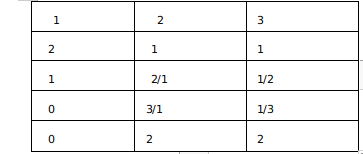
According to the question each column, each row, and each of the two diagonals of the 3X3 matrix add up to the same value. This value must be 15.
Let us consider the matrix as shown below:
Now we'll try substituting values from 1 to 9 in the exact middle grid shown as 'x'.
If x = 1 or 3, then the value in the left bottom grid will be more than 9 which is not possible.
x cannot be equal to 2.
If x = 4, value in the left bottom grid will be 9. But then addition of first column will come out to be more than 15. Hence, not possible.
If x=5, we get the grid as shown below:
Hence, for x = 5 all conditions are satisfied. We see that the bottom middle entry is 3.
Hence, 3 is the correct answer.
In how many ways can 8 identical pens be distributed among Amal, Bimal, and Kamal so that Amal gets at least 1 pen, Bimal gets at least 2 pens, and Kamal gets at least 3 pens?
After Amal, Bimal and Kamal are given their minimum required pens, the pens left are 8 - (1 + 2 + 3) = 2 pens
Now these two pens have to be divided between three persons so that each person can get zero pens = $$^{2+3-1}C_{3-1}$$ = $$^4C_2$$ = 6
Let AB, CD, EF, GH, and JK be five diameters of a circle with center at 0. In how many ways can three points be chosen out of A, B, C, D, E, F, G, H, J, K, and O so as to form a triangle?
The total number of given points are 11. (10 on circumference and 1 is the center)
So total possible triangles = 11C3 = 165.
However, AOB, COD, EOF, GOH, JOK lie on a straight line. Hence, these 5 triangles are not possible. Thus, the required number of triangles = 165 - 5 = 160
How many four digit numbers, which are divisible by 6, can be formed using the digits 0, 2, 3, 4, 6, such that no digit is used more than once and 0 does not occur in the left-most position?
For the number to be divisible by 6, the sum of the digits should be divisible by 3 and the units digit should be even. Hence we have the digits as
Case I: 2, 3, 4, 6
Now the units place can be filled in three ways (2,4,6), and the remaining three places can be filled in 3! = 6 ways.
Hence total number of ways = 3*6 = 18
Case II: 0, 2, 3, 4
case II a: 0 is in the units place => 3! = 6 ways
case II b: 0 is not in the units place => units place can be filled in 2 ways( 2,4) , thousands place can be filled in 2 ways ( remaining 3 - 0) and remaining can be filled in 2! = 2 ways. Hence total number of ways = 2 * 2 * 2 = 8
Total number of ways in this case = 6 + 8 = 14 ways.
Case III: 0, 2, 4, 6
case III a: 0 is in the units place => 3! = 6 ways
case II b: 0 is not in the units place => units place can be filled in 3 ways( 2,4,6) , thousands place can be filled in 2 ways (remaining 3 - 0) and remaining can be filled in 2! = 2 ways. Hence total number of ways = 3 * 2 * 2 = 12
Total number of ways in this case = 6 + 12= 18 ways.
Hence the total number of ways = 18 + 14 + 18 = 50 ways
In how many ways can 7 identical erasers be distributed among 4 kids in such a way that each kid gets at least one eraser but nobody gets more than 3 erasers?
We have been given that a + b + c + d = 7
Total ways of distributing 7 things among 4 people so that each one gets at least one = $$^{n-1}C_{r-1}$$ = 6C3 = 20
Now we need to subtract the cases where any one person got more than 3 erasers. Any person cannot get more than 4 erasers since each child has to get at least 1. Any of the 4 childs can get 4 erasers. Thus, there are 4 cases. On subtracting these cases from the total cases we get the required answer. Hence, the required value is 20 - 4 = 16
How many integers, greater than 999 but not greater than 4000, can be formed with the digits 0, 1, 2, 3 and 4, if repetition of digits is allowed?
We have to essentially look at numbers between 1000 and 4000 (including both).
The first digit can be either 1 or 2 or 3.
The second digit can be any of the five numbers.
The third digit can be any of the five numbers.
The fourth digit can also be any of the five numbers.
So, total is 3*5*5*5 = 375.
However, we have ignored the number 4000 in this calculation and hence the total is 375+1=376
What is the number of distinct terms in the expansion of $$(a + b + c)^{20}$$?
The power is 20.
20 has to be divided among a, b and c. This can be done in $$^{20+3-1}C_{3-1}$$ = $$^{22}C_2$$ = 231
Option a) is the correct answer.
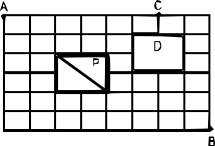
Directions for the next two questions: The figure below shows the plan of a town. The streets are at right angles to each other. A rectangular park (P) is situated inside the town with a diagonal road running through it. There is also a prohibited region (D) in the town.

Neelam rides her bicycle from her house at A to her office at B, taking the shortest path. Then the number of possible shortest paths that she can choose is
[CAT 2008]
The shortest route from A to B is via the diagonal OQ in the square P. One can travel from A to O in 4!/2!*2! ways. The shortest way from O to Q is through the diagonal only.From Q to B can be travelled in 6!/4!*2! ways.
The total number of ways is, therefore, (4!/2!*2!) * (6!/4!*2!) = 6*15 = 90
Neelam rides her bicycle from her house at A to her club at C, via B taking the shortest path. Then the number of possible shortest paths that she can choose is
[CAT 2008]
The shortest route from A to B is via the diagonal in the square P. A to the north-west corner of square P can be travelled in 4!/2!*2! ways. Number of ways to travel from the south-east corner of square P to B is 6!/4!*2!.
B to the north-east corner of D can be travelled in 6!/5! ways. From there to C can be travelled in 2 ways. There is 1 other way of travelling from B to C (along the perimeter of the field).
The total number of ways is, therefore, (4!/2!*2!) * (6!/4!*2!) * (6!/5! * 2 + 1)
= 6*15*13 = 1170
Consider the set S = { 1, 2, 3, .., 1000 }. How many arithmetic progressions can be formed from the elements of S that start with l and end with 1000 and have at least 3 elements?
The nth term is a + (n-1)d
1000 = 1 + (n-1)d
So, (n-1)d = 999
999 = 3^3 * 37
So, the number of factors is 4*2 = 8
Since there should be at least 3 terms in the series, d cannot be 999.
So, the number of possibilities is 7
There are 6 tasks and 6 persons. Task 1 cannot be assigned either to person 1 or to person 2; task 2 must be assigned to either person 3 or person 4. Every person is to be assigned one task. In how many ways can the assignment be done?
If the first task is assigned to either person 3 or person 4, the second task can be assigned in only 1 way. If the first task is assigned to either person 5 or person 6, the second task can be assigned in 2 ways. Therefore, the number of ways in which the first two tasks can be assigned is 2*1 + 2*2 = 6.
The other 4 tasks can be assigned to 4 people in 4! ways.
The total number of ways of assigning the 6 tasks is, therefore, 6*4! = 144.
In a chess competition involving some boys and girls of a school, every student had to play exactly one game with every other student. It was found that in 45 games both the players were girls, and in 190 games both were boys. The number of games in which one player was a boy and the other was a girl is
Number of games in which both the players are girls = $$^GC_2$$ where G is the number of girls
$$^GC_2 = 45$$
$$^{10}C_2 = 45$$
So, G = 10
Similarly, number of games in which both the players are boys = $$^BC_2$$, where B is the number of boys
$$^BC_2 = 190$$
$$^{20}C_2 = 190$$
So, B = 20
So, number of games in which one player is a boy and the other player is a girl is 20*10 = 200
Let S be the set of five-digit numbers formed by the digits 1, 2, 3, 4 and 5, using each digit exactly once such that exactly two odd positions are occupied by odd digits. What is the sum of the digits in the rightmost position of the numbers in S?
When the odd numbers occupy places 1 and 3, only 2 or 4 can be in the 5th place. Odd numbers can occupy places 1 and 3 in 3C2*2! = 6 ways. When 2 is at the 5th place, the other odd number and 4 can be arranged in the remaining places in 2 ways. So, 2 occurs at the end 6*2 = 12 times. Similarly, 4 occurs 12 times.
If odd numbers occupy places 1 and 5, then 2 or 4 should come in the 3rd place. The other two numbers can then be arranged in 2 ways in the remaining blanks. So, if 1 is in the first place and 5 is in the 5th place, the other numbers can be arranged in 2*2 = 4 ways. Similar for 1 and 3; 5 and 1; 3 and 1; 5 and 3; 3 and 5. So, 5 occurs 8 times, 1 8 times and 3 8 times. Similar is the case when odd numbers are placed in 3rd and 5th places.
On the whole, 4 occurs 12 times, 2 occurs 12 times, 5, 3 and 1 each occur 16 times. The total is, therefore, 48+24+80+48+16 = 216
Three Englishmen and three Frenchmen work for the same company. Each of them knows a secret not known to others. They need to exchange these secrets over person-to-person phone calls so that eventually each person knows all six secrets. None of the Frenchmen knows English, and only one Englishman knows French. What is the minimum number of phone calls needed for the above purpose?
Consider there are 6 people numbered 1-3 englishmen and 3-6 frenchmen, let 3 know both english and french.
First call would be between 1-3 then 2-3 such that 3 know secret of all 3 englishmen.
Let 3 call 4 .
Similarly there would be call between 4-5 then 4-6 such that 4 know secret of all 3 frenchmen.
Now 3 would call 4 . Such that 3 and 4 would know secret of all 6 members.
Now to let this know to 1,2,5,6 more 4 calls would be required.
Hence, minimum calls required would be 9.
N persons stand on the circumference of a circle at distinct points. Each possible pair of persons, not standing next to each other, sings a two-minute song one pair after the other. If the total time taken for singing is 28 minutes, what is N?
Total number of pairs is $$^{N}C_2$$. Number of pairs standing next to each other = N. Therefore, number of pairs in question = $$^{N}C_2$$ - N
= 28/2 = 14.
If N = 7,
$$^{7}C_2$$ - 7 = 21 - 7 = 14.
N = 7.
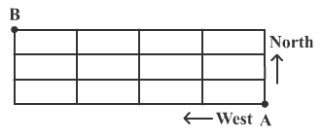
In the adjoining figure, the lines represent one-way roads allowing travel only northwards or only westwards. Along how many distinct routes can a car reach point B from point A?
The person has to take 3 steps north and 4 steps west, in whatever way he travels.
Total steps = 7, 3 north and 4 west.
Number of ways = 7!/(4!3!) = 35
A new flag is to be designed with six vertical stripes using some or all of the colours yellow, green, blue and red. Then, the number of ways this can be done such that no two adjacent stripes have the same colour is
The number of ways of selecting a colour for the first stripe is 4. The number of ways of selecting a colour for the second stripe is 3. Similarly, the number of ways of selecting colours for the third, fourth, fifth and sixth stripes are 3, 3, 3 and 3 respectively.
The total number of ways of selecting the colours is, therefore, 4*3*3*3*3*3 = 12*81.
How many three digit positive integers, with digits x, y and z in the hundred's, ten's and unit's place respectively, exist such that x < y, z < y and x $$\neq$$ 0 ?
x, y and z in the hundred's, ten's and unit's place. So y should start from 2
If y=2 , possible values of x=1 and z = 0,1 .So 2 cases 120,121.
Also if y=3 , possible values of x=1,2 and z=0,1,2.
Here 6 three digit nos. possible .
Similarly for next cases would be 3*4=12,4*5=20,5*6=30,.....,8*9=72 . Adding all we get 240 cases.
There are 6 boxes numbered 1,2,… 6. Each box is to be filled up either with a red or a green ball in such a way that at least 1 box contains a green ball and the boxes containing green balls are consecutively numbered. The total number of ways in which this can be done is
If there is only 1 green ball, it can be done in 6 ways
If there are 2 green balls, it can be done in 5 ways.
.
.
.
If there are 6 green balls, it can be done in 1 way.
So, the total number of possibilities is 6*7/2 = 21
A graph may be defined as a set of points connected by lines called edges. Every edge connects a pair of points. Thus, a triangle is a graph with 3 edges and 3 points. The degree of a point is the number of edges connected to it. For example, a triangle is a graph with three points of degree 2 each. Consider a graph with 12 points. It is possible to reach any point from any point through a sequence of edges. The number of edges, e, in the graph must satisfy the condition
Take any 12 points.
The maximum number of edges which can be drawn through these 12 points are $$^{12}C_2$$ = 66
The minimum number of edges which can be drawn through these 12 points are 12-1 = 11 as the resulting figure need not be closed. It might be open.
Ten straight lines, no two of which are parallel and no three of which pass through any common point, are drawn on a plane. The total number of regions (including finite and infinite regions) into which the plane would be divided by the lines is
If there are 'm' non-parallel lines, then the maximum number of regions into which the plane is divided is given by
[m(m+1)/2]+1
In this case, 'm' = 10
So, the number of regions into which the plane is divided is (10*11/2) + 1 = 56
In how many ways is it possible to choose a white square and a black square on a chessboard so that the squares must not lie in the same row or column?
First a black square can be selected in 32 ways. Out of remaining rows and columns, 24 white squares remain. 1 white square can them be chosen in 24 ways. So total no. of ways of selection is 32*24 = 768.
How many numbers greater than 0 and less than a million can be formed with the digits 0, 7 and 8?
According to given condiitons, number of 1 digit nos. = 2, number of 2 digit nos. = 2*3 , number of 3 digit nos. = $$2*3^2$$ , number of 4 digit nos. = $$2*3^3$$ , number of 5 digit numbers. = $$2*3^4$$, Number of 6 digit nos. = $$2 *3^5$$.
Total summation 2*(1+3+9+27+81+243) = 728 .
If there are 10 positive real numbers $$n_1 < n_2 < n_3 ... < n_{10}$$ , how many triplets of these numbers $$(n_1, n_2, n_3 ), ( n_2, n_3, n_4 )$$ can be generated such that in each triplet the first number is always less than the second number, and the second number is always less than the third number?
For any selection of three numbers, there is only one way in which they can be arranged in ascending order.
So, the answer is $$^{10}C_3 = 120$$
Directions for the next two questions: Answer the questions based on the following information.
Each of the 11 letters A, H, I, M, O, T, U, V, W, X and Z appears same when looked at in a mirror. They are called symmetric letters. Other letters in the alphabet are asymmetric letters.
How many four-letter computer passwords can be formed using only the symmetric letters (no repetition allowed)?
The number of ways in which this can be done is 11*10*9*8 = 7920
How many three-letter computer passwords can be formed (no repetition allowed) with at least one symmetric letter?
If there are 3 symmetric letters, it can be formed in 11*10*9 ways
If there are 2 symmetric letters, it can be formed in 11C2 * 15C1 * 3! ways
If there is only 1 symmetric letter, the password can be formed in 15C2*11C1*3! ways
Total = 990+330*15+630*11 = 12870 ways
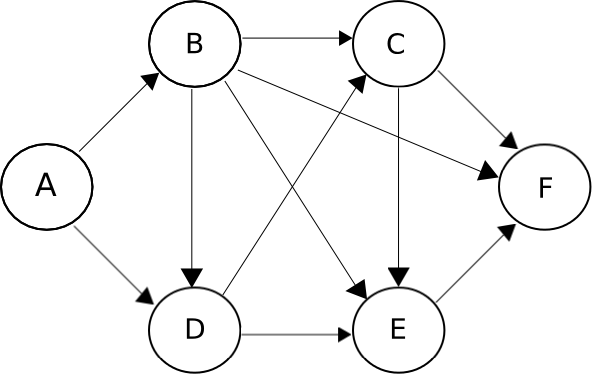
The figure below shows the network connecting cities A, B, C, D, E and F. The arrows indicate permissible direction of travel. What is the number of distinct paths from A to F?

The distinct paths are:
A -> D -> C -> F
A -> D -> E -> F
A -> D -> C -> E -> F
A -> B -> D -> C -> F
A -> B -> D -> E -> F
A -> B -> D -> C -> E -> F
A -> B -> C -> F
A -> B -> E -> F
A -> B -> F
A -> B -> C -> E -> F
So, the total number of distinct paths is 10
One red flag, three white flags and two blue flags are arranged in a line such that,
A. no two adjacent flags are of the same colour
B. the flags at the two ends of the line are of different colours.
In how many different ways can the flags be arranged?
The three white flags can be arranged in the following two ways:
__ W __ W __ W or W __ W __ W __
In the blanks, the 2 blue and one red flag can be arranged in 3 ways.
So, the total number of arrangements is 2*3 = 6
Sam has forgotten his friend’s seven-digit telephone number. He remembers the following:
a) the first three digits are either 635 or 674,
b) the number is odd, and
c) the number nine appears once.
If Sam were to use a trial and error process to reach his friend, what is the minimum number of trials he has to make before he can be certain to succeed?
Consider cases : 1) Last digit is 9: No. of ways in which the first 3 digits can be guessed is 2. No. of ways in which next 3 digits can be guessed is 9*9*9. So in total the number of ways of guessing = 2*9*9*9 = 1458.
2) Last digit is not 9: the number 9 can occupy any of the given position 4, 5, or 6, and there shall be an odd number at position 7.
So in total, the number of guesses = 2*3*(9*9*4) = 1944+1458 = 3402
There are three cities A, B and C. Each of these cities is connected with the other two cities by at least one direct road. If a traveller wants to go from one city (origin) to another city (destination), she can do so either by traversing a road connecting the two cities directly, or by traversing two roads, the, first connecting the origin to the third city and the second connecting the third city to the destination. In all there are 33 routes from A to B (including those via C). Similarly there are 23 routes from B to C (including those via A). How many roads are there from A to C directly?
The possible roads are:
A -> B Let this be x
A -> C Let this be y
B -> C Let this be z
From the information given, x + yz = 33 -> (1)
z + xy = 23 -> (2)
From the options, if y = 10, x =2 and z = 3 from (2), but it doesn't satisfy (1)
If y = 5, x = 4 and z = 3 from (2) but they don't satisfy (1)
A possible set of numbers for (x,y,z) are (3,6,5)
Number of roads from A -> C = 6
For a scholarship, at most n candidates out of 2n + 1 can be selected. If the number of different ways of selection of at least one candidate is 63, the maximum number of candidates that can be selected for the scholarship is:
At least one candidate and at most n candidates among 2n+1 candidates =>
^{2n+1}C_1Total number of ways alteast one candidate can be selected = Total number of ways of selecting a candidate - total number of ways of selecting no candidates
$$\Rightarrow ^{2n+1}C_1+^{2n+1}C_2+^{2n+2}C_3+....+^{2n+1}C_{n-1}+^{2n+1}C_n = 63 $$
We know that $$^{2n+1} C_0$$ and $$^{2n+1} C_{2n+1}$$ are equal to 1.
By Binomial Expansion
$$ ^{2n+1}C_0+^{2n+1}C_1$$+... + $$^{2n+1}C_{2n}+^{2n+1}C_{2n+1} = (1+1)^{2n+1} $$ ---- Eq 1
Also $$^{2n+1}C_1$$ = $$^{2n+1}C_{2n}$$ by symmetry
and $$^{2n+1}C_2$$ = $$^{2n+1}C_{2n-1}$$ and so on
So $$\Rightarrow ^{2n+1}C_{n+1}+^{2n+1}C_{n+2}+....+^{2n+1}C_{2n-1}+^{2n+1}C_{2n} = 63 $$
Therefore, on substituting these values in Eq 1 we get
1 + 63 + 63 +1 = $$2^{2n+1}$$
$$2^{2n+1}$$ = 128
2n+1 = 7
Therefore, n=3
As at most n students can be selected, the correct answer is 3.
In how many ways can eight directors, the vice chairman and chairman of a firm be seated at a round table, if the chairman has to sit between the the vice chairman and a specific director?
Chariman, Vice-Chairman and the director can be made as a group such that Chairman sits between the Vice-Chairman and the director. This group can be formed in 2 ways.
Each of the remaining 7 directors and the group can be arranged in 7! ways.
=> Total number of ways = 2 * 7!.
A man has 9 friends: 4 boys and 5 girls. In how many ways can he invite them, if there has to be exactly 3 girls in the invitees?
Selecting 3 girls from 5 girls can be done in $$^5C_3$$ ways => 10 ways
Each of the boys may or may not be selected => 2 * 2 * 2 * 2 = 16 ways
=> 16 * 10 = 160 ways
How many 3 - digit even number can you form such that if one of the digits is 5, the following digit must be 7?
For a number to be even, its unit digit should be 0,2,4,6,8
Case 1: One of the digit is 5
Hence according to question, 5 can't come in middle and at unit's place, so numbers will be 570,572,574,576,578.
Case 2: No digit is 5
Hence the hundreds place can be filled in 8 ways (except 0,5) and tens place can be filled in 9 ways (except 5).
Number of ways = 8 * 9 * 5 = 360
Hence total number of ways = 360 + 5 = 365
A player rolls a die and receives the same number of rupees as the number of dots on the face that turns up. What should the player pay for each roll if he wants to make a profit of one rupee per throw of the die in the long run?
The expected money got by the player = 1*1/6 + 2*1/6 + 3*1/6 + 4*1/6 + 5*1/6 + 6*1/6 = 21/6 = Rs 3.5
So, the player has to pay 3.5 - 1 = Rs 2.5 to get a profit of Re 1 in the long run.
There are six boxes numbered 1, 2, 3, 4, 5, 6. Each box is to be filled up either with a white ball or a black ball in such a manner that at least one box contains a black ball and all the boxes containing black balls are consecutively numbered. The total number of ways in which this can be done equals.
Total ways when all 6 boxes have only black balls = 1
Total ways when 5 boxes have black balls = 2
Total ways when 4 boxes have black balls = 3
Total ways when 3 boxes have black balls = 4
Total ways when 2 boxes have black balls = 5
Total ways when only 1 box has black ball = 6
So total ways of putting a black ball such that all of them come consecutively = (1+2+3+4+5+6) = 21
Frequently Asked Questions
CAT probability and combinatorics questions test your understanding of arrangements, permutations, combinations, and probability concepts in the CAT Quant section.
Start with basic probability concepts, practice previous year CAT questions, and learn shortcuts to solve problems quickly and accurately.
Yes, combinatorics is an important topic in CAT Quant and frequently appears in the exam with moderate to high difficulty level questions.
Important formulas include permutation (nPr), combination (nCr), probability rules, factorials, and basic counting principles.
Usually, 1-2 questions are asked from probability and combinatorics combined in the CAT exam.
CAT probability questions are generally moderate but can become tricky if concepts are not clear.
Practice regularly, memorize formulas, and learn pattern-based approaches to solve questions faster.
You can find CAT probability and combinatorics questions with solutions on platforms like Cracku and previous year question papers.