The surface area of a closed rectangular box, which is inscribed in a sphere, is 846 sq cm, and the sum of the lengths of all its edges is 144 cm. The volume, in cubic cm, of the sphere is
CAT Mensuration Questions
Given that, The surface area of a closed rectangular box, which is inscribed in a sphere, is 846 sq cm
So, $$2(lb+bh+hl)=846$$.
And $$4(l+b+h)=144$$
$$(l+b+h)=36$$
$$\left(l+b+h\right)^2=l^2+b^2+h^2+2\left(lb+bh+hl\right)$$
$$1296=\left(l^2+b^2+h^2\right)+846$$
$$450=l^2+b^2+h^2$$
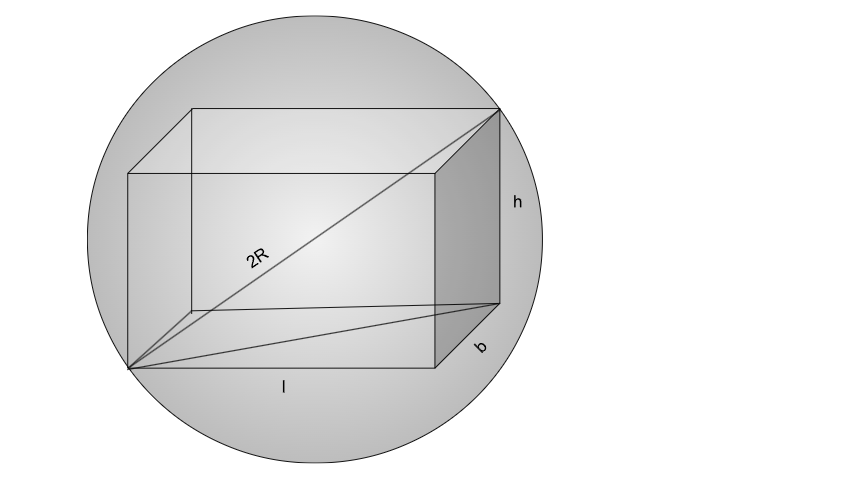
We are told that this cuboid is inscribed in a sphere, the body diagonal of the cuboid equals the diameter of the sphere, this can be visualised as:
This is nothing but, $$\sqrt{l^2+b^2+h^2}=2R$$
$$l^2+b^2+h^2=4R^2$$
$$450=4R^2$$
$$R^2=\frac{225}{2}$$
$$R=\frac{15}{\sqrt{2}}$$
Volume of sphere will be $$\dfrac{4}{3}\times\ \pi\ \times\ \left(\dfrac{15}{\sqrt{2}}\right)^3$$
$$\dfrac{4}{3}\pi\ \left(\dfrac{3375}{2\sqrt{\ 2}}\right)$$
$$\pi\ \times\ 1125\sqrt{\ 2}$$
A triangle is drawn with its vertices on the circle C such that one of its sides is a diameter of C and the other two sides have their lengths in the ratio a : b. If the radius of the circle is r, then the area of the triangle is
Since BC is the diameter of the circle, which implies angle BAC is 90 degrees. Let AB = a cm, which implies AC = b cm. Hence, $$BC\ =\ \sqrt{\ a^2+b^2}$$, which is diameter of the circle (2r).
Hence, $$2r\ =\sqrt{\ a^2+b^2}$$
=> $$4r^2=a^2+b^2$$
The area of the triangle is $$\frac{1}{2}\times\ a\times\ b$$, which can be written as
=> $$\ \frac{\ a\cdot b}{2\left(a^2+b^2\right)}\times\ \left(a^2+b^2\right)$$
=> $$\frac{\ a\cdot b}{2\left(a^2+b^2\right)}\times\ 4r^2$$
=> $$\frac{\ a\cdot b}{a^2+b^2}\times\ 2r^2$$
The correct option is B
A rectangle with the largest possible area is drawn inside a semicircle of radius 2 cm. Then, the ratio of the lengths of the largest to the smallest side of this rectangle is
Let us assume the length of the rectangle is 'l' and breadth of the rectangle is 'b'.
The radius, l/2 and b in the above diagram form a right-angled triangle.
=> $$\left(\frac{l}{2}\right)^2+b^2=2^2$$
We know that the area of the rectangle is l*b, which can be obtained by considering 2 times the geometric mean of $$\left(\frac{l}{2}\right)^2$$ and $$b^2$$.
Therefore, for the maximum area, the equality condition of AM-GM inequality should be satisfied
=> $$\left(\frac{l}{2}\right)^2=b^2$$ => l = 2b.
=> l/b = 2/1.
In a rectangle ABCD, AB = 9 cm and BC = 6 cm. P and Q are two points on BC such that the areas of the figures ABP, APQ, and AQCD are in geometric progression. If the area of the figure AQCD is four times the area of triangle ABP, then BP : PQ : QC is
It is given that AB = 9 cm, BC = 6 cm.
It is also known that the areas of the figures ABP, APQ, and AQCD are in geometric progression.
Hence, the area of the ABP, APQ, and AQCD are k, 2k, and 4k respectively.
The ratio of BP, PQ, QC will be the ratio of the respective triangles. Hence, we can draw a line from point A to point C.
Let the area of triangle AQC be x, which implies the area of triangle ADC = ADQC - AQC = 4k -x, which is equal to the sum of the area of triangle APB, AQP, and ACQ, respectively.
Therefore, 4k-x = 3k+x
=> x = k/2
Hence the ratio of BP: PQ: CQ = k:2k: k/2 =2:4:1
In a regular polygon, any interior angle exceeds the exterior angle by 120 degrees. Then, the number of diagonals of this polygon is
The sum of the interior angles of a polygon of 'n' sides is given by $$\left(2n-4\right)\times\ 90$$, and the sum of the exterior angles of a polygon is 360 degrees.
So, the difference between them will be 120 * n
=> $$\left(2n-4\right)90-360=120n$$
=> 60n = 720 => n = 12.
We know that the number of diagonals of a regular polygon is nC2 - n = 12C2 - 12 = 66 - 12 = 54.
A trapezium $$ABCD$$ has side $$AD$$ parallel to $$BC, \angle BAD = 90^\circ, BC = 3$$ cm and $$AD= 8$$ cm. If the perimeter of this trapezium is 36 cm, then its area, in sq. cm, is
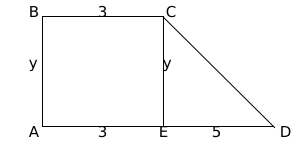
CD = $$\sqrt{\ y^2+25}$$
$$11+y+\sqrt{y^2+25}=36$$
$$\sqrt{y^2+25}=25-y$$
$$y^2+25=25^2+y^2-50y$$
2y = 24
y = 12
Area of trapezium = $$3y+\frac{5y}{2}=\frac{11y}{2}=\frac{11}{2}\left(12\right)=66$$
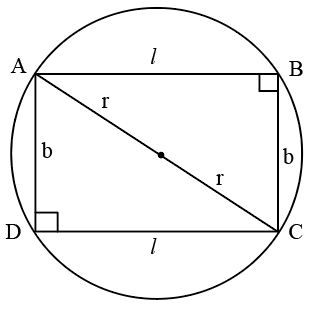
All the vertices of a rectangle lie on a circle of radius R. If the perimeter of the rectangle is P, then the area of the rectangle is
$$A=lb$$
$$l^2+b^2=4r^2$$
$$P\ =2\left(l+b\right)$$
$$\frac{P}{2}=l+b$$
Squaring on both the sides, we get
$$\frac{P^2}{4}=l^2+b^2+2lb$$
$$\frac{P^2}{4}=4r^2+2lb$$
$$\frac{P^2}{8}-2r^2=lb$$
The answer is option B.
If the area of a regular hexagon is equal to the area of an equilateral triangle of side 12 cm, then the length, in cm, of each side of the hexagon is
Area of a regular hexagon = $$\frac{3\sqrt{3}}{2}x^2$$
Area of an equilateral triangle = $$\frac{\sqrt{3}}{4}\left(a\right)^2$$ ; where a = side of the triangle
Since the area of the two figures are equal, we can equate them as folllows: $$\frac{3\sqrt{3}}{2}x^2=\frac{\sqrt{3}}{4}\left(12\right)^2$$
On simplifying: $$x^2=24\ $$
$$\therefore\ x=2\sqrt{6}$$
If a rhombus has area 12 sq cm and side length 5 cm, then the length, in cm, of its longer diagonal is
All the sides of the rhombus are equal.
The area of a rhombus is $$12\ cm^2$$
Considering d1 to be the length of the longer diagonal, d2 to be the length of the shorter diagonal.
The area of a rhombus is $$\left(\frac{1}{2}\right)\left(d1\right)\cdot\left(d2\right)\ =\ 12$$
d1*d2 = 24.
The length of the side of a rhombus is given by $$\frac{\sqrt{\ d1^2+d2^2}}{2}$$. This is because the two diagonals and a side from a right-angled triangle with sides d1/2, d2/2 and the side length.
$$\frac{\sqrt{\ d1^2+d2^2}}{2}=\ 5$$
Hence $$\sqrt{\ d1^2+d2^2}\ =\ 10$$
$$d1^2+d2^2\ =\ 100$$
Using d1*d2 = 24, 2*d1*d2 = 48.
$$d1^2+d2^2\ +2\cdot d1\cdot d2=\ 100+48\ =\ 148$$
$$d1^2+d2^2\ -2\cdot d1\cdot d2=\ 100-48\ =\ 52$$
$$d1+d2\ =\ \sqrt{\ 148}$$ (1)
d1-d2 = $$\sqrt{52}$$ (2)
(1) + (2)= 2*(d1) = 2*($$\sqrt{\ 37}+\sqrt{\ 13}$$)
d1 = $$\sqrt{\ 37}+\sqrt{\ 13}$$
or
In a rhombus the area of a Rhombus is given by :
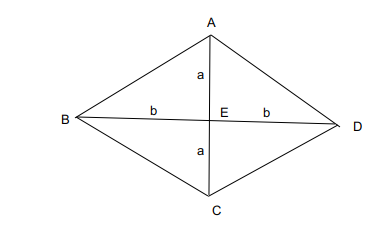
The diagonals perpendicularly bisect each other. Considering the length of the diagonal to be 2a, 2b.
The area of a Rhombus is : $$\left(\frac{1}{2}\right)\cdot\left(2a\right)\cdot\left(2b\right)\ =\ 12$$
ab =6.
The length of each side is : $$\sqrt{\ a^2+b^2}$$ = 5, $$a^2+b^{2\ }=\ 25,\ $$
$$\left(a+b\right)^2=\ 37,\ \left(a+b\right)\ =\ \sqrt{\ 37}$$
($$\left(a-b\right)^2=\ 13,\ a-b\ =\ \sqrt{\ 13}$$
$$2a\ =\ \left(\sqrt{\ 37}+\sqrt{\ 13}\right)$$, $$2b\ =\ \left(\sqrt{\ 37}-\sqrt{\ 13}\right)$$.
2a is longer diagonal which is equal to $$\ \left(\sqrt{\ 37}+\sqrt{\ 13}\right)$$
The cost of fencing a rectangular plot is ₹ 200 per ft along one side, and ₹ 100 per ft along the three other sides. If the area of the rectangular plot is 60000 sq. ft, then the lowest possible cost of fencing all four sides, in INR, is
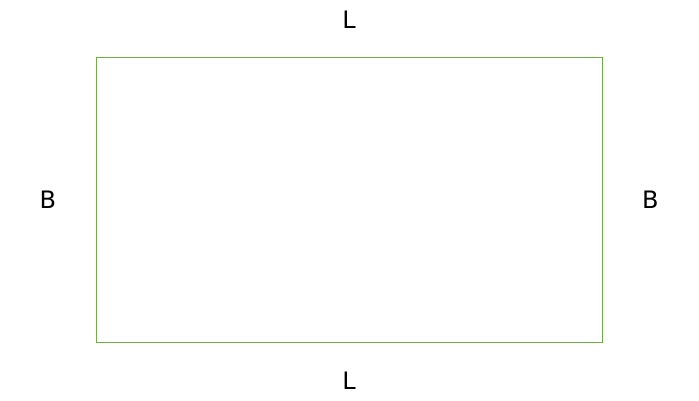
Let us draw the rectangle.
Now, definitely, three sides should be fenced at Rs 100/ft, and one side should be fenced at Rs 200/ft.
In this question, we are going to assume that the L is greater than B.
Hence, the one side painted at Rs 200/ft should be B to minimise costs.
Hence, the total cost = 200B + 100B + 100L + 100L = 300B + 200L
Now, L x B = 60000
B = 60000/L
Hence, total cost = 300B + 200L = 18000000/L + 200L
To minimise this cost, we can use AM>=GM,
$$\frac{\frac{18000000}{L}+200L}{2}\ge\sqrt{\ \frac{18000000}{L}\times\ 200L}$$
$$\frac{18000000}{L}+200L\ge2\sqrt{\ 18000000\times\ 200}$$
$$\frac{18000000}{L}+200L\ge2\times\ 60000$$
Hence, minimum cost = Rs 120000.
A park is shaped like a rhombus and has area 96 sq m. If 40 m of fencing is needed to enclose the park, the cost, in INR, of laying electric wires along its two diagonals, at the rate of ₹125 per m, is
We can say 40m is the perimeter of the park
so side of rhombus = 10
Now $$\frac{1}{2}\times\ d_1\times\ d_2\ =\ 96$$
so we get $$\ d_1\times\ d_2\ =\ 192$$ (1)
And as we know diagonals of a rhombus are perpendicular bisectors of each other :
so $$\ \frac{d_1^2}{4}+\ \frac{d_2^2}{4}=\ 100$$
so we get $$\ d_1^2+\ d_2^2=\ 400$$ (2)
Solving (1) and (2)
We get $$d_1=12$$ and$$d_2=16$$
Now the cost, in INR, of laying electric wires along its two diagonals, at the rate of ₹125 per m, is= (12+16)(125) =3500
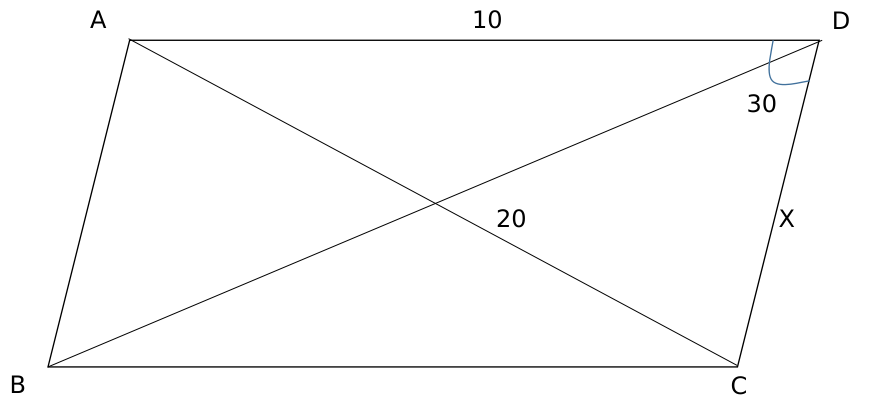
Let ABCD be a parallelogram. The lengths of the side AD and the diagonal AC are 10cm and 20cm, respectively. If the angle $$\angle ADC$$ is equal to $$30^{0}$$ then the area of the parallelogram, in sq.cm is
Applying cosine rule in triangle ACD,
$$100+X^2-2\times\ 10\times\ X\cos30=400$$
$$X^2-10X\sqrt{\ 3}-300=0$$
Solving, we get X = $$\left(\frac{10\sqrt{\ 3}+10\sqrt{\ 15}}{2}\right)$$
Hence, area = 10Xsin 30 = $$\frac{\left(\frac{10\sqrt{\ 3}+10\sqrt{\ 15}}{2}\right)10}{2}$$
= $$25(\sqrt{3}+\sqrt{15})$$
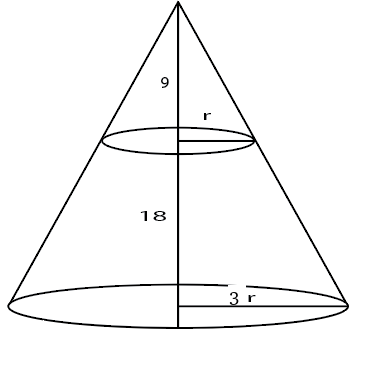
A solid right circular cone of height 27 cm is cut into two pieces along a plane parallel to its base at a height of 18 cm from the base. If the difference in volume of the two pieces is 225 cc, the volume, in cc, of the original cone is
Let the base radius be 3r.
Height of upper cone is 9 so, by symmetry radius of upper cone will be r.
Volume of frustum=$$\frac{\pi}{3}\left(9r^2\cdot27-r^2.9\right)$$
Volume of upper cone = $$\frac{\pi}{3}.r^2.9$$
Difference= $$\frac{\pi}{3}\cdot9\cdot r^2\cdot25=225$$ => $$\frac{\pi}{3}\cdot r^2=1$$
Volume of larger cone = $$\frac{\pi}{3}\cdot9r^2\cdot27=243$$
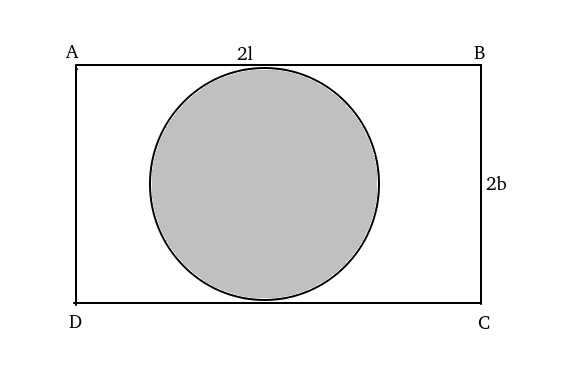
On a rectangular metal sheet of area 135 sq in, a circle is painted such that the circle touches two opposite sides. If the area of the sheet left unpainted is two-thirds of the painted area then the perimeter of the rectangle in inches is
Let ABCD be the rectangle with length 2l and breadth 2b respectively.
Area of the circle i.e. area of painted region = $$\pi\ b^2$$.
Given, 4lb-$$\pi\ b^2$$=(2/3)$$\pi\ b^2$$.
=> 4lb=(5/3)$$\pi\ b^2$$.
=>l=$$\frac{5\pi}{12}b$$.
Given, 4lb=135 => 4*$$\frac{5\pi}{12}b^2$$=135 => b= $$\frac{9}{\sqrt{\ \pi\ }}$$
=> l=$$\frac{15}{4}\sqrt{\ \pi\ }$$
Perimeter of rectangle =4(l+b)=4($$\frac{15}{4}\sqrt{\ \pi\ }$$+$$\frac{9}{\sqrt{\ \pi\ }}$$ )=$$3\sqrt{\pi}(5+\frac{12}{\pi})$$.
Hence option A is correct.
The sum of the perimeters of an equilateral triangle and a rectangle is 90cm. The area, T, of the triangle and the area, R, of the rectangle, both in sq cm, satisfying the relationship $$R=T^{2}$$. If the sides of the rectangle are in the ratio 1:3, then the length, in cm, of the longer side of the rectangle, is
Let the sides of the rectangle be "a" and "3a" m. Hence the perimeter of the rectangle is 8a.
Let the side of the equilateral triangle be "m" cm. Hence the perimeter of the equilateral triangle is "3m" cm. Now we know that 8a+3m=90......(1)
Moreover area of the equilateral triangle is $$\frac{\sqrt{\ 3}}{4}m^2$$ and area of the rectangle is $$3a^2$$
According to the relation given $$\left(\frac{\sqrt{\ 3}}{4}m^2\right)^{^2}=\ 3a^2$$
$$\frac{3}{16}m^4=\ 3a^2\ or\ a^2=\frac{m^4}{16}$$
$$a=\frac{m^2}{4}$$
Substituting this in (1) we get $$2m^2+3m-90\ =0$$ solving this we get m=6 (ignoring the negative value since side can't be negative)
Hence a=9 and the longer side of the rectangle will be 3a=27cm
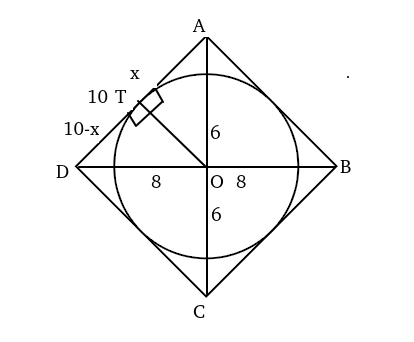
A circle is inscribed in a rhombus with diagonals 12 cm and 16 cm. The ratio of the area of circle to the area of rhombus is
Let the length of radius be 'r'.
From the above diagram,
$$x^2+r^2=6^2\ $$....(i)
$$\left(10-x\right)^2+r^2=8^2\ $$----(ii)
Subtracting (i) from (ii), we get:
x=3.6 => $$r^2=36-\left(3.6\right)^2$$ ==> $$r^2=36-\left(3.6\right)^2\ =23.04$$.
Area of circle = $$\pi\ r^2=23.04\pi\ $$
Area of rhombus= 1/2*d1*d2=1/2*12*16=96.
.'. Ratio of areas = 23.04$$\pi\ $$/96=$$\frac{6\pi}{25}$$
In a trapezium $$ABCD$$, $$AB$$ is parallel to $$DC$$, $$BC$$ is perpendicular to $$DC$$ and $$\angle BAD=45^{0}$$. If $$DC$$ = 5cm, $$BC$$ = 4 cm,the area of the trapezium in sq cm is
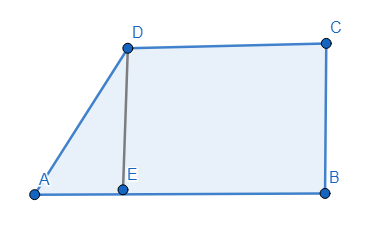
Given, BC = DE = 4
CD = BE = 5
In triangle ADE, EAD=45^{0}$$
$$\tan\ 45\ =\ \frac{DE}{AE}$$ => AE = 4
Area of trapezium = Area of rectangle BCDE + Area of triangle AED
= 20 + 8 = 28