In a school with 1500 students, each student chooses any one of the streams out of science, arts, and commerce, by paying a fee of Rs 1100, Rs 1000, and Rs 800, respectively. The total fee paid by all the students is Rs 15,50,000. If the number of science students is not more than the number of arts students, then the maximum possible number of science students in the school is
CAT Linear Equations Questions
Let the total number of students who chose science, arts, and commerce streams be $$S$$, $$A$$, and $$C$$, respectively.
We have,
$$S+A+C = 1500$$, such that, $$C = 1500-S-A$$ .....(1)
Also, $$1100S + 1000A + 800C = 15,50,000$$, which can be simplified by dividing by $$100$$;
$$11S + 10A + 8C = 15500$$ .....(2)
Substituting the value of $$C$$ from equation (1) in equation (2), we have
$$11S + 10A + 8(1500-S-A) = 15500$$
$$\Rightarrow 3S + 2A = 3500$$
Since $$S\leq A$$, the maximum value of $$S$$ (if possible), would occur when $$S=A$$, therefore,
$$5S = 3500$$, or $$S= 700$$.
If m and n are integers such that $$(m+2n)(2m+n)=27$$, then the maximum possible value of $$2m-3n$$ is
Sure! We can solve it without explicitly introducing new variables for substitution.
We are given $$(m+2n)(2m+n) = 27$$ and we want to maximize $$2m-3n$$
Because m and n are integers, both (m+2n) and (2m+n) are going to be integers.
Factor pairs of 27 (including negatives) are: $$(1,27),(3,9),(9,3),(27,1),(-1,-27),(-3,-9),(-9,-3),(-27,-1)$$
For each factor pair (a,b), take $$a=m+2n$$, $$b=2m+n$$ and solve for integers (m,n).
If we notice $$a+b=\left(m+2n\right)+\left(2m+n\right)=3\left(m+n\right)$$
So, basically the sum of the two numbers has to be a multiple of $$3$$.
So, the ordered pairs we will consider are $$\left(3,9\right),\left(9,3\right),\left(-3,-9\right),\left(-9,-3\right)$$
For $$(a,b)=(9,3)$$:
$$ m+2n=9,\quad 2m+n=3 $$
Upon solving, we get $$n=5$$ and $$m=-1$$
For $$(a,b)=(3,9)$$:
$$ m+2n=3,\quad 2m+n=9 $$
Upon solving, we get $$n=-1$$ and $$m=5$$
Then $$2m-3n=2\cdot5-3(-1)=10+3=13$$
For negative factor pairs, we similarly get integer solutions $$(-5,1)$$ and $$(1,-5)$$, giving $$2m-3n=-13 \text{and} 17$$, respectively.
Thus, the maximum value of $$(2m-3n)$$ among all solutions is 17
Stocks A, B and C are priced at rupees 120, 90 and 150 per share, respectively. A trader holds a portfolio consisting of 10 shares of stock A, and 20 shares of stocks B and C put together. If the total value of her portfolio is rupees 3300, then the number of shares of stock B that she holds, is
Let the number of stocks B hold be $$x$$
So, number of stocks C hold is $$20-x$$
So, $$10\times\ 120+90\times\ x+150\times\ \left(20-x\right)=3300$$
or, $$1200+90\ x+150\left(20-x\right)=3300$$
or, $$1200+90\ x+3000-150x=3300$$
or, $$4200-60x=3300$$
or, $$60x=900$$
or, $$x=\dfrac{900}{60}=15$$
So, the number of shares of stock that B hold is 15.
Suppose a,b,c are three distinct natural numbers, such that $$3ac=8(a+b)$$. Then, the smallest possible value of $$3a+2b+c$$ is
Our task is to minimise $$3a+2b+c$$.
Here, the coefficient for $$c$$ is the minimum.
$$3ac=8(a+b)$$
We know that a, b, and c are natural numbers. So, the product $$ac$$ should definately be a multiple of 8.
Case 1: a = 1, c = 8 and b = 2 $$\Rightarrow$$ 3a+2b+c = 15
Case 2: a = 2, c = 4 and b = 1 $$\Rightarrow$$ 3a+2b+c = 12
So, 12 is the correct answer.
If $$a-6b+6c=4$$ and $$6a+3b-3c=50$$, where a, b and c are real numbers, the value of $$2a+3b-3c$$ is
Given, $$a-6b+6c=4$$ --->(1)
and, $$6a+3b-3c=50$$ ---->(2)
Multiplying eqn (1) with $$x$$, $$ax-6bx+6cx=4x$$
And multiplying eqn (2) with $$y$$, $$6ay+3by-3cy=50y$$
So, $$x+6y=2$$ and $$3y-6x=3$$
So, $$x+6y=2$$ ---->(3) and $$-2x+y=1$$ ---->(4)
Multiplying eqn (4) with 6 and subtracting from eqn (3),
$$13x=-4$$
So, $$x=-\dfrac{4}{13}$$
Putting the value of $$x$$ in equation (4),
$$y=\dfrac{5}{13}$$
So, the final answer is $$4x+5y$$
=$$4\left(-\frac{4}{13}\right)+50\left(\frac{5}{13}\right)=-\frac{16}{13}+\frac{250}{13}=\frac{234}{13}=18$$
So, correct answer is $$18$$.
For some constant real numbers p, k and a, consider the following system of linear equations in x and y:
px - 4y = 2
3x + ky= a
A necessary condition for the system to have no solution for (x, y ), is
Arranging the equation, we know that there are no solutions when the lines are parallel:
for that the condition had to $$\frac{p}{3}=-\frac{4}{k}\ne\ \frac{2}{a}$$
Checking through options:
Option A: using the first and last terms in our relation, we see that ap must not be equal to 6 for the lines to be parallel. This option puts no conditions on that and thus is not relevant.
Option C: This question is the opposite of what we want; if this is true, the lines can never be parallel.
Option D: Using the first and second terms of the relation, we see that we want kp = -12, or kp-12 = 0. Hence, this statement is not what we want.
Option B: Using the second and third terms, we see that we do not want k equals to -2a, or we do not want k+2a to be equal to 0
Therefore, B is a condition that is necessary for the lines to be parallel and have no solution.
Therefore, Option B is the correct answer.
For some real numbers a and b, the system of equations $$x + y = 4$$ and $$(a+5)x+(b^2-15)y=8b$$ has infinitely many solutions for x and y. Then, the maximum possible value of ab is
It is given that for some real numbers a and b, the system of equations $$x + y = 4$$ and $$(a+5)x+(b^2-15)y=8b$$ has infinitely many solutions for x and y.
Hence, we can say that
=> $$\ \frac{\ a+5}{1}=\ \frac{\ b^2-15}{1}=\ \frac{\ 8b}{4}$$
This equation can be used to find the value of a, and b.
Firstly, we will determine the value of b.
=> $$\ \frac{\ b^2-15}{1}=\ \frac{\ 8b}{4}\ =>\ b^2-2b-15=0$$
=> $$\left(b-5\right)\left(b+3\right)=0$$
Hence, the values of b are 5, and -3, respectively.
The value of a can be expressed in terms of b, which is $$a+5=b^2-15\ =>\ a\ =b^2-20$$
When $$b=5,a=5^2-20=5$$
When $$b=-3,a=3^2-20=-11$$
The maximum value of $$ab=(-3)\cdot(-11)=33$$
The correct option is A
A fruit seller has a stock of mangoes, bananas and apples with at least one fruit of each type. At the beginning of a day, the number of mangoes make up 40% of his stock. That day, he sells half of the mangoes, 96 bananas and 40% of the apples. At the end of the day, he ends up selling 50% of the fruits. The smallest possible total number of fruits in the stock at the beginning of the day is
Let us assume the initial stock of all the fruits is S.
Let us take we have 'b' and 'a' mangoes initially.
Stock of Mangoes = 40% of S = 2S/5
The total number of fruits sold are Mangoes Sold + Apples Sold + Bananas Sold
= 2S/10 + 96 + 4a/10 = S/2 (Given)
=> S/5 + 96 + 2a/5 = S/2
=> S = $$\dfrac{\left(4a+960\right)}{3}$$
=> $$\dfrac{4a}{3}+320$$
'a' has to be a multiple of 3 for the above term to be an integer.
But 'a' has to be a multiple of 5 for 4a/10 to be an integer.
=> The smallest value of 'a' satisfying both conditions is 15.
=> $$\dfrac{4a}{3}+320=\dfrac{4\left(15\right)}{3}+320$$ = 340
If $$c=\frac{16x}{y}+\frac{49y}{x}$$ for some non-zero real numbers x and y, then c cannot take the value
Let $$\frac{x}{y}\ be\ t$$
Therefore, $$c=16t\ +\ \frac{49}{t}$$
Applying AM>= GM
$$\frac{\left(16t\ +\ \frac{49}{t}\right)}{2}\ge\ \left(16t\times\frac{49}{t}\right)^{\frac{1}{2}}$$
$$16t\ +\ \frac{49}{t}\ge56$$
When t is positive then c is greater than equal to 56.
When t is negative then c is less than equal to -56.
Therefore $$c\ \in\ \left(-\infty,\ -56\right]\ ∪\ \left[56,\infty\ \right]$$
As -50 is not in the range of c so it is the answer
In an examination, there were 75 questions. 3 marks were awarded for each correct answer, 1 mark was deducted for each wrong answer and 1 mark was awarded for each unattempted question. Rayan scored a total of 97 marks in the examination. If the number of unattempted questions was higher than the number of attempted questions, then the maximum number of correct answers that Rayan could have given in the examination is
Let the number of questions attempted be x+y out of which x are correct and y are incorrect and the number of questions unattempted be z.
It is given,
x + y + z = 75 ...... (1)
3x - y + z = 97 ...... (2)
(2)-(1) -> x - y = 11
(1)+(2) -> 2x + z = 86
z > x + y
z > 75 - z
z > 37.5
Minimum possible value of z is 38
2x + 38 = 86
2x = 48
x = 24
The maximum number of correct answers is 24.
Let a and b be natural numbers. If $$a^2 + ab + a = 14$$ and $$b^2 + ab + b = 28$$, then $$(2a + b)$$ equals
a(a + b + 1) = 14 ...... (1)
b(a + b + 1) = 28 ...... (2)
$$\frac{a}{b}=\frac{1}{2}$$
b = 2a
Substituting in (1), we get
a(3a + 1) = 14
$$3a^2+a-14=0$$
$$3a^2-6a+7a-14=0$$
$$3a\left(a-2\right)+7\left(a-2\right)=0$$
Given, a and b are natural numbers.
Therefore, a = 2 and b = 4
2a + b = 2(2) + 4 = 8
The answer is option A.
The largest real value of a for which the equation $$\mid x + a \mid + \mid x - 1 \mid = 2$$ has an infinite number of solutions for x is
In the question, it is given that the equation $$\mid x + a \mid + \mid x - 1 \mid = 2$$ has an infinite number of solutions for any value of x. This is possible when x in |x+a| and x in |x-1| cancels out.
Case 1:
x + a < 0, x - 1 $$\ge\ $$ 0
- a - x + x - 1 = 2
a = -3
Case 2:
x + a $$\ge\ $$ 0 and x - 1 < 0
x + a - x + 1 = 2
a = 1
Largest value of a is 1.
The answer is option C.
A donation box can receive only cheques of ₹100, ₹250, and ₹500. On one good day, the donation box was found to contain exactly 100 cheques amounting to a total sum of ₹15250. Then, the maximum possible number of cheques of ₹500 that the donation box may have contained, is
Let the number of 100 cheques, 250 cheques and 500 cheques be x, y and z respectively.
We need to find the maximum value of z.
x + y + z = 100 ...... (1)
100x + 250y + 500z = 15250
2x + 5y + 10z = 305 ...... (2)
2x + 2y + 2z = 200 ....... (1)
(2) - (1), we get
3y + 8z = 105
At z = 12, x = 3
Therefore, maximum value z can take is 12.
For natural numbers x, y, and z, if xy + yz = 19 and yz + xz = 51, then the minimum possible value of xyz is
It is given, y(x + z) = 19
y cannot be 19.
If y = 19, x + z = 1 which is not possible when both x and z are natural numbers.
Therefore, y = 1 and x + z = 19
It is given, z(x + y) = 51
z can take values 3 and 17
Case 1:
If z = 3, y = 1 and x = 16
xyz = 3*1*16 = 48
Case 2:
If z = 17, y = 1 and x = 2
xyz = 17*1*2 = 34
Minimum value xyz can take is 34.
A shop owner bought a total of 64 shirts from a wholesale market that came in two sizes, small and large. The price of a small shirt was INR 50 less than that of a large shirt. She paid a total of INR 5000 for the large shirts, and a total of INR 1800 for the small shirts. Then, the price of a large shirt and a small shirt together, in INR, is
Let the number of large shirts be l and the number of small shirts be s.
Let the price of a small shirt be x and that of a large shirt be x + 50.
Now, s + l = 64
l (x+50) = 5000
sx = 1800
Adding them, we get,
lx + sx + 50l = 6800
64x +50l = 6800
Substituting l = (6800 - 64x) / 50, in the original equation, we get
$$\frac{\left(6800-64x\right)}{50}\left(x+50\right)=5000$$
(6800 - 64x)(x + 50) = 250000
$$6800x+340000-64x^2-3200x = 250000$$
$$64x^2-3600x-90000=0$$
Solving, we get, x= $$\frac{225\pm\ 375}{8}=\frac{600}{8}or-\frac{150}{8}$$
SO, x = 75
x + 50 = 125
Answer = 75 + 125 = 200.
Alternate approach: By options.
Hint: Each option gives the sum of the costs of one large and one small shirt. We know that large = small + 50
Hence, small + small + 50 = option.
SMALL = (Option - 50)/2
LARGE = Small + 50 = (Option + 50)/2
Option A and Option D gives us decimal values for SMALL and LARGE, hence we will consider them later.
Lets start with Option B.
Large = 150 + 50 / 2 = 100
Small = 150 - 50 / 2 = 50
Now, total shirts = 5000/100 + 1800/50 = 50 + 36 = 86 (X - This is wrong)
Option C -
Large = 200 + 50 / 2 = 125
Small = 200 - 50 / 2 = 75
Total shirts = 5000/125 + 1800/75 = 40 + 24 = 64 ( This is the right answer)
A basket of 2 apples, 4 oranges and 6 mangoes costs the same as a basket of 1 apple, 4 oranges and 8 mangoes, or a basket of 8 oranges and 7 mangoes. Then the number of mangoes in a basket of mangoes that has the same cost as the other baskets is
Let the cost of an apple, an orange and a mango be a, o, and m respectively.
Then it is given that:
2a+4o+6m = a+4o+8m
or a = 2m.
Also, a+4o+8m = 8o + 7m
10m-7m = 4o
3m = 4o.
We can now express the cost of a basket in terms of mangoes only:
2a+4o+6m = 4m+3m+6m = 13m.
If $$3x+2\mid y\mid+y=7$$ and $$x+\mid x \mid+3y=1$$ then $$x+2y$$ is:
We need to check for all regions:
x >= 0, y >= 0
x >= 0, y < 0
x < 0, y >= 0
x < 0, y < 0
However, once we find out the answer for any one of the regions, we do not need to calculate for other regions since the options suggest that there will be a single answer.
Let us start with x >= 0, y >= 0,
3x + 3y = 7
2x + 3y = 1
Hence, x = 6 and y = -11/3
Since y > = 0, this is not satisfying the set of rules.
Next, let us test x >= 0, y < 0,
3x - y = 7
2x + 3y = 1
Hence, y = -1
x = 2.
This satisfies both the conditions. Hence, this is the correct point.
WE need the value of x + 2y
x + 2y = 2 + 2(-1) = 2 - 2 = 0.
A gentleman decided to treat a few children in the following manner. He gives half of his total stock of toffees and one extra to the first child, and then the half of the remaining stock along with one extra to the second and continues giving away in this fashion. His total stock exhausts after he takes care of 5 children. How many toffees were there in his stock initially?
Let the initial number of chocolates be 64x.
First child gets 32x+1 and 32x-1 are left.
2nd child gets 16x+1/2 and 16x-3/2 are left
3rd child gets 8x+1/4 and 8x-7/4 are left
4th child gets 4x+1/8 and 4x-15/8 are left
5th child gets 2x+1/16 and 2x-31/16 are left.
Given, 2x-31/16=0=> 2x=31/16 => x=31/32.
.'. Initially the Gentleman has 64x i.e. 64*31/32 =62 chocolates.
Dick is thrice as old as Tom and Harry is twice as old as Dick. If Dick's age is 1 year less than the average age of all three, then Harry's age, in years, is
Let tom's age = x
=> Dick=3x
=>harry = 6x
Given,
3x+1 = (x+3x+6x)/3
=> x= 3
Hence, Harry's age = 18 years
Let k be a constant. The equations $$kx + y = 3$$ and $$4x + ky = 4$$ have a unique solution if and only if
Two linear equations ax+by= c and dx+ ey = f have a unique solution if $$\frac{a}{d}\ne\ \frac{b}{e}$$
Therefore, $$\frac{k}{4}\ne\ \frac{1}{k}$$ => $$k^2\ne\ 4$$
=> k $$\ne\ $$ |2|
In May, John bought the same amount of rice and the same amount of wheat as he had bought in April, but spent ₹ 150 more due to price increase of rice and wheat by 20% and 12%, respectively. If John had spent ₹ 450 on rice in April, then how much did he spend on wheat in May?
Let John buy "m" kg of rice and "p" kg of wheat.
Now let the price of rice be "r" in April. Price in May will be "1.2(r)"
Now let the price of wheat be "w" in April . Price in April will be "1.12(w)".
Now he spent ₹150 more in May , so 0.2(rm)+0.12(wp)=150
Its also given that he had spent ₹450 on rice in April. So (rm)=450
So 0.2(rm)= (0.2)(450)=90 Substituting we get (wp)=60/0.12 or (wp)=500
Amount spent on wheat in May will be 1.12(500)=₹560
If x and y are non-negative integers such that $$x + 9 = z$$, $$y + 1 = z$$ and $$x + y < z + 5$$, then the maximum possible value of $$2x + y$$ equals
We can write x=z-9 and y=z-1 Now we have x+y< z+5
Substituting we get z-9+z-1<z+5 or z<15
Hence the maximum possible value of z is 14
Maximum value of "x" is 5 and maximum value of "y" is 13
Now 2x+y = 10+13=23
Aron bought some pencils and sharpeners. Spending the same amount of money as Aron, Aditya bought twice as many pencils and 10 less sharpeners. If the cost of one sharpener is ₹ 2 more than the cost of a pencil, then the minimum possible number of pencils bought by Aron and Aditya together is
Let the number of pencils bought by Aron be "p" and the cost of each pencil be "a".
Let the number of sharpeners bought Aron be "s" and the cost of each sharpener be "b".
Now amount spent by Aron will be (pa)+(sb)
Aditya bought (2p) pencils and (s-10) sharpeners. Amount spent will be (2pa)+(s-10)b
Amount spent in both the cases is same
pa + sb = 2pa + (s-10)b or pa=10b
Now its given in the question that cost of sharpener is 2 more than pencil i.e. b=a+2
pa= 10a+20 or a=20/(p-10)
Now the number of pencils has to be minimum, for that we have to find smallest "p" such that both "p" and "a" are integers. The smallest such value is p=11 . Total number of pencils bought will be p+2p=11+22=33
Let A, B and C be three positive integers such that the sum of A and the mean of B and C is 5. In addition, the sum of B and the mean of A and C is 7. Then the sum of A and B is
Given
A+(B+C)/2=5 => 2A+B+C=10....(i)
(A+C)/2 +B=7 => A+2B+C=14.....(ii)
(i)-(ii)=> B-A=4 => B=4+A.
Given, A, B, C are positive integers
If A=1=>B=5 => C=3
If A=2=>B=6 => C=0 but this is invalid as C is positive.
Similarly if A>2 C will be negative and cases are not valid.
Hence, A+B=6.
If $$5^x - 3^y = 13438$$ and $$5^{x - 1} + 3^{y + 1} = 9686$$, then x + y equals
$$5^x - 3^y = 13438$$ and $$5^{x - 1} + 3^{y + 1} = 9686$$
$$5^{x} + 3^{y}*15 = 9686*5$$
$$5^{x} + 3^{y}*15 = 48430$$
16*$$3^y$$=34992
$$3^y$$ = 2187
y = 7
$$5^x$$=13438+2187=15625
x=6
x+y = 13
In 2010, a library contained a total of 11500 books in two categories - fiction and nonfiction. In 2015, the library contained a total of 12760 books in these two categories. During this period, there was 10% increase in the fiction category while there was 12% increase in the non-fiction category. How many fiction books were in the library in 2015?
Let the number of fiction and non-fiction books in 2010 = 100a, 100b respectively
It is given that the total number of books in 2010 = 11500
100a+100b = 11500 -------Eq 1
The number of fiction and non-fiction books in 2015 = 110a, 112b respectively
110a+112b = 12760 -------Eq 2
On solving both the equations we get, b=55, a= 60
The number of fiction books in 2015 = 110*60=6600
Let a, b, x, y be real numbers such that $$a^2 + b^2 = 25, x^2 + y^2 = 169$$, and $$ax + by = 65$$. If $$k = ay - bx$$, then
$$\left(ax+by\right)^2=65^2$$
$$a^2x^2\ +\ b^2y^2+\ 2abxy\ =\ 65^2$$
$$k = ay - bx$$
$$k^2\ =\ a^2y^2+b^2x^2-2abxy$$
$$(a^2 + b^2)(x^2 + y^2 )= 25* 169$$
$$a^2x^2+a^2y^2+b^2x^2+b^2y^2=\ 25\times\ 169$$
$$k^2=\ 65^2\ -\ \left(25\times\ 169\right)$$
k = 0
D is the correct answer.
The number of solutions $$(x, y, z)$$ to the equation $$x - y - z = 25$$, where x, y, and z are positive integers such that $$x\leq40,y\leq12$$, and $$z\leq12$$ is
x - y - z = 25 and $$x\leq40,y\leq12$$, $$z\leq12$$
If x = 40 then y + z = 15. Now since both y and z are natural numbers less than 12, so y can range from 3 to 12 giving us a total of 10 solutions.Similarly, if x = 39, then y + z = 14. Now y can range from 2 to 12 giving us a total of 11 solutions.
If x = 38, then y + z = 13. Now y can range from 1 to 12 giving us a total of 12 solutions.
If x = 37 then y + z = 12 which will give 11 solutions.
Similarly on proceeding in the same manner the number of solutions will be 10, 9, 8, 7 and so on till 1.
Hence, required number of solutions will be (1 + 2 + 3 + 4 . . . . + 12) + 10 + 11
= 12*13/2 + 21
78 + 21 = 99
How many different pairs(a,b) of positive integers are there such that $$a\geq b$$ and $$\frac{1}{a}+\frac{1}{b}=\frac{1}{9}$$?
$$\frac{1}{a}+\frac{1}{b}=\frac{1}{9}$$
=> $$ab = 9(a + b)$$
=> $$ab - 9(a+b) = 0$$
=> $$ ab - 9(a+b) + 81 = 81$$
=> $$(a - 9)(b - 9) = 81, a > b$$
Hence we have the following cases,
$$ a - 9 = 81, b - 9 = 1$$ => $$(a,b) = (90,10)$$
$$ a - 9 = 27, b - 9 = 3$$ => $$(a,b) = (36,12)$$
$$ a - 9 = 9, b - 9 = 9$$ => $$(a,b) = (18,18)$$
Hence there are three possible positive integral values of (a,b)
Suppose you have a currency, named Miso, in three denominations: 1 Miso, 10 Misos and 50 Misos. In how many ways can you pay a bill of 107 Misos?
If two 50 Misos are used, the 107 can be paid in only 1 way.
If one 50 Miso is used, the number of ways of paying 107 is 6 - zero 10 Miso, one 10 Miso and so on till five 10 Misos.
If no 50 Miso is used, the number of ways of paying 107 is 11 - zero 10 Miso, one 10 Miso and so on till ten 10 Misos.
So, the total number of ways is 18
A confused bank teller transposed the rupees and paise when he cashed a cheque for Shailaja, giving her rupees instead of paise and paise instead of rupees. After buying a toffee for 50 paise, Shailaja noticed that she was left with exactly three times as much as the amount on the cheque. Which of the following is a valid statement about the cheque amount?
Let the value of cheque be x Rs and y ps and the amount she received is y Rs and x ps.
After 50 ps is deducted she has the amount which is 3 times the amount on cheque,
So 100y+x-50=3(100x+y) (After converting the amount in paise)
y= (299x+50)/97 = 3x+ (8x+50)/97
Since x is an integer, 3x will definitely be an integer. Now, (8x+50)/97 has to be an integer for y to be an integer.
So, 8x+50 has to be a multiple of 97.
8x+50= 97
$$\Rightarrow$$ x = 47/8, this value of x is not an integer.
8x+50= 97*2 = 194
8x = 144
$$\Rightarrow$$ x = 144/8 = 18. Here, we got an integer.
So, the amount has to be 18 rupees and some paise. Hence, option D is correct.
The price of Darjeeling tea (in rupees per kilogram) is 100 + 0.10n, on the nth day of 2007 (n=1, 2, ..., 100), and then remains constant. On the other hand, the price of Ooty tea (in rupees per kilogram) is 89 + 0.15n, on the nth day of 2007 (n = 1, 2, ..., 365). On which date in 2007 will the prices of these two varieties of tea be equal?
Price of Darjeeling tea on 100th day= 100+(0.1*100)=110
Price of Ooty tea on nth day= 89+0.15n
Let us assume that the price of both varieties of tea would become equal on nth day where n<=100
So
89+0.15n=100+0.1n
n=220 which does not satisfy the condition of n<=100
So the price of two varieties would become equal after 100th day.
89+0.15n=110
n=140
140th day of 2007 is May 20 (Jan=31,Feb=28,March=31,April=30,May=20)
When you reverse the digits of the number 13, the number increases by 18. How many other two-digit numbers increase by 18 when their digits are reversed?
Let the number be xy
10y + x = 10x + y + 18
=> 9y - 9x = 18
=> y - x = 2
So, y can take values from 9 to 4 (since 3 is already counted in 13)
Number of possible values = 6
An airline has a certain free luggage allowance and charges for excess luggage at a fixed rate per kg. Two passengers, Raja and Praja have 60 kg of luggage between them, and are charged Rs 1200 and Rs 2400 respectively for excess luggage. Had the entire luggage belonged to one of them, the excess luggage charge would have been Rs 5400.
What is the weight of Praja’s luggage?
Let the limit be x and the rate of charge be k per kg.
Let the excess luggage with Raja be R kg.
So, excess luggage with Praja = 2R kg
Now, excess luggage with Raja + excess luggage with Praja = 60 - 2x
So, 3R = 60 - 2x => R = 20 - 2x/3 which was charged 1200 Also, if one person had the entire luggage, excess luggage would have been 60 - x, which would have been charged 5400.
So the charge for the excess of (20-$$\frac{2x}{3}$$) = k(20-$$\frac{2x}{3}$$) = 1200 ....(1)
Also, the charge for the excess of 60-x = k(60-x) = 5400 .....(2)
Dividing (1) by (2), we get
=>$$\frac{\left(60-2x\right)}{3\times\ \left(60-x\right)}=\frac{1200}{5400}$$
Solving this, x = 15 kg
So, Praja's luggage = 35 kg
An airline has a certain free luggage allowance and charges for excess luggage at a fixed rate per kg. Two passengers, Raja and Praja have 60 kg of luggage between them, and are charged Rs 1200 and Rs 2400 respectively for excess luggage. Had the entire luggage belonged to one of them, the excess luggage charge would have been Rs 5400.
What is the free luggage allowance?
Let the limit be x and the rate of charge be k per kg.
Let the excess luggage with Raja be R kg.
So, excess luggage with Praja = 2R kg
Now, excess luggage with Raja + excess luggage with Praja = 60 - 2x
So, 3R = 60 - 2x => R = 20 - 2x/3 which was charged 1200 Also, if one person had the entire luggage, excess luggage would have been 60 - x, which would have been charged 5400.
=> (60-2x)/3*(60-x) = 1200/5400
Solving this, x = 15 kg
A telecom service provider engages male and female operators for answering 1000 calls per day. A male operator can handle 40 calls per day whereas a female operator can handle 50 calls per day. The male and the female operators get a fixed wage of Rs. 250 and Rs. 300 per day respectively. In addition, a male operator gets Rs. 15 per call he answers and a female operator gets Rs. 10 per call she answers. To minimize the total cost, how many male operators should the service provider employ assuming he has to employ more than 7 of the 12 female operators available for the job?
Let x be no. of male and y be no. of female operators.
We have 40x+50y=1000 .
So x = 25-(5*y/4) also 7<=y<=12.
So y can be 8 or 12.
If y=8 then x=15 and y=12 then x=10 .
Then we have to find total cost incurred in both the cases.
We find that cost is minimum in 2nd case when no. of males are 10.
A rectangular floor is fully covered with square tiles of identical size. The tiles on the edges are white and the tiles in the interior are red. The number of white tiles is the same as the number of red tiles. A possible value of the number of tiles along one edge of the floor is
Let C and R be no. of columns and rows respectively.
The number of red coloured tiles would be given by (R-2)(C-2). This is because two outer rows made of white tiles and the two outer columns made up of outer columns are removed.
Similarly the number of white tiles would be given by R*2 + (C-2)*2. Two tiles are removed from columns because the corner tiles would have already been included while considering the rows.
So according to given condition we have (C-2)*2 + 2*R = (C-2)(R-2).
Now start putting value of c from options into this equation. Only for one option B we get an integer value of R .
In NutsAndBolts factory, one machine produces only nuts at the rate of 100 nuts per minute and needs to be cleaned for 5 minutes after production of every 1000 nuts.
Another machine produces only bolts at the rate of 75 bolts per minute and needs to be cleaned for 10 minutes after production of every 1500 bolts. If both the machines start production at the same time, what is the minimum duration required for producing 9000 pairs of nuts and bolts?
Machine A takes 15 min to produce 1000 nuts with clean time. machine b takes 30 min to make 1500 nuts with clean time . So B is slower. So with B 900 nuts will be made in 180 mins but at last round cleaning time of 10 min no need to count hence 170 mins
The total number of integers pairs (x, y) satisfying the equation x + y = xy is
xy = x + y
=> xy - x - y = 0
=> xy - x - y + 1 = 1
=> (x - 1) (y - 1) = 1
=> Both x - 1 and y - 1 have to be equal to 1 or -1.
So, values taken by (x,y) are (2,2) and (0,0).
=> 2 solutions
Directions for the following two questions: Answer the questions on the basis of the information given below.
In an examination, there are 100 questions divided into three groups A, B and C such that each group contains at least one question. Each question in group A carries 1 mark, each question in group B carries 2 marks and each question in group C carries 3 marks. It is known that the questions in group A together carry at least 60% of the total marks.
If group B contains 23 questions, then how many questions are there in group C?
Group B contains 23 questions => Marks of group B = 46
Let the number of questions in A be x and in C be 77-x.
Marks of group A = x
So, x/(x+46+3*77-3x) >= 60%
=> 5x >= 3(277-2x)
=> 11x >= 831
=> x >= 75.54
=> x = 76 (min)
So, the possible number of questions in group C = 1.
Directions for the following two questions: Answer the questions on the basis of the information given below.
In an examination, there are 100 questions divided into three groups A, B and C such that each group contains at least one question. Each question in group A carries 1 mark, each question in group B carries 2 marks and each question in group C carries 3 marks. It is known that the questions in group A together carry at least 60% of the total marks.
If group C contains 8 questions and group B carries at least 20% of the total marks, which of the following best describes the number of questions in group B?
Let the number of questions in group B be x.
So, number of questions in group A = 92-x
Marks of group B = 2x
2x/(92-x+2x+24) >= 20%
=> 10x >= 116+x
=> 9x >= 116
=> x >= 12.88
From the options, x can be 13 or 14
Which one of the following conditions must p, q and r satisfy so that the following system of linear simultaneous equations has at least one solution, such that p + q + r $$\neq$$ 0?
x+ 2y - 3z = p
2x + 6y - 11z = q
x - 2y + 7z = r
Substitute value of p,q,r in the options only option A satisfies .
5(x+2y-3z)-2(2x+6y-11z)-(x-2y+7z) = 5x+10y-15z-4x-12y+22z-x+2y-7z = 0
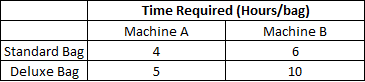
A leather factory produces two kinds of bags, standard and deluxe. The profit margin is Rs. 20 on a standard bag and Rs. 30 on a deluxe bag. Every bag must be processed on machine A and on Machine B. The processing times per bag on the two machines are as follows:

The total time available on machine A is 700 hours and on machine B is 1250 hours. Among the following production plans, which one meets the machine availability constraints and maximizes the profit?
.Let x be no. of standard bags and y be no. of deluxe bags. According to given conditions we have 2 equations 4x+5y<=700 and 6x+10y<=1250. Here option A satisfies both the equations.
A test has 50 questions. A student scores 1 mark for a correct answer, -1/3 for a wrong answer, and -1/6 for not attempting a question. If the net score of a student is 32, the number of questions answered wrongly by that student cannot be less than
Let the number of questions answered correctly be x and the number of questions answered wrongly be y.
So, number of questions left unattempted = (50-x-y)
So, x - y/3 - (50-x-y)/6 = 32
=> 6x - 2y - 50 + x + y = 192 => 7x - y = 242 => y = 7x - 242
If x = 35, y = 3
If x = 36, y = 10
So, min. value of y is 3.
The number of wrongly answered questions cannot be less than 3.
DIRECTIONS for the following two questions: Answer the questions on the basis of the information given below.
A certain perfume is available at a duty-free shop at the Bangkok international airport. It is priced in the Thai currency Baht but other currencies are also acceptable. In particular, the shop accepts Euro and US Dollar at the following rates of exchange:
US Dollar 1 = 41 Bahts
Euro 1= 46 Bahts
The perfume is priced at 520 Bahts per bottle. After one bottle is purchased, subsequent bottles are available at a discount of 30%. Three friends S, R and M together purchase three bottles of the perfume, agreeing to share the cost equally. R pays 2 Euros. M pays 4 Euros and 27 Thai Bahts and S pays the remaining amount in US Dollars.
How much does R owe to S in Thai Baht?
Total to be paid = 1248 Baht
Each has to pay 1248/3 = 416 Baht
R paid 92 Baht
M paid 184+27 = 211 Baht
So, R owes S 416 - 92 = 324 Baht
DIRECTIONS for the following two questions: Answer the questions on the basis of the information given below.
A certain perfume is available at a duty-free shop at the Bangkok international airport. It is priced in the Thai currency Baht but other currencies are also acceptable. In particular, the shop accepts Euro and US Dollar at the following rates of exchange:
US Dollar 1 = 41 Bahts
Euro 1= 46 Bahts
The perfume is priced at 520 Bahts per bottle. After one bottle is purchased, subsequent bottles are available at a discount of 30%. Three friends S, R and M together purchase three bottles of the perfume, agreeing to share the cost equally. R pays 2 Euros. M pays 4 Euros and 27 Thai Bahts and S pays the remaining amount in US Dollars.
How much does M owe to S in US Dollars?
Total to be paid = 1248 Baht
Each has to pay 1248/3 = 416 Baht
R paid 92 Baht
M paid 184+27 = 211 Baht
So, R owes S 416 - 92 = 324 Baht
M owes S 416-211 Baht = 205 Baht = 5 US Dollars
The owner of a local jewellery store hired three watchmen to guard his diamonds, but a thief still got in and stole some diamonds. On the way out, the thief met each watchman, one at a time. To each he gave 1/2 of the diamonds he had then, and 2 more besides. He escaped with one diamond. How many did he steal originally?
Suppose the thief stole 'x' diamonds. \
After giving the share to the first watchman, the thief has (x/2)-2 diamonds.
After giving to the second watchman, the thief has (x/4)-3 diamonds.
After giving to the third watchman, the thief has (x/8)-(7/2) diamonds.
This is equal to 1. So, (x/8) - 7/2 = 1
Solving this equation, we get x = 36
Mayank, Mirza, Little and Jaspal bought a motorbike for $60. Mayank paid one-half of the sum of the amounts paid by the other boys. Mirza paid one-third of the sum of the amounts paid by the other boys. Little paid one-fourth of the sum of the amounts paid by the other boys. How much did Jaspal have to pay?
Let the amount paid by Mayank be x. So, amount paid by the other three = 2x
=> Total bill = x+2x = 3x = 60 => x = 20. So, Mayank paid 20
Similarly, amount paid by Mirza + 3*Amount paid by Mirza = 60
=> Amount paid by Mirza = 15
Amount paid by Little + 4*Amount paid by Little = 60
=> Amount paid by Little = 12
So, amount paid by Jaspal = 60 - (20+15+12) = 60 - 47 = $13
A car rental agency has the following terms. If a car is rented for 5 hr or less, then, the charge is Rs. 60 per hour or Rs. 12 per kilometre whichever is more. On the other hand, if the car is rented for more than 5 hr, the charge is Rs. 50 per hour or Rs. 7.50 per kilometre whichever is more. Akil rented a car from this agency, drove it for 30 km and ended up playing Rs. 300. For how many hours did he rent the car?
Suppose Akil drove the car for less than 5 hrs. In this case, by distance basis, Rs 360 should be charged. This is not the case.
So he dove for more than 5 hrs. Cost comes more using time basis; which is Rs 300, i.e. he used the car for 6 hours.
A piece of string is 40 cm long. It is cut into three pieces. The longest piece is three times as long as the middle-sized and the shortest piece is 23 cm shorter than the longest piece. Find the length of the shortest piece.
Let the longest piece be x
Shortest piece = x - 23
Middle-sized piece = x/3
So, x + x - 23 + x/3 = 40 => 7x/3 = 63 => x = 27
Shortest piece = 27 - 23 = 4
Three travellers are sitting around a fire, and are about to eat a meal. One of them has 5 small loaves of bread, the second has 3 small loaves of bread. The third has no food, but has 8 coins. He offers to pay for some bread. They agree to share the 8 loaves equally among the three travellers, and the third traveller will pay 8 coins for his share of the 8 loaves. All loaves were the same size. The second traveller (who had 3 loaves) suggests that he will be paid 3 coins, and that the first traveller be paid 5 coins. The first traveller says that he should get more than 5 coins. How much should the first traveller get?
Suppose A, B and C have 5 pieces of bread, 3 pieces of bread and 8 coins respectively. Since in total there are 8 pieces of bread, each one should get around 2.66 bread. So A must give 2.33 part of his bread to C and B must give 0.33. Distributing the amount in the same ratio of bread contribution, A must get 7 coins and B must get 1 coin.
Three friends, returning from a movie, stopped to eat at a restaurant. After dinner, they paid their bill and noticed a bowl of mints at the front counter. Sita took one-third of the mints, but returned four because she had a momentary pang of guilt. Fatima then took one-fourth of what was left but returned three for similar reason. Eswari then took half of the remainder but threw two back into the bowl. The bowl had only 17 mints left when the raid was over. How many mints were originally in the bowl?
Let the total number of mints in the bowl be n
Sita took n/3 - 4. Remaining = 2n/3 + 4
Fatim took 1/4(2n/3 + 4) - 3. Remaining = 3/4(2n/3 + 4) + 3
Eswari took 1/2(3/4(2n/3+4)+3) - 2
Remaining = 1/2(3/4(2n/3+4)+3) + 2 = 17
=> 3/4(2n/3+4)+3 = 30 => (2n/3+4) = 36 => n = 48
So, the answer is option d)
Every 10 years the Indian Government counts all the people living in the country. Suppose that the director of the census has reported the following data on two neighbouring villages Chota Hazri and Mota Hazri.
Chota Hazri has 4,522 fewer males than Mota Hazri.
Mota Hazri has 4,020 more females than males.
Chota Hazri has twice as many females as males.
Chota Hazri has 2,910 fewer females than Mota Hazri.
What is the total number of males in Chota Hazri?
Let the number of males in Mota Hazri = x
No. of males in Chota Hazri = x - 4522
Let the number of females in Mota Hazri = y
No. of females in Chota Hazri = y - 2910
(y - 2910) = 2(x - 4522) => y = 2x - 9044 + 2910 = 2x - 6134
Also y = x + 4020
So, x + 4020 = 2x - 6134 => x = 10154
So, number of males in Chota Hazri = 10154 - 4522 = 5632
At a certain fast food restaurant, Brian can buy 3 burgers, 7 shakes, and one order of fries for Rs. 120 exactly. At the same place it would cost Rs. 164.5 for 4 burgers, 10 shakes, and one order of fries. How much would it cost for an ordinary meal of one burger, one shake, and one order of fries?
Let the price of 1 burger be x and the price of 1 shake be y and the prize of 1 french fries be z
3x + 7y + z = 120
4x + 10y + z = 164.5
=> x + 3y = 44.5
=> x = 44.5 - 3y
=> 3(44.5 - 3y) + 7y + z = 120 => z = 120 - 133.5 + 2y
So, x+y+z = 44.5 - 3y + y -13.5 + 2y = 31
So, the cost of a meal consisting of 1 burger, 1 shake and 1 french fries = Rs 31
A change-making machine contains one-rupee, two-rupee and five-rupee coins. The total number of coins is 300. The amount is Rs. 960. If the numbers of one-rupee coins and two-rupee coins are interchanged, the value comes down by Rs. 40. The total number of five-rupee coins is
Let the number of coins of the three denominations be x, y and z respectively.
x+y+z = 300
x+2y+5z = 960
2x+y+5z = 920
=> 3(x+y) + 10z = 1880
=> 3(300 - z) + 10z = 1880
=> 900 + 7z = 1880 => z = 980/7 = 140
So, the number of 5 rupee coins is 140
Two full tanks, one shaped like a cylinder and the other like a cone, contain jet fuel. The cylindrical tank holds 500 litres more than the conical tank. After 200 litres of fuel has been pumped out from each tank the cylindrical tank contains twice the amount of fuel in the conical tank. How many litres of fuel did the cylindrical tank have when it was full?
Let the current capacity of conical flask be C. So, cylinder = C+500.
After pumping out 200 liters, C+300 = 2(C-200) => C = 700
So, full capacity of cylinder = 700+500 = 1200
My son adores chocolates. He likes biscuits. But he hates apples. I told him that he can buy as many chocolates he wishes. But then he must have biscuits twice the number of chocolates and should have apples more than biscuits and chocolates together. Each chocolate cost Re 1. The cost of apple is twice the chocolate and four biscuits are worth one apple. Then which of the following can be the amount that I spent on that evening on my son if number of chocolates, biscuits and apples brought were all integers?
When numbers of chocolates, biscuits and apples are integers.
Now let's say number of chocolates taken 1 , then biscuits will be 2 and apples can be 4,5,6,7
Hence minimum money that should be spent = 1+1+8 = 10 (Hence option C is cancelled)
Now when number of chocolates are 4
Biscuits will be 8
And apples can be 13,14,15....
Now total money spent can be 4+4+26 = 34 and more of it.
Hence answer will be A
I bought 5 pens, 7 pencils and 4 erasers. Rajan bought 6 pens, 8 erasers and 14 pencils for an amount which was half more what I had paid. What per cent of the total amount paid by me was paid for the pens?
Let the cost of pen, pencil and eraer be x,y,z respectively
5x+7y+4z = A
6x+8z+14y = 3A/2
4x + 16/3 z + 28/3 y = A
Comparing two equations
5x+7y+4z = 4x+16/3 z + 28/3 y
x = 7/3 y + 4/3 z
3x = 7y+4z
Now required percentage = $$\frac{5x}{5x+7y+4z}\times100=\frac{5x}{5x+3x}=62.5$$%
Out of two-thirds of the total number of basketball matches, a team has won 17 matches and lost 3 of them. What is the maximum number of matches that the team can lose and still win more than three- fourths of the total number of matches, if it is true that no match can end in a tie?
Total matches played = 17+3 = 20
Total matches = 20*$$\frac{3}{2}$$ = 30
Number of wins required = 75% of 30 = 22.5 = 23 wins
23-17 = 6 more wins are required out of 10 matches to maintain 75% win recor which means there would be 4 losses.
The points of intersection of three lines $$2x+3y-5=0, 5x-7y+2=0$$ and $$9x-5y-4=0$$
For points to be coincident, value of determinant should not be equal zero, so that they have a unique value of system.
Here value of determinant is not equal to zero, simultaneously not any two lines are parallel or perpendicular.
So system has a unique value
Hence points are coincident.
Iqbal dealt some cards to Mushtaq and himself from a full pack of playing cards and laid the rest aside. Iqbal then said to Mushtaq. "If you give me a certain number of your cards, I will have four times as many cards as you will have. If I give you the same number of cards, I will have thrice as many cards as you will have". Of the given choices, which could represent the number of cards with Iqbal?
Let's say Iqbal has x cards initially and Mushtaq has y number of cards initially.
So first Mushtaq gave t cards to Iqbal, hence (x+t) = 4(y-t)
Now second time, Iqbal gave t cards to Mushtaq, hence x-t = 3(y+t)
Solving above two equations we will get x=31t and y=9t
And we know x+y<52 hence 40t<52
because t should be a whole number it will be 1 here and x=31 and y=9
The sum of two integers is 10 and the sum of their reciprocals is 5/12. Then the larger of these integers is
let's say integers are x and y
so x+y = 10 => y = 10 - x
and $$\frac{1}{x} + \frac{1}{y} = \frac{5}{12}$$
$$\frac{1}{x} + \frac{1}{10-x} = \frac{5}{12}$$
=> (10 - x + x)*12 = 5*x(10-x)
=> $$120 = 50x - 5x^2$$
=> $$24 = 10x - x^2$$
=> x = 4, 6
=> y = 6 or 4
The bigger of the two numbers is 6.
In Sivakasi, each boy's quota of match sticks to fill into boxes is not more than 200 per session. If he reduces the number of sticks per box by 25, he can fill 3 more boxes with the total number of sticks assigned to him. Which of the following is the possible number of sticks assigned to each boy?
Let the number of sticks assigned to each boy be N.
Let the number of boxes be M.
So, number of sticks per box = N/M
Now, if he reduces the number of sticks in each box, the equation becomes N/(M+3) = N/M - 25
So, 25 = N/M - N/(M+3)
From the options, if N = 150, then, we get 25 = 150 [ 1/M - 1/(M+3) ]
=> 1/6 = 1/M - 1/(M+3) => M = 3
So, the number of sticks assigned to each boy = 150
Consider the following steps :
1. Put x = 1, y = 2
2. Replace x by xy
3. Replace y by y +1
4. If y = 5 then go to step 6 otherwise go to step 5.
5. Go to step 2
6. Stop Then the final value of x equals
1. x=1 ; y=2
2. x=2 ; y=3
3. x=6 ; y=4
4. x=24 ; y=5
Hence when y=5 , x will be 24
The last time Rahul bought Diwali cards, he found that the four types of cards that he liked were priced Rs.2.00, Rs.3.50, Rs.4.50 and Rs.5.00 each. As Rahul wanted 30 cards, he took five each of two kinds and ten each of the other two, putting down the exact number of 10 rupees notes on the counter payment. How many notes did Rahul give?
According to question Rahul put exact number of 10 rs. notes, hence total price will be a multiple of 10.
And Rahul wants 30 cards, where he took 5 each of two kind and 10 each of other two kind.
So summation of (price of one type card multiplied by number of that type of card) should be a multiple of 10.
By looking at the prices of cards and to make the sum a multiple of 10, we can say that two 5 cards were of rs. 3.5 and 4.5
and two 10 cards were of prices 2 rs.and 5 rs each respectively.
Hence total sum will be 5 $$\times$$ (3.5+4.5) + 10 $$\times$$ (2+5) = 110
So rahul gave 11 notes of 10 rs.
Frequently Asked Questions
Video solutions can be a helpful resource for candidates preparing for CAT Linear Equations questions. They can provide a step-by-step explanation of how to solve the problem, helping candidates better understand the concept and formula.
Usually, the questions in the CAT from Linear equations questions are moderately difficult. But not so tough if you are well versed with the basics and practice a good number of questions from this topic.