91- 6303239042
 CAT WhatsApp Group
An air conditioner (AC) company has four dealers - D1, D2, D3 and D4 in a city. It is evaluating sales performances of these dealers. The company sells two variants of ACs - Window and Split. Both these variants can be either Inverter type or Non-inverter type. It is known that of the total number of ACs sold in the city, 25% were of Window variant, while the rest were of Split variant. Among the Inverter ACs sold, 20% were of Window variant.
The following information is also known:
1. Every dealer sold at least two window ACs.
2. D1 sold 13 inverter ACs, while D3 sold 5 Non-inverter ACs.
3. A total of six Window Non-inverter ACs and 36 Split Inverter ACs were sold in the city.
4. The number of Split ACs sold by D1 was twice the number of Window ACs sold by it.
5. D3 and D4 sold an equal number of Window ACs and this number was one-third of the number of similar ACs sold by D2.
6. D2 and D3 were the only ones who sold Window Non-inverter ACs. The number of these ACs sold by D2 was twice the number of these ACs sold by D3.
7. D3 and D4 sold an equal number of Split Inverter ACs. This number was half the number of similar ACs sold by D2.
CAT Maxima-Minima Questions
What percentage of ACs sold were of Non-inverter type?
Let us assume, A is the total number of AC's sold
=> From the information that the total number of ACs sold in the city, 25% were of Window variant => Window AC's = A/4 and Split AC's = 3A/4
Now, let us assume B is the total number of inverter ACs
=> From the information that among the Inverter ACs sold, 20% were of Window variant.=> Window Inverter AC's = B/5 and Window Non-Inverter AC's = 4B/5

From - Condition-3
=> A/4 - B/5 = 6 and 4B/5 = 36 => B = 46 and A = 60.

Now, from condition-6
a) D1 & D4 sold "0" window Non-inverter ACs => D2 & D3 sold 6 window non-inverter ACs, it is given that D2 sold twice as many as D3 => D2 sold 4 and D3 sold 2 ACs of this type.
From condition-2
b) Let us assume, D1 sold "x" window inverter ACs => Number of split inverter ACs sold is 13-x
From condition-4
c) Number of split ACs sold by D1 will be "2x"
From condition-5
d) Let us assume 'y' is the number of window ACs sold by D3 & D4 => D2 sold 3y ACs of this type.
From condition-7
e) Let us assume 'z' is the number of split inverter ACs sold by D3 and D4 => D2 sold 2z ACs of this type.
Let us use a, b, c, d, and e make a table:

We know that the total number of window ACs is 15
=> x + 3y + y + y = 15 => x + 5y = 15, also x and y should be greater than or equal to 2 from condition-1
=> x = 5 and y = 2 is the only solution.
Filling this in the table:

Now, Number of split inverter ACs is 36
=> 8 + 2z + z + z = 36 => 4z = 28 => z = 7.
Filling this and using (5), the number of split AC's sold by D1 is 2*5 = 10.

From this table, we see that total number of non-inverter ACs is 9 + 6 = 15.
Required percentage is 15 out of 60 => 25%.
What was the total number of ACs sold by D2 and D4?
Let us assume, A is the total number of AC's sold
=> From the information that the total number of ACs sold in the city, 25% were of Window variant => Window AC's = A/4 and Split AC's = 3A/4
Now, let us assume B is the total number of inverter ACs
=> From the information that among the Inverter ACs sold, 20% were of Window variant.=> Window Inverter AC's = B/5 and Window Non-Inverter AC's = 4B/5
From - Condition-3
=> A/4 - B/5 = 6 and 4B/5 = 36 => B = 46 and A = 60.
Now, from condition-6
a) D1 & D4 sold "0" window Non-inverter ACs => D2 & D3 sold 6 window non-inverter ACs, it is given that D2 sold twice as many as D3 => D2 sold 4 and D3 sold 2 ACs of this type.
From condition-2
b) Let us assume, D1 sold "x" window inverter ACs => Number of split inverter ACs sold is 13-x
From condition-4
c) Number of split ACs sold by D1 will be "2x"
From condition-5
d) Let us assume 'y' is the number of window ACs sold by D3 & D4 => D2 sold 3y ACs of this type.
From condition-7
e) Let us assume 'z' is the number of split inverter ACs sold by D3 and D4 => D2 sold 2z ACs of this type.
Let us use a, b, c, d, and e make a table:
We know that the total number of window ACs is 15
=> x + 3y + y + y = 15 => x + 5y = 15, also x and y should be greater than or equal to 2 from condition-1
=> x = 5 and y = 2 is the only solution.
Filling this in the table:
Now, Number of split inverter ACs is 36
=> 8 + 2z + z + z = 36 => 4z = 28 => z = 7.
Filling this and using (5), the number of split AC's sold by D1 is 2*5 = 10.
Total number of ACs sold by D2 and D4 = 60 - D1 - D3 = 60 - 15 - 12 = 33.
Each of the bottles mentioned in this question contains 50 ml of liquid. The liquid in any bottle can be 100% pure content (P) or can have certain amount of impurity (I). Visually it is not possible to distinguish between P and I. There is a testing device which detects impurity, as long as the percentage of impurity in the content tested is 10% or more.
For example, suppose bottle 1 contains only P, and bottle 2 contains 80% P and 20% I. If content from bottle 1 is tested, it will be found out that it contains only P. If content of bottle 2 is tested, the test will reveal that it contains some amount of I. If 10 ml of content from bottle 1 is mixed with 20 ml content from bottle 2, the test will show that the mixture has impurity, and hence we can conclude that at least one of the two bottles has I. However, if 10 ml of content from bottle 1 is mixed with 5 ml of content from bottle 2. the test will not detect any impurity in the resultant mixture.
5 ml of content from bottle A is mixed with 5 ml of content from bottle B. The resultant mixture, when tested, detects the presence of I. If it is known that bottle A contains only P, what BEST can be concluded about the volume of I in bottle B?
Given that each of the bottles contains a volume of 50 ml each.
If 5 ml from bottle A which contains only P is mixed with 5 ml of bottle B and in the resultant mixture the presence of I was detected.
In order to detect the presence of I in this, there must be at least 10% impurity in the 10 ml which is equivalent to 1 ml. This must be from bottle B.
Hence 5 ml of solution from B must contain at least 1ml of impurity and since bottle B is of a total volume of 50 ml. This must contain at least 10 ml of impurity.
There are four bottles. Each bottle is known to contain only P or only I. They will be considered to be “collectively ready for despatch” if all of them contain only P. In minimum how many tests, is it possible to ascertain whether these four bottles are “collectively ready for despatch”?
The bottles contain either P(pure) or I(impure). The possible cases here are :
1- (P, P, P, P), 2-(P,P,P,I), 3-(P,P,I,I), 4-(P,I,I,I), 5-(I,I,I,I).
In the first case if all the four solutions are pure then taking equal volumes of all the four bottles will get the result to dispatch or not to dispatch.
In the second case if 3 bottles are pure and one impure taking equal volumes of all four bottles and testings will confirm the impurity and hence cannot be dispatched.
In the third case if 2 bottles are pure and two are impure taking equal volumes of all four bottles and testing will confirm the impurity and hence cannot be dispatched.
In the fourth case when only one bottle is pure taking equal volumes of all four bottles will confirm the impurity and hence cannot be dispatched.
In the fifth case if all four bottles are impure taking equal volumes of the four bottles will confirm the impurity and hence cannot be dispatched.
In all the cases a single test is enough to determine if the lot is to be dispatched or not.
There are four bottles. It is known that three of these bottles contain only P, while the remaining one contains 80% P and 20% I. What is the minimum number of tests required to definitely identify the bottle containing some amount of I?
The percentage concentration of the impure solution is 80 percent.
When equal volumes of all four solutions are mixed.
Considering 10 ml of each we have impurity to be 2ml/40ml. The impurity concentration is less than 10 percent and hence cannot be recognized.
Similarly when equal volumes of one impure and 2 pure solutions are mixed.
The impurity in the solution is 2ml/30ml which is less than 10 percent and hence cannot be recognized.
Hence for detecting the impure solution we must use equal volumes of 2 solutions at a time.
Considering the three pure solutions to be P and the impure solution to be I.
P, P, P, I.
Considering equal volumes of solution from the bottle one bottle of P, and I. Testing this would recognize the impurity.
After this consider one bottle among the other 2 P bottles which are left and test this with one among the previously tested P, I.
If the one considered is I it will detect the impurity and confirms the bottle to be I.
If the one considered is P it will fail to detect the impurity and hence the other bottle will be I.
Hence a minimum of two tests are required to identify the bottle with the impurity.
There are four bottles. It is known that either one or two of these bottles contain(s) only P, while the remaining ones contain 85% P and 15% I. What is the minimum number of tests required to ascertain the exact number of bottles containing only P?
The bottles could possibly be :
Case - 1 Pure, Impure, Impure, Impure.
Case-2, Pure , Pure, Impure, Impure.
Since the concentration in the impure bottle is 85 percent.
In case 1 when equal volumes from all the bottles are considered and mixed. The test result detects the impurity..
Since the overall concentration of impurity is greater than 10 percent.
Considering 10 ml from all four bottles.
The impure concentration is 4.5ml/40ml which is greater than 10.(15ml*3 = 4.5ml) (Impurity is detected)
For case 2 when all four bottles are considered. The case here has 2 pure and 2 impure bottles.
When equal volumes from all four bottles are mixed. The resultant concentration of impurity when 10 ml from each of the four solutions is considered :
The impure concentration is 3ml/40ml which is less than 10 percent.. (1.5ml*2 = 3ml). (Impurity is not detected.)
Hence in one possibility the impurity is detected and not detected in the other case. A single test is enough based on the results of which the number of pure and the number of impure bottles can be identified.
Ganga, Kaveri, and Narmada are three women who buy four raw materials (Mango, Apple, Banana and Milk) and sell five finished products (Mango smoothie, Apple smoothie, Banana smoothie, Mixed fruit smoothie and Fruit salad). Table-1 gives information about the raw materials required to produce the five finished products. One unit of a finished product requires one unit of each of the raw materials mentioned in the second column of the table.
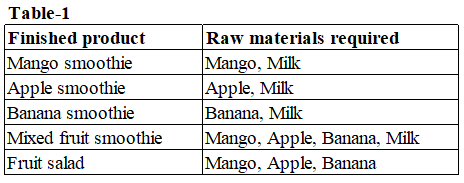
One unit of milk, mango, apple, and banana cost ₹5, ₹3, ₹2, and ₹1 respectively. Each unit of a finished product is sold for a profit equal to two times the number of raw materials used to make that product. For example, apple smoothie is made with two raw materials (apple and milk) and will be sold for a profit of ₹4 per unit. Leftover raw materials are sold during the last business hour of the day for a loss of ₹1 per unit.
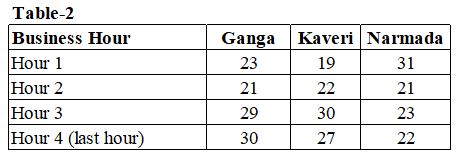
The amount, in rupees, received from sales (revenue) for each woman in each of the four business hours of the day is given in Table-2.
The following additional facts are known.
1. No one except possibly Ganga sold any Mango smoothie.
2. Each woman sold either zero or one unit of any single finished product in any hour.
3. Each woman had exactly one unit each of two different raw materials as leftovers.
4. No one had any banana leftover.
What BEST can be concluded about the number of units of fruit salad sold in the first hour?
Given that each item is sold for a profit of 2 times the number of materials required for the dish.
Hence for different finished products: The cost price and selling price are :
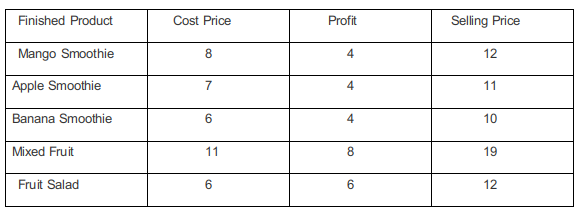
Given that in any hour only either zero or one unit of a single finished product is sold. Hence the price distribution for the first three hours sales distribution is given by :
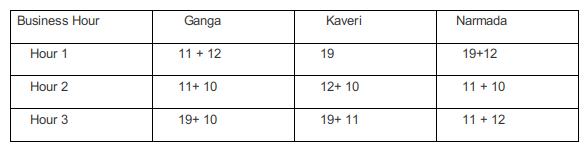
Additionally, it has been mentioned that no one except Ganga possibly sold Mango smoothies.
Considering Apple Smoothie : (AS), Mango Smoothie : ( M.S), Banana Smoothie : (B. S), Mixed Fruit : (M.F), Fruit Salad : (F.S)
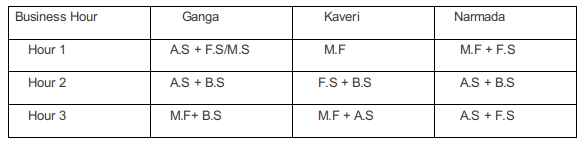
In the last one hour everyone had one unit each of two different materials as leftovers:
Each leftover item is sold at Re1 less than their cost price. Hence
One unit of milk, mango, and apple will cost ₹4, ₹2, ₹1,
The three possible combinations for the last hour in which raw materials can be sold is :
One unit of milk+ One unit of mango = Rs 4+2 = Rs 6.
One unit of milk+ One unit of apple = Rs 4+1 = Rs 5.
One unit of mango+ One unit of apple = Rs 2+1 = Rs 3.
In the last one hour :
Total sale of Ganga is Rs 30. This is the total cost earned by considering selling the finished items and raw materials :
Hence the possible cases are :
(24 + 6) or (25 + 5) or ( 27 + 3). It is not possible to earn 25 and 27 by selling finished products.
Hence she earns Rs 24 which is possible by selling one ( M.S + F.S) and one raw unit of milk and mango each.
Total sale of Kaveri is Rs 27. This is the total cost earned by considering selling the finished items and raw materials :
Hence the possible cases are :
(21 + 6) or (22+5) or (24+3).
Since Kaveri cannot sell mango smoothies the possible cases are :
(21+6) Selling one apple smoothie and one banana smoothie and one raw unit of Milk and Mango.
(22+5) Selling one Banana smoothie and Fruit Salad, one unit of raw milk, and one unit of Raw Apple.
Total sale for Narmada is Rs 22. The possible cases are :
(16+6), (17+5), (19+3).
Among these, the only possible case is 19 + 3. Selling one unit Mixed Fruit, and one raw unit of Mango and Apple.
Case 1 :
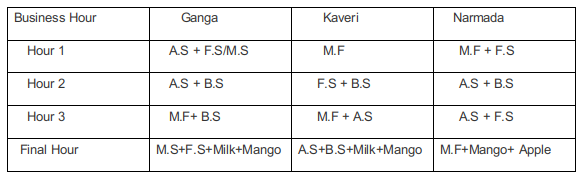
case 2 :
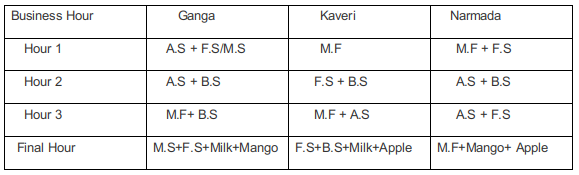
In the first one hour, either one or two fruit salads are sold.
Which of the following is NECESSARILY true?
Given that each item is sold for a profit of 2 times the number of materials required for the dish.
Hence for different finished products: The cost price and selling price are :
Given that in any hour only either zero or one unit of a single finished product is sold. Hence the price distribution for the first three hours sales distribution is given by :
Additionally, it has been mentioned that no one except Ganga possibly sold Mango smoothies.
Considering Apple Smoothie : (AS), Mango Smoothie : ( M.S), Banana Smoothie : (B. S), Mixed Fruit : (M.F), Fruit Salad : (F.S)
In the last one hour everyone had one unit each of two different materials as leftovers:
Each leftover item is sold at Re1 less than their cost price. Hence
One unit of milk, mango, and apple will cost ₹4, ₹2, ₹1,
The three possible combinations for the last hour in which raw materials can be sold is :
One unit of milk+ One unit of mango = Rs 4+2 = Rs 6.
One unit of milk+ One unit of apple = Rs 4+1 = Rs 5.
One unit of mango+ One unit of apple = Rs 2+1 = Rs 3.
In the last one hour :
Total sale of Ganga is Rs 30. This is the total cost earned by considering selling the finished items and raw materials :
Hence the possible cases are :
(24 + 6) or (25 + 5) or ( 27 + 3). It is not possible to earn 25 and 27 by selling finished products.
Hence she earns Rs 24 which is possible by selling one ( M.S + F.S) and one raw unit of milk and mango each.
Total sale of Kaveri is Rs 27. This is the total cost earned by considering selling the finished items and raw materials :
Hence the possible cases are :
(21 + 6) or (22+5) or (24+3).
Since Kaveri cannot sell mango smoothies the possible cases are :
(21+6) Selling one apple smoothie and one banana smoothie and one raw unit of Milk and Mango.
(22+5) Selling one Banana smoothie and Fruit Salad, one unit of raw milk, and one unit of Raw Apple.
Total sale for Narmada is Rs 22. The possible cases are :
(16+6), (17+5), (19+3).
Among these, the only possible case is 19 + 3. Selling one unit Mixed Fruit, and one raw unit of Mango and Apple.
Case 1 :
case 2 :
In both, cases Ganga did not sell any leftover apples. The other options are not necessarily true.
What BEST can be concluded about the total number of units of milk the three women had in the beginning?
Given that each item is sold for a profit of 2 times the number of materials required for the dish.
Hence for different finished products: The cost price and selling price are :
Given that in any hour only either zero or one unit of a single finished product is sold. Hence the price distribution for the first three hours sales distribution is given by :
Additionally, it has been mentioned that no one except Ganga possibly sold Mango smoothies.
Considering Apple Smoothie : (AS), Mango Smoothie : ( M.S), Banana Smoothie : (B. S), Mixed Fruit : (M.F), Fruit Salad : (F.S)
In the last one hour everyone had one unit each of two different materials as leftovers:
Each leftover item is sold at Re1 less than their cost price. Hence
One unit of milk, mango, and apple will cost ₹4, ₹2, ₹1,
The three possible combinations for the last hour in which raw materials can be sold is :
One unit of milk+ One unit of mango = Rs 4+2 = Rs 6.
One unit of milk+ One unit of apple = Rs 4+1 = Rs 5.
One unit of mango+ One unit of apple = Rs 2+1 = Rs 3.
In the last one hour :
Total sale of Ganga is Rs 30. This is the total cost earned by considering selling the finished items and raw materials :
Hence the possible cases are :
(24 + 6) or (25 + 5) or ( 27 + 3). It is not possible to earn 25 and 27 by selling finished products.
Hence she earns Rs 24 which is possible by selling one ( M.S + F.S) and one raw unit of milk and mango each.
Total sale of Kaveri is Rs 27. This is the total cost earned by considering selling the finished items and raw materials :
Hence the possible cases are :
(21 + 6) or (22+5) or (24+3).
Since Kaveri cannot sell mango smoothies the possible cases are :
(21+6) Selling one apple smoothie and one banana smoothie and one raw unit of Milk and Mango.
(22+5) Selling one Banana smoothie and Fruit Salad, one unit of raw milk, and one unit of Raw Apple.
Total sale for Narmada is Rs 22. The possible cases are :
(16+6), (17+5), (19+3).
Among these, the only possible case is 19 + 3. Selling one unit Mixed Fruit, and one raw unit of Mango and Apple.
Case 1 :
case 2 :
In except fruit salad, all the other finished products require one unit of milk :
For case 1: a minimum of 19 units of milk and a maximum of 20 units of milk can be used.
For case 2: a minimum of 18 units of milk and a maximum of 19 units of milk is used
If it is known that three leftover units of mangoes were sold during the last business hour of the day, how many apple smoothies were sold during the day?
Given that each item is sold for a profit of 2 times the number of materials required for the dish.
Hence for different finished products: The cost price and selling price are :
Given that in any hour only either zero or one unit of a single finished product is sold. Hence the price distribution for the first three hours sales distribution is given by :
Additionally, it has been mentioned that no one except Ganga possibly sold Mango smoothies.
Considering Apple Smoothie : (AS), Mango Smoothie : ( M.S), Banana Smoothie : (B. S), Mixed Fruit : (M.F), Fruit Salad : (F.S)
In the last one hour everyone had one unit each of two different materials as leftovers:
Each leftover item is sold at Re1 less than their cost price. Hence
One unit of milk, mango, and apple will cost ₹4, ₹2, ₹1,
The three possible combinations for the last hour in which raw materials can be sold is :
One unit of milk+ One unit of mango = Rs 4+2 = Rs 6.
One unit of milk+ One unit of apple = Rs 4+1 = Rs 5.
One unit of mango+ One unit of apple = Rs 2+1 = Rs 3.
In the last one hour :
Total sale of Ganga is Rs 30. This is the total cost earned by considering selling the finished items and raw materials :
Hence the possible cases are :
(24 + 6) or (25 + 5) or ( 27 + 3). It is not possible to earn 25 and 27 by selling finished products.
Hence she earns Rs 24 which is possible by selling one ( M.S + F.S) and one raw unit of milk and mango each.
Total sale of Kaveri is Rs 27. This is the total cost earned by considering selling the finished items and raw materials :
Hence the possible cases are :
(21 + 6) or (22+5) or (24+3).
Since Kaveri cannot sell mango smoothies the possible cases are :
(21+6) Selling one apple smoothie and one banana smoothie and one raw unit of Milk and Mango.
(22+5) Selling one Banana smoothie and Fruit Salad, one unit of raw milk, and one unit of Raw Apple.
Total sale for Narmada is Rs 22. The possible cases are :
(16+6), (17+5), (19+3).
Among these, the only possible case is 19 + 3. Selling one unit Mixed Fruit, and one raw unit of Mango and Apple.
Case 1 :
case 2 :
3 units of leftover mangoes were available in case 1 and in here a total of 6 apple shakes were sold.
Ravi works in an online food-delivery company. After each delivery, customers rate Ravi on each of four parameters - Behaviour, Packaging, Hygiene, and Timeliness, on a scale from 1 to 9. If the total of the four rating points is 25 or more, then Ravi gets a bonus of ₹20 for that delivery. Additionally, a customer may or may not give Ravi a tip. If the customer gives a tip, it is either ₹30 or ₹50.
One day, Ravi made four deliveries - one to each of Atal, Bihari, Chirag, and Deepak, and received a total of ₹120 in bonus and tips. He did not get both a bonus and a tip from the same customer.
The following additional facts are also known.
1. In Timeliness, Ravi received a total of 21 points, and three of the customers gave him the same rating points in this parameter. Atal gave higher rating points than Bihari and Chirag in this parameter.
2. Ravi received distinct rating points in Packaging from the four customers adding up to 29 points. Similarly, Ravi received distinct rating points in Hygiene from the four customers adding up to 26 points.
3. Chirag gave the same rating points for Packaging and Hygiene.
4. Among the four customers, Bihari gave the highest rating points in Packaging, and Chirag gave the highest rating points in Hygiene.
5. Everyone rated Ravi between 5 and 7 in Behaviour. Unique maximum and minimum ratings in this parameter were given by Atal and Deepak respectively.
6. If the customers are ranked based on ratings given by them in individual parameters, then Atal’s rank based on Packaging is the same as that based on Hygiene. This is also true for Deepak.
What was the minimum rating that Ravi received from any customer in any parameter?
Using condition 1 :
Ravi had a total of 21 points in timeliness. 3 of the four customers among Atal, Bihari, Chirag, and Deepak gave him the same ratings. Atal gave the highest rating in timeliness in comparison with Bihari and Chirag. Hence he must have given the distinct rating.
Using condition 2 :
The possibilities are A - 9, B - 4, C - 4, D - 4.
A - 6, B - 5, C - 5, D - 5.
Ravi received a total of 29 points in the Packaging and for this, the possibility of the four scores are (5, 7, 8, 9) awarded by the four customers.
In Hygiene the sum of the ratings awarded was 26. This could possibly be awarded by considering the following cases :
A-(4,6,7,9) , B-( 5,6,7,8), C-(4,5,8,9).
Using condition 4: Bihari gave the highest rating in packaging and thus Bihari must have given a 9 rating in the packaging.
Chirag gave the highest rating in Hygiene. In condition 3 it was mentioned that Chirag gave the same points for packaging and hygiene. Since 9 was rated by Bihari packaging it cannot be awarded by Chirag in packaging and hygiene. Since Chirag was awarded the highest in Hygiene. He must award 8 points in Hygiene and Packaging.
Hence of the three possibilities among A, B, and C for Hygiene only B is the possible case with 8 as the maximum score.
In condition 5 it was mentioned that everyone awarded Ravi between 5 and 7 in Behaviour. Unique maximum and minimum ratings in this parameter were given by Atal and Deepak respectively.
Hence Atal must have awarded 7, Deepak 6, Bihari, and Chirag 6 each in Behaviour.
The two possible cases are :
Case 1 :
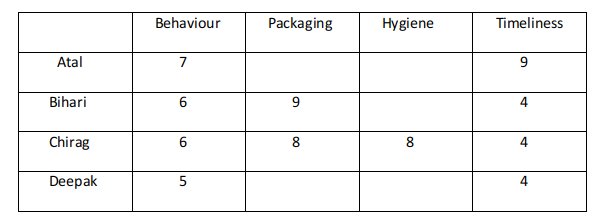
Case 2 :
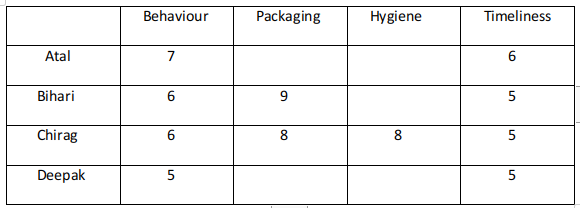
The ratings awarded by Atal and Deepak in Packaging are among 5 and 7.
The ratings awarded by Atal, Bihari, Deepak are among 5,6, and 7.
Atal individual ranking in Packaging and Hygiene are the same. The same is true for Deepak.
Since Atal and Deepak can give the ranking among 3 and 4 in Packaging as Bihari is first and Chirag is second in this parameter.
They can rank 3 or 4 in the Hygiene parameter also. Hence Bihari must rate 7 points in Hygiene.
In both the possibilities Bihari and Chirag award a total of 26 points. Hence he wins 40 because the total ratings are greater than 25 received from Bihari and Chirag.
Since he gets a total of 120 in bonuses and tips. He must have 80 from Atal and Deepak.
This is possible if he gets a tip of 30 ad 50 from them respectively.
In case 1 irrespective of Atal standing at rank 3 or rank 4 in Hygiene and Packaging Atal total rating is greater than 25 which implies Ravi gets a tip from Atal but this is not a possible case because Ravi needs a total of Rs 80 from Atal and Deepak. From Atal if he gets Rs 20 as a bonus he cannot get a total of Rs 120 and hence this case fails.
Hence case 1 fails.
In case 2 there are two possibilities :
Atal ranking 3 in both the parameters and Deepak 4th. Atal ranking 4th in both the parameters and Deepak 3rd
In the case where Atal ranks 3rd in Packaging and Hygiene the total score is 26 and is not a feasible case.
Case - 2A
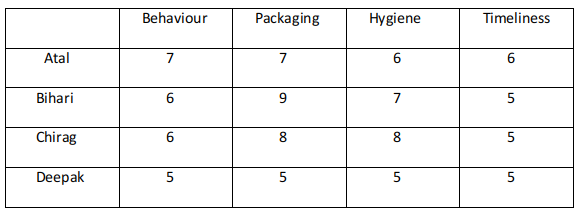
Case - 2B :
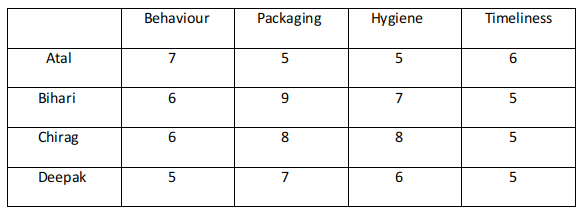
Case - 2A fails because Atal's total rating is greater than 25 which should not be the case.
The minimum rating awarded is 5.
The COMPLETE list of customers who gave the maximum total rating points to Ravi is
Using condition 1 :
Ravi had a total of 21 points in timeliness. 3 of the four customers among Atal, Bihari, Chirag, and Deepak gave him the same ratings. Atal gave the highest rating in timeliness in comparison with Bihari and Chirag. Hence he must have given the distinct rating.
Using condition 2 :
The possibilities are A - 9, B - 4, C - 4, D - 4.
A - 6, B - 5, C - 5, D - 5.
Ravi received a total of 29 points in the Packaging and for this, the possibility of the four scores are (5, 7, 8, 9) awarded by the four customers.
In Hygiene the sum of the ratings awarded was 26. This could possibly be awarded by considering the following cases :
A-(4,6,7,9) , B-( 5,6,7,8), C-(4,5,8,9).
Using condition 4: Bihari gave the highest rating in packaging and thus Bihari must have given a 9 rating in the packaging.
Chirag gave the highest rating in Hygiene. In condition 3 it was mentioned that Chirag gave the same points for packaging and hygiene. Since 9 was rated by Bihari packaging it cannot be awarded by Chirag in packaging and hygiene. Since Chirag was awarded the highest in Hygiene. He must award 8 points in Hygiene and Packaging.
Hence of the three possibilities among A, B, and C for Hygiene only B is the possible case with 8 as the maximum score.
In condition 5 it was mentioned that everyone awarded Ravi between 5 and 7 in Behaviour. Unique maximum and minimum ratings in this parameter were given by Atal and Deepak respectively.
Hence Atal must have awarded 7, Deepak 6, Bihari, and Chirag 6 each in Behaviour.
The two possible cases are :
Case 1 :
Case 2 :
The ratings awarded by Atal and Deepak in Packaging are among 5 and 7.
The ratings awarded by Atal, Bihari, Deepak are among 5,6, and 7.
Atal individual ranking in Packaging and Hygiene are the same. The same is true for Deepak.
Since Atal and Deepak can give the ranking among 3 and 4 in Packaging as Bihari is first and Chirag is second in this parameter.
They can rank 3 or 4 in the Hygiene parameter also. Hence Bihari must rate 7 points in Hygiene.
In both the possibilities Bihari and Chirag award a total of 26 points. Hence he wins 40 because the total ratings are greater than 25 received from Bihari and Chirag.
Since he gets a total of 120 in bonuses and tips. He must have 80 from Atal and Deepak.
This is possible if he gets a tip of 30 ad 50 from them respectively.
In case 1 irrespective of Atal standing at rank 3 or rank 4 in Hygiene and Packaging Atal total rating is greater than 25 which implies Ravi gets a tip from Atal but this is not a possible case because Ravi needs a total of Rs 80 from Atal and Deepak. From Atal if he gets Rs 20 as a bonus he cannot get a total of Rs 120 and hence this case fails.
Hence case 1 fails.
In case 2 there are two possibilities :
Atal ranking 3 in both the parameters and Deepak 4th. Atal ranking 4th in both the parameters and Deepak 3rd
In the case where Atal ranks 3rd in Packaging and Hygiene the total score is 26 and is not a feasible case.
Case - 2A
Case - 2B :
Case - 2A fails because Atal's total rating is greater than 25 which should not be the case.
Bihari and Chirag has given the highest ratings
What rating did Atal give on Timeliness?
Using condition 1 :
Ravi had a total of 21 points in timeliness. 3 of the four customers among Atal, Bihari, Chirag, and Deepak gave him the same ratings. Atal gave the highest rating in timeliness in comparison with Bihari and Chirag. Hence he must have given the distinct rating.
Using condition 2 :
The possibilities are A - 9, B - 4, C - 4, D - 4.
A - 6, B - 5, C - 5, D - 5.
Ravi received a total of 29 points in the Packaging and for this, the possibility of the four scores are (5, 7, 8, 9) awarded by the four customers.
In Hygiene the sum of the ratings awarded was 26. This could possibly be awarded by considering the following cases :
A-(4,6,7,9) , B-( 5,6,7,8), C-(4,5,8,9).
Using condition 4: Bihari gave the highest rating in packaging and thus Bihari must have given a 9 rating in the packaging.
Chirag gave the highest rating in Hygiene. In condition 3 it was mentioned that Chirag gave the same points for packaging and hygiene. Since 9 was rated by Bihari packaging it cannot be awarded by Chirag in packaging and hygiene. Since Chirag was awarded the highest in Hygiene. He must award 8 points in Hygiene and Packaging.
Hence of the three possibilities among A, B, and C for Hygiene only B is the possible case with 8 as the maximum score.
In condition 5 it was mentioned that everyone awarded Ravi between 5 and 7 in Behaviour. Unique maximum and minimum ratings in this parameter were given by Atal and Deepak respectively.
Hence Atal must have awarded 7, Deepak 6, Bihari, and Chirag 6 each in Behaviour.
The two possible cases are :
Case 1 :
Case 2 :
The ratings awarded by Atal and Deepak in Packaging are among 5 and 7.
The ratings awarded by Atal, Bihari, Deepak are among 5,6, and 7.
Atal individual ranking in Packaging and Hygiene are the same. The same is true for Deepak.
Since Atal and Deepak can give the ranking among 3 and 4 in Packaging as Bihari is first and Chirag is second in this parameter.
They can rank 3 or 4 in the Hygiene parameter also. Hence Bihari must rate 7 points in Hygiene.
In both the possibilities Bihari and Chirag award a total of 26 points. Hence he wins 40 because the total ratings are greater than 25 received from Bihari and Chirag.
Since he gets a total of 120 in bonuses and tips. He must have 80 from Atal and Deepak.
This is possible if he gets a tip of 30 ad 50 from them respectively.
In case 1 irrespective of Atal standing at rank 3 or rank 4 in Hygiene and Packaging Atal total rating is greater than 25 which implies Ravi gets a tip from Atal but this is not a possible case because Ravi needs a total of Rs 80 from Atal and Deepak. From Atal if he gets Rs 20 as a bonus he cannot get a total of Rs 120 and hence this case fails.
Hence case 1 fails.
In case 2 there are two possibilities :
Atal ranking 3 in both the parameters and Deepak 4th. Atal ranking 4th in both the parameters and Deepak 3rd
In the case where Atal ranks 3rd in Packaging and Hygiene the total score is 26 and is not a feasible case.
Case - 2A
Case - 2B :
Case - 2A fails because Atal's total rating is greater than 25 which should not be the case.
Atal has given a rating of 6 in timeliness
What BEST can be concluded about the tip amount given by Deepak?
Using condition 1 :
Ravi had a total of 21 points in timeliness. 3 of the four customers among Atal, Bihari, Chirag, and Deepak gave him the same ratings. Atal gave the highest rating in timeliness in comparison with Bihari and Chirag. Hence he must have given the distinct rating.
Using condition 2 :
The possibilities are A - 9, B - 4, C - 4, D - 4.
A - 6, B - 5, C - 5, D - 5.
Ravi received a total of 29 points in the Packaging and for this, the possibility of the four scores are (5, 7, 8, 9) awarded by the four customers.
In Hygiene the sum of the ratings awarded was 26. This could possibly be awarded by considering the following cases :
A-(4,6,7,9) , B-( 5,6,7,8), C-(4,5,8,9).
Using condition 4: Bihari gave the highest rating in packaging and thus Bihari must have given a 9 rating in the packaging.
Chirag gave the highest rating in Hygiene. In condition 3 it was mentioned that Chirag gave the same points for packaging and hygiene. Since 9 was rated by Bihari packaging it cannot be awarded by Chirag in packaging and hygiene. Since Chirag was awarded the highest in Hygiene. He must award 8 points in Hygiene and Packaging.
Hence of the three possibilities among A, B, and C for Hygiene only B is the possible case with 8 as the maximum score.
In condition 5 it was mentioned that everyone awarded Ravi between 5 and 7 in Behaviour. Unique maximum and minimum ratings in this parameter were given by Atal and Deepak respectively.
Hence Atal must have awarded 7, Deepak 6, Bihari, and Chirag 6 each in Behaviour.
The two possible cases are :
Case 1 :
Case 2 :
The ratings awarded by Atal and Deepak in Packaging are among 5 and 7.
The ratings awarded by Atal, Bihari, Deepak are among 5,6, and 7.
Atal individual ranking in Packaging and Hygiene are the same. The same is true for Deepak.
Since Atal and Deepak can give the ranking among 3 and 4 in Packaging as Bihari is first and Chirag is second in this parameter.
They can rank 3 or 4 in the Hygiene parameter also. Hence Bihari must rate 7 points in Hygiene.
In both the possibilities Bihari and Chirag award a total of 26 points. Hence he wins 40 because the total ratings are greater than 25 received from Bihari and Chirag.
Since he gets a total of 120 in bonuses and tips. He must have 80 from Atal and Deepak.
This is possible if he gets a tip of 30 ad 50 from them respectively.
In case 1 irrespective of Atal standing at rank 3 or rank 4 in Hygiene and Packaging Atal total rating is greater than 25 which implies Ravi gets a tip from Atal but this is not a possible case because Ravi needs a total of Rs 80 from Atal and Deepak. From Atal if he gets Rs 20 as a bonus he cannot get a total of Rs 120 and hence this case fails.
Hence case 1 fails.
In case 2 there are two possibilities :
Atal ranking 3 in both the parameters and Deepak 4th. Atal ranking 4th in both the parameters and Deepak 3rd
In the case where Atal ranks 3rd in Packaging and Hygiene the total score is 26 and is not a feasible case.
Case - 2A
Case - 2B :
Case - 2A fails because Atal's total rating is greater than 25 which should not be the case.
Among Atal and Deepak, one of them gives a tip of 30 and the other gives a tip of 50. Hence 30 or 50 any case is possible
In which parameter did Atal give the maximum rating points to Ravi?
Using condition 1 :
Ravi had a total of 21 points in timeliness. 3 of the four customers among Atal, Bihari, Chirag, and Deepak gave him the same ratings. Atal gave the highest rating in timeliness in comparison with Bihari and Chirag. Hence he must have given the distinct rating.
Using condition 2 :
The possibilities are A - 9, B - 4, C - 4, D - 4.
A - 6, B - 5, C - 5, D - 5.
Ravi received a total of 29 points in the Packaging and for this, the possibility of the four scores are (5, 7, 8, 9) awarded by the four customers.
In Hygiene the sum of the ratings awarded was 26. This could possibly be awarded by considering the following cases :
A-(4,6,7,9) , B-( 5,6,7,8), C-(4,5,8,9).
Using condition 4: Bihari gave the highest rating in packaging and thus Bihari must have given a 9 rating in the packaging.
Chirag gave the highest rating in Hygiene. In condition 3 it was mentioned that Chirag gave the same points for packaging and hygiene. Since 9 was rated by Bihari packaging it cannot be awarded by Chirag in packaging and hygiene. Since Chirag was awarded the highest in Hygiene. He must award 8 points in Hygiene and Packaging.
Hence of the three possibilities among A, B, and C for Hygiene only B is the possible case with 8 as the maximum score.
In condition 5 it was mentioned that everyone awarded Ravi between 5 and 7 in Behaviour. Unique maximum and minimum ratings in this parameter were given by Atal and Deepak respectively.
Hence Atal must have awarded 7, Deepak 6, Bihari, and Chirag 6 each in Behaviour.
The two possible cases are :
Case 1 :
Case 2 :
The ratings awarded by Atal and Deepak in Packaging are among 5 and 7.
The ratings awarded by Atal, Bihari, Deepak are among 5,6, and 7.
Atal individual ranking in Packaging and Hygiene are the same. The same is true for Deepak.
Since Atal and Deepak can give the ranking among 3 and 4 in Packaging as Bihari is first and Chirag is second in this parameter.
They can rank 3 or 4 in the Hygiene parameter also. Hence Bihari must rate 7 points in Hygiene.
In both the possibilities Bihari and Chirag award a total of 26 points. Hence he wins 40 because the total ratings are greater than 25 received from Bihari and Chirag.
Since he gets a total of 120 in bonuses and tips. He must have 80 from Atal and Deepak.
This is possible if he gets a tip of 30 ad 50 from them respectively.
In case 1 irrespective of Atal standing at rank 3 or rank 4 in Hygiene and Packaging Atal total rating is greater than 25 which implies Ravi gets a tip from Atal but this is not a possible case because Ravi needs a total of Rs 80 from Atal and Deepak. From Atal if he gets Rs 20 as a bonus he cannot get a total of Rs 120 and hence this case fails.
Hence case 1 fails.
In case 2 there are two possibilities :
Atal ranking 3 in both the parameters and Deepak 4th. Atal ranking 4th in both the parameters and Deepak 3rd
In the case where Atal ranks 3rd in Packaging and Hygiene the total score is 26 and is not a feasible case.
Case - 2A
Case - 2B :
Case - 2A fails because Atal's total rating is greater than 25 which should not be the case.
Atal has given the maximum rating in Behaviour.
What rating did Deepak give on Packaging?
Using condition 1 :
Ravi had a total of 21 points in timeliness. 3 of the four customers among Atal, Bihari, Chirag, and Deepak gave him the same ratings. Atal gave the highest rating in timeliness in comparison with Bihari and Chirag. Hence he must have given the distinct rating.
Using condition 2 :
The possibilities are A - 9, B - 4, C - 4, D - 4.
A - 6, B - 5, C - 5, D - 5.
Ravi received a total of 29 points in the Packaging and for this, the possibility of the four scores are (5, 7, 8, 9) awarded by the four customers.
In Hygiene the sum of the ratings awarded was 26. This could possibly be awarded by considering the following cases :
A-(4,6,7,9) , B-( 5,6,7,8), C-(4,5,8,9).
Using condition 4: Bihari gave the highest rating in packaging and thus Bihari must have given a 9 rating in the packaging.
Chirag gave the highest rating in Hygiene. In condition 3 it was mentioned that Chirag gave the same points for packaging and hygiene. Since 9 was rated by Bihari packaging it cannot be awarded by Chirag in packaging and hygiene. Since Chirag was awarded the highest in Hygiene. He must award 8 points in Hygiene and Packaging.
Hence of the three possibilities among A, B, and C for Hygiene only B is the possible case with 8 as the maximum score.
In condition 5 it was mentioned that everyone awarded Ravi between 5 and 7 in Behaviour. Unique maximum and minimum ratings in this parameter were given by Atal and Deepak respectively.
Hence Atal must have awarded 7, Deepak 6, Bihari, and Chirag 6 each in Behaviour.
The two possible cases are :
Case 1 :
Case 2 :
The ratings awarded by Atal and Deepak in Packaging are among 5 and 7.
The ratings awarded by Atal, Bihari, Deepak are among 5,6, and 7.
Atal individual ranking in Packaging and Hygiene are the same. The same is true for Deepak.
Since Atal and Deepak can give the ranking among 3 and 4 in Packaging as Bihari is first and Chirag is second in this parameter.
They can rank 3 or 4 in the Hygiene parameter also. Hence Bihari must rate 7 points in Hygiene.
In both the possibilities Bihari and Chirag award a total of 26 points. Hence he wins 40 because the total ratings are greater than 25 received from Bihari and Chirag.
Since he gets a total of 120 in bonuses and tips. He must have 80 from Atal and Deepak.
This is possible if he gets a tip of 30 ad 50 from them respectively.
In case 1 irrespective of Atal standing at rank 3 or rank 4 in Hygiene and Packaging Atal total rating is greater than 25 which implies Ravi gets a tip from Atal but this is not a possible case because Ravi needs a total of Rs 80 from Atal and Deepak. From Atal if he gets Rs 20 as a bonus he cannot get a total of Rs 120 and hence this case fails.
Hence case 1 fails.
In case 2 there are two possibilities :
Atal ranking 3 in both the parameters and Deepak 4th. Atal ranking 4th in both the parameters and Deepak 3rd
In the case where Atal ranks 3rd in Packaging and Hygiene the total score is 26 and is not a feasible case.
Case - 2A
Case - 2B :
Case - 2A fails because Atal's total rating is greater than 25 which should not be the case.
Deepak gives a rating of 7 in Packaging.
The local office of the APP-CAB company evaluates the performance of five cab drivers, Arun, Barun, Chandan, Damodaran, and Eman for their monthly payment based on ratings in five different parameters (P1 to P5) as given below:
P1: timely arrival
P2: behaviour
P3: comfortable ride
P4: driver's familiarity with the route
P5: value for money
Based on feedback from the customers, the office assigns a rating from 1 to 5 in each of these parameters. Each rating is an integer from a low value of 1 to a high value of 5. The final rating of a driver is the average of his ratings in these five parameters. The monthly payment of the drivers has two parts - a fixed payment and final rating-based bonus. If a driver gets a rating of 1 in any of the parameters, he is not eligible to get bonus. To be eligible for bonus a driver also needs to get a rating of five in at least one of the parameters. The partial information related to the ratings of the drivers in different parameters and the monthly payment structure (in rupees) is given in the table below:
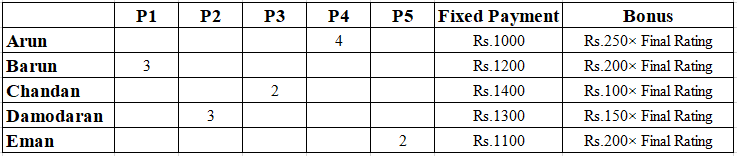
The following additional facts are known.
1. Arun and Barun have got a rating of 5 in exactly one of the parameters. Chandan has got a rating of 5 in exactly two parameters.
2. None of drivers has got the same rating in three parameters.
If Damodaran does not get a bonus, what is the maximum possible value of his final rating?
Based on the given conditions, Damodaran misses out on the bonus if he gets a rating of 1 in any of the five parameters. He additionally needs to obtain a rating of 5 in at least one of the parameters. Thus, the maximum value of the range of ratings that he can acquire would be 1+3(given)+5+5+5. However, based on condition 2, he can have similar ratings in only two of the parameters. Thus, the maximum value of the final rating would be (1+3+5+5+4) /5 = 18/5 = 3.6. Hence, Option C is the correct answer.
If Eman gets a bonus, what is the minimum possible value of his final rating?
Since Eman got a bonus, he must have obtained a rating of 5 in at least one of the parameters. To minimize his final rating we need to consider the following range of values: 5(mandatory)+2(given)+2+3+3 = 15. The least value of his final rating is, therefore, 15/5 = 3. Hence, Option D is the correct answer.
If all five drivers get bonus, what is the minimum possible value of the monthly payment (in rupees) that a driver gets?
Our objective here is to minimize the final ratings in order to find the minimum value of the monthly payment. We cannot have a rating of 1 in any of the parameters since all the drives got the bonus and we need to have at least one parameter with a rating of 5. With this understanding, we obtain the following:
Arun:
Final rating = (5+4+2+2+3)/5 = 16/5 = 3.2; Fixed payment = Rs.1000
Variable payment = 3.2 * Rs. 250 = Rs.800 ; Total = Rs.(1000+800) = Rs. 1800
Barun:
Final rating = (5+3+2+2+3)/5 = 15/5 = 3; Fixed payment = Rs.1200
Variable payment = 3 * Rs. 200 = Rs.600 ; Total = Rs.(1200+600) = Rs. 1800
Chandan: {rating of 5 in exactly two parameters based on condition 1}
Final rating = (5+5+2+2+3)/5 = 17/5 = 3.4; Fixed payment = Rs.1400
Variable payment = 3.4 * Rs. 100 = Rs.340 ; Total = Rs.(1400+340) = Rs. 1740
Damodaran:
Final rating = (5+3+2+2+3)/5 = 15/5 = 3; Fixed payment = Rs.1300
Variable payment = 3 * Rs. 150 = Rs.450 ; Total = Rs.(1300+450) = Rs. 1750
Eman:
Final rating = (5+3+2+2+3)/5 = 15/5 = 3; Fixed payment = Rs.1100
Variable payment = 3 * Rs. 200 = Rs.600 ; Total = Rs.(1100+600) = Rs. 1700
Hence, we observe that the minimum value of the monthly payment is Rs. 1700. Option D is the correct answer.
If all five drivers get bonus, what is the maximum possible value of the monthly payment (in rupees) that a driver gets?
Our objective here is to maximize the final ratings in order to find the maximum possible value of the monthly payment. We cannot have a rating of 1 in any of the parameters since all the drives got the bonus and we need to have at least one parameter with a rating of 5. With this understanding, we obtain the following:
Arun: {can have only one rating of 5 based on condition 1}
Final rating = (5+4+4+3+3)/5 = 19/5 = 3.8; Fixed payment = Rs.1000
Variable payment = 3.8 * Rs. 250 = Rs.950 ; Total = Rs.(1000+950) = Rs. 1950
Barun: {can have only one rating of 5 based on condition 1}
Final rating = (5+4+4+3+3)/5 = 19/5 = 3.8; Fixed payment = Rs.1200
Variable payment = 3.8 * Rs. 200 = Rs.760 ; Total = Rs.(1200+760) = Rs. 1960
Chandan:
Final rating = (5+5+2+4+4)/5 = 20/5 = 4; Fixed payment = Rs.1400
Variable payment = 4 * Rs. 100 = Rs.400 ; Total = Rs.(1400+400) = Rs. 1800
Damodaran:
Final rating = (5+5+4+4+3)/5 = 21/5 = 4.2; Fixed payment = Rs.1300
Variable payment = 4.2 * Rs. 150 = Rs.630 ; Total = Rs.(1300+630) = Rs. 1930
Eman:
Final rating = (5+5+2+4+4)/5 = 20/5 = 4; Fixed payment = Rs.1100
Variable payment = 4 * Rs. 200 = Rs.800 ; Total = Rs.(1100+800) = Rs. 1900
Hence, we observe that the maximum possible value of the monthly payment is Rs. 1960. Option A is the correct answer.
A new game show on TV has 100 boxes numbered 1, 2, . . . , 100 in a row, each containing a mystery prize. The prizes are items of different types, a, b, c, . . . , in decreasing order of value. The most expensive item is of type a, a diamond ring, and there is exactly one of these. You are told that the number of items at least doubles as you move to the next type. For example, there would be at least twice as many items of type b as of type a, at least twice as many items of type c as of type b and so on. There is no particular order in which the prizes are placed in the boxes.
What is the minimum possible number of different types of prizes?
It is given that the most expensive item is a diamond ring of type a and there is exactly one of these. Since the item b should be at least twice. The minimum number of items will be obtained when a=1 and b=99, which means there are only two different types of items.
What is the maximum possible number of different types of prizes?
It is given that the most expensive item is a diamond ring of type a and there is exactly one of these. Since the number of items of type b should be at least twice of that of a and the number of items of type c should be at least twice of that of b and so on. So the maximum number of different types of items of a, b and c will be obtained when a=1, b=2, c=4, d=8, e=16, f=69. Hence the maximum number of different types of items will be 6.
If the number of items is 7, then the minimum number of prizes should be 1+2+4+8+16+32+64=127 which is more than 100.
Hence 6 is the answer.
Which of the following is not possible?
Option A: There are exactly 75 items of type e.
a=1,b=2,c=4,d=8, e=85. Here the maximum value of e= 85. Hence it can take the value 75.
An example of such case is a=1,b=2,c=4,d=18, e=75
Option B: There are exactly 30 items of type b.
a=1 b=30 and c=69. Hence this case is also possible.
Option C: There are exactly 45 items of type c.
Since the value of d should be at least 90, it means that d is not present because 45+90 will be more than 100(maximum number of items). Only a,b and c are present.
The maximum value of b = 22 and a =1, but 45+22+1=68, which is less than 100. So this case is not possible.
Option D: There are exactly 60 items of type d.
d=60, c=30, b=9 and a=1. a+b+c+d=100. Hence this case is possible.
C is the answer.
You ask for the type of item in box 45. Instead of being given a direct answer, you are told that there are 31 items of the same type as box 45 in boxes 1 to 44 and 43 items of the same type as box 45 in boxes 46 to 100.
What is the maximum possible number of different types of items?
The total number of items from 1 to 100, which are of same type as in box 45 = 31+1+43=75
Now to maximize the number of items, a=1, b=2, c=4, d=18 and e=75(given)
There can be maximum 5 types of items.
If we consider number of items to be 6, then minimum number of items of 5th type will be 16, 1+2+4+8+16+75=106 which is more than 100.