The (x, y) coordinates of vertices P, Q and R of a parallelogram PQRS are (-3, -2), (1, -5) and (9, 1), respectively. If the diagonal SQ intersects the x-axis at (a, 0) , then the value of a is
CAT Coordinate Geometry Questions
Given (P(-3,-2)), (Q(1,-5)), and (R(9,1)).
For parallelogram (PQRS), S = P + R - Q = (-3,-2) + (9,1) - (1,-5) = (5,4)
Diagonal SQ passes through S(5,4) and Q(1,-5).
Slope m = $$\dfrac{-5-4}{1-5} = \dfrac{9}{4}$$
Equation of SQ is $$y - 4 = \dfrac{9}{4}(x - 5)$$
At the x-axis, y = 0: $$-4 = \dfrac{9}{4}(a - 5)$$
$$-16 = 9(a - 5)$$
$$9a = 29$$
$$a = \dfrac{29}{9}$$
So, $$a = {\dfrac{29}{9}}$$
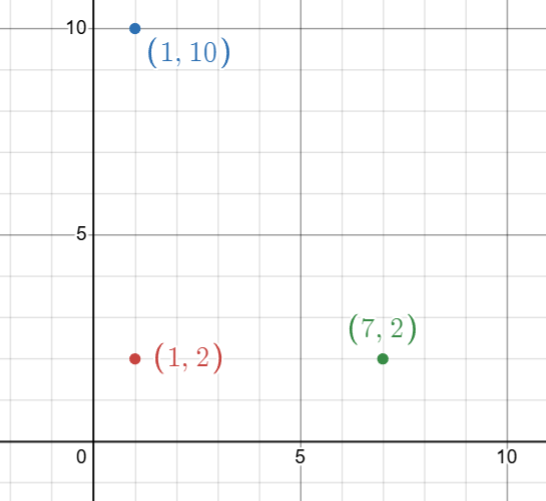
The coordinates of the three vertices of a triangle are: (1, 2), (7, 2), and (1, 10). Then the radius of the incircle of the triangle is
Upon drawing a rough sketch of the coordinates given, we realise that this is a right-angled triangle.
The three side lengths are 6, 8 and 10 units
The inradius of a circle can be calculated using the formula: $$rs=Area$$, where s is the semi-perimeter of the triangle
The Area would be $$\frac{1}{2}\times\ 6\times\ 8=24$$
and the semi-perimeter would be $$\frac{10+6+8}{2}=12$$
Giving the inradius to be $$\frac{24}{12}=2$$ units
Therefore, 2 is the correct answer.
Let C be the circle $$x^{2} + y^{2} + 4x - 6y - 3 = 0$$ and L be the locus of the point of intersection of a pair of tangents to C with the angle between the two tangents equal to $$60^{\circ}$$. Then, the point at which L touches the line $$x$$ = 6 is
Given equation of circle = $$x^{2} + y^{2} + 4x - 6y - 3 = 0$$
Center of the circle is (-2,3) and radius of the circle = $$\sqrt{\ g^2+f^2-c}=\sqrt{\ 4+9+3}=4$$
Let us assume the point of the intersection of the tangents is ( h,k)
The angle made by the line joining (h,k) to the centre makes an angle of 30 degrees with the tangent, and sin(30) will be the ratio of the radius and the distance between the center and (h,k)
=> $$\sin\left(30\right)=\dfrac{4}{\sqrt{\left(\ h+2\right)^2+\left(k-3\right)^2}}$$
Squaring on both sides:
$$\dfrac{1}{4}=\dfrac{16}{\left(h+2\right)^2+\left(k-3\right)^2}$$
=> $$\left(h+2\right)^2+\left(k-3\right)^2=64$$
When x = 6 => h = 6 => $$64+\left(k-3\right)^2=64$$ => k = 3.
=> required point is (6,3)
Let ABCD be a parallelogram such that the coordinates of its three vertices A, B, C are (1, 1), (3, 4) and (−2, 8), respectively. Then, the coordinates of the vertex D are
In a parallelogram, two diagonals of parallelogram bisects each other, which concludes that mid-point of both diagonals are the same.
Midpoint of AC = $$\left(\ \frac{\ 1-2}{2},\ \frac{\ 1+8}{2}\right)$$
Let the coordinates of vertex D be (x,y)
$$\left(\ \frac{\ x+3}{2},\ \frac{\ y+4}{2}\right)=\left(\ \frac{\ 1-2}{2},\ \frac{\ 1+8}{2}\right)$$
x = -4 and y = 5
The answer is option D.
The points (2,1) and (-3,-4) are opposite vertices of a parallelogram.If the other two vertices lie on the line $$x+9y+c=0$$, then c is
The midpoints of two diagonals of a parallelogram are the same
Hence the midpoint of (2,1) and (-3,-4) lie on $$x+9y+c=0$$
midpoint of (2,1) and (-3,-4) = ($$\frac{2-3}{2},\frac{1-4}{2}$$) = (-1/2 , -3/2)
Keeping this cordinates in the above line equation, we get c = 14
The vertices of a triangle are (0,0), (4,0) and (3,9). The area of the circle passing through these three points is
Equation of circle $$x^2+y^2+2gx+2fy+c=0$$
It passes through (0,0), (4,0) and (3,9). Substitute each point in the above equation:
=> On substituting the value (0,0) in the above equation, we obtain: $$c=0$$
=> On substituting the value (4,0) in the above equation, we obtain: $$16+0+8g+0 = 0$$ ; $$g=-2$$
=> On substituting the value (3,9) in the above equation, we obtain: $$9+81-12+18f = 0$$ ; $$f= -13/3$$
Radius of the circle r = $$\sqrt{\ g^2+f^2-c}$$ => $$r^2=\frac{205}{9}$$
Therefore, Area = $$\pi\ r^2=\frac{205\pi\ }{9}$$
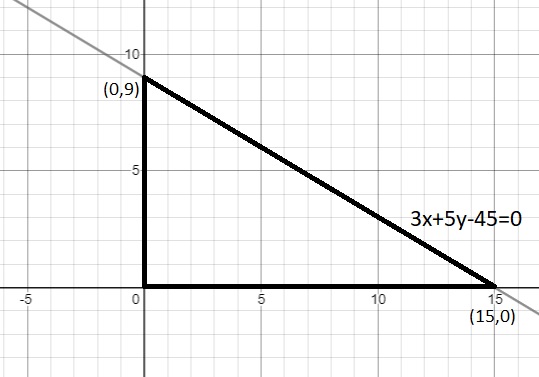
Let T be the triangle formed by the straight line 3x + 5y - 45 = 0 and the coordinate axes. Let the circumcircle of T have radius of length L, measured in the same unit as the coordinate axes. Then, the integer closest to L is

In any right triangle, the circumradius is half of the hypotenuse. Here,L=$$\ \frac{\ 1}{2}\ $$* the length of the hypotenuse = $$\ \frac{\ 1}{2}$$($$\sqrt{\ 15^2+9^2}$$) = $$\ \frac{\ 1}{2}\ $$*$$\sqrt{\ 306}$$ = $$\ \frac{\ 1}{\ 2}\times\ $$17.49 = 8.74
Hence, the integer close to L = 9
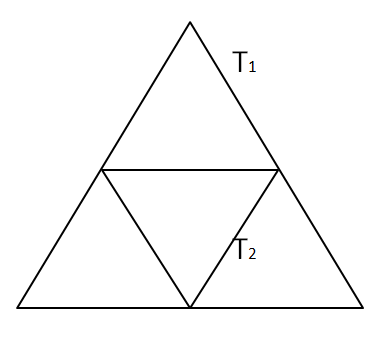
Given an equilateral triangle T1 with side 24 cm, a second triangle T2 is formed by joining the midpoints of the sides of T1. Then a third triangle T3 is formed by joining the midpoints of the sides of T2. If this process of forming triangles is continued, the sum of the areas, in sq cm, of infinitely many such triangles T1, T2, T3,... will be
We can see that T$$_{2}$$ is formed by using the mid points of T$$_{1}$$. Hence, we can say that area of triangle of T$$_{2}$$ will be (1/4)th of the area of triangle T$$_{1}$$.
Area of triangle T$$_{1}$$ = $$\dfrac{\sqrt{3}}{4}*(24)^2$$ = $$144\sqrt{3}$$ sq. cm
Area of triangle T$$_{2}$$ = $$\dfrac{144\sqrt{3}}{4}$$ = $$36\sqrt{3}$$ sq. cm
Sum of the area of all triangles = T$$_{1}$$ + T$$_{2}$$ + T$$_{3}$$ + ...
$$\Rightarrow$$ T$$_{1}$$ + T$$_{1}$$/$$4$$ + T$$_{1}$$/$$4^2$$ + ...
$$\Rightarrow$$ $$\dfrac{T_{1}}{1 - 0.25}$$
$$\Rightarrow$$ $$\dfrac{4}{3}*T_{1}$$
$$\Rightarrow$$ $$\dfrac{4}{3}*144\sqrt{3}$$
$$\Rightarrow$$ $$192\sqrt{3}$$
Hence, option D is the correct answer.
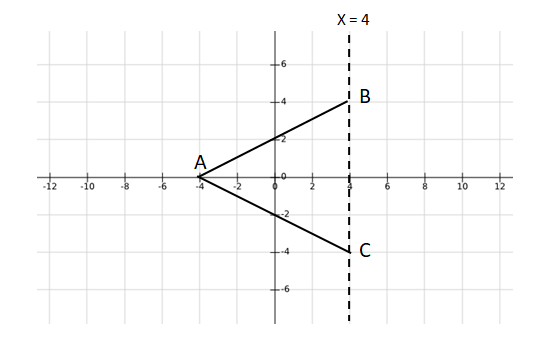
A triangle ABC has area 32 sq units and its side BC, of length 8 units, lies on the line x = 4. Then the shortest possible distance between A and the point (0,0) is
We know that area of the triangle = 32 sq. units, BC = 8 units
Therefore, the height of the perpendicular drawn from point A to BC = 2*32/8 = 8 units.
Let us draw a possible diagram of the given triangle.
We can see that if A coincide with (-4, 0) then the distance between A and (0, 0) = 4 units.
If we move the triangle up or down keeping the base BC on x = 4, then point A will move away from origin as vertical distance will come into factor whereas horizontal distance will remain as 4 units.
Hence, we can say that minimum distance between A and origin (0, 0) = 4 units.
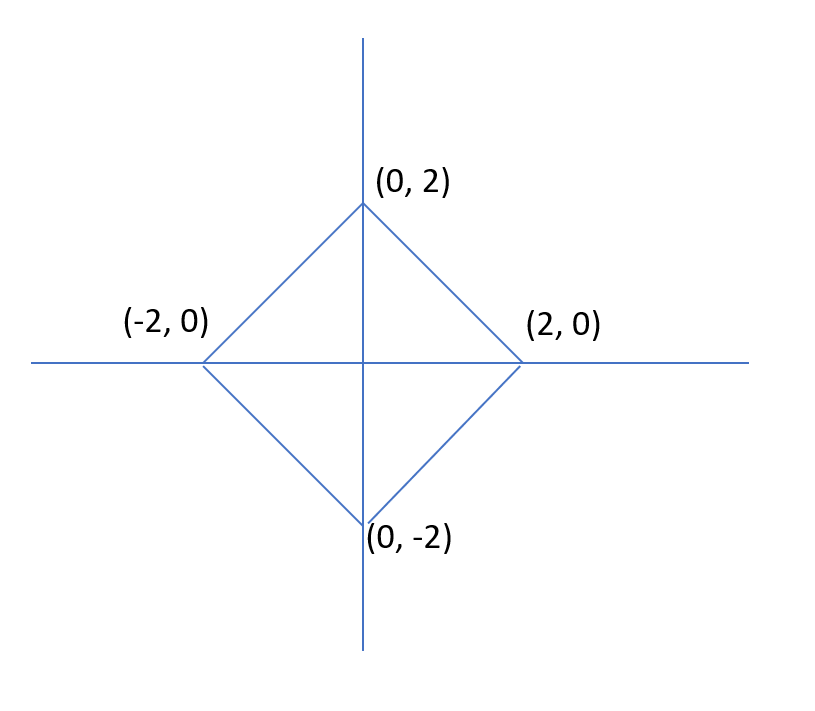
The area of the closed region bounded by the equation
I x I + I y I = 2 in the two-dimensional plane is
The following equation will form a square of side $$ 2\sqrt{2} $$.
The area of the square = $$(2\sqrt{2})^2$$ = 8 units.
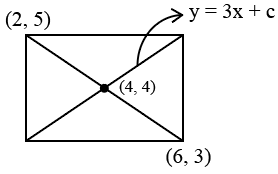
The points (2, 5) and (6, 3) are two end points of a diagonal of a rectangle. If the other diagonal has the equation y =3x+c,then c is

The midpoint of one diagonal lies on the other diagonal.
Midpoint is ((2+6)/2, (5+3)/2) = (4,4)
Hence 4 = 3 * 4 + c => c = -8
The shortest distance of the point $$(\frac{1}{2},1)$$ from the curve y = I x -1I + I x + 1I is
The graph of the given function is as shown below.
We can see that the shortest distance of the point (1/2, 1) will be 1 unit.
Consider a triangle drawn on the X-Y plane with its three vertices at (41, 0), (0, 41) and (0, 0), each vertex being represented by its (X,Y) coordinates. The number of points with integer coordinates inside the triangle (excluding all the points on the boundary) is
The number of points on x = 1 is 39. The number of points on x = 2 is 38 and so on till x = 39, which has one point.
So, the total is 1+2+3+...+39 = $$\frac{39*40}{2}$$ = 780.
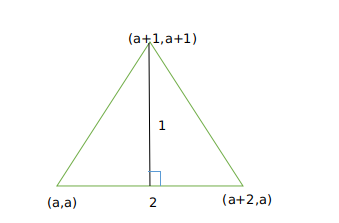
The area of the triangle whose vertices are (a,a), (a + 1, a + 1) and (a + 2, a) is
The triangle we have is :
The length of three sides is $$\sqrt 2, \sqrt 2$$ and $$2$$.
This is a right-angled triangle.
Hence, it's area equals $$1/2 * \sqrt 2 * \sqrt 2 = 1$$
So, the correct answer is b)
Alternate Approach :
Area of triangle = $$\frac{1}{2}\times\ base\times\ height$$
So we get $$\frac{1}{2}\times2\times\ 1$$=1 square units
ABCD is a rhombus with the diagonals AC and BD intersection at the origin on the x-y plane. The equation of the straight line AD is x + y = 1. What is the equation of BC?
The line should be parallel to AD and should be of equal distance from the origin in the third quadrant. The equation x+y = -1 satisfies all these conditions.
The points of intersection of three lines $$2x+3y-5=0, 5x-7y+2=0$$ and $$9x-5y-4=0$$
For points to be coincident, value of determinant should not be equal zero, so that they have a unique value of system.
Here value of determinant is not equal to zero, simultaneously not any two lines are parallel or perpendicular.
So system has a unique value
Hence points are coincident.
What is the distance between the points A(3, 8) and B(-2,-7)?
Distance between two points = $$\sqrt {(3-(-2))^2 + (8-(-7))^2}$$ = $$5\sqrt10$$