The average number of copies of a book sold per day by a shopkeeper is 60 in the initial seven days and 63 in the initial eight days, after the book launch. On the ninth day, she sells 11 copies less than the eighth day, and the average number of copies sold per day from second day to ninth day becomes 66. The number of copies sold on the first day of the book launch is
CAT Averages Mixtures Alligations Questions
Let the copies sold on days 1 through 9 be $$d_1,\dots,d_9$$
From the averages:
$$d_1+\cdots+d_7=7\times60=420$$
$$d_1+\cdots+d_8=8\times63=504$$
So $$d_8=504-420=84$$. Then $$d_9=84-11=73$$
The sum from day 2 to day 9 is $$8\times66=528$$
$$d_2+\cdots+d_9=(d_1+\cdots+d_8)-d_1+d_9=504-d_1+73=577-d_1$$
Thus $$577-d_1=528 \Rightarrow d_1=49$$
A container holds 200 litres of a solution of acid and water, having 30% acid by volume. Atul replaces 20% of this solution with water, then replaces 10% of the resulting solution with acid, and finally replaces 15% of the solution thus obtained, with water. The percentage of acid by volume in the final solution obtained after these three replacements, is nearest to
200 L with (30%) acid $$\Rightarrow$$ acid = $$0.30\times200=60 L$$
Replace 20% with water: remaining acid $$=60\times(1-0.20)=60\times0.8=48 L$$.
Replace 10% with pure acid: After removing 10% of the mixture, the acid becomes $$48\times0.9=43.2 L$$, then adding back 20 L pure acid $$\Rightarrow acid =43.2+20=63.2 L$$.
Replace 15 with water: acid left $$= 63.2\times(1-0.15)=63.2\times0.85=53.72 L$$.
Final concentration $$= \dfrac{53.72}{200}=0.2686\approx26.86%$$.
The answer is 27%
The average salary of 5 managers and 25 engineers in a company is 60000 rupees. If each of the managers received 20% salary increase while the salary of the engineers remained unchanged, the average salary of all 30 employees would have increased by 5%. The average salary, in rupees, of the engineers is
Let the average salary of managers be $$x$$ and let the average salary of engineers be $$y$$. The total salary of all the employees will be $$(5+25)*60000 = 1800000$$
We have, $$5x+25y = 1800000$$ .... (1)
If the average salary of all the employees increases by $$5\%$$, the total salary of all the employees will also increase by $$5\%$$, because the total number of employees remains the same. The new total salary will be, $$1800000\times 1.05 = 1890000$$
Also, the average salary of all the managers has increased by $$20\%$$ and has become $$1.2x$$, we have
$$5*1.2x + 25y = 1890000$$, or $$6x + 25y = 1890000$$ .... (2)
Subtracting equation (1) from equation (2), we get,
$$x = 90000$$
Which gives $$25y = 1800000 - 90000*5$$ or $$y = \dfrac{1350000}{25} = 54000$$
Therefore, the correct answer is option C.
A mixture of coffee and cocoa, 16% of which is coffee, costs Rs 240 per kg. Another mixture of coffee and cocoa, of which 36% is coffee, costs Rs 320 per kg. If a new mixture of coffee and cocoa costs Rs 376 per kg, then the quantity, in kg, of coffee in 10 kg of this new mixture is
Let coffee price = C Rs/kg and cocoa price = K Rs/kg.
From the two given mixtures:
$$0.16C + 0.84K = 240$$
$$0.36C + 0.64K = 320$$
Multiply both equations by 100 to remove decimals:
$$16C + 84K = 24000$$
$$36C + 64K = 32000$$
Subtract the first from the second:
$$(36C+64K)-(16C+84K)=32000-24000$$
$$20C - 20K = 8000 \implies C - K = 400$$
Put $$C=K+400$$ into $$16C+84K=24000$$:
$$16(K+400)+84K=24000 $$
$$16K+6400+84K=24000 $$
$$100K = 17600 \implies K = 176$$
So $$C = 176 + 400 = 576$$ (Rs/kg).
For the new mixture priced at Rs 376/kg, let the coffee fraction be p. Then
$$ p\cdot 576 + (1-p)\cdot 176 = 376$$
Upon solving $$p = \tfrac{1}{2}$$
Thus, coffee is (50%) of the new mixture. In 10 kg of this mixture, coffee = $$10\times 0.5 = 5\text{kg}$$
Vessels A and B contain 60 litres of alcohol and 60 litres of water, respectively. A certain volume is taken out from A and poured into B. After stirring, the same volume is taken out from B and poured into A. If the resultant ratio of alcohol and water in A is 15 : 4, then the volume, in litres, initially taken out from A is
Vessel A contains $$60$$ litres of pure alcohol, and Vessel B contains $$60$$ litres of pure water. Let the amount taken out from vessel A be $$x$$ litres. The contents in Vessel A now are $$60-x$$ litres of alcohol, and in Vessel B now are $$60$$ litres of water and $$x$$ litres of alcohol.
After mixing, when the same quantity $$x$$ is taken out from Vessel B, the alcohol that would be taken out would be $${\left(\dfrac{x}{60+x}\right)}^{\text{th}}$$ of $$x$$, which is $$\dfrac{x^2}{60+x}$$ litres.
The initial total quantity of $$60$$ litres has been restored in A after replacement. The total amount of alcohol in Vessel A after the process is complete is:
$$60 - x + \dfrac{x^2}{60+x} = \dfrac{(60+x)(60-x) + x^2}{60+x} = \dfrac{3600}{60+x}$$
The total quantity in vessel A is $$60$$ litres where the ratio of alcohol to total quantity is $$\dfrac{15}{15+4} = \dfrac{15}{19}$$
Therefore,
$$\dfrac{3600\div (60+x)}{60} = \dfrac{15}{19}$$
$$\Rightarrow \dfrac{60}{60+x} = \dfrac{15}{19}$$
$$\Rightarrow x = 16$$
Thus, the quantity taken out and replaced in the two iterations is $$16$$ litres.
The average of three distinct real numbers is 28. If the smallest number is increased by 7 and the largest number is reduced by 10, the order of the numbers remains unchanged, and the new arithmetic mean becomes 2 more than the middle number, while the difference between the largest and the smallest numbers becomes 64.Then, the largest number in the original set of three numbers is
We are given that average of three distinct integers is 28, that means the sum of these three integers is 28x3=84
Let us write $$x+y+z=84$$
x, y, z being the three distinct integers in ascending order.
If the smallest number is increased by 7 and the largest number is reduced by 10
$$(x+7)+(y)+(z-10)=81$$
New arithmetic mean will be $$\frac{81}{3}=27$$
And this is said to be 2 more than the middle number, meaning
$$27-2=y=25$$
$$x+z=59$$
We are given that difference between the largest and the smallest numbers becomes 64,
$$(z-10)-(x+7)=64$$
$$z-x=81$$
Adding the two equations we get, $$2z=140$$
$$z=70$$
A certain amount of water was poured into a 300 litre container and the remaining portion of the container was filled with milk. Then an amount of this solution was taken out from the container which was twice the volume of water that was earlier poured into it, and water was poured to refill the container again. If the resulting solution contains 72% milk, then the amount of water, in litres, that was initially poured into the container was
Let us assume the amount of Milk in the container to be X and the amount of water in the container to be Y.
We are told that X+Y=300.
Now, an operation is given where "an amount of this solution was taken out from the container which was twice the volume of water that was earlier poured into it, and water was poured to refill the container again"
Volume of the water initially is Y. If twice that amount is taken out, the percentage of the solution that is taken out will be, $$\frac{2Y}{X+Y}$$
That means the quantity of milk that will remain in the solution will be, $$X\left(1-\frac{2Y}{X+Y}\right)$$
This value is given to be 72%, 72% of 300 will be 216
$$X\left(1-\frac{2Y}{X+Y}\right)=216$$
$$X\left(\frac{X+Y-2Y}{X+Y}\right)=216$$
Writing $$X=300-Y$$
$$\left(300-Y\right)\left(300-2Y\right)=64800$$
Expanding this we have,
$$2Y^2-900Y+25200=0$$
Factorising this equation we have,
$$2\left(Y-30\right)\left(Y-420\right)=0$$
Y is either 30 or 420.
Given that the capacity of the container itself is 300, Y has to be 30.
Hence the amount of water initially is 30 Litres.
A glass is filled with milk. Two-thirds of its content is poured out and replaced with water. If this process of pouring out two-thirds the content and replacing with water is repeated three more times, then the final ratio of milk to water in the glass, is
Let us say the capacity of the glass is X, and it is completely filled with milk,
If two-thirds of its content is poured out and replaced with water, the remaining fraction of the milk will be one third.
And this is said to be done three more times, that means a total of 4 times.
So the contents of Milk initially being X,
And after 4 times the contents will be, $$X\left(1-\frac{2}{3}\right)^4=\frac{X}{81}$$
Since the total contents is X, and the milk contents is X/81, the water contents will be 80X/81.
Ratio of milk to water will be $$\frac{X}{81}:\ \frac{80X}{81}$$
Answer is $$1:80$$
There are four numbers such that average of first two numbers is 1 more than the first number, average of first three numbers is 2 more than average of first two numbers, and average of first four numbers is 3 more than average of first three numbers. Then, the difference between the largest and the smallest numbers, is
Let us assume the four numbers to be a, b, c and d in ascending order.
Average of first two numbers is 1 more than the first number
$$\frac{\left(a+b\right)}{2}=a+1$$
$$b-a=2$$
$$b=a+2$$
Average of first three numbers is 2 more than average of first two numbers
$$\frac{\left(a+b+c\right)}{3}=\frac{\left(a+b\right)}{2}+2$$
$$2c=a+b+12$$
Substituting the value for b
$$2c=a+a+2+12$$
$$2c=2a+14$$
$$c=a+7$$
Average of first four numbers is 3 more than average of first three numbers.
$$\frac{\left(a+b+c+d\right)}{4}=\frac{\left(a+b+c\right)}{3}+3$$
$$3d=a+b+c+36$$
Substituting the value of b and c
$$3d=a+a+2+a+7+36$$
$$3d=3a+45$$
$$d=a+15$$
d is the largest and a is the smallest and we know that d=a+15
Hence the difference between the smallest and the largest values is 15.
Rajesh and Vimal own 20 hectares and 30 hectares of agricultural land, respectively, which are entirely covered by wheat and mustard crops. The cultivation area of wheat and mustard in the land owned by Vimal are in the ratio of 5 : 3. If the total cultivation area of wheat and mustard are in the ratio 11 : 9, then the ratio of cultivation area of wheat and mustard in the land owned by Rajesh is
We are told that Rajesh manages 20 hectares and Vimal manages 30 hectares
For Vimal, we know the distribution of the land between Wheat and Mustard, 5:3
So, wheat area will be, $$\frac{5}{8}\left(30\right)$$
Mustard area will be, $$\frac{3}{8}\left(30\right)$$
Similarly, let us assume that the distribution of crops between Wheat and Mustard to be k:1
Wheat will be, $$\frac{k}{k+1}\left(20\right)$$
Mustard will be, $$\frac{1}{k+1}\left(20\right)$$
We are told that total area of Wheat and Mustard is in the ratio 11:9
Adding them up we get,
$$\dfrac{\left(\frac{150}{8}+\frac{20k}{k+1}\right)}{\left(\frac{90}{8}+\frac{20}{k+1}\right)}=\dfrac{11}{9}$$
$$\dfrac{\left(\frac{15}{8}+\frac{2k}{k+1}\right)}{\left(\frac{9}{8}+\frac{2}{k+1}\right)}=\dfrac{11}{9}$$
$$\frac{135}{8}+\frac{18k}{k+1}=\frac{99}{8}+\frac{22}{k+1}$$
$$\frac{36}{8}=\frac{22-18k}{k+1}$$
$$44-36k=9k+9$$
$$45k=35$$
$$k=\frac{7}{9}$$
Hence the ratio of distribution of area between Wheat and Mustard for Rajesh is $$\dfrac{7}{9}$$
A vessel contained a certain amount of a solution of acid and water. When 2 litres of water was added to it, the new solution had 50% acid concentration. When 15 litres of acid was further added to this new solution, the final solution had 80% acid concentration. The ratio of water and acid in the original solution was
Let's start from the step when there was 50% concentration.
Let's take there to ee 2T solution: T acid and T water.
Adding 15 litres of acid increases the acid concentration to 80%, giving the equation $$\frac{T+15}{2T+15}=\frac{4}{5}$$
Solving this would give us T=5
This means that there were 5 litres of acid and 5 litres of water after mixing 2 litres of water.
Therefore, there would be 5 litres of acid and 3 litres of water before adding the water.
We are asked the ratio of water to acid, which would be 3:5
Therefore, Option B is the correct answer.
A mixture P is formed by removing a certain amount of coffee from a coffee jar and replacing the same amount with cocoa powder. The same amount is again removed from mixture P and replaced with same amount of cocoa powder to form a new mixture Q. If the ratio of coffee and cocoa in the mixture Q is 16 : 9, then the ratio of cocoa in mixture P to that in mixture Q is
Given that in the final mixture, the ratio of coffee and cocoa is 16:9
Let us assume coffee is 16 units and cocoa is 9 units.
=> Initially, there are 25 units of coffee and 0 units of cocoa
Let's say x units of the mixture is removed and replaced with cocoa
=> Now, we have (25-x) coffee and x units of cocoa. => Mixture P
Now, if x units of the mixture is removed:
Amount of coffee present = (25-x) - $$\dfrac{\left(25-x\right)}{25}\times\ x$$
=> $$\left(25-x\right)\left(1-\dfrac{x}{25}\right)=16$$
=> $$\left(25-x\right)^2=16\times\ 25$$
=> 25 - x = 20 => x = 5.
In mixture P, cocoa = x = 5
In mixture Q, cocoa = 9 units.
=> Required ratio = 5:9
Anil mixes cocoa with sugar in the ratio 3 : 2 to prepare mixture A, and coffee with sugar in the ratio 7 : 3 to prepare mixture B. He combines mixtures A and B in the ratio 2 : 3 to make a new mixture C. If he mixes C with an equal amount of milk to make a drink, then the percentage of sugar in this drink will be
Let the volume of mixture A be 200 ml, which implies the quantity of cocoa in the mixture is 120 ml, and the quantity of sugar In the mixture 80 ml.
Similarly, let the volume of the mixture be 300 ml, which implies the quantity of coffee, and sugar in the mixture is 210, and 90 ml, respectively.
Now we combine mixture A, and B in the ratio of 2:3 (if 200 ml mixture A, then 300 ml of mixture B).
Hence, the volume of the mixture C is (200+300) = 500 ml, and the quantity of the sugar is (90+80) = 170 ml.
Now he mixes C with an equal amount of milk to make a drink, which implies the quantity of the final mixture is (500+500) = 1000 ml.
The quantity of sugar in the final mixture is 170 ml.
Hence, the percentage is 17%
The correct option is A
There are three persons A, B and C in a room. If a person D joins the room, the average weight of the persons in the room reduces by x kg. Instead of D, if person E joins the room, the average weight of the persons in the room increases by 2x kg. If the weight of E is 12 kg more than that of D, then the value of x is
Let us assume that A, B, C, D, and E weights are a, b, c, d, and e.
1st condition
$$\frac{\left(a+b+c\right)}{3}-\frac{\left(a+b+c+d\right)}{4}=x$$
2nd condition
$$\frac{\left(a+b+c+e\right)}{4}-\frac{\left(a+b+c\right)}{3}=2x$$
Adding both the equations, we get:
$$\frac{\left(e-d\right)}{4}=3x$$
=> $$\frac{\left(e-d\right)}{4}=3x$$ => e - d = 12x
Given that 12x = 12 => x = 1.
In a company, 20% of the employees work in the manufacturing department. If the total salary obtained by all the manufacturing employees is one-sixth of the total salary obtained by all the employees in the company, then the ratio of the average salary obtained by the manufacturing employees to the average salary obtained by the nonmanufacturing employees is
Let the number of total employees in the company be 100x, and the total salary of all the employees be 100y.
It is given that 20% of the employees work in the manufacturing department, and the total salary obtained by all the manufacturing employees is one-sixth of the total salary obtained by all the employees in the company.
Hence, the total number of employees in the manufacturing department is 20x, and the total salary received by them is (100y/6)
Average salary in the manufacturing department = (100y/6*20x) = 5y/6x
Similarly, the total number of employees in the nonmanufacturing department is 80x, and the total salary received by them is (500y/6)
Hence, the average salary in the nonmanufacturing department = (500y/6*80x) = 25y/24x
Hence, the ratio is:- (5y/6x): (25y/24x)
=> 120: 150 = 4:5
The correct option is B
A container has 40 liters of milk. Then, 4 liters are removed from the container and replaced with 4 liters of water. This process of replacing 4 liters of the liquid in the container with an equal volume of water is continued repeatedly. The smallest number of times of doing this process, after which the volume of milk in the container becomes less than that of water, is
Let's assume that after n iteration, the volume of the milk will be less than 50%, which is less than 20 liters.
Initially, the amount of milk is 40 liters, after the first iteration, the volume of milk is$$40\cdot\frac{9}{10}$$
After the second iteration, the volume of milk is $$40\times\left(\frac{9}{10}\right)^{^2}$$
Similarly, after the n iterations, the volume of milk is $$40\times\left(\frac{9}{10}\right)^{^n}$$
Now,
$$40\times\left(\frac{9}{10}\right)^{^n}\ \le\ 20$$
=> $$\left(\frac{9}{10}\right)^{^n}\ \le\ \frac{1}{2}$$
=> $$n\ge\ 7$$
Hence, the correct answer is 7
The average weight of students in a class increases by 600 gm when some new students join the class. If the average weight of the new students is 3 kg more than the average weight of the original students, then the ratio of the number of original students to the number of new students is
Let the original number of students be 'n' whose average weight is 'x'
Let the number of students added be 'm' and the average weight will be x + 3
We need to find the value of n : m
It is given, average weight of students in a class increased by 0.6 after new students are added.
Therefore,
$$\ \frac{\ nx+m\left(x+3\right)}{n+m}=x+0.6$$
$$\ \ nx+mx+3m=mx+nx+0.6n+0.6m$$
$$2.4m=0.6n$$
$$4m=n$$
$$\frac{n}{m}=\frac{4}{1}$$
The answer is option C.
Manu earns ₹4000 per month and wants to save an average of ₹550 per month in a year. In the first nine months, his monthly expense was ₹3500, and he foresees that, tenth month onward, his monthly expense will increase to ₹3700. In order to meet his yearly savings target, his monthly earnings, in rupees, from the tenth month onward should be
Savings target in a year = 550*12 = Rs 6600
Saving in first 9 months = 9(4000-3500) = Rs 4500
Saving for remaining 3 months should be 6600-4500, i.e. Rs 2100
Savings for each month in last 3 months = $$\frac{2100}{3}$$ = Rs 700
It is given, monthly expenses in last 3 months = Rs 3700
This implies, his monthly earnings from 10th month should be 3700+700, i.e. Rs 4400
The answer is option A.
A glass contains 500 cc of milk and a cup contains 500 cc of water. From the glass, 150 cc of milk is transferred to the cup and mixed thoroughly. Next, 150 cc of this mixture is transferred from the cup to the glass. Now, the amount of water in the glass and the amount of milk in the cup are in the ratio
Initially: a glass 500cc milk and a cup 500cc water
Step 1: 150 cc of milk is transferred to the cup from glass
After step 1: Glass - 350 cc milk, Cup - 150 cc milk and 500 cc water
Step 2: 150 cc of this mixture is transferred from the cup to the glass
After step 2:
Glass - 350 cc milk + 150 cc mixture with milk:water ratio 3:10
Cup - 500 cc mixture with milk:water ratio 3:10
water in glass : milk in cup = $$\frac{10}{13}\times150\ :\ \frac{3}{13}\times500=1:1$$
The answer is option A.
In an examination, the average marks of students in sections A and B are 32 and 60, respectively. The number of students in section A is 10 less than that in section B. If the average marks of all the students across both the sections combined is an integer, then the difference between the maximum and minimum possible number of students in section A is
Let the number of students in section A and B be a and b, respectively.
It is given, a = b - 10
$$\ \ \dfrac{\ 32a+60b}{a+b}$$ is an integer
$$\ \ \dfrac{\ 32a+60\left(a+10\right)}{a+a+10}=k$$
$$\ \ \dfrac{\ 46a+300}{a+5}=k$$
$$k=\ \dfrac{\ 46\left(a+5\right)}{a+5}+\dfrac{70}{a+5}$$
$$k=\ \ 46+\dfrac{70}{a+5}$$
a can take values 2, 5, 9, 30, 65
Difference = 65 - 2 = 63
The average of three integers is 13. When a natural number n is included, the average of these four integers remains an odd integer. The minimum possible value of n is
It is given that average of three numbers is 13.
Sum = 3*13 = 39
It is given, $$\ \frac{\ 39+n}{4}$$ is a odd number.
Minimum value $$\ \frac{\ 39+n}{4}$$ can take such that n is a natural number is 11
$$\ \frac{\ 39+n}{4}=11$$
n = 5
The answer is option C.
A mixture contains lemon juice and sugar syrup in equal proportion. If a new mixture is created by adding this mixture and sugar syrup in the ratio 1 : 3, then the ratio of lemon juice and sugar syrup in the new mixture is
Lemon juice : sugar syrup in the mixture is 1:1, i.e. 50% Lemon juice and 50% sugar syrup.
In sugar syrup, 100% is sugar syrup.
These two are mixed in the ratio 1:3.
Lemon juice = $$\ \dfrac{\ 1\left(50\%\right)}{1+3}$$
Sugar syrup = $$\ \dfrac{\ 1\left(50\%\right)+3\left(100\%\right)}{1+3}=\dfrac{350}{4}$$
Required ratio = 50:350 = 1:7
The answer is option D.
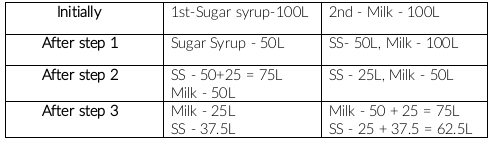
There are two containers of the same volume, first container half-filled with sugar syrup and the second container half-filled with milk. Half the content of the first container is transferred to the second container, and then the half of this mixture is transferred back to the first container. Next, half the content of the first container is transferred back to the second container. Then the ratio of sugar syrup and milk in the second container is
Step 1: Half the content of the first container is transferred to the second container
Step 2: Half of the mixture of second container is transferred back to the first container
Step 3: Half the content of the first container is transferred back to the second container
Sugar syrup : Milk in second container = 62.5 : 75 = 5 : 6
The answer is option D.
If a and b are non-negative real numbers such that a+ 2b = 6, then the average of the maximum and minimum possible values of (a+ b) is
a + 2b = 6
From the above equation, we can say that maximum value b can take is 3 and minimum value b can take is 0.
a + b + b = 6
a + b = 6 - b
a + b is maximum when b is minimum, i.e. b = 0
Maximum value of a + b = 6 - 0 = 6
a + b is minimum when b is maximum, i.e. b = 3
Minimum value of a + b = 6 - 3 = 3
Average = $$\ \frac{\ 6+3}{2}$$ = 4.5
The answer is option D.
Five students, including Amit, appear for an examination in which possible marks are integers between 0 and 50, both inclusive. The average marks for all the students is 38 and exactly three students got more than 32. If no two students got the same marks and Amit got the least marks among the five students, then the difference between the highest and lowest possible marks of Amit is
The average marks for all the students is 38.
Sum = 5*38 = 190
To find the minimum marks scored by Amit, we need to maximise the score of remaining students.
Maximum scores sum of remaining students = 50 + 49 + 48 + 32 = 179
Minimum possible score of Amit = 190 - 179 = 11
It is given, Amit scored least. This implies maximum possible score of Amit is 31.
Difference = 31 - 11 = 20
The answer is option D.
Onion is sold for 5 consecutive months at the rate of Rs 10, 20, 25, 25, and 50 per kg, respectively. A family spends a fixed amount of money on onion for each of the first three months, and then spends half that amount on onion for each of the next two months. The average expense for onion, in rupees per kg, for the family over these 5 months is closest to
Let us assume the family spends Rs. 100 each month for the first 3 months and then spends Rs. 50 in each of the next two months.
Then amount of onions bought = 10, 5, 4, 2, 1, for months 1-5 respectively.
Total amount bought = 22kg.
Total amount spent = 100+100+100+50+50 = 400.
Average expense = $$\frac{400}{22}=Rs.18.18\approx\ 18$$
From a container filled with milk, 9 litres of milk are drawn and replaced with water. Next, from the same container, 9 litres are drawn and again replaced with water. If the volumes of milk and water in the container are now in the ratio of 16 : 9, then the capacity of the container, in litres, is
Let initial volume be V, final be F for milk.
The formula is given by : $$F\ =\ V\cdot\left(1-\frac{K}{V}\right)^n$$ n is the number of times the milk is drawn and replaced.
so we get $$F=\ V\left(1-\frac{K}{V}\right)^{^2}$$
here K =9
we get
$$\frac{16}{25}V\ =\ V\ \left(1-\frac{9}{V}\right)^{^2}$$
we get $$1-\frac{9}{V}=\ \frac{4}{5}or\ -\frac{4}{5}$$
If considering $$1-\frac{9}{V}=-\frac{4}{5}$$
V =5, but this is not possible because 9 liters is drawn every time.
Hence : $$1-\frac{9}{V}=\frac{4}{5},\ V\ =\ 45\ liters$$
The arithmetic mean of scores of 25 students in an examination is 50. Five of these students top the examination with the same score. If the scores of the other students are distinct integers with the lowest being 30, then the maximum possible score of the toppers is
Let sum of marks of students be x
Now therefore x = 25*50 =1250
Now to maximize the marks of the toppers
We will minimize the marks of 20 students
so their scores will be (30,31,32.....49 )
let score of toppers be y
so we get 5y +$$\frac{20}{2}\left(79\right)$$=1250
we get 5y +790=1250
5y=460
y=92
So scores of toppers = 92
If a certain weight of an alloy of silver and copper is mixed with 3 kg of pure silver, the resulting alloy will have 90% silver by weight. If the same weight of the initial alloy is mixed with 2 kg of another alloy which has 90% silver by weight, the resulting alloy will have 84% silver by weight. Then, the weight of the initial alloy, in kg, is
Let the alloy contain x Kg silver and y kg copper
Now when mixed with 3Kg Pure silver
we get $$\frac{\left(x+3\right)}{x+y+3}=\frac{9}{10}$$
we get 10x+30 =9x+9y+27
9y-x=3 (1)
Now as per condition 2
silver in 2nd alloy = 2(0.9) =1.8
so we get$$\frac{\left(x+1.8\right)}{x+y+2}=\frac{21}{25}$$
we get 21y-4x =3 (2)
solving (1) and (2) we get y= 0.6 and x =2.4
so x+y = 3
In a football tournament, a player has played a certain number of matches and 10 more matches are to be played. If he scores a total of one goal over the next 10 matches, his overall average will be 0.15 goals per match. On the other hand, if he scores a total of two goals over the next 10 matches, his overall average will be 0.2 goals per match. The number of matches he has played is
Let Total matches played be n and in initial n-10 matches his goals be x
so we get $$\frac{\left(x+1\right)}{n}=0.15$$
we get x+1 =0.15n (1)
From condition (2) we get :
$$\frac{\left(x+2\right)}{n}=0.2$$
we get x+2 = 0.2n (2)
Subtracting (1) and (2)
we get 1 =0.05n
n =20
So initially he played n-10 =10 matches
A person buys tea of three different qualities at ₹ 800, ₹ 500, and ₹ 300 per kg, respectively, and the amounts bought are in the proportion 2 : 3 : 5. She mixes all the tea and sells one-sixth of the mixture at ₹ 700 per kg. The price, in INR per kg, at which she should sell the remaining tea, to make an overall profit of 50%, is
Considering the three kinds of tea are A, B, and C.
The price of kind A = Rs 800 per kg.
The price of kind B = Rs 500 per kg.
The price of kind C = Rs 300 per kg.
They were mixed in the ratio of 2 : 3: 5.
1/6 of the total mixture is sold for Rs 700 per kg.
Assuming the ratio of mixture to A = 12kg, B = 18kg, C =30 kg.
The total cost price is 800*12+500*18+300*30 = Rs 27600.
Selling 1/6 which is 10kg for Rs 700/kg the revenue earned is Rs 7000.
In order to have an overall profit of 50 percent on Rs 27600.
Thes selling price of the 60 kg is Rs 27600*1.5 = Rs 41400.
Hence he must sell the remaining 50 kg mixture for Rs 41400 - Rs 7000 = 34400.
Hence the price per kg is Rs 34400/50 = Rs 688
The strength of an indigo solution in percentage is equal to the amount of indigo in grams per 100 cc of water. Two 800 cc bottles are filled with indigo solutions of strengths 33% and 17%, respectively. A part of the solution from the first bottle is thrown away and replaced by an equal volume of the solution from the second bottle. If the strength of the indigo solution in the first bottle has now changed to 21% then the volume, in cc, of the solution left in the second bottle is
Let Bottle A have an indigo solution of strength 33% while Bottle B have an indigo solution of strength 17%.
The ratio in which we mix these two solutions to obtain a resultant solution of strength 21% : $$\frac{A}{B}=\frac{21-17}{33-21}=\frac{4}{12}or\ \frac{1}{3}$$
Hence, three parts of the solution from Bottle B is mixed with one part of the solution from Bottle A. For this process to happen, we need to displace 600 cc of solution from Bottle A and replace it with 600 cc of solution from Bottle B {since both bottles have 800 cc, three parts of this volume = 600cc}.As a result, 200 cc of the solution remains in Bottle B.
Hence, the correct answer is 200 cc.
Identical chocolate pieces are sold in boxes of two sizes, small and large. The large box is sold for twice the price of the small box. If the selling price per gram of chocolate in the large box is 12% less than that in the small box, then the percentage by which the weight of chocolate in the large box exceeds that in the small box is nearest to
Let the selling price of the Large and Small boxes of chocolates be Rs.200 and Rs.100 respectively. Let us consider that the Large box has $$L$$ grams of chocolate while the Small box has $$S$$ grams of chocolate.
The relation between the selling price per gram of chocolate can be represented as: $$\frac{200}{L}=0.88\times\ \frac{100}{S}$$
On solving we obtain the ratio of the amount of chocolate in each box as: $$\frac{L}{S}=\frac{25}{11}$$
The percentage by which the weight of chocolate in the large box exceeds that in the small box = $$\left(\frac{25}{11}-1\right)\times\ 100\approx\ 127\%$$
Two alcohol solutions, A and B, are mixed in the proportion 1:3 by volume. The volume of the mixture is then doubled by adding solution A such that the resulting mixture has 72% alcohol. If solution A has 60% alcohol, then the percentage of alcohol in solution B is
Initially let's consider A and B as one component
The volume of the mixture is doubled by adding A(60% alcohol) i.e they are mixed in 1:1 ratio and the resultant mixture has 72% alcohol.
Let the percentage of alcohol in component 1 be 'x'.
Using allegations , $$\frac{\left(72-60\right)}{x-72}=\frac{1}{1}$$ => x= 84
Percentage of alcohol in A = 60% => Let's percentage of alcohol in B = x%
The resultant mixture has 84% alcohol. ratio = 1:3
Using allegations , $$\frac{\left(x-84\right)}{84-60}=\frac{1}{3}$$
=> x= 92%
A batsman played n + 2 innings and got out on all occasions. His average score in these n + 2 innings was 29 runs and he scored 38 and 15 runs in the last two innings. The batsman scored less than 38 runs in each of the first n innings. In these n innings, his average score was 30 runs and lowest score was x runs. The smallest possible value of x is
Given, $$\frac{\text{sum of scores in n matches+38+15}}{n+2}=29$$
Given, $$\frac{\text{sum of scores in n matches}}{n}=30$$
=> 30n + 53 = 29(n+2) => n=5
Sum of the scores in 5 matches = 29*7 - 38-15 = 150
Since the batsmen scored less than 38, in each of the first 5 innings. The value of x will be minimum when remaining four values are highest
=> 37+37+37+37 + x = 150
=> x = 2
A solution, of volume 40 litres, has dye and water in the proportion 2 : 3. Water is added to the solution to change this proportion to 2 : 5. If one fourths of this diluted solution is taken out, how many litres of dye must be added to the remaining solution to bring the proportion back to 2 : 3?
Initially the amount of Dye and Water are 16,24 respectively.
To make the ratio of Dye to Water to 2:5 the amount of water should be 40l for 16l of Dye=> 16l of water is added.
Now, the Dye and Water arr 16,40 respectively.
After removing 1/4th of solution the amount of Dye and Water will be 12,30l respectively.
To have Dye and Water in the ratio of 2:3, for 30l of water we need 20l of Dye => 8l of Dye should be added.
Hence , 8 is correct answer.
An alloy is prepared by mixing three metals A, B and C in the proportion 3 : 4 : 7 by volume. Weights of the same volume of the metals A. B and C are in the ratio 5 : 2 : 6. In 130 kg of the alloy, the weight, in kg. of the metal C is
Let the volume of Metals A,B,C we 3x, 4x, 7x
Ratio weights of given volume be 5y,2y,6y
.'. 15xy+8xy+42xy=130 => 65xy=130 => xy=2.
.'.`The weight, in kg. of the metal C is 42xy=84.
The average of 30 integers is 5. Among these 30 integers, there are exactly 20 which do not exceed 5. What is the highest possible value of the average of these 20 integers?
It is given that the average of the 30 integers = 5
Sum of the 30 integers = 30*5=150
There are exactly 20 integers whose value is less than 5.
To maximise the average of the 20 integers, we have to assign minimum value to each of the remaining 10 integers
So the sum of 10 integers = 10*6=60
The sum of the 20 integers = 150-60= 90
Average of 20 integers = $$\ \frac{\ 90}{20}$$ = 4.5
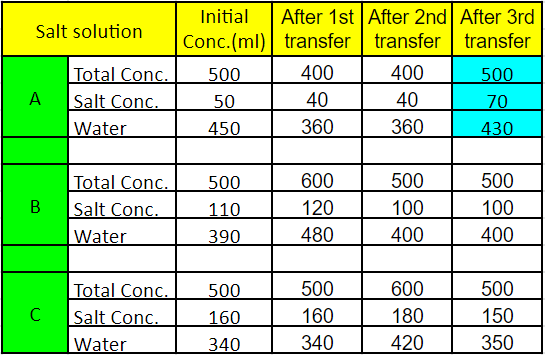
The strength of a salt solution is p% if 100 ml of the solution contains p grams of salt. Each of three vessels A, B, C contains 500 ml of salt solution of strengths 10%, 22%, and 32%, respectively. Now, 100 ml of the solution in vessel A is transferred to vessel B. Then, 100 ml of the solution in vessel B is transferred to vessel C. Finally, 100 ml of the solution in vessel C is transferred to vessel A. The strength, in percentage, of the resulting solution in vessel A is
Each of three vessels A, B, C contains 500 ml of salt solution of strengths 10%, 22%, and 32%, respectively.
The amount of salt in vessels A, B, C = 50 ml, 110 ml, 160 ml respectively.
The amount of water in vessels A, B, C = 450 ml, 390 ml, 340 ml respectively.
In 100 ml solution in vessel A, there will be 10ml of salt and 90 ml of water
Now, 100 ml of the solution in vessel A is transferred to vessel B. Then, 100 ml of the solution in vessel B is transferred to vessel C. Finally, 100 ml of the solution in vessel C is transferred to vessel A
i.e after the first transfer, the amount of salt in vessels A, B, C = 40, 120, 160 ml respectively.
after the second transfer, the amount of salt in vessels A, B, C =40, 100, 180 ml respectively.
After the third transfer, the amount of salt in vessels A, B, C = 70, 100, 150 respectively.
Each transfer can be captured through the following table.
Percentage of salt in vessel A =$$\ \frac{\ 70}{500}\times\ 100$$
=14%
A chemist mixes two liquids 1 and 2. One litre of liquid 1 weighs 1 kg and one litre of liquid 2 weighs 800 gm. If half litre of the mixture weighs 480 gm, then the percentage of liquid 1 in the mixture, in terms of volume, is
The weight/volume(g/L) for liquid 1 = 1000
The weight/volume(g/L) for liquid 2 = 800
The weight/volume(g/L) of the mixture = 480/(1/2) = 960
Using alligation the ratio of liquid 1 and liquid 2 in the mixture = (960-800)/(1000-960) = 160/40 = 4:1
Hence the percentage of liquid 1 in the mixture = 4*100/(4+1)=80
Ramesh and Gautam are among 22 students who write an examination. Ramesh scores 82.5. The average score of the 21 students other than Gautam is 62. The average score of all the 22 students is one more than the average score of the 21 students other than Ramesh. The score of Gautam is
Assume the average of 21 students other than Ramesh = a
Sum of the scores of 21 students other than Ramesh = 21a
Hence the average of 22 students = a+1
Sum of the scores of all 22 students = 22(a+1)
The score of Ramesh = Sum of scores of all 22 students - Sum of the scores of 21 students other than Ramesh = 22(a+1)-21a=a+22 = 82.5 (Given)
=> a = 60.5
Hence, sum of the scores of all 22 students = 22(a+1) = 22*61.5 = 1353
Now the sum of the scores of students other than Gautam = 21*62 = 1302
Hence the score of Gautam = 1353-1302=51
In an apartment complex, the number of people aged 51 years and above is 30 and there are at most 39 people whose ages are below 51 years. The average age of all the people in the apartment complex is 38 years. What is the largest possible average age, in years, of the people whose ages are below 51 years?
The possible average age of people whose ages are below 51 years will be maximum if the average age of the number of people aged 51 years and above is minimum. Hence, we can say that that there are 30 people having same age 51 years.
Let 'x' be the maximum average age of people whose ages are below 51.
Then we can say that,
$$\dfrac{51*30+39*x}{30+39} = 38$$
$$\Rightarrow$$ $$1530+39x = 2622$$
$$\Rightarrow$$ $$x = 1092/39 = 28$$
Hence, we can say that option D is the correct answer.
A CAT aspirant appears for a certain number of tests. His average score increases by 1 if the first 10 tests are not considered, and decreases by 1 if the last 10 tests are not considered. If his average scores for the first 10 and the last 10 tests are 20 and 30, respectively, then the total number of tests taken by him is
Let the total number of tests be 'n' and the average by 'A'
Total score = n*A
When 1st 10 tests are excluded, decrease in total value of scores = (nA - 20 * 10) = (nA - 200)
Also, (n - 10)(A + 1) = (nA - 200)
On solving, we get 10A - n = 190..........(i)
When last 10 tests are excluded, decrease in total value of scores = (nA - 30 * 10) = (nA - 300)
Also, (n - 10)(A - 1) = (nA - 300)
On solving, we get 10A + n = 310..........(ii)
From (i) and (ii), we get n = 60
Hence, 60 is the correct answer.
An elevator has a weight limit of 630 kg. It is carrying a group of people of whom the heaviest weighs 57 kg and the lightest weighs 53 kg. What is the maximum possible number of people in the group?
It is given that the maximum weight limit is 630. The lightest person's weight is 53 Kg and the heaviest person's weight is 57 Kg.
In order to have maximum people in the lift, all the remaining people should be of the lightest weight possible, which is 53 Kg.
Let there be n people.
53 + n(53) + 57 = 630
n is approximately equal to 9.8. Hence, 9 people are possible.
Therefore, a total of 9 + 2 = 11 people can use the elevator.
The average height of 22 toddlers increases by 2 inches when two of them leave this group. If the average height of these two toddlers is one-third the average height of the original 22, then the average height, in inches, of the remaining 20 toddlers is
Let the average height of 22 toddlers be 3x.
Sum of the height of 22 toddlers = 66x
Hence average height of the two toddlers who left the group = x
Sum of the height of the remaining 20 toddlers = 66x - 2x = 64x
Average height of the remaining 20 toddlers = 64x/20 = 3.2x
Difference = 0.2x = 2 inches => x = 10 inches
Hence average height of the remaining 20 toddlers = 3.2x = 32 inches
A class consists of 20 boys and 30 girls. In the mid-semester examination, the average score of the girls was 5 higher than that of the boys. In the final exam, however, the average score of the girls dropped by 3 while the average score of the entire class increased by 2. The increase in the average score of the boys is
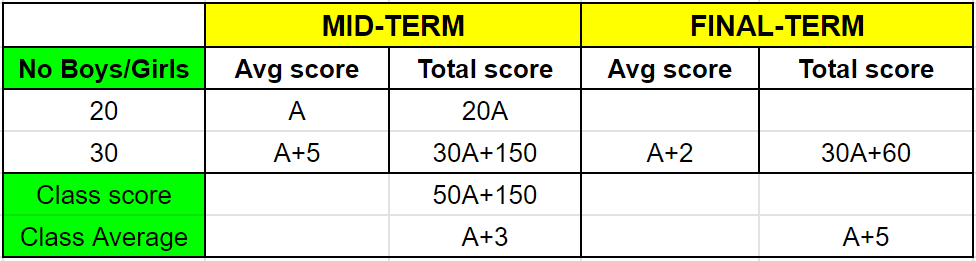
Let, the average score of boys in the mid semester exam is A.
Therefore, the average score of girls in the mid semester exam be A+5.
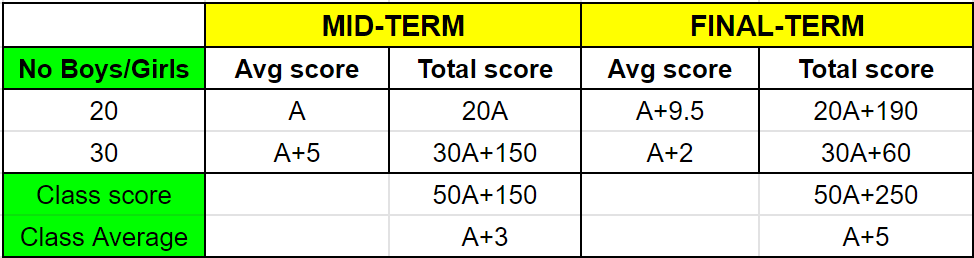
Hence, the total marks scored by the class is $$20\times (A) + 30\times (A+5) = 50\times A + 150$$
The average score of the entire class is $$\dfrac{(50\times A + 150)}{50} = A + 3$$
wkt, class average increased by 2, class average in final term $$= (A+3) + 2 = A + 5$$
Given, that score of girls dropped by 3, i.e $$(A+5)-3 = A+2$$
Total score of girls in final term $$= 30\times(A+2) = 30A + 60$$
Total class score in final term $$= (A + 5)\times50 = 50A + 250$$
the total marks scored by the boys is $$(50A + 250) - (30A - 60) = 20A + 190$$
Hence, the average of the boys in the final exam is $$\dfrac{(20G + 190)}{20} = A + 9.5$$
Hence, the increase in the average marks of the boys is $$(A+9.5) - A = 9.5$$
Consider the set S = {2, 3, 4, ...., 2n+1}, where n is a positive integer larger than 2007. Define X as the average of the odd integers in S and Y as the average of the even integers in S. What is the value of X - Y ?
The odd numbers in the set are 3, 5, 7, ...2n+1
Sum of the odd numbers = 3+5+7+...+(2n+1) = $$n^2 + 2n$$
Average of odd numbers = $$n^2 + 2n$$/n = n+2
Sum of even numbers = 2 + 4 + 6 + ... + 2n = 2(1+2+3+...+n) = 2*n*(n+1)/2 = n(n+1)
Average of even numbers = n(n+1)/n = n+1
So, difference between the averages of even and odd numbers = 1
Ten years ago, the ages of the members of a joint family of eight people added up to 231 years. Three years later, one member died at the age of 60 years and a child was born during the same year. After another three years, one more member died, again at 60, and a child was born during the same year. The current average age of this eight-member joint family is nearest to
Ten years ago, the total age of the family is 231 years.
Seven years ago, (Just before the death of the first person), the total age of the family would have been 231+8*3 = 231+24 = 255.
This is because, in 3 years, every person in the family would have aged by 3 years,
Total change in age = 231+24 = 255
After the death of one member, the total age is 255-60 = 195 years.
Since a child takes birth in the same year, the number of members remain the same i.e. (7+1) = 8
Four years ago, (i.e. 6 years after start date) one of the member of age 60 dies,
therefore, total age of the family is 195+24-60 = 159 years.
Since a child takes birth in the same year, the number of members remain the same i.e. (7+1) = 8
After 4 more years, the current total age of the family is = 8x4 + 159 = 191 years
The average age is 191/8 = 23.875 years = 24 years (approx)
Alternatively,
Since the number of members is always the same throughout
The 2 older members dropped their age by 60
So, after 10yrs, total age = 231 + 8*10 - 2*60 = 191
Average age = 191/8 = 23.875 $$\simeq$$ 24
Amol was asked to calculate the arithmetic mean of 10 positive integers, each of which had 2 digits. By mistake, he interchanged the 2 digits, say a and b, in one of these 10 integers. As a result, his answer for the arithmetic mean was 1.8 more than what it should have been. Then |b - a| equals
Let the actual average be n. So, the new average is n + 1.8
Actual total = 10n
New total = 10n + 18
Let the number which was miswritten = ab(a is the tenth's digit and b is the units digit) = 10a+b
and reversed number ba = 10b+a
So, 10b + a - (10a + b) = 18
=> 9(b-a) = 18
=> b-a = 2
Three classes X, Y and Z take an algebra test.
The average score in class X is 83.
The average score in class Y is 76.
The average score in class Z is 85.
The average score of all students in classes X and Y together is 79.
The average score of all students in classes Y and Z together is 81.
What is the average for all the three classes?
Let x , y and z be no. of students in class X, Y ,Z respectively.
From 1st condition we have
83*x+76*y = 79*x+79*y which give 4x = 3y.
Next we have 76*y + 85*z = 81(y+z) which give 4z = 5y .
Now overall average of all the classes can be given as $$\frac{83x+76y+85z}{x+y+z}$$
Substitute the relations in above equation we get,
$$\frac{83x+76y+85z}{x+y+z}$$ = (83*3/4 + 76 + 85*5/4)/(3/4 + 1 + 5/4) = 978/12 = 81.5
Consider a sequence of seven consecutive integers. The average of the first five integers is n. The average of all the seven integers is:
The first five numbers could be n-2, n-1, n, n+1, n+2. The next two number would then be, n+3 and n+4, in which case, the average of all the 7 numbers would be $$\frac{(5n+2n+7)}{7}$$ = n+1
Total expenses of a boarding house are partly fixed and partly varying linearly with the number of boarders. The average expense per boarder is Rs. 700 when there are 25 boarders and Rs. 600 when there are 50 boarders. What is the average expense per boarder when there are 100 boarders?
Let the fixed income be x and the number of boarders be y.
x + 25y = 17500
x + 50y = 30000
=> y = 500 and x = 5000
x + 100y = 5000 + 50000 = 55000
Average expense = $$\frac{55000}{100}$$ = Rs.550.
The average marks of a student in 10 papers are 80. If the highest and the lowest scores are not considered, the average is 81. If his highest score is 92, find the lowest.
Total marks = 80 x 10 = 800
Total marks except highest and lowest marks = 81 x 8 = 648
So Summation of highest marks and lowest marks will be = 800 - 648 = 152
When highest marks is 92, lowest marks will be = 152-92 = 60