The monthly sales of a product from January to April were 120, 135, 150 and 165 units, respectively. The cost price of the product was Rs. 240 per unit, and a fixed marked price was used for the product in all the four months. Discounts of 20%, 10% and 5% were given on the marked price per unit in January, February and March, respectively, while no discounts were given in April. If the total profit from January to April was Rs. 138825, then the marked price per unit, in rupees, was

CAT Arithmetic Questions
The total number of products is $$120+135+150+165= 570$$. Therefore, the total cost must have been $$570\times 240 = 136800$$
Let the marked price for the products be $$X$$. The January, February, March, and April, selling prices would respectively be $$0.8X$$, $$0.9X$$, $$0.95X$$, and $$X$$; based on the discounts given on each of the months.
The revenue earned from selling the products in each of the months would be: $$120*0.8X + 135*0.9X + 150*0.95X + 165*X = 525X$$.
The profit earned would be: Revenue - Cost, and therefore,
$$525X - 136800 = 138825$$
$$525X = 275625$$
$$X = \dfrac{275625}{525} = 525$$
The correct answer is option B, Rs. 525.
Shruti travels a distance of 224 km in four parts for a total travel time of 3 hours. Her speeds in these four parts follow an arithmetic progression, and the corresponding time taken to cover these four parts follow another arithmetic progression. If she travels at a speed of 960 meters per minute for 30 minutes to cover the first part, then the distance, in meters, she travels in the fourth part is
According to question, Shruti travels a distance of 224 km in four parts for a total travel time of 3 hours.
Given, in the first part time required is 30 minutes.
Also, the time taken to cover these four parts follow arithmetic progression.
So, let us say the times be 30 minutes, (30+d) minutes, (30+2d) minutes and (30+3d) minutes
So, $$30+\left(30+d\right)+\left(30+2d\right)+\left(30+3d\right)=180$$
or, $$6d=180-120$$
or, $$6d=60$$
or, $$d=\dfrac{60}{6}=10$$ minutes.
So, the time required in these four parts are 30 minutes, 40 minutes, 50 minutes and 60 minutes respectively.
Now, in the first part, speed is 960 metres per minute.
Speed in the four parts is also in arithmetic progression.
Let's say the speeds be $$(960+x)$$,$$(960+2x)$$,$$(960+3x)$$ metres per minute
So, total distance covered = $$960\times\ 30+\left(960+x\right)\times\ 40+\left(960+2x\right)\times\ 50+\left(960+3x\right)\times\ 60$$ metres
So, $$960\times\ 30+\left(960+x\right)\times\ 40+\left(960+2x\right)\times\ 50+\left(960+3x\right)\times\ 60=224000$$
or, $$960\left(30+40+50+60\right)+40x+\left(2x\right)\left(50\right)+\left(3x\right)\left(60\right)=224000$$
or, $$172800+320x=224000$$
or, $$320x=224000-172800=51200$$
or, $$x=\dfrac{51200}{320}=160$$
So, the speed in the fourth part is $$960+3x=960+3\times\ 160=1440$$ metres per minute
Time in the fourth part is 60 minutes
So, distance covered in the fourth part = $$1440\times\ 60=86400$$ metres
So, option D is the correct answer.
Teams A, B, and C consist of five, eight, and ten members, respectively, such that every member within a team is equally productive. Working separately, teams A, B, and C can complete a certain job in 40 hours, 50 hours, and 4 hours, respectively. Two members from team A, three members from team B, and one member from team C together start the job, and the member from team C leaves after 23 hours. The number of additional member(s) from team B, that would be required to replace the member from team C, to finish the job in the next one hour, is
Let the per hour productivity of each member from teams A, B, and C, be $$a$$, $$b$$, and $$c$$ units respectively.
Let $$W$$ be the total units of work that each of the teams does. We have:
$$W = 40*5*a = 50*8*b = 4*10*c$$
This gives, $$a= \dfrac{W}{200}$$, $$b= \dfrac{W}{400}$$, and $$c = \dfrac{W}{40}$$
When two members from team A, three members from team B, and one member from team C together start the job, the total per hour productivity for the first 23 hours will be;
$$\dfrac{2W}{200} + \dfrac{3W}{400} + \dfrac{W}{40} = \dfrac{17W}{400}$$.
In 23 hours, the work done will be $$\dfrac{23*17W}{400} = \dfrac{391W}{400}$$
The remaining work, after 23 hours, is $$W - \dfrac{391W}{400} = \dfrac{9}{400}$$
The current per hour efficiency of the group that comprises members from only teams A and B, is $$\dfrac{2W}{200} + \dfrac{3W}{400} = \dfrac{7W}{400}$$
In the next hour, the members from A and B will finish $$\dfrac{7W}{400}$$ units of work and $$\dfrac{9W}{400}-\dfrac{7W}{400} = \dfrac{2W}{400}$$ units of work would remain.
This work has to be finished by newly added members from team B in one hour, therefore, the number of new members required from team B would be $$\dfrac{2W}{400} \div \dfrac{W}{400} = 2$$
Option B is the correct answer.
An item with a cost price of Rs. 1650 is sold at a certain discount on a fixed marked price to earn a profit of 20% on the cost price. If the discount was doubled, the profit would have been Rs. 110. The rate of discount, in percentage, at which the profit percentage would be equal to the rate of discount, is nearest to
Let the marked price be M and the initial discount rate be d. The cost price is 1650. A profit of 20% means the selling price is
$$SP = 1650 \times 1.2 = 1980$$
With discount d,
$$M(1-d) = 1980$$
If the discount is doubled, the selling price becomes (M(1-2d)), and the profit is 110, so
$$M(1-2d) - 1650 = 110 \Rightarrow M(1-2d) = 1760$$
Subtracting the two equations:
$$M(1-d) - M(1-2d) = 1980 - 1760 \Rightarrow Md = 220 \Rightarrow M = \frac{220}{d}$$
Plug into the first equation:
$$ \frac{220}{d}(1-d) = 1980 \Rightarrow \frac{1-d}{d} = 9 \Rightarrow 1-d = 9d \Rightarrow d = 0.1 $$
So the initial discount rate is 10% and the marked price is
$$M = \frac{220}{0.1} = 2200 $$
Now, let the discount rate be (r) such that the profit percentage equals the discount percentage. Then
$$\frac{2200(1-r) - 1650}{1650} = r$$
Simplify:
$$2200(1-r) - 1650 = 1650 r \Rightarrow 2200 - 2200r - 1650 = 1650r \Rightarrow 550 = 3850 r \Rightarrow r = \frac{550}{3850} \approx 0.142857 $$
Thus, the required discount rate is approximately 14%
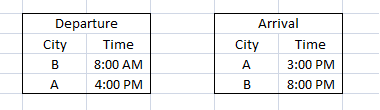
Ankita walks from A to C through B, and runs back through the same route at a speed that is 40% more than her walking speed. She takes exactly 3 hours 30 minutes to walk from B to C as well as to run from B to A. The total time, in minutes, she would take to walk from A to B and run from B to C, is
Let the walking speed of Ankita be $$5x$$, implying that her running speed (which is $$40\%$$ more than her walking speed), is $$1.4\times 5x = 7x$$.
Thus, the ratio of her walking and running speeds is $$5:7$$. Therefore, the ratio of the time taken by Ankita to cover a fixed distance walking and running would by $$7:5$$.
She takes 3 hours 30 minutes, or $$3.5$$ hours to walk from B to C. Since Ankita is running from B to C in the second scenario, her time will reduce inversely to the ratio of her speed. The time taken by her to run from B to C would be $$\dfrac{3.5}{7}\times 5 = 2.5$$ hours.
She takes 3 hours 30 minutes, or $$3.5$$ hours to run from A to B. Since Ankita is walking from A to B in the second scenario, her time will increase inversely to the ratio of her speed. The time taken by her to walk from A to B would be $$\dfrac{3.5}{5}\times 7 = 4.9$$ hours.
Therefore, the total time it takes for Ankita in the second scenario is $$4.9+2.5 = 7.4$$ hours. This gives $$7.4*60 = 444$$ minutes.
Rahul starts on his journey at 5 pm at a constant speed so that he reaches his destination at 11 pm the same day. However, on his way, he stops for 20 minutes, and after that, increases his speed by 3 km per hour to reach on time. If he had stopped for 10 minutes more, he would have had to increase his speed by 5 km per hour to reach on time. His initial speed, in km per hour, was
Let the initial speed of Rahul be $$x$$ kilometres per hour. Since he travels the distance usually in $$6$$ hours, (5 pm to 11 pm), the total distance should be $$6\times x = 6x$$ kilometres.
Let the distance after which Rahul stops for some duration in both scenarios be $$y$$ kilometres.
In the first scenario, he stops for $$20$$ minutes or $$\dfrac{1}{3}$$ hours, therefore, the travel time would be $$6-\dfrac{1}{3} = \dfrac{17}{3}$$ hours. We have,
$$\dfrac{k}{x} + \dfrac{6x-k}{x+3} = \dfrac{17}{3}$$
$$\Rightarrow \dfrac{6x^2+3k}{x^2+3x} = \dfrac{17}{3}$$
$$\Rightarrow 18x^2 + 9k = 17x^2 + 51x$$
$$\Rightarrow x^2 = 51x - 9k$$ .....(1)
Similarly, in the second scenario, he stops for $$20+10=30$$ minutes or $$\dfrac{1}{2}$$ hours, therefore, the travel time would be $$6-\dfrac{1}{2} = \dfrac{11}{2}$$ hours. We have,
$$\dfrac{k}{x} + \dfrac{6x-k}{x+5} = \dfrac{11}{2}$$
$$\Rightarrow \dfrac{6x^2+5k}{x^2+5x} = \dfrac{11}{2}$$
$$\Rightarrow 12x^2 + 10k = 11x^2 + 55x$$
$$\Rightarrow x^2 = 55x - 10k$$ .....(2)
From equations (1) and (2), we have;
$$55x - 10k = 51x - 9k$$ or
$$4x = k$$.
Substituting the value of $$k$$ in equation (1), we have
$$x^2 = 51x - 36x$$ or, since $$x$$ is positive, $$x= 15$$. Therefore, option B is the correct answer.
The rate of water flow through three pipes A, B and C are in the ratio 4 : 9 : 36. An empty tank can be filled up completely by pipe A in 15 hours. If all the three pipes are used simultaneously to fill up this empty tank, the time, in minutes, required to fill up the entire tank completely is nearest to
Let the rate of flow of water from pipe A be $$4x$$ units per hour. From the ratio of the rates of flow of water (4:9:36), we have that the rate of flow of water from pipe B should be $$9x$$ units per hour, and from pipe C should be $$36x$$ units per hour.
Since pipe A fills the empty tank in 15 hours, the capacity of the tank must be $$15\times 4x = 60x$$ units.
When all three pipes work together, their combined capacity would be $$4x+9x+36x = 49x$$ units per hour.
Therefore, the time it would take for the three pipes to fill the empty tank working together is: $$\dfrac{60x}{49x}$$ hours
In minutes, this time is equivalent to $$\dfrac{60x}{49x}\times 60 \approx 73.47$$ minutes.
Option A is the closest, and is the correct answer.
At a certain simple rate of interest, a given sum amounts to Rs 13920 in 3 years, and to Rs 18960 in 6 years and 6 months. If the same given sum had been invested for 2 years at the same rate as before but with interest compounded every 6 months, then the total interest earned, in rupees, would have been nearest to
Let the principal be ₹ P and rate of interest be r%.
Now, $$13920=P+\dfrac{P\times\ r\times\ 3}{100}$$
or, $$13920-P=\dfrac{P\times\ r\times\ 3}{100}$$ ---->(1)
Also, $$18960=P+\dfrac{P\times\ r\times\ 13}{100\times\ 2}$$
$$18960-P=\dfrac{P\times\ r\times13}{100\times\ 2}$$ ----->(2)
Dividing eqn(1) by eqn(2),
$$\dfrac{13920-P}{18960-P}=\dfrac{3}{\frac{12}{2}}=\dfrac{6}{13}$$
or, $$\left(13920-P\right)13=\left(18960-P\right)6$$
or, $$13920\times\ 13-13P=18960\times\ 6-6P$$
or, $$13920\times\ 13-18960\times\ 6=13P-6P$$
or, $$180960-113760=7P$$
or, $$67200=7P$$
or, $$P=\dfrac{67200}{7}=9600$$
Putting this in equation (1),
$$13920-9600=\dfrac{9600\times\ r\times\ 3}{100}$$
or, $$4320=96\times\ 3r$$
or, $$r=\dfrac{4320}{96\times\ 3}=15$$
So, rate percent is $$15\%$$
Now if the same sum had been invested for 2 years at the same rate as before but with interest compounded every 6 months, amount = $$9600\left(1+\dfrac{\frac{15}{2}}{100}\right)^4=9600\left(1+\frac{7.5}{100}\right)^4$$
So, interest = $$9600\left(1+\frac{7.5}{100}\right)^4-9600$$
= Rs 3220.50
= Rs 3221
So, the total interest earned is Rs 3221.
Rita and Sneha can row a boat at 5 km/h and 6 km/h in still water, respectively. In a river flowing with a constant velocity, Sneha takes 48 minutes more to row 14 km upstream than to row the same distance downstream. If Rita starts from a certain location in the river, and returns downstream to the same location, taking a total of 100 minutes, then the total distance, in km, Rita will cover is
Let the river speed be v km/h. For Sneha still-water speed = 6 km/h:
Upstream speed = (6-v), downstream speed = (6+v).
Given $$\dfrac{14}{(6-v)}-\dfrac{14}{(6+v)}=48$$minutes =0.8 hours.
So, $$\dfrac{14(6+v-6+v)}{36-v^2}=0.8 \Rightarrow \dfrac{28v}{36-v^2}=0.8$$
$$28v=0.8(36-v^2)=28.8-0.8v^2 \Rightarrow 0.8v^2+28v-28.8=0$$
Multiply by 5: $$4v^2+140v-144=0$$
$$v^2+35v-36=0$$
We get v = 1
Thus, the river speed is 1 km/h. For Rita, the still water speed is 5 km/h:
Upstream speed = 5-1=4 km/h, Downstream Speed = (5+1=6) km/h.
If she rows d km upstream and returns d km downstream, the total time
$$ \dfrac{d}{4}+\dfrac{d}{6}=d\Big(\dfrac{1}{4}+\dfrac{1}{6}\Big)=d\cdot\dfrac{5}{12}\ \text{hours}$$
This equals 100 minutes $$=100/60=\dfrac{5}{3}$$ hours.
So, $$d\cdot\dfrac{5}{12}=\dfrac{5}{3}\ \Rightarrow\ d=4\ \text{km}$$
Total distance covered 2d=8 km.
A container holds 200 litres of a solution of acid and water, having 30% acid by volume. Atul replaces 20% of this solution with water, then replaces 10% of the resulting solution with acid, and finally replaces 15% of the solution thus obtained, with water. The percentage of acid by volume in the final solution obtained after these three replacements, is nearest to
200 L with (30%) acid $$\Rightarrow$$ acid = $$0.30\times200=60 L$$
Replace 20% with water: remaining acid $$=60\times(1-0.20)=60\times0.8=48 L$$.
Replace 10% with pure acid: After removing 10% of the mixture, the acid becomes $$48\times0.9=43.2 L$$, then adding back 20 L pure acid $$\Rightarrow acid =43.2+20=63.2 L$$.
Replace 15 with water: acid left $$= 63.2\times(1-0.15)=63.2\times0.85=53.72 L$$.
Final concentration $$= \dfrac{53.72}{200}=0.2686\approx26.86%$$.
The answer is 27%
In a class, there were more than 10 boys and a certain number of girls. After 40% of the girls and 60% of the boys left the class, the remaining number of girls was 8 more than the remaining number of boys. Then, the minimum possible number of students initially in the class was
Let say number of girls be $$g$$ and number of boys be $$b$$.
If 40% of the girls left, remaining number of girls = $$0.6g$$
Also if 60% of the boys left, remaining number of boys = $$0.4b$$
or, $$0.6g=0.4b+8$$
or, $$6g=4b+80$$
or, $$3g=2b+40$$
So, the possible values of (b,g) are: (13,22),(16,24),(19,26),(22,28),(25,30),.....
Now, $$0.6g$$ and $$0.4b$$ has to be an integer.
So, for this $$g$$ and $$b$$ has to be a multiple of 5
So, $$b=25$$ and $$g=30$$
So, minimum possible number of students = $$25+30=55$$
A loan of Rs 1000 is fully repaid by two installments of Rs 530 and Rs 594, paid at the end of first and second year, respectively. If the interest is compounded annually, then the rate of interest, in percentage, is
Let the annual interest rate be (r) (in decimal). Discount the two instalments to present value:
$$\dfrac{530}{1+r}+\dfrac{594}{(1+r)^2}=1000$$
Set $$x=\dfrac{1}{1+r}$$. Then
$$594x^2+530x-1000=0$$
Discriminant = $$530^2+4\cdot594\cdot1000=280900+2376000=2656900=1630^2$$.
$$x=\dfrac{\ -b\pm\sqrt{b^2-4ac}}{2a}$$
$$x=\dfrac{-530+1630}{2\cdot594}=\frac{1100}{1188}=\dfrac{275}{297}$$
So $$1+r=\dfrac{297}{275}$$
$$r=\dfrac{297-275}{275}=\dfrac{22}{275}=\dfrac{2}{25}=0.08=8\%$$
Arun, Varun and Tarun, if working alone, can complete a task in 24, 21, and 15 days, respectively. They charge Rs 2160, Rs 2400, and Rs 2160 per day, respectively, even if they are employed for a partial day. On any given day, any of the workers may or may not be employed to work. If the task needs to be completed in 10 days or less, then the minimum possible amount, in rupees, required to be paid for the entire task is
Let's assume that Total work = 1
If the work is entirely carried by each one of them it would cost
Arun: $$2160 \times 24 = 51840$$
Varun: $$2400 \times 21 = 50400$$
Tarun: $$2160 \times 15 = 32400$$
The cheapest worker is Tarun. He can finish the work in 15 days. But we need the work completed in 10 days.
Tarun does $$10 \times \dfrac{1}{15} = \dfrac{2}{3}$$
$$1 - \dfrac{2}{3} = \dfrac{1}{3}$$
Complete the remaining (1/3) work using the next cheapest worker, which is Varun.
Days needed: $$\dfrac{x}{21} = \dfrac{1}{3} \quad\Rightarrow\quad x = 7$$
Total cost = Amount paid for Tarun + Amount paid for Varun = $$10 \times 2160 + 7 \times 2400 = 38400$$
Kamala divided her investment of Rs 100000 between stocks, bonds, and gold. Her investment in bonds was 25% of her investment in gold. With annual returns of 10%, 6%, 8% on stocks, bonds, and gold, respectively, she gained a total amount of Rs 8200 in one year. The amount, in rupees, that she gained from the bonds, was
Let the amounts invested in Stocks be S, Bonds B, and, Gold be G
Given that $$S + B + G = 100000, B = 0.25G$$
$$0.10S + 0.06B + 0.08G = 8200$$
Substitute S = 100000 - B - G = 100000 - 1.25G
$$0.10(100000 - 1.25G) + 0.06(0.25G) + 0.08G = 8200$$
$$10000 - 0.125G + 0.015G + 0.08G = 8200$$
$$10000 - 0.03G = 8200$$
$$ 0.03G = 1800 \Rightarrow G = 60000$$
$$B = 0.25G = 15000$$
Gain from bonds = $$0.06 \times 15000 = 900$$
The average salary of 5 managers and 25 engineers in a company is 60000 rupees. If each of the managers received 20% salary increase while the salary of the engineers remained unchanged, the average salary of all 30 employees would have increased by 5%. The average salary, in rupees, of the engineers is
Let the average salary of managers be $$x$$ and let the average salary of engineers be $$y$$. The total salary of all the employees will be $$(5+25)*60000 = 1800000$$
We have, $$5x+25y = 1800000$$ .... (1)
If the average salary of all the employees increases by $$5\%$$, the total salary of all the employees will also increase by $$5\%$$, because the total number of employees remains the same. The new total salary will be, $$1800000\times 1.05 = 1890000$$
Also, the average salary of all the managers has increased by $$20\%$$ and has become $$1.2x$$, we have
$$5*1.2x + 25y = 1890000$$, or $$6x + 25y = 1890000$$ .... (2)
Subtracting equation (1) from equation (2), we get,
$$x = 90000$$
Which gives $$25y = 1800000 - 90000*5$$ or $$y = \dfrac{1350000}{25} = 54000$$
Therefore, the correct answer is option C.
The ratio of expenditures of Lakshmi and Meenakshi is 2 : 3, and the ratio of income of Lakshmi to expenditure of Meenakshi is 6 : 7. If excess of income over expenditure is saved by Lakshmi and Meenakshi, and the ratio of their savings is 4 : 9, then the ratio of their incomes is
Let Lakshmi's income = A and expenditure = B.
Let Meenakshi's income = C and expenditure = D.
From B:D = 2:3, take B = 2k and D = 3k.
From A:D = 6:7, $$A = \tfrac{6}{7} D = \tfrac{6}{7}\cdot 3k = \tfrac{18}{7}k$$.
Lakshmi's saving = $$A - B = \tfrac{18}{7}k - 2k = \tfrac{4}{7}k$$.
Let Meenakshi's saving $$= C - D = C - 3k$$. Given the savings ratio $$\frac{\frac{4k}{7}}{C-3k} = \tfrac{4}{9}$$.
Solve: $$\dfrac{4}{7}k\cdot\dfrac{9}{4} = C - 3k \Rightarrow \dfrac{9}{7}k = C - 3k \Rightarrow C = \dfrac{30}{7}k$$
So incomes ratio $$A:C = \dfrac{18}{7}k : \dfrac{30}{7}k = 18:30 = 3:5.$$
A mixture of coffee and cocoa, 16% of which is coffee, costs Rs 240 per kg. Another mixture of coffee and cocoa, of which 36% is coffee, costs Rs 320 per kg. If a new mixture of coffee and cocoa costs Rs 376 per kg, then the quantity, in kg, of coffee in 10 kg of this new mixture is
Let coffee price = C Rs/kg and cocoa price = K Rs/kg.
From the two given mixtures:
$$0.16C + 0.84K = 240$$
$$0.36C + 0.64K = 320$$
Multiply both equations by 100 to remove decimals:
$$16C + 84K = 24000$$
$$36C + 64K = 32000$$
Subtract the first from the second:
$$(36C+64K)-(16C+84K)=32000-24000$$
$$20C - 20K = 8000 \implies C - K = 400$$
Put $$C=K+400$$ into $$16C+84K=24000$$:
$$16(K+400)+84K=24000 $$
$$16K+6400+84K=24000 $$
$$100K = 17600 \implies K = 176$$
So $$C = 176 + 400 = 576$$ (Rs/kg).
For the new mixture priced at Rs 376/kg, let the coffee fraction be p. Then
$$ p\cdot 576 + (1-p)\cdot 176 = 376$$
Upon solving $$p = \tfrac{1}{2}$$
Thus, coffee is (50%) of the new mixture. In 10 kg of this mixture, coffee = $$10\times 0.5 = 5\text{kg}$$
The ratio of the number of students in the morning shift and afternoon shift of a school was 13 : 9. After 21 students moved from the morning shift to the afternoon shift, this ratio became 19 : 14. Next, some new students joined the morning and afternoon shifts in the ratio 3 : 8 and then the ratio of the number of students in the morning shift and the afternoon shift became 5 : 4. The number of new students who joined is
Let M=13k, A=9k.
After 21 students were moved $$\frac{13k-21}{9k+21}=\frac{19}{14}\Rightarrow 14(13k-21)=19(9k+21)$$
So $$182k-294=171k+399\Rightarrow 11k=693\Rightarrow k=63$$
So, the number of students in the morning and afternoon shifts are $$819-21=798, 567+21=588$$ respectively.
Let's assume that $$3t$$ and $$8t$$ students joined the respective sessions.
$$\dfrac{798+3t}{588+8t}=\dfrac{5}{4}\Rightarrow 4(798+3t)=5(588+8t)$$
So $$3192+12t=2940+40t\Rightarrow 28t=252\Rightarrow t=9$$
Number of new students $$=11t=99$$
Vessels A and B contain 60 litres of alcohol and 60 litres of water, respectively. A certain volume is taken out from A and poured into B. After stirring, the same volume is taken out from B and poured into A. If the resultant ratio of alcohol and water in A is 15 : 4, then the volume, in litres, initially taken out from A is
Vessel A contains $$60$$ litres of pure alcohol, and Vessel B contains $$60$$ litres of pure water. Let the amount taken out from vessel A be $$x$$ litres. The contents in Vessel A now are $$60-x$$ litres of alcohol, and in Vessel B now are $$60$$ litres of water and $$x$$ litres of alcohol.
After mixing, when the same quantity $$x$$ is taken out from Vessel B, the alcohol that would be taken out would be $${\left(\dfrac{x}{60+x}\right)}^{\text{th}}$$ of $$x$$, which is $$\dfrac{x^2}{60+x}$$ litres.
The initial total quantity of $$60$$ litres has been restored in A after replacement. The total amount of alcohol in Vessel A after the process is complete is:
$$60 - x + \dfrac{x^2}{60+x} = \dfrac{(60+x)(60-x) + x^2}{60+x} = \dfrac{3600}{60+x}$$
The total quantity in vessel A is $$60$$ litres where the ratio of alcohol to total quantity is $$\dfrac{15}{15+4} = \dfrac{15}{19}$$
Therefore,
$$\dfrac{3600\div (60+x)}{60} = \dfrac{15}{19}$$
$$\Rightarrow \dfrac{60}{60+x} = \dfrac{15}{19}$$
$$\Rightarrow x = 16$$
Thus, the quantity taken out and replaced in the two iterations is $$16$$ litres.
Ankita is twice as efficient as Bipin, while Bipin is twice as efficient as Chandan. All three of them start together on a job, and Bipin leaves the job after 20 days. If the job got completed in 60 days, the number of days needed by Chandan to complete the job alone, is
Let Chandan’s one-day work = x.
Then Bipin = 2x and Ankita = 4x.
All three work together for the first 20 days. Their combined daily work = $$x + 2x + 4x = 7x$$.
Work done in 20 days = $$20\times7x = 140x$$.
Bipin leaves after 20 days; Ankita and Chandan continue for the remaining (60-20=40) days.
Their combined daily work = $$4x + x = 5x$$. Work done in 40 days = $$40\times5x = 200x$$.
Total work = $$140x+200x=340x$$.
We know that Chandan does x work in a day. So, the number of days it takes him to finish the work is 340.
Answer: 340 days.
The ratio of the number of coins in boxes A and B was 17:7. After 108 coins were shifted from box A to box B, this ratio became 37:20. The number of coins that needs to be shifted further from A to B, to make this ratio 1:1, is
Let the initial total number of coins in box A be $$17x$$, since the ratio of the number of coins in boxes A and B is $$17:7$$, the initial total number of coins in box B would be $$7x$$.
After $$108$$ coins are shifted from box A to box B, the number of coins in box A would be $$17x-108$$ and in box B would be $$7x+108$$. We have,
$$\dfrac{17x-108}{7x+108} = \dfrac{37}{20}$$
$$\Rightarrow 340x - 2160 = 259x + 3996$$
$$\Rightarrow 81x = 6156$$ or $$x= 76$$
Therefore, the total number of coins in the two boxes combined are $$(17+7)*76 = 1824$$, half of which is $$912$$. The number of coins in box B currently is $$7*76+108 = 640$$. The number of coins needed to make the coins equal in both the boxes is, $$912-640 = 272$$.
Thus, $$272$$ coins will be transferred from box A to box B to make the number of coins equal (1:1) in both the boxes.
A certain amount of money was divided among Pinu, Meena, Rinu and Seema. Pinu received 20% of the total amount and Meena received 40% of the remaining amount. If Seema received 20% less than Pinu, the ratio of the amounts received by Pinu and Rinu is
Let the total amount be 100 units (taking 100 makes percentage calculations easy).
Pinu receives 20% of the total, so Pinu gets 20 units.
The amount left after giving Pinu his share is 100 - 20 = 80 units.
Meena receives 40% of this remaining amount, so Meena gets 40% of 80 = 32 units.
Now, the amount left for Rinu and Seema together is 80 - 32 = 48 units.
Seema receives 20% less than Pinu. Since Pinu gets 20 units, Seema gets
20 - 20% of 20 = 20 - 4 = 16 units.
Out of the 48 units left for Rinu and Seema, Seema’s share is 16 units, so Rinu gets
48 - 16 = 32 units.
Therefore, Pinu receives 20 units, and Rinu gets 32 units.
The required ratio of the amounts received by Pinu : Rinu = 20 : 32 = 5 : 8.
A shopkeeper offers a discount of 22% on the marked price of each chair, and gives 13 chairs to a customer for the discounted price of 12 chairs to earn a profit of 26% on the transaction. If the cost price of each chair is Rs 100, then the marked price, in rupees, of each chair is
Cost price of each chair = 100
For 13 chairs, total cost = $$13 \times 100 = 1300$$
Profit = 26%, so total revenue
$$ 1.26 \times 1300 = 1638$$
We were told that this amount is equal to the discounted price of 12 chairs. So the discounted selling price per chair = $$\text{SP}_{\text{disc}} = \frac{1638}{12} = 136.5$$
Discount offered = 22%, so:
MP = $$\frac{136.5}{0.78}$$ = 175
Bina incurs 19% loss when she sells a product at Rs. 4860 to Shyam, who in turn sells this product to Hari. If Bina would have sold this product to Shyam at the purchase price of Hari, she would have obtained 17% profit. Then, the profit, in rupees, made by Shyam is
Let the cost price of the item be C
We are given that Bina sells this at 19% loss or at (1 - 0.19)C = 0.81C at 4860
This gives us the value of C at Rs. 6000
If Bina had sold this at 17% profit, the selling price would have been $$1.17\times\ 6000\ =\ 7020$$
So Shyam bought the product at 4860 and sold it to Hari at 7020
Giving the profit made by Shyam to be $$7020-4860\ =\ 2160$$
Therefore, 2160 is the correct answer.
In a group of 250 students, the percentage of girls was at least 44% and at most 60%.The rest of the students were boys. Each student opted for either swimming or running or both. If 50% of the boys and 80% of the girls opted for swimming while 70%of the boys and 60% of the girls opted for running, then the minimum and maximum possible number of students who opted for both swimming and running, are
Total number of students is 250, and we are told that, The percentage of girls was at least 44% and at most 60%.
So the number of girls range from, $$0.44\left(250\right)\le Girls\le0.6\left(250\right)$$
$$110\le Girls\le150$$
Statement 1:
If 50% of the boys and 80% of the girls opted for swimming, that means if the total number of Boys is B, Girls is G where B+G=250.
Swimming is: 0.5B+0.8G
Statement 2:
If 70%of the boys and 60% of the girls opted for running, that means
Running is 0.7B+0.6G
Total number of enrolments for swimming and running together will be
(0.7B+0.6G)+(0.5B+0.8G)=1.2B+1.4G
Using the overlapping principle, where I represents people who have enrolled only for one activity and II represents number of people who have enrolled for two activities.
We know that, $$I+II=250=B+G$$
$$I+2II=1.2B+1.4G$$
Subtracting the two equations,
$$II=0.2B+0.4G$$
$$II=0.2\left(B+2G\right)$$
Using B+G=250
$$II=0.2\left(250+G\right)$$
G can at-most be 150 and at least 110.
So maximum value of II will be $$0.2\left(250+150\right)=80$$
Minimum value of II will be $$0.2\left(250+110\right)=72$$
A fruit seller has a stock of mangoes, bananas and apples with at least one fruit of each type. At the beginning of a day, the number of mangoes make up 40% of his stock. That day, he sells half of the mangoes, 96 bananas and 40% of the apples. At the end of the day, he ends up selling 50% of the fruits. The smallest possible total number of fruits in the stock at the beginning of the day is
(Note: This was a repeated question that appeared in both CAT 2023 and CAT 2024)
Let us assume the initial stock of all the fruits is S.
Let us take we have 'b' and 'a' mangoes initially.
Stock of Mangoes = 40% of S = 2S/5
The total number of fruits sold are Mangoes Sold + Apples Sold + Bananas Sold
= 2S/10 + 96 + 4a/10 = S/2 (Given)
=> S/5 + 96 + 2a/5 = S/2
=> S = $$\dfrac{\left(4a+960\right)}{3}$$
=> $$\dfrac{4a}{3}+320$$
'a' has to be a multiple of 3 for the above term to be an integer.
But 'a' has to be a multiple of 5 for 4a/10 to be an integer.
=> The smallest value of 'a' satisfying both conditions is 15.
=> $$\dfrac{4a}{3}+320=\dfrac{4\left(15\right)}{3}+320$$ = 340
Therefore, 340 is the correct answer.
Renu would take 15 days working 4 hours per day to complete a certain task whereas Seema would take 8 days working 5 hours per day to complete the same task. They decide to work together to complete this task. Seema agrees to work for double the number of hours per day as Renu, while Renu agrees to work for double the number of days as Seema. If Renu works 2 hours per day, then the number of days Seema will work, is
Let us assign the amount of work done by Renu in one hour is R
And the amount of work done by Seema in one hour is S
We are told that a certain task with different time durations for Seema and Renu
Renu=15 days with 4 hours each day, that is total work done by Renu is $$15\times\ 4\times\ R=60R$$
Similarly for Seema, 8 days and 5 hours each day, total work done by Seema is $$40S$$
We know that $$60R=40S$$ or $$S=1.5R$$
For this task, let us assume that the amount of days that Seema decides to work is X and the hours per day that Renu decides to work is Y
We are then told that, Seema works for 2Y hours per day and Renu works for 2X days,
Work done by them will be $$2XYR$$ and $$2XYS$$
We are told that Y=2, Making this $$4XR$$ and $$4XS$$
$$S=1.5R$$
Total work will be, $$4XR$$+$$6XR$$=$$60R$$
We get the value of $$X=6$$
X is the number of days Seema will work, which is 6.
Sam can complete a job in 20 days when working alone. Mohit is twice as fast as Sam and thrice as fast as Ayna in the same job. They undertake a job with an arrangement where Sam and Mohit work together on the first day, Sam and Ayna on the second day, Mohit and Ayna on the third day, and this three-day pattern is repeated till the work gets completed. Then, the fraction of total work done by Sam is
We are given that Sam completes a piece of work in 20 days. We are also given that Mohit is twice as fast, so he should take only 10 days. Mohit is thrice as fast as Ayna, so he would take 30 days.
Let's take the total work to be 60 units; this would give the work done per day for Mohit, Sam, and Ayna to be 6, 3 and 2, respectively.
On the first day Sam and Mohit work: doing 9 units
On the second day Sam and Ayan work: doing 5 units
On the third day, Mohit and Ayan work: doing 8 units
Essentially doing 22 units in a 3 days cycle.
After two such cycles, there will be 60-44 = 16 units of work left
On day 7, Sam and Mohit would work 9 units, leaving 7 units
On day 8, Sam and Ayan would work 5 units, leaving 2 units
And on day 9, Ayan and Mohit would complete the remaining work.
So Sam worked for a total of 2+2+2= 6 days and on each day he did 3 units of work, completing 18 units of work.
The ratio of work done by Sam would be $$\frac{18}{60}=\frac{3}{10}$$
Therefore, Option B is the correct answer.
When Rajesh's age was same as the present age of Garima, the ratio of their ages was 3 : 2. When Garima's age becomes the same as the present age of Rajesh, the ratio of the ages of Rajesh and Garima will become
Let's take Rajesh and Garima's ages to be R and G, respectively
From the given ratio, we can see that Rajesh is older than Garima, so let's take R=G+x
When Rajesh was of age G, which was x years ago, Garima was of G-x years old
Giving the ratio as $$\frac{G}{G-x}=\frac{3}{2}$$
This gives us G as 3x, which in turn gives R as 4x
We are asked the ratio when Gramia becomes 4x years old.
By that time, Rajesh will be 5x years old.
Giinv their ratio as $$\frac{5x}{4x}=5:4$$
Therefore, Option C is the correct answer.
Aman invests Rs 4000 in a bank at a certain rate of interest, compounded annually. If the ratio of the value of the investment after 3 years to the value of the investment after 5 years is 25 : 36, then the minimum number of years required for the value of the investment to exceed Rs 20000 is
Let us assume the amount invested to be $$P$$, and the rate of interest to be $$r$$.
Value of the investment after 3 years will be, $$P\left(1+r\right)^3$$
Value of the investment after 5 years will be, $$P\left(1+r\right)^5$$
$$\left(1+r\right)^2=\frac{36}{25}$$
$$\left(1+r\right)^2=1.44$$
$$r=0.2$$
We need to find the value of n for which $$4000\left(1+r\right)^n>20000$$
$$\left(1+r\right)^n>5$$
$$\left(1.2\right)^n>5$$
We see that,
$$1.2^8=4.2999$$
$$1.2^9=5.15$$
Hence it takes 9 years to grow to over 20,000.
In September, the incomes of Kamal, Amal and Vimal are in the ratio 8 ∶ 6 ∶ 5. They rent a house together, and Kamal pays 15%, Amal pays 12% and Vimal pays 18% of their respective incomes to cover the total house rent in that month. In October, the house rent remains unchanged while their incomes increase by 10%, 12% and 15%, respectively. In October, the percentage of their total income that will be paid as house rent, is nearest to
We are told that, the incomes of Kamal, Amal and Vimal are in the ratio 8 ∶ 6 ∶ 5
Lets assume them to be 80X, 60X, 50X respectively.
Money that each one of them pays towards rent,
Kamal 15% which comes to 12X
Amal 12% which comes to 7.2X
Vimal 18% which comes to 9X
Total Rental expenditure will be, 28.2X
Their incomes increase by 10%, 12% and 15% respectively,
Kamal 10% which comes to 88X
Amal 12% which comes to 67.2X
Vimal 15% which comes to 57.5X
Total income will be 212.7X
We are told the rent is the same, so it will be 28.2X
Percentage of income going towards rent in October will be, $$\frac{28.2X}{212.7X}=0.13258$$
Hence, the answer is 13.26%
A company has 40 employees whose names are listed in a certain order. In the year 2022, the average bonus of the first 30 employees was Rs. 40000, of the last 30 employees was Rs. 60000, and of the first 10 and last 10 employees together was Rs. 50000. Next year, the average bonus of the first 10 employees increased by 100%, of the last 10 employees increased by 200% and of the remaining employees was unchanged. Then, the average bonus, in rupees, of all the 40 employees together in the year 2023 was
We can divide the list into 4 elements: the first 10 as a, the next 10 as b, the next 10 as c, and the last 10 as d
From the relations we are given, we can form the equations: $$\frac{a+b+c}{3}=40,000$$
$$\frac{b+c+d}{3}=60,000$$ and $$\frac{a+d}{2}=50,000$$
Adding the first two equations, we get $$a+2\left(b+c\right)+d=300,000$$
We can substitute the value of a+d as 100,000 to get b+c as 100,000
Using this value in the first and second equation would give a and d as 20,000 and 80,000, respectively.
We are told that the average of the first 10 employees increases by 100%, that is, it changes from 20,000 to 40,000
The average of the last 10 increases by 200%; that is, it changes from 80,000 to 240,000
The total of all the four elements would be 40,000+100,000+240.000 = 380,000
Giving the average to be $$\frac{380,000}{4}=95,000$$
Therefore, Option A is the correct answer.
A train travelled a certain distance at a uniform speed. Had the speed been 6 km per hour more, it would have needed 4 hours less. Had the speed been 6 km per hour less, it would have needed 6 hours more. The distance, in km, travelled by the train is
Let us assume that the distance is D, speed of the train is S and time taken by the train is t.
t is nothing but $$\frac{D}{S}$$
Statement 1: Had the speed been 6 km per hour more, it would have needed 4 hours less
$$\frac{D}{S+6}=t-4$$
$$\frac{D}{S+6}=\frac{D}{S}-4$$
$$4=\frac{D}{S}-\frac{D}{S+6}$$
$$\frac{S+6-S}{S\left(S+6\right)}=\frac{4}{D}$$
$$\frac{6}{S\left(S+6\right)}=\frac{4}{D}$$
$$D=\frac{2S\left(S+6\right)}{3}$$
Statement 2: Had the speed been 6 km per hour less, it would have needed 6 hours more
$$\frac{D}{S-6}=t+6$$
$$D\left[\frac{1}{S-6}-\frac{1}{S}\right]=6$$
$$\frac{S-S+6}{S\left(S-6\right)}=6$$
$$D=S\left(S-6\right)$$
Equating the two equations for distance,
$$S\left(S-6\right)=\frac{2S\left(S+6\right)}{3}$$
$$3S-18=2S+12$$
$$S=30$$
Hence the speed is 30 kmph
We know that the distance $$D=S\left(S-6\right)$$ = 30*24 =720 km
Amal and Vimal together can complete a task in 150 days, while Vimal and Sunil together can complete the same task in 100 days. Amal starts working on the task and works for 75 days, then Vimal takes over and works for 135 days. Finally, Sunil takes over and completes the remaining task in 45 days. If Amal had started the task alone and worked on all days, Vimal had worked on every second day, and Sunil had worked on every third day, then the number of days required to complete the task would have been
We can take the work done by Amal, Vimal and Sunil to be A, V and S, respectively.
Let's take the total work they did to be T.
We are given the equations:
150A + 150V = T ...(1)
100V + 100S = T ...(2)
75A + 135V + 45S = T ...(3)
Adding (1) and (2), we get: 150A + 250V + 100S = 2T ...(4)
And multiplying (3) with 2 we get: 150A + 270V + 100S = 2T ...(5)
Subtracting (5) from (4), we get 10S = 20V or simply S = 2V
Using this in (2), we get the total work T to be 300V, and using that result in (1), we get A=V
Therefore, the work done by A, V and S equals V, V, and 2V units per day.
Now, in the question, we are given work cycles. To simplify the calculations, we should consider a time duration that is the LCM of the period taken by the three agents, which in this case would be 6
In 6 days, Amal will work for 6 days, doing 6V units of work.
Vimal will work for 3 days, doing 3V units of work.
Sunil will work for 2 days, doing 4V units of work.
So, in one 6-day cycle, 13V units of work will be done.
Dividing the total work (300V) by 13V we can see that in 23 cycles 299V units of work will be done.
These 23 cycles will be $$23\times\ 6\ =\ 138$$ days
The remaining 1V units of work will be done the next day.
Therefore, a total of 139 days will be required.
Anil invests Rs 22000 for 6 years in a scheme with 4% interest per annum, compounded half-yearly. Separately, Sunil invests a certain amount in the same scheme for 5 years, and then reinvests the entire amount he receives at the end of 5 years, for one year at 10% simple interest. If the amounts received by both at the end of 6 years are equal, then the initial investment, in rupees, made by Sunil is
Let's take the amount invested by Sunil to be X.
The amount received by Anil at the end of 6 years would be $$22000\left(1+\frac{4}{2\times\ 100}\right)^{6\times\ 2}=22000\left(1.02\right)^{12}$$
The amount received by Sunil at the end of 5 years would be $$X\left(1.02\right)^{10}$$
In the 6th year, Sunil invests this at a simple interest of 10%, giving him an interest of $$X\left(1.02\right)^{10}\times\ 0.1$$
Giving the total amount with him at the end of 6 years to be $$X\left(1.02\right)^{10}\times\ \left(1+0.1\right)$$
Equating the final amount with Sunil and Anil, we get:
$$X\left(1.02\right)^{10}\times\ \left(1.1\right)=22000\left(1.02\right)^{12}$$
$$X=\frac{22000\left(1.02\right)^2}{1.1}=20808$$
Therefore, Option D is the correct answer.
Gopi marks a price on a product in order to make 20% profit. Ravi gets 10% discount on this marked price, and thus saves Rs 15. Then, the profit, in rupees, made by Gopi by selling the product to Ravi, is
Let us say the cost price of an item is X
It is said that it is marked to make a profit of 20%.
That means it is marked at 1.2X
Ravi gets a 10% discount on the marked price,
$$0.9\left(1.2X\right)=1.08X$$
Saves 15 rupees, so 1.2X-1.08X
0.12X=15
X=125
Profit made by Gopi is 0.08(125)=10 rupees.
A bus starts at 9 am and follows a fixed route every day. One day, it traveled at a constant speed of 60 km per hour and reached its destination 3.5 hours later than its scheduled arrival time. Next day, it traveled two-thirds of its route in one-third of its total scheduled travel time, and the remaining part of the route at 40 km per hour to reach just on time. The scheduled arrival time of the bus is
Let's take the scheduled time taken by the bus to be t
From the first statement (bus travelling at 60 kmph), we can get the total distance travelled by bus to 60(t+3.5)
The second scenario gives us that the bus covered two-thirds of the distance in one-third of the time, meaning that the remaining one-third distance was covered in two-thirds of the time, giving us the relation $$\frac{1}{3}st$$ covered in $$\frac{2}{3}t$$ giving the speed to be $$\frac{s}{2}$$ which is given as 40 km/h, thereby giving the usual speed of the bus to be 80 km/hr
Now the first relation we get 60(t+3.5)=80t
Giving us t=10.5 hours
Thus, the bus usually takes 10.5 hours on its journey.
Staring at 9:00, it will complete the journey at 7:30 pm
Therefore, Option A is the correct answer.
A certain amount of water was poured into a 300 litre container and the remaining portion of the container was filled with milk. Then an amount of this solution was taken out from the container which was twice the volume of water that was earlier poured into it, and water was poured to refill the container again. If the resulting solution contains 72% milk, then the amount of water, in litres, that was initially poured into the container was
Let us assume the amount of Milk in the container to be X and the amount of water in the container to be Y.
We are told that X+Y=300.
Now, an operation is given where "an amount of this solution was taken out from the container which was twice the volume of water that was earlier poured into it, and water was poured to refill the container again"
Volume of the water initially is Y. If twice that amount is taken out, the percentage of the solution that is taken out will be, $$\frac{2Y}{X+Y}$$
That means the quantity of milk that will remain in the solution will be, $$X\left(1-\frac{2Y}{X+Y}\right)$$
This value is given to be 72%, 72% of 300 will be 216
$$X\left(1-\frac{2Y}{X+Y}\right)=216$$
$$X\left(\frac{X+Y-2Y}{X+Y}\right)=216$$
Writing $$X=300-Y$$
$$\left(300-Y\right)\left(300-2Y\right)=64800$$
Expanding this we have,
$$2Y^2-900Y+25200=0$$
Factorising this equation we have,
$$2\left(Y-30\right)\left(Y-420\right)=0$$
Y is either 30 or 420.
Given that the capacity of the container itself is 300, Y has to be 30.
Hence the amount of water initially is 30 Litres.
The selling price of a product is fixed to ensure 40% profit. If the product had cost 40% less and had been sold for 5 rupees less, then the resulting profit would have been 50%. The original selling price, in rupees, of the product is
Let us fix the Cost Price of the product to be X, and the Selling Price of the product to be 1.4X, since it is given that it is fixed to have a profit of 40%.
If the CP has been 40% less, making the CP 0.6X,
And the selling price is 5 rupees less, making it 1.4X-5
Profit will be 50%,
So, $$1.5\left(0.6X\right)=1.4X-5$$
$$0.9X=1.4X-5$$
$$0.5X=5$$
$$X=10$$
Original selling price will be 14.
A glass is filled with milk. Two-thirds of its content is poured out and replaced with water. If this process of pouring out two-thirds the content and replacing with water is repeated three more times, then the final ratio of milk to water in the glass, is
Let us say the capacity of the glass is X, and it is completely filled with milk,
If two-thirds of its content is poured out and replaced with water, the remaining fraction of the milk will be one third.
And this is said to be done three more times, that means a total of 4 times.
So the contents of Milk initially being X,
And after 4 times the contents will be, $$X\left(1-\frac{2}{3}\right)^4=\frac{X}{81}$$
Since the total contents is X, and the milk contents is X/81, the water contents will be 80X/81.
Ratio of milk to water will be $$\frac{X}{81}:\ \frac{80X}{81}$$
Answer is $$1:80$$
A fruit seller has a total of 187 fruits consisting of apples, mangoes and oranges. The number of apples and mangoes are in the ratio 5 : 2. After she sells 75 apples, 26 mangoes and half of the oranges, the ratio of number of unsold apples to number of unsold oranges becomes 3 : 2. The total number of unsold fruits is
The number of apples and mangoes are in the ratio 5 : 2.
Let us write the number of apples as 5X and number of mangoes as 2X
This means oranges will be 187-7X.
After selling the remaining fruits,
Apples: 5X-75
Mangoes: 2X-26
Oranges: (187-7X)/2
Unsold Apples to Unsold oranges is 3:2
$$\frac{2\left(5x-75\right)}{187-7x}=\frac{3}{2}$$
$$20x-300=561-21x$$
$$41x=861$$
$$x=21$$
Total number of unsold fruits will be,
Apples: 30
Mangoes: 16
Oranges: 20
Total is 66.
Two places A and B are 45 kms apart and connected by a straight road. Anil goes from A to B while Sunil goes from B to A. Starting at the same time, they cross each other in exactly 1 hour 30 minutes. If Anil reaches B exactly 1 hour 15 minutes after Sunil reaches A, the speed of Anil, in km per hour, is
We can use the formula for when two people moving towards each other and meeting in a straight line. $$t^2=t_1\times\ t_2$$
Where $$t$$ is time taken for them to meet each other. $$t_1$$ is the time taken by person 1 to reach the destination after meeting and
$$t_2$$ is the time taken by person 2 to reach the destination after meeting
We are told they meet each other in 1 and a half hours, that is 90 minutes.
And if Sunil takes X minutes to reach A, Anil will take X+75 minutes
Since it is given that, Anil reaches B exactly 1 hour 15 minutes after Sunil reaches A
$$90^2=x\left(x+75\right)$$
$$8100=x^2+75x$$
$$x^2+75x-8100=0$$
$$\dfrac{\left(-75\pm\sqrt{5625+32400}\right)}{2}$$
$$\dfrac{\left(-75+195\right)}{2}$$
$$x=60$$
Total time of travel of Anil is, $$90\ \min\ +60\ \min\ +75\ \min$$
Total of 225 minutes.
Time in hours will be 3.75 hours.
Speed is $$\dfrac{45}{3.75}=12\ \dfrac{km}{hr}$$
There are four numbers such that average of first two numbers is 1 more than the first number, average of first three numbers is 2 more than average of first two numbers, and average of first four numbers is 3 more than average of first three numbers. Then, the difference between the largest and the smallest numbers, is
Let us assume the four numbers to be a, b, c and d in ascending order.
Average of first two numbers is 1 more than the first number
$$\frac{\left(a+b\right)}{2}=a+1$$
$$b-a=2$$
$$b=a+2$$
Average of first three numbers is 2 more than average of first two numbers
$$\frac{\left(a+b+c\right)}{3}=\frac{\left(a+b\right)}{2}+2$$
$$2c=a+b+12$$
Substituting the value for b
$$2c=a+a+2+12$$
$$2c=2a+14$$
$$c=a+7$$
Average of first four numbers is 3 more than average of first three numbers.
$$\frac{\left(a+b+c+d\right)}{4}=\frac{\left(a+b+c\right)}{3}+3$$
$$3d=a+b+c+36$$
Substituting the value of b and c
$$3d=a+a+2+a+7+36$$
$$3d=3a+45$$
$$d=a+15$$
d is the largest and a is the smallest and we know that d=a+15
Hence the difference between the smallest and the largest values is 15.
An amount of Rs 10000 is deposited in bank A for a certain number of years at a simple interest of 5% per annum. On maturity, the total amount received is deposited in bank B for another 5 years at a simple interest of 6% per annum. If the interests received from bank A and bank B are in the ratio 10 : 13, then the investment period, in years, in bank A is
We are told that, 10000 is deposited in bank A for a certain number of years at a simple interest of 5% per annum.
Let us say that the number of years is x
Total value of the deposit after x years is, $$10000\left(1+x\left(0.05\right)\right)$$
On maturity, the total amount received is deposited in bank B for another 5 years at a simple interest of 6% per annum
Here we know the years and the interest rate,
$$10000\left(1+x\left(0.05\right)\right)\left(1+5\left(0.06\right)\right)$$
$$10000\left(1+\left(0.05\right)x\right)\left(1.3\right)$$
Interest received from Bank A is $$\left(x\left(0.05\right)\right)10000$$
Interest received from Bank B is $$0.3\left(10000\left(1+x\left(0.05\right)\right)\right)$$
This ratio is given to be 10:13.
$$\dfrac{x\left(0.05\right)}{0.3\left(1+x\left(0.05\right)\right)}=\dfrac{10}{13}$$
$$0.65x=3+0.15x$$
$$0.5x=3$$
$$x=6$$
Hence the number of years the money was invested in Bank A is 6 years.
Rajesh and Vimal own 20 hectares and 30 hectares of agricultural land, respectively, which are entirely covered by wheat and mustard crops. The cultivation area of wheat and mustard in the land owned by Vimal are in the ratio of 5 : 3. If the total cultivation area of wheat and mustard are in the ratio 11 : 9, then the ratio of cultivation area of wheat and mustard in the land owned by Rajesh is
We are told that Rajesh manages 20 hectares and Vimal manages 30 hectares
For Vimal, we know the distribution of the land between Wheat and Mustard, 5:3
So, wheat area will be, $$\frac{5}{8}\left(30\right)$$
Mustard area will be, $$\frac{3}{8}\left(30\right)$$
Similarly, let us assume that the distribution of crops between Wheat and Mustard to be k:1
Wheat will be, $$\frac{k}{k+1}\left(20\right)$$
Mustard will be, $$\frac{1}{k+1}\left(20\right)$$
We are told that total area of Wheat and Mustard is in the ratio 11:9
Adding them up we get,
$$\dfrac{\left(\frac{150}{8}+\frac{20k}{k+1}\right)}{\left(\frac{90}{8}+\frac{20}{k+1}\right)}=\dfrac{11}{9}$$
$$\dfrac{\left(\frac{15}{8}+\frac{2k}{k+1}\right)}{\left(\frac{9}{8}+\frac{2}{k+1}\right)}=\dfrac{11}{9}$$
$$\frac{135}{8}+\frac{18k}{k+1}=\frac{99}{8}+\frac{22}{k+1}$$
$$\frac{36}{8}=\frac{22-18k}{k+1}$$
$$44-36k=9k+9$$
$$45k=35$$
$$k=\frac{7}{9}$$
Hence the ratio of distribution of area between Wheat and Mustard for Rajesh is $$\dfrac{7}{9}$$
A shop wants to sell a certain quantity (in kg) of grains. It sells half the quantity and an additional 3 kg of these grains to the first customer. Then, it sells half of the remaining quantity and an additional 3 kg of these grains to the second customer. Finally, when the shop sells half of the remaining quantity and an additional 3 kg of these grains to the third customer, there are no grains left. The initial quantity, in kg, of grains is
Let us say the quantity of grains is X
For the first customer he sells $$\frac{X}{2}+3$$
Remaining is $$\frac{X}{2}-3$$
Second customer he sells: $$\frac{X}{4}-\frac{3}{2}+3=\frac{X}{4}+\frac{3}{2}$$
Remaining will be $$\frac{X}{4}-\frac{9}{2}$$
Third customer he sells: $$\frac{X}{8}-\frac{9}{4}+3$$ = $$\frac{X}{8}+\frac{3}{4}$$
Remaining will be $$\frac{X}{8}-\frac{21}{4}$$
Now, this is said to be 0,
$$\frac{X}{8}-\frac{21}{4}=0$$
X=42
A vessel contained a certain amount of a solution of acid and water. When 2 litres of water was added to it, the new solution had 50% acid concentration. When 15 litres of acid was further added to this new solution, the final solution had 80% acid concentration. The ratio of water and acid in the original solution was
Let's start from the step when there was 50% concentration.
Let's take there to ee 2T solution: T acid and T water.
Adding 15 litres of acid increases the acid concentration to 80%, giving the equation $$\frac{T+15}{2T+15}=\frac{4}{5}$$
Solving this would give us T=5
This means that there were 5 litres of acid and 5 litres of water after mixing 2 litres of water.
Therefore, there would be 5 litres of acid and 3 litres of water before adding the water.
We are asked the ratio of water to acid, which would be 3:5
Therefore, Option B is the correct answer.
After two successive increments, Gopal's salary became 187.5% of his initial salary. If the percentage of salary increase in the second increment was twice of that in the first increment, then the percentage of salary increase in the first increment was
We are told that there was two successive increments in the salary, with the second increment percentage twice the first one. Total Increment was 187.5%.
Drawing up the equation
$$\left(1+z\right)\left(1+2z\right)=1.875$$
$$1+3z+2z^2=1.875$$
$$2z^2+3z-0.875$$
$$z=\frac{\left(-3\pm\sqrt{9+8\left(0.875\right)}\right)}{4}$$
$$z=\frac{\left(-3\pm\ 4\right)}{4}$$
$$z=0.25$$
Answer is 25%.
A merchant purchases a cloth at a rate of Rs.100 per meter and receives 5 cm length of cloth free for every 100 cm length of cloth purchased by him. He sells the same cloth at a rate of Rs.110 per meter but cheats his customers by giving 95 cm length of cloth for every 100 cm length of cloth purchased by the customers. If the merchant provides a 5% discount, the resulting profit earned by him is
It is given that a merchant purchases a cloth at a rate of Rs.100 per meter and receives 5 cm length of cloth free for every 100 cm length of cloth purchased by him.
Hence, the cost price of 105 cm clothes is 100 rupees.
It is also known that he marked the price of 100 cm clothes as 110 rupees, and gave a 5% discount, and he cheated his customers by giving 95 cm length of cloth for every 100 cm length of cloth purchased by the customers.
Hence, the selling price of 95 cm clothes is 110*(19/20) rupees.
Therefore, the selling price of 105 cm clothes is 115.5 rupees.
Hence, the profit is 15.5%
The correct option is C
A mixture P is formed by removing a certain amount of coffee from a coffee jar and replacing the same amount with cocoa powder. The same amount is again removed from mixture P and replaced with same amount of cocoa powder to form a new mixture Q. If the ratio of coffee and cocoa in the mixture Q is 16 : 9, then the ratio of cocoa in mixture P to that in mixture Q is
Given that in the final mixture, the ratio of coffee and cocoa is 16:9
Let us assume coffee is 16 units and cocoa is 9 units.
=> Initially, there are 25 units of coffee and 0 units of cocoa
Let's say x units of the mixture is removed and replaced with cocoa
=> Now, we have (25-x) coffee and x units of cocoa. => Mixture P
Now, if x units of the mixture is removed:
Amount of coffee present = (25-x) - $$\dfrac{\left(25-x\right)}{25}\times\ x$$
=> $$\left(25-x\right)\left(1-\dfrac{x}{25}\right)=16$$
=> $$\left(25-x\right)^2=16\times\ 25$$
=> 25 - x = 20 => x = 5.
In mixture P, cocoa = x = 5
In mixture Q, cocoa = 9 units.
=> Required ratio = 5:9
Pipes A and C are fill pipes while Pipe B is a drain pipe of a tank. Pipe B empties the full tank in one hour less than the time taken by Pipe A to fill the empty tank. When pipes A, B and C are turned on together, the empty tank is filled in two hours. If pipes B and C are turned on together when the tank is empty and Pipe B is turned off after one hour, then Pipe C takes another one hour and 15 minutes to fill the remaining tank. If Pipe A can fill the empty tank in less than five hours, then the time taken, in minutes, by Pipe C to fill the empty tank is
Let the time taken by A to fill the tank alone be x hours, which implies the time taken by B to empty the tank alone is (x-1) hours (B is the drainage pipe), and the time taken by C to fill the tank is y hours.
It is given that when pipes A, B, and C are turned on together, the empty tank is filled in two hours.
Hence, $$\frac{1}{x}-\frac{1}{x-1}+\frac{1}{y}=\frac{1}{2}$$ .... Eq(1)
It is given that if pipes B and C are turned on together when the tank is empty and Pipe B is turned off after one hour, then Pipe C takes another one hour and 15 minutes to fill the remaining tank.
Hence, B worked for 1 hour, and C worked for 2 hours 15 minutes, which is equal to $$\frac{9}{4}$$ hours.
In 1 hour, B worked $$-\frac{1}{x-1}$$ units, and in $$\frac{9}{4}$$ hours, C worked $$\frac{9}{4y}$$ units.
Hence, $$\frac{9}{4y}-\frac{1}{x-1}=1$$ .... Eq(2)
Solving both equations, we get $$y=\frac{3}{2}$$, and $$x=3$$
Hence, the time taken by C is $$\frac{3}{2}$$ hours, which is equal to $$90$$ minutes.
The correct option is A
Anil borrows Rs 2 lakhs at an interest rate of 8% per annum, compounded half-yearly. He repays Rs 10320 at the end of the first year and closes the loan by paying the outstanding amount at the end of the third year. Then, the total interest, in rupees, paid over the three years is nearest to
It is given that Anil borrows Rs 2 lakhs at an interest rate of 8% per annum, compounded half-yearly. It is also known that he repays Rs 10320 at the end of the first year and closes the loan by paying the outstanding amount at the end of the third year.
The total amount at the end of the first year is: $$200000\times\ \frac{104}{100}\times\ \frac{104}{100}=216320$$
He repays 10320 rupees at the end of the first year, which implies the amount that remains unpaid at the end of the first year is 206000 rupees.
This unpaid amount will accrue interest for another two years.
Hence, the final amount at the end of three years is $$206000\times\ \frac{104}{100}\times\ \frac{104}{100}\times\ \frac{104}{100}\times\ \frac{104}{100}=240990.86$$
Hence, the accrued interest in these two years is (240990.86-206000) = 34990.86 rupees.
Hence, the total interest accrued over the three years = (34990.86+16320) = 51311 rupees.
The correct option is B
Rahul, Rakshita and Gurmeet, working together, would have taken more than 7 days to finish a job. On the other hand, Rahul and Gurmeet, working together would have taken less than 15 days to finish the job. However, they all worked together for 6 days, followed by Rakshita, who worked alone for 3 more days to finish the job. If Rakshita had worked alone on the job then the number of days she would have taken to finish the job, cannot be
Let the work done by Rahul, Rakshita, and Gurmeet be a, b, and c units per day, respectively, and the total units of work are W.
Hence, we can say that 7(a+b+c) < W ( Rahul, Rakshita, and Gurmeet, working together, would have taken more than 7 days to finish a job).
Similarly, we can say that 15(a+c) > W ( Rahul and Gurmeet, working together would have taken less than 15 days to finish the job)
Now, comparing these two inequalities, we get: 7(a+b+c) < W < 15(a+c)
It is also known that they all worked together for 6 days, followed by Rakshita, who worked alone for 3 more days to finish the job. Therefore, the total units of work done is: W = 6(a+b+c)+3b
Hence, we can say that 7(a+b+c) < 6(a+b+c)+3b < 15(a+c)
Therefore, (a+b+c) < 3b => a+c < 2b, and 9b < 9(a+c) => b < a+c
=> a+b+c < 3b => 7(a+b+c) < 21b , and 15b < 15(a+c)
Hence, The number of days required for b must be in between 15 and 21 (both exclusive).
Hence, the correct option is D
The minor angle between the hours hand and minutes hand of a clock was observed at 8:48 am. The minimum duration, in minutes, after 8.48 am when this angle increases by 50% is
The given time is 8:48 AM.
Angle made by hours hand w.r.t 12 is 8 * 30 (30 degrees in 1 hour) + 0.5 * 48 (0.5 degree in 1 minute) = 240 + 24 = 264 degrees.
Angle made by minutes hands w.r.t 12 is 48 * 6 = 288 degrees.
=> The angle between them is 288 - 264 = 24 degrees.
This should further increase by 12 degrees (50% of 24)
After m minutes, the further increase in angle = (6 - 0.5)*m = $$\dfrac{11}{2}m=12$$ => m = $$\dfrac{24}{11}$$
Gita sells two objects A and B at the same price such that she makes a profit of 20% on object A and a loss of 10% on object B. If she increases the selling price such that objects A and B are still sold at an equal price and a profit of 10% is made on object B, then the profit made on object A will be nearest to
Let us assume the initial selling prices of A and B is p.
Given, she made profit of 20% on A => 1.2 * c = p => c = 5p/6 => cost of A is $$\dfrac{5}{6}p$$
Given, she made a loss of 10% on B => 0.9 * c = p => c = 10p/9 => cost of B is $$\dfrac{10}{9}p$$
Now, she sold them at a price such that a 10% profit is made on B
=> Selling price = s = 11/10 * 10/9 p => $$\dfrac{11}{9}p$$
=> Profit % on A = $$\dfrac{\left(\dfrac{11}{9}-\dfrac{5}{6}\right)}{\left(\dfrac{5}{6}\right)}\times\ 100$$ = 46.66% = nearly 47%
Ravi is driving at a speed of 40 km/h on a road. Vijay is 54 meters behind Ravi and driving in the same direction as Ravi. Ashok is driving along the same road from the opposite direction at a speed of 50 km/h and is 225 meters away from Ravi. The speed, in km/h, at which Vijay should drive so that all the three cross each other at the same time, is
It is given that the speed of Ravi is 40 kmph, which is equal to $$\frac{100}{9}$$ m/s. It is also known that the speed of Ashok is 50 kmph, which is equal to $$\frac{125}{9}$$ m/s.
It is known that the distance between Ravi and Ashok is 225 meters, and the relative speed of Ravi and Ashok is $$\frac{125}{9}+\frac{100}{9}=25$$ m/s
Hence, they will meet each other in $$\frac{225}{25}=9$$ seconds. The distance traveled by Ravi in these 9 seconds is $$\frac{100}{9}\times\ 9=100$$ meters.
Since Vijay was already 54 meters behind Ravi when they were starting, Vijay must travel (100+54) = 154 meters in these 9 seconds.
Hence, the speed of Vijay is $$\frac{154}{9}$$ m/s, which is equal to $$\frac{154}{9}\times\ \frac{18}{5}\ =\frac{308}{5}=61.6$$ kmph.
The correct option is C
Anil mixes cocoa with sugar in the ratio 3 : 2 to prepare mixture A, and coffee with sugar in the ratio 7 : 3 to prepare mixture B. He combines mixtures A and B in the ratio 2 : 3 to make a new mixture C. If he mixes C with an equal amount of milk to make a drink, then the percentage of sugar in this drink will be
Let the volume of mixture A be 200 ml, which implies the quantity of cocoa in the mixture is 120 ml, and the quantity of sugar In the mixture 80 ml.
Similarly, let the volume of the mixture be 300 ml, which implies the quantity of coffee, and sugar in the mixture is 210, and 90 ml, respectively.
Now we combine mixture A, and B in the ratio of 2:3 (if 200 ml mixture A, then 300 ml of mixture B).
Hence, the volume of the mixture C is (200+300) = 500 ml, and the quantity of the sugar is (90+80) = 170 ml.
Now he mixes C with an equal amount of milk to make a drink, which implies the quantity of the final mixture is (500+500) = 1000 ml.
The quantity of sugar in the final mixture is 170 ml.
Hence, the percentage is 17%
The correct option is A
Brishti went on an 8-hour trip in a car. Before the trip, the car had travelled a total of $$x$$ km till then, where $$x$$ is a whole number and is palindromic, i.e., $$x$$ remains unchanged when its digits are reversed. At the end of the trip, the car had travelled a total of 26862 km till then, this number again being palindromic. If Brishti never drove at more than 110 km/h, then the greatest possible average speed at which she drove during the trip, in km/h, was
Given the total number of kilometres travelled, including the trip = is 26862 Km, and the duration of the trip is 8 hrs.
If avg. speed of the car during the trip is 's' => the km travelled till just before the trip is 26862 - 8s, which should also be a palindrome.
=> From the options if s = 110 => The reading will be 26862 - 110*8 = 25982 (Not a palindrome)
=> If s = 100 => The reading will be 26862 - 100*8 = 26062 => It is a palindrome.
=> s = 100 is the correct option.
Minu purchases a pair of sunglasses at Rs.1000 and sells to Kanu at 20% profit. Then, Kanu sells it back to Minu at 20% loss. Finally, Minu sells the same pair of sunglasses to Tanu. If the total profit made by Minu from all her transactions is Rs.500, then the percentage of profit made by Minu when she sold the pair of sunglasses to Tanu is
The cost price of the sunglass for Meenu when he purchased it for the first time was 1000 rupees, and he sold it to Kanu at 20% profit. Hence, the selling price of the sunglass is 1200 rupees, which Kanu purchased. Hence, the profit made by Meenu is (1200-1000) = 200 rupees.
Hence, the cost price of the same sunglass for Kanu is 1200 rupees, and now he sold it to Meenu at a 20% loss. Hence, the selling price of the sunglass now is (1200*0.8) = 960 rupees.
The cost price of the same sunglass for Meenu when he purchased it for the second time was 960 rupees. Now Meenu sold it Tanu, at a certain price such that the total profit of Meenu becomes 500 rupees.
Hence, on the second transaction (selling it to Tanu), Meenu made a profit of (500-200) = 300 rupees.
Hence, the profit made by Minu in the second transaction is (300/960)*100% = 31.25%
The correct option is C
The price of a precious stone is directly proportional to the square of its weight. Sita has a precious stone weighing 18 units. If she breaks it into four pieces with each piece having distinct integer weight, then the difference between the highest and lowest possible values of the total price of the four pieces will be 288000. Then, the price of the original precious stone is
it is given that the price of a precious stone is directly proportional to the square of its weight. Let the price be denoted by C and the weight is denoted by W.
Hence, $$C\ ∝\ W^2$$ => $$C\ =kw^2$$ (where k is the proportional constant)
Now, Sita has a precious stone weighing 18 units.
Therefore, $$C\ =kw^2=k\cdot18^2\ =\ 324$$
If she breaks it into four pieces with each piece having a distinct integer weight, then the difference between the highest and lowest possible values of the total price of the four pieces will be 288000.
To get the lowest possible value of C, we will get the weight of the four-piece as close as possible (3,4,5,6). To get the highest value we will try to take three pieces as low as possible, and one is as high as possible (1, 2, 3, 12).
Hence, the maximum cost = $$k(12^2+1^2+2^2+3^2) = 158k$$, and the minimum cost is $$k(3^2+4^2+5^2+6^2) = 86k$$
Hence, the difference is $$(158k - 86k) = 72k$$, which is equal to 288000.
=> $$72k = 288000$$
=> $$k = 4000$$
Hence, the price of the original stone is $$324k = 324\times\ 4000\ =\ 1296000$$
The correct option is D
There are three persons A, B and C in a room. If a person D joins the room, the average weight of the persons in the room reduces by x kg. Instead of D, if person E joins the room, the average weight of the persons in the room increases by 2x kg. If the weight of E is 12 kg more than that of D, then the value of x is
Let us assume that A, B, C, D, and E weights are a, b, c, d, and e.
1st condition
$$\frac{\left(a+b+c\right)}{3}-\frac{\left(a+b+c+d\right)}{4}=x$$
2nd condition
$$\frac{\left(a+b+c+e\right)}{4}-\frac{\left(a+b+c\right)}{3}=2x$$
Adding both the equations, we get:
$$\frac{\left(e-d\right)}{4}=3x$$
=> $$\frac{\left(e-d\right)}{4}=3x$$ => e - d = 12x
Given that 12x = 12 => x = 1.
A boat takes 2 hours to travel downstream a river from port A to port B, and 3 hours to return to port A. Another boat takes a total of 6 hours to travel from port B to port A and return to port B. If the speeds of the boats and the river are constant, then the time, in hours, taken by the slower boat to travel from port A to port B is
Let us assume the speed of the 1st boat is b, the 2nd boat is s, and the river's speed is r.
Let 'd' be the distance between A and B.
=> d = 2(b+r) and d = 3(b-r)
=> b + r = d/2 and b - r = d/3 => r = d/12 (subtracting both equations).
Now, it is given that
$$\dfrac{d}{s+r}+\dfrac{d}{s-r}=6$$
=> $$\dfrac{d}{s+\dfrac{d}{12}}+\dfrac{d}{s-\dfrac{d}{12}}=6$$
=> $$2ds=6\left(s^2-\dfrac{d^2}{144}\right)$$
=> $$144s^2-48ds-d^2=0$$
Solving the quadratic equation, we get:
$$s=d\left(\dfrac{\left(48+\sqrt{\ 48^2+4\left(144\right)}\right)}{2\times\ 144}\right)$$
$$s=d\left(\dfrac{1}{6}+\dfrac{\sqrt{\ 5}}{12}\right)$$
=> Required value of $$\dfrac{d}{s+r}$$
= $$\dfrac{d}{\dfrac{d}{6}+\dfrac{\sqrt{5}d}{12}+\dfrac{d}{12}}$$
= $$\dfrac{12}{3+\sqrt{\ 5}}=\dfrac{\left(12\right)\left(3-\sqrt{\ 5}\right)}{4}$$
= $$3\left(3-\sqrt{\ 5}\right)$$
In a company, 20% of the employees work in the manufacturing department. If the total salary obtained by all the manufacturing employees is one-sixth of the total salary obtained by all the employees in the company, then the ratio of the average salary obtained by the manufacturing employees to the average salary obtained by the nonmanufacturing employees is
Let the number of total employees in the company be 100x, and the total salary of all the employees be 100y.
It is given that 20% of the employees work in the manufacturing department, and the total salary obtained by all the manufacturing employees is one-sixth of the total salary obtained by all the employees in the company.
Hence, the total number of employees in the manufacturing department is 20x, and the total salary received by them is (100y/6)
Average salary in the manufacturing department = (100y/6*20x) = 5y/6x
Similarly, the total number of employees in the nonmanufacturing department is 80x, and the total salary received by them is (500y/6)
Hence, the average salary in the nonmanufacturing department = (500y/6*80x) = 25y/24x
Hence, the ratio is:- (5y/6x): (25y/24x)
=> 120: 150 = 4:5
The correct option is B
The salaries of three friends Sita, Gita and Mita are initially in the ratio 5 : 6 : 7, respectively. In the first year, they get salary hikes of 20%, 25% and 20%, respectively. In the second year, Sita and Mita get salary hikes of 40% and 25%, respectively, and the salary of Gita becomes equal to the mean salary of the three friends. The salary hike of Gita in the second year is
Given, the salaries of Sita, Gita and Mita are initially in the ratio 5 : 6 : 7, respectively, Let us assume their salaries are 5p, 6p and 7p.
They get salary hikes of 20%, 25% and 20%, respectively.
=> Their salaries are 6/5 * 5p, 5/4 * 6p and 6/5 * 7p => 6p, 7.5p, 8.4p
Now, Sita and Mita get salary hikes of 40% and 25%, respectively
=> Sita's salary = 1.4 * 6p = 8.4p and Mita's salary = 1.25 * 8.4p = 10.5p
Let Gita's salary be 'g' after hike
=> 3g = 8.4p + g + 10.5p => 2g = 18.9p => g = 9.45p
=> Hike % = $$\dfrac{\left(9.45-7.5\right)}{7.5}\times\ 100$$ = 26%
Arvind travels from town A to town B, and Surbhi from town B to town A, both starting at the same time along the same route. After meeting each other, Arvind takes 6 hours to reach town B while Surbhi takes 24 hours to reach town A. If Arvind travelled at a speed of 54 km/h, then the distance, in km, between town A and town B is
Let us assume the speeds of Arvind and Surbhi are 'a' and 's', respectively.
Let us say they meet after 't' hours
=> Arvind travelled s*t distance in 6 hrs and Surbhi travelled a*t in 24 hrs
=> s*t = a*6 and a*t = s*24 => $$t^2=6\times\ 24$$ => t = 12
Given a = 54 => s*12 = 54*6 => s = 27.
=> Total distance between A and B is (s+a)*t = (54+27)*12 = 81*12 = 972 Kms.
Anil invests Rs. 22000 for 6 years in a certain scheme with 4% interest per annum, compounded half-yearly. Sunil invests in the same scheme for 5 years, and then reinvests the entire amount received at the end of 5 years for one year at 10% simple interest. If the amounts received by both at the end of 6 years are same, then the initial investment made by Sunil, in rupees, is
Anil invested 22000 for 6 years at 4% interest compounded half-yearly
=> Amount =$$22000\left(1.02\right)^{12}$$
Let Sunil invest 'S' rupees for 5 years at 4% C.I. half-yearly and 10% S.I. for 1 additional year
=> Amount = $$S\left(1.02\right)^{10}\left(1.1\right)$$
Given that the both amounts are equal
=> $$22000\left(1.02\right)^{12}=S\left(1.02\right)^{10}\left(1.1\right)$$
=> $$S=\dfrac{22000\left(1.02\right)^2}{1.1}=20808$$
Jayant bought a certain number of white shirts at the rate of Rs 1000 per piece and a certain number of blue shirts at the rate of Rs 1125 per piece. For each shirt, he then set a fixed market price which was 25% higher than the average cost of all the shirts. He sold all the shirts at a discount of 10% and made a total profit of Rs.51000. If he bought both colors of shirts, then the maximum possible total number of shirts that he could have bought is
Let the number of white shirts be m, and the number of blue shirts be n. Hence, the total cost of the shirts = (1000m+1125n), and the number of shirts is (m+n)
The average price of the shirts is $$\ \frac{\ 1000m+1125n}{m+n}$$.
It is given that he set a fixed market price which was 25% higher than the average cost of all the shirts. He sold all the shirts at a discount of 10%.
Hence, the average selling price of the shirts = $$\left(\ \frac{\ 1000m+1125n}{m+n}\right)\times\ \frac{5}{4}\times\ \frac{9}{10}=\frac{9}{8}\left(\ \frac{\ 1000m+1125n}{m+n}\right)$$
The average profit of the shirts = $$\frac{9}{8}\left(\ \frac{\ 1000m+1125n}{m+n}\right)-\frac{\ 1000m+1125n}{m+n}=\frac{1}{8}\left(\frac{\ 1000m+1125n}{m+n}\right)$$
The total profit of the shirts = $$\frac{1}{8}\left(\frac{\ 1000m+1125n}{m+n}\right)\times\ \left(m+n\right)\ =\ \frac{1}{8}\left(1000m+1125n\right)$$
Now, $$=>\frac{1}{8}\left(1000m+1125n\right)=51000$$
$$=>1000m+1125n=51000\times\ 8=408000$$
Now to get the maximum number of shirts, we need to minimize n (since the coefficient of n is greater than the coefficient of m), but it can't be zero. Therefore, m has to be maximum.
$$m\ =\ \ \frac{\ 408000-1125n}{1000}$$
The maximum value of m such that m, and both are integers is m = 399, and n = 8 (by inspection)
Hence, the maximum number of shirts = m+n = 399+8 = 407
A container has 40 liters of milk. Then, 4 liters are removed from the container and replaced with 4 liters of water. This process of replacing 4 liters of the liquid in the container with an equal volume of water is continued repeatedly. The smallest number of times of doing this process, after which the volume of milk in the container becomes less than that of water, is
Let's assume that after n iteration, the volume of the milk will be less than 50%, which is less than 20 liters.
Initially, the amount of milk is 40 liters, after the first iteration, the volume of milk is$$40\cdot\frac{9}{10}$$
After the second iteration, the volume of milk is $$40\times\left(\frac{9}{10}\right)^{^2}$$
Similarly, after the n iterations, the volume of milk is $$40\times\left(\frac{9}{10}\right)^{^n}$$
Now,
$$40\times\left(\frac{9}{10}\right)^{^n}\ \le\ 20$$
=> $$\left(\frac{9}{10}\right)^{^n}\ \le\ \frac{1}{2}$$
=> $$n\ge\ 7$$
Hence, the correct answer is 7
Gautam and Suhani, working together, can finish a job in 20 days. If Gautam does only 60% of his usual work on a day, Suhani must do 150% of her usual work on that day to exactly make up for it. Then, the number of days required by the faster worker to complete the job working alone is
Let 'g' and 's' be the efficiencies of Gautam and Suhani. Let W is the total amount of work.
=> g + s = W/20 (1 day work) ----(1)
Also Gautam doing only 60% => 3g/5 and Suhani doing 150% => 3s/2
=> 3g/5 + 3s/2 = W/20 (1 day work)
=> $$g+s=\dfrac{3g}{5}+\dfrac{3s}{2}$$
=> $$\dfrac{s}{g}=\dfrac{4}{5}$$ => Gautam is the more efficient person.
Now, from the 1st equation
=> $$g+\dfrac{4g}{5}=\dfrac{W}{20}$$
=> $$\dfrac{9}{5}g=\dfrac{W}{20}$$
=> $$g=\dfrac{W}{36}$$
=> Gautam takes 36 days to finish the complete work.
The amount of job that Amal, Sunil and Kamal can individually do in a day, are in harmonic progression. Kamal takes twice as much time as Amal to do the same amount of job. If Amal and Sunil work for 4 days and 9 days, respectively, Kamal needs to work for 16 days to finish the remaining job. Then the number of days Sunil will take to finish the job working alone, is
Let us assume the efficiencies of Amal, Sunil, and Kamal are a, s, and k, respectively.
Given that they are in H.P.
=> $$\dfrac{2}{s}=\dfrac{1}{a}+\dfrac{1}{k}$$ ---(1)
Also, given that Kamal takes twice as much time as Amal to do the same amount of job
=> a = 2k
Given that when Amal and Sunil work for 4 days and 9 days, respectively, Kamal needs to work for 16 days to finish the remaining job.
=> If W is the total work => 4a + 9s + 16k = W.
from (1)$$\dfrac{2}{s}=\dfrac{1}{a}+\dfrac{2}{a}$$ => $$a=\dfrac{3}{2}s$$ and $$k=\dfrac{3}{4}s$$
=> $$4\left(\dfrac{3s}{2}\right)+9s+16\left(\dfrac{3s}{4}\right)=W$$
=> $$6s+9s+12s=W$$
=> $$27s=W\ =>\ s\ =\ \dfrac{W}{27}$$
=> Sunil will take 27 days to finish the work when working alone.
In a village, the ratio of number of males to females is 5 : 4. The ratio of number of literate males to literate females is 2 : 3. The ratio of the number of illiterate males to illiterate females is 4 : 3. If 3600 males in the village are literate, then the total number of females in the village is
In the question, it is given that the ratio of number of literate males to literate females is 2 : 3.
Given, the number of literate males = 3600
The number of literate females = $$\frac{3600}{2}\times3$$ = 5400
Males : Females = 5 : 4
Let the number of males be 5y and the number of females be 4y
Illiterate males = 5y - 3600
Illiterate females = 4y - 5400
It is given,
$$\ \frac{\ 5y-3600}{4y-5400}=\frac{4}{3}$$
15y - 10800 = 16y - 21600
y = 10800
Number of females = 4y = 4*10800 = 43200
Mr. Pinto invests one-fifth of his capital at 6%, one-third at 10% and the remaining at 1%, each rate being simple interest per annum. Then, the minimum number of years required for the cumulative interest income from these investments to equal or exceed his initial capital is
Let the total investment me 15x and the no. of years required be T years
$$\frac{\left(3x\times6\times T\right)}{100}+\frac{\left(5x\times10\times T\right)}{100}+\frac{\left(7x\times1\times T\right)}{100}\ge15x$$
or, $$\frac{75xT}{100}\ge15x$$
or, $$T\ge20$$
So minimum value of T is 20 years
The average weight of students in a class increases by 600 gm when some new students join the class. If the average weight of the new students is 3 kg more than the average weight of the original students, then the ratio of the number of original students to the number of new students is
Let the original number of students be 'n' whose average weight is 'x'
Let the number of students added be 'm' and the average weight will be x + 3
We need to find the value of n : m
It is given, average weight of students in a class increased by 0.6 after new students are added.
Therefore,
$$\ \frac{\ nx+m\left(x+3\right)}{n+m}=x+0.6$$
$$\ \ nx+mx+3m=mx+nx+0.6n+0.6m$$
$$2.4m=0.6n$$
$$4m=n$$
$$\frac{n}{m}=\frac{4}{1}$$
The answer is option C.
Manu earns ₹4000 per month and wants to save an average of ₹550 per month in a year. In the first nine months, his monthly expense was ₹3500, and he foresees that, tenth month onward, his monthly expense will increase to ₹3700. In order to meet his yearly savings target, his monthly earnings, in rupees, from the tenth month onward should be
Savings target in a year = 550*12 = Rs 6600
Saving in first 9 months = 9(4000-3500) = Rs 4500
Saving for remaining 3 months should be 6600-4500, i.e. Rs 2100
Savings for each month in last 3 months = $$\frac{2100}{3}$$ = Rs 700
It is given, monthly expenses in last 3 months = Rs 3700
This implies, his monthly earnings from 10th month should be 3700+700, i.e. Rs 4400
The answer is option A.
Trains A and B start traveling at the same time towards each other with constant speeds from stations X and Y, respectively. Train A reaches station Y in 10 minutes while train B takes 9 minutes to reach station X after meeting train A. Then the total time taken, in minutes, by train B to travel from station Y to station X is
M - First meeting point
Let the speeds of trains A and B be 'a' and 'b', respectively.
$$\dfrac{x}{a}=\ \dfrac{\ D-x}{b}$$
It is given,
$$\dfrac{D}{a}=10$$ and $$\dfrac{x}{b}=9$$
$$\dfrac{x}{\dfrac{D}{10}}=\ \dfrac{\ D-x}{\dfrac{x}{9}}$$
$$\dfrac{10x}{D}=\ \dfrac{\ 9D-9x}{x}$$
$$10x^2=\ \ 9D^2-9Dx$$
$$10x^2+9Dx-9D^2=\ 0$$
Solving, we get $$x=\dfrac{3D}{5}$$
$$\dfrac{x}{b}=9$$
$$\dfrac{3D}{b\times5}=9$$
$$\dfrac{D}{b}=15$$
The total time taken by train B to travel from station Y to station X is 15 minutes.
The answer is option B
A group of N people worked on a project. They finished 35% of the project by working 7 hours a day for 10 days. Thereafter, 10 people left the group and the remaining people finished the rest of the project in 14 days by working 10 hours a day. Then the value of N is
Let the unit of work done by 1 man in 1 hour and 1 day be 1 MDH unit (Man Day Hour).
Thus, in 7 hours per day for 10 days, the work done by N people =$$N\times\ 7\times\ 10$$ MDH units.
Since this is equal to 35% of the total work,
35% of the total work = $$N\times\ 7\times\ 10$$ MDH units.
Total work = $$\frac{\left(N\times\ 100\times\ 7\times\ 10\right)}{35}=200\times N$$ MDH units.
The work left = $$200N-70N=130N$$ MDH units.
Now, 10 people left the job. So, the number of people left = (N-10)
Since (N-10) people completed the rest of work in 14 days by working 10 hours a day,
$$(N-10)\times\ 14\times\ 10=130N$$
$$10N=1400$$
N = 140
Thus, the correct option is D.
Ankita buys 4 kg cashews, 14 kg peanuts and 6 kg almonds when the cost of 7 kg cashews is the same as that of 30 kg peanuts or 9 kg almonds. She mixes all the three nuts and marks a price for the mixture in order to make a profit of ₹1752. She sells 4 kg of the mixture at this marked price and the remaining at a 20% discount on the marked price, thus making a total profit of ₹744. Then the amount, in rupees, that she had spent in buying almonds is
It is given,
7C = 30P = 9A and Ankita bought 4C, 14P and 6A.
Let 7C = 30P = 9A = 630k
C = 90k, P = 21k, and A = 70k
Cost price of 4C, 14P and 6A = 4(90k)+14(21k)+6(70k) = 1074k
Marked up price = 1074k + 1752
S.P = $$\frac{1}{6}\left(1074k+1752\right)+\left(\frac{4}{5}\right)\left(\frac{5}{6}\right)\left(1074k+1752\right)$$ = $$\frac{5}{6}\left(1074k+1752\right)$$
S.P - C.P = profit
$$1460-\frac{1074k}{6}=744$$
$$\frac{1074k}{6}=716$$
k = 4
Money spent on buying almonds = 420k = 420*4 = Rs 1680
The answer is option A.
A glass contains 500 cc of milk and a cup contains 500 cc of water. From the glass, 150 cc of milk is transferred to the cup and mixed thoroughly. Next, 150 cc of this mixture is transferred from the cup to the glass. Now, the amount of water in the glass and the amount of milk in the cup are in the ratio
Initially: a glass 500cc milk and a cup 500cc water
Step 1: 150 cc of milk is transferred to the cup from glass
After step 1: Glass - 350 cc milk, Cup - 150 cc milk and 500 cc water
Step 2: 150 cc of this mixture is transferred from the cup to the glass
After step 2:
Glass - 350 cc milk + 150 cc mixture with milk:water ratio 3:10
Cup - 500 cc mixture with milk:water ratio 3:10
water in glass : milk in cup = $$\frac{10}{13}\times150\ :\ \frac{3}{13}\times500=1:1$$
The answer is option A.
Two ships meet mid-ocean, and then, one ship goes south and the other ship goes west, both travelling at constant speeds. Two hours later, they are 60 km apart. If the speed of one of the ships is 6 km per hour more than the other one, then the speed, in km per hour, of the slower ship is
Let the speeds of two ships be 'x' and 'x+6' km per hour
Distance covered in 2 hours will be 2x and 2x+12
It is given,
$$\left(2x\right)^2+\left(2x+12\right)^2=60^2$$
$$\left(x\right)^2+\left(x+6\right)^2=30^2$$
$$2x^2+12x+36=900$$
$$x^2+6x+18=450$$
$$x^2+6x-432=0$$
Solving, we get x = 18
The speed of slower ship is 18 kmph
The answer is option C.
Nitu has an initial capital of ₹20,000. Out of this, she invests ₹8,000 at 5.5% in bank A, ₹5,000 at 5.6% in bank B and the remaining amount at x% in bank C, each rate being simple interest per annum. Her combined annual interest income from these investments is equal to 5% of the initial capital. If she had invested her entire initial capital in bank C alone, then her annual interest income, in rupees, would have been
It is given,
$$\ \frac{\ 5.5\times1\times8000}{100}+\ \frac{\ 5.6\times1\times5000}{100}+\ \frac{\ x\times1\times7000}{100}=\frac{5}{100}\times20000$$
$$440+280+70x=1000$$
x = 4%
Interest = $$\ \frac{\ 20000\times4\times1}{100}$$ = Rs 800
The answer is option B.
Two cars travel from different locations at constant speeds. To meet each other after starting at the same time, they take 1.5 hours if they travel towards each other, but 10.5 hours if they travel in the same direction. If the speed of the slower car is 60 km/hr, then the distance traveled, in km, by the slower car when it meets the other car while traveling towards each other, is
Both the cars take 1.5 hrs to meet when they travel towards each other.
It is given, speed of slower car is 60 km/hr
Therefore, distance covered by slower car before they meet = 60*1.5 = 90 km
The answer is option B.
Amal buys 110 kg of syrup and 120 kg of juice, syrup being 20% less costly than juice, per kg. He sells 10 kg of syrup at 10% profit and 20 kg of juice at 20% profit. Mixing the remaining juice and syrup, Amal sells the mixture at ₹ 308.32 per kg and makes an overall profit of 64%. Then, Amal’s cost price for syrup, in rupees per kg, is
Total syrup - 110 kg
Total juice - 120 kg
It is given, cost price of syrup is 20% less than the cost price of juice.
Let the cost price of juice per kg be 10CP
Cost price of syrup per kg is 8CP
10kg syrup -> cost price = 80CP
It is given, 10kg syrup is sold at 10% profit. This implies selling price = 1.1*80CP = 88CP
20kg juice -> cost price = 200CP
It is given, 20kg juice is sold at 20% profit. This implies selling price = 1.2*200CP = 240CP
It is given, Mixing the remaining juice and syrup, Amal sells the mixture at ₹ 308.32 per kg
Selling price of the remaining mixture = 308.32*200 = Rs 61664
Total S.P = 61664 + 328CP
Total C.P = 880CP + 1200CP = 2080CP
Overall profit = 64%
$$61664+328CP=\frac{164}{100}\left(2080CP\right)$$
Solving, we get CP = 20
Cost price for syrup per kg = 8CP = 8*20 = Rs 160
In an election, there were four candidates and 80% of the registered voters casted their votes. One of the candidates received 30% of the casted votes while the other three candidates received the remaining casted votes in the proportion 1 : 2 : 3. If the winner of the election received 2512 votes more than the candidate with the second highest votes, then the number of registered voters was
Let the number of registered votes be 100x
The number of votes casted = 80x
Votes received by one of the candidates = $$\frac{30}{100}\times80x$$ = 24x
Remaining votes = 80x - 24x = 56x
Votes received by other three candidates is $$\frac{56x}{6},\frac{2\times56x}{6},\ \frac{\ 3\times56x}{6}$$
It is given,
28x - 24x = 2512
4x = 2512
x = 628
The number of registered votes = 100x = 62800
The answer is option D.
In an examination, the average marks of students in sections A and B are 32 and 60, respectively. The number of students in section A is 10 less than that in section B. If the average marks of all the students across both the sections combined is an integer, then the difference between the maximum and minimum possible number of students in section A is
Let the number of students in section A and B be a and b, respectively.
It is given, a = b - 10
$$\ \ \dfrac{\ 32a+60b}{a+b}$$ is an integer
$$\ \ \dfrac{\ 32a+60\left(a+10\right)}{a+a+10}=k$$
$$\ \ \dfrac{\ 46a+300}{a+5}=k$$
$$k=\ \dfrac{\ 46\left(a+5\right)}{a+5}+\dfrac{70}{a+5}$$
$$k=\ \ 46+\dfrac{70}{a+5}$$
a can take values 2, 5, 9, 30, 65
Difference = 65 - 2 = 63
The average of three integers is 13. When a natural number n is included, the average of these four integers remains an odd integer. The minimum possible value of n is
It is given that average of three numbers is 13.
Sum = 3*13 = 39
It is given, $$\ \frac{\ 39+n}{4}$$ is a odd number.
Minimum value $$\ \frac{\ 39+n}{4}$$ can take such that n is a natural number is 11
$$\ \frac{\ 39+n}{4}=11$$
n = 5
The answer is option C.
A mixture contains lemon juice and sugar syrup in equal proportion. If a new mixture is created by adding this mixture and sugar syrup in the ratio 1 : 3, then the ratio of lemon juice and sugar syrup in the new mixture is
Lemon juice : sugar syrup in the mixture is 1:1, i.e. 50% Lemon juice and 50% sugar syrup.
In sugar syrup, 100% is sugar syrup.
These two are mixed in the ratio 1:3.
Lemon juice = $$\ \dfrac{\ 1\left(50\%\right)}{1+3}$$
Sugar syrup = $$\ \dfrac{\ 1\left(50\%\right)+3\left(100\%\right)}{1+3}=\dfrac{350}{4}$$
Required ratio = 50:350 = 1:7
The answer is option D.
Working alone, the times taken by Anu, Tanu and Manu to complete any job are in the ratio 5 : 8 : 10. They accept a job which they can finish in 4 days if they all work together for 8 hours per day. However, Anu and Tanu work together for the first 6 days, working 6 hours 40 minutes per day. Then, the number of hours that Manu will take to complete the remaining job working alone is
Let the time taken by Anu, Tanu and Manu be 5x, 8x and 10x hours.
Total work = LCM(5x, 8x, 10x) = 40x
Anu can complete 8 units in one hour
Tanu can complete 5 units in one hour
Manu can complete 4 units in one hour
It is given, three of them together can complete in 32 hours.
32(8 + 5 + 4) = 40x
x = $$\frac{68}{5}$$
It is given,
Anu and Tanu work together for the first 6 days, working 6 hours 40 minutes per day, i.e. 36 + 4 = 40 hours
40(8 + 5) + y(4) = 40x
4y = 24
y = 6
Manu alone will complete the remaining work in 6 hours.
There are two containers of the same volume, first container half-filled with sugar syrup and the second container half-filled with milk. Half the content of the first container is transferred to the second container, and then the half of this mixture is transferred back to the first container. Next, half the content of the first container is transferred back to the second container. Then the ratio of sugar syrup and milk in the second container is
Step 1: Half the content of the first container is transferred to the second container
Step 2: Half of the mixture of second container is transferred back to the first container
Step 3: Half the content of the first container is transferred back to the second container
Sugar syrup : Milk in second container = 62.5 : 75 = 5 : 6
The answer is option D.
Alex invested his savings in two parts. The simple interest earned on the first part at 15% per annum for 4 years is the same as the simple interest earned on the second part at 12% per annum for 3 years. Then, the percentage of his savings invested in the first part is
Let the savings invested in first part and second part be 'x' and 'y', respectively.
It is given,
$$\ \frac{\ x\times15\times4}{100}=\ \frac{\ y\times12\times3}{100}$$
60x = 36y
5x = 3y
Required percentage = $$\frac{x}{x+y}\times100=\frac{3}{3+5}\times100=37.5\%$$
The answer is option A.
If a and b are non-negative real numbers such that a+ 2b = 6, then the average of the maximum and minimum possible values of (a+ b) is
a + 2b = 6
From the above equation, we can say that maximum value b can take is 3 and minimum value b can take is 0.
a + b + b = 6
a + b = 6 - b
a + b is maximum when b is minimum, i.e. b = 0
Maximum value of a + b = 6 - 0 = 6
a + b is minimum when b is maximum, i.e. b = 3
Minimum value of a + b = 6 - 3 = 3
Average = $$\ \frac{\ 6+3}{2}$$ = 4.5
The answer is option D.
Moody takes 30 seconds to finish riding an escalator if he walks on it at his normal speed in the same direction. He takes 20 seconds to finish riding the escalator if he walks at twice his normal speed in the same direction. If Moody decides to stand still on the escalator, then the time, in seconds, needed to finish riding the escalator is
Let the speed of Moody be 'x' steps/sec and that of the escalator be 'y' steps/sec.
In 30 seconds, Moody will finish riding the escalator when going in the same direction.
Thus, total steps = 30(x+y)
If Moody's speed becomes twice, the time becomes 20 seconds.
Thus, total steps = 20(2x+y)
Or 30x + 30y = 40x + 20y
Or x = y
So, total steps = 60y.
Time taken by only escalator= 60y/y = 60s.
Five students, including Amit, appear for an examination in which possible marks are integers between 0 and 50, both inclusive. The average marks for all the students is 38 and exactly three students got more than 32. If no two students got the same marks and Amit got the least marks among the five students, then the difference between the highest and lowest possible marks of Amit is
The average marks for all the students is 38.
Sum = 5*38 = 190
To find the minimum marks scored by Amit, we need to maximise the score of remaining students.
Maximum scores sum of remaining students = 50 + 49 + 48 + 32 = 179
Minimum possible score of Amit = 190 - 179 = 11
It is given, Amit scored least. This implies maximum possible score of Amit is 31.
Difference = 31 - 11 = 20
The answer is option D.
Pinky is standing in a queue at a ticket counter. Suppose the ratio of the number of persons standing ahead of Pinky to the number of persons standing behind her in the queue is 3 : 5. If the total number of persons in the queue is less than 300, then the maximum possible number of persons standing ahead of Pinky is
Let the number of persons standing ahead and behind of Pinky be 3a and 5a.
Total number of persons = 3a + 5a + 1(including pinky) = 8a + 1
8a + 1 < 300
8a < 299
a < 37.375
Maximum value a can take is 37.
The maximum possible number of persons standing ahead of Pinky = 3a = 3*37 = 111
Two ships are approaching a port along straight routes at constant speeds. Initially, the two ships and the port formed an equilateral triangle with sides of length 24 km. When the slower ship travelled 8 km, the triangle formed by the new positions of the two ships and the port became right-angled. When the faster ship reaches the port, the distance, in km, between the other ship and the port will be
Let S be the slower ship and F be the faster ship.
It is given that when S travelled 8 km, the positions of ships with the port is forming a right triangle.
Since one of the angles is 60(since one vertex is still part of the equilateral triangle),
the other two vertexes will have angles of 30 and 90.
The distance between O and S = 24 - 8 = 16
In triangle OFS, $$\cos60^0\ =\ \frac{OF}{OS}$$
Thus, OF = 8.
Thus in the time, S covered 8 km, F will cover 24 - 8 = 16 km.
Thus, the ratio of their speeds is 2:1,
Thus, when F covers 24 km, S will cover 12 km.
The correct option is B.
Bob can finish a job in 40 days, if he works alone. Alex is twice as fast as Bob and thrice as fast as Cole in the same job. Suppose Alex and Bob work together on the first day, Bob and Cole work together on the second day, Cole and Alex work together on the third day, and then, they continue the work by repeating this three - day roster, with Alex and Bob working together on the fourth day, and so on. Then, the total number of days Alex would have worked when the job gets finished, is
Let the efficiency of Bob be 3 units/day. So, Alex's efficiency will be 6 units/day, and Cole's will be 2 units/day.
Since Bob can finish the job in 40 days, the total work will be 40*3 = 120 units.
Since Alex and Bob work on the first day, the total work done = 3 + 6 = 9 units.
Similarly, for days 2 and 3, it will be 5 and 8 units, respectively.
Thus, in the first 3 days, the total work done = 9 + 5 + 8 = 22 units.
The work done in the first 15 days = 22*5 = 110 units.
Thus, the work will be finished on the 17th day(since 9 + 5 = 14 units are greater than the remaining work).
Since Alex works on two days of every 3 days, he will work for 10 days out of the first 15 days.
Then he will also work on the 16th day.
The total number of days = 11.
Two trains cross each other in 14 seconds when running in opposite directions along parallel tracks. The faster train is 160 m long and crosses a lamp post in 12 seconds. If the speed of the other train is 6 km/hr less than the faster one, its length, in m, is
Speed of the faster train = $$\frac{160}{12}=\frac{40}{3}\ $$ m/s
Speed of the slower train = $$\frac{40}{3}-\left(6\times\ \frac{5}{18}\right)=\frac{35}{3}$$ m/s
Sum of speeds (when the trains travel towards each other) = $$\frac{40}{3}+\frac{35}{3}=25$$ m/s
Let the slower train be $$x$$ metres long; then: $$\frac{160+x}{25}=14$$
On solving, $$x=190\ m$$
One day, Rahul started a work at 9 AM and Gautam joined him two hours later. They then worked together and completed the work at 5 PM the same day. If both had started at 9 AM and worked together, the work would have been completed 30 minutes earlier. Working alone, the time Rahul would have taken, in hours, to complete the work is
Let Rahul work at a units/hr and Gautam at b units/hour
Now as per the condition :
8a+6b =7.5a+7.5b
so we get 0.5a=1.5b
or a=3b
Therefore total work = 8a +6b = 8a +2a =10a
Now Rahul alone takes 10a/10 = 10 hours.
In a tournament, a team has played 40 matches so far and won 30% of them. If they win 60% of the remaining matches, their overall win percentage will be 50%. Suppose they win 90% of the remaining matches, then the total number of matches won by the team in the tournament will be
Initially number of matches = 40
Now matches won = 12
Now let remaining matches be x
Now number of matches won = 0.6x
Now as per the condition :
$$\frac{\left(12+0.6x\right)}{40+x}=\frac{1}{2}$$
24 +1.2x=40+x
0.2x=16
x=80
Now when they won 90% of remaining = 80(0.9) =72
So total won = 84
Anu, Vinu and Manu can complete a work alone in 15 days, 12 days and 20 days, respectively. Vinu works everyday. Anu works only on alternate days starting from the first day while Manu works only on alternate days starting from the second day. Then, the number of days needed to complete the work is
Let the total amount of work be 60 units.
Then Anu, Vinu, and Manu do 4, 5, and 3 units of work per day respectively.
On the 1st day, Anu and Vinu work. Work done on the 1st day = 9 units
On the 2nd day, Manu and Vinu work. Work done on the 2nd day = 8 units
This cycle goes on. And in 6 days, the work completed is 9+8+9+8+9+8 = 51 units.
On the 7th day, again Anu and Vinu work and complete the remaining 9 units of work. Thus, the number of days taken is 7 days.
Raj invested ₹ 10000 in a fund. At the end of first year, he incurred a loss but his balance was more than ₹ 5000. This balance, when invested for another year, grew and the percentage of growth in the second year was five times the percentage of loss in the first year. If the gain of Raj from the initial investment over the two year period is 35%, then the percentage of loss in the first year is
Raj invested Rs 10000 in the first year. Assuming the loss he faced was x%.
The amount after 1 year is 10,000*(1 - x/100). = 10000 - 100*x.
Given the balance was greater than Rs 5000 and hence x < 50 percent.
When Raj invested this amount in the second year he earned a profit which is five times that of the first-year percentage.
Hence the amount after the second year is : (10000 - 100x)(1+$$\frac{\left(5\cdot x\right)}{100}$$).
Raj gained a total of 35 percent over the period of two years and hence the 35 percent is Rs 3500.
Hence the final amount is Rs 13,500.
(10000 - 100x)(1+$$\frac{\left(5\cdot x\right)}{100}$$) = 13,500
$$\left(100+5\cdot x\right)\cdot\left(100\ -\ x\right)\ =\ 13500$$
10000 - 100*x +500*x - 5*$$x^2$$ = 13500.
$$5x^2-400x+3500\ =\ 0$$
Solving the equation the roots are :
x = 10, x = 70.
Since x < 50, x = 10 percent.
The amount Neeta and Geeta together earn in a day equals what Sita alone earns in 6 days. The amount Sita and Neeta together earn in a day equals what Geeta alone earns in 2 days. The ratio of the daily earnings of the one who earns the most to that of the one who earns the least is
Let the amounts Neeta, Geeta, and Sita earn in a day be n, g, and s respectively.
Then, it has been given that:
n+g=6s -i
s+n=2g -ii
ii-i, we get: s-g = 2g-6s
7s = 3g.
Let g be 7a. Then s earns 3a.
Then n earns 6s-g = 18a-7a = 11a.
Thus, the ratio is 11a:3a = 11:3
Onion is sold for 5 consecutive months at the rate of Rs 10, 20, 25, 25, and 50 per kg, respectively. A family spends a fixed amount of money on onion for each of the first three months, and then spends half that amount on onion for each of the next two months. The average expense for onion, in rupees per kg, for the family over these 5 months is closest to
Let us assume the family spends Rs. 100 each month for the first 3 months and then spends Rs. 50 in each of the next two months.
Then amount of onions bought = 10, 5, 4, 2, 1, for months 1-5 respectively.
Total amount bought = 22kg.
Total amount spent = 100+100+100+50+50 = 400.
Average expense = $$\frac{400}{22}=Rs.18.18\approx\ 18$$
The total of male and female populations in a city increased by 25% from 1970 to 1980. During the same period, the male population increased by 40% while the female population increased by 20%. From 1980 to 1990, the female population increased by 25%. In 1990, if the female population is twice the male population, then the percentage increase in the total of male and female populations in the city from 1970 to 1990 is
Let us solve this question by assuming values(multiples of 100) and not variables(x).
Since we know that the female population was twice the male population in 1990, let us assume their respective values as 200 and 100.
Note that while assuming numbers, some of the population values might come out as a fraction(which is not possible, since the population needs to be a natural number). However, this would not affect our answer, since the calculations are in ratios and percentages and not real values of the population in any given year.
Now, we know that the female population became 1.25 times itself in 1990 from what it was in 1980.
Hence, the female population in 1980 = 200/1.25 = 160
Also, the female population became 1.2 times itself in 1980 from what it was in 1970.
Hence, the female population in 1970 = 160/1.2 = 1600/12 = 400/3
Let the male population in 1970 be x. Hence, the male population in 1980 is 1.4x.
Now, the total population in 1980 = 1.25 times the total population in 1970.
Hence, 1.25 (x + 400/3) = 1.4x + 160
Hence, x = 400/9.
Population change = 300 - 400/9 - 400/3 = 300 - 1600/9 = 1100/9
percentage change = $$\frac{\frac{1100}{9}}{\frac{1600}{9}}\times\ 100\ =\ \frac{1100}{16}\%=68.75\%$$
Two trains A and B were moving in opposite directions, their speeds being in the ratio 5 : 3. The front end of A crossed the rear end of B 46 seconds after the front ends of the trains had crossed each other. It took another 69 seconds for the rear ends of the trains to cross each other. The ratio of length of train A to that of train B is
Considering the length of train A = La, length of train B = Lb.
The speed of train A be 5*x, speed of train B be 3*x.
From the information provided :
The front end of A crossed the rear end of B 46 seconds after the front ends of the trains had crossed each other.
In this case, train A traveled a distance equivalent to the length of train B which is Lb at a speed of 5*x+3*x = 8*x because both the trains are traveling in the opposite direction.
Hence (8*x)*(46) = Lb.
In the information provided :
It took another 69 seconds for the rear ends of the trains to cross each other.
In the next 69 seconds
The train B traveled a distance equivalent to the length of train A in this 69 seconds.
Hence (8*x)*(69) = La.
La/Lb = 69/46 = 3/2 = 3 : 2
Amal purchases some pens at ₹ 8 each. To sell these, he hires an employee at a fixed wage. He sells 100 of these pens at ₹ 12 each. If the remaining pens are sold at ₹ 11 each, then he makes a net profit of ₹ 300, while he makes a net loss of ₹ 300 if the remaining pens are sold at ₹ 9 each. The wage of the employee, in INR, is
Let the number of pens purchased be n. Then the cost price is 8n. The total expenses incurred would be 8n+W, where W refers to the wage.
Then SP in the first case = $$12\times\ 100+11\times\ \left(n-100\right)$$
Given profit is 300 in this case: 1200+11n-1100-8n-W=300 =>3n-W = 200
In second case: 1200+9n-900-8n-W=-300 (Loss). => W-n = 600.
Adding the two equations: 2n = 800
n = 400.
Thus W = 600 + 400 = 1000
From a container filled with milk, 9 litres of milk are drawn and replaced with water. Next, from the same container, 9 litres are drawn and again replaced with water. If the volumes of milk and water in the container are now in the ratio of 16 : 9, then the capacity of the container, in litres, is
Let initial volume be V, final be F for milk.
The formula is given by : $$F\ =\ V\cdot\left(1-\frac{K}{V}\right)^n$$ n is the number of times the milk is drawn and replaced.
so we get $$F=\ V\left(1-\frac{K}{V}\right)^{^2}$$
here K =9
we get
$$\frac{16}{25}V\ =\ V\ \left(1-\frac{9}{V}\right)^{^2}$$
we get $$1-\frac{9}{V}=\ \frac{4}{5}or\ -\frac{4}{5}$$
If considering $$1-\frac{9}{V}=-\frac{4}{5}$$
V =5, but this is not possible because 9 liters is drawn every time.
Hence : $$1-\frac{9}{V}=\frac{4}{5},\ V\ =\ 45\ liters$$
The arithmetic mean of scores of 25 students in an examination is 50. Five of these students top the examination with the same score. If the scores of the other students are distinct integers with the lowest being 30, then the maximum possible score of the toppers is
Let sum of marks of students be x
Now therefore x = 25*50 =1250
Now to maximize the marks of the toppers
We will minimize the marks of 20 students
so their scores will be (30,31,32.....49 )
let score of toppers be y
so we get 5y +$$\frac{20}{2}\left(79\right)$$=1250
we get 5y +790=1250
5y=460
y=92
So scores of toppers = 92
One part of a hostel’s monthly expenses is fixed, and the other part is proportional to the number of its boarders. The hostel collects ₹ 1600 per month from each boarder. When the number of boarders is 50, the profit of the hostel is ₹ 200 per boarder, and when the number of boarders is 75, the profit of the hostel is ₹ 250 per boarder. When the number of boarders is 80, the total profit of the hostel, in INR, will be
Profit per boarder = Total profit / Number of boarders.
Let the number of boarders be n.
Profit/boarder = 1600 - (Total cost/n)
Let the total cost be a + bn, where a = fixed, and b is the variable additional cost per boarder.
Profit/boarder = 1600 - (a + bn)/n
Profit/boarder = 1600 - a/n - b
1600 - a/50 - b = 200
1600 - a/75 - b = 250
Solving, we get a = 7500, and b = 1250
Hence, total profit with 80 people = 80 ( 1600 - 7500/80 - 1250) = 80 (350 - 7500/80) = 28000 - 7500 = Rs. 20500
A tea shop offers tea in cups of three different sizes. The product of the prices, in INR, of three different sizes is equal to 800. The prices of the smallest size and the medium size are in the ratio 2 : 5. If the shop owner decides to increase the prices of the smallest and the medium ones by INR 6 keeping the price of the largest size unchanged, the product then changes to 3200. The sum of the original prices of three different sizes, in INR, is
Let price of smallest cup be 2x and medium be 5x and large be y
Now by condition 1
we get $$2x\ \times\ \ 5x\ \times\ y\ =800$$
we get $$x^2y\ =80$$ (1)
Now as per second condition ;
$$\left(2x+6\right)\times\ \left(5x+6\right)\ y\ =3200$$ (2)
Now dividing (2) and (1)
we get $$\frac{\left(\left(2x+6\right)\times\ \left(5x+6\right)\right)}{x^2}=40$$
we get $$10x^2+42x+36\ =\ 40x^2$$
we get $$\ 30x^2-42x-36=0$$
$$5x^2-7x-6=0$$
we get x=2
So 2x=4 and 5x=10
Now substituting in (1) we get y =20
Now therefore sum = 4+10+20 =34
Anil invests some money at a fixed rate of interest, compounded annually. If the interests accrued during the second and third year are ₹ 806.25 and ₹ 866.72, respectively, the interest accrued, in INR, during the fourth year is nearest to
Let the principal amount be P and the interest rate be r.
Then $$P\left(1+r\right)^2-P\left(1+r\right)=806.25$$ -(1)
$$P\left(1+r\right)^3-P\left(1+r\right)^2=866.72$$ -(2)
Dividing (2) by (1), we get:
$$\frac{\left(P\left(1+r\right)^3-P\left(1+r\right)^2\right)}{P\left(1+r\right)^2-P\left(1+r\right)}=\frac{866.72}{806.25}$$
$$\frac{\left(\left(1+r\right)^2-1-r\right)}{1+r-1}=1.075$$
$$\frac{r^2+r}{r}=1.075$$
r=0.075 or 7.5%
$$\frac{\left(Interest\ accrued\ in\ 4th\ yr\right)}{Interest\ accrued\ in\ 3rd\ yr}=\frac{X}{866.72}$$
$$\frac{\left(P\left(1+r\right)^4-P\left(1+r\right)^3\right)}{P\left(1+r\right)^3-P\left(1+r\right)^2}=\frac{X}{866.72}$$
Dividing numerator and denominator by $$P\left(1+r\right)^2$$
$$\frac{r^2+2r+1-1-r}{1+r-1}=\frac{X}{866.72}$$
$$r+1=\frac{X}{866.72}$$
$$X=1.075\times\ 866.72=931.72$$
Mira and Amal walk along a circular track, starting from the same point at the same time. If they walk in the same direction, then in 45 minutes, Amal completes exactly 3 more rounds than Mira. If they walk in opposite directions, then they meet for the first time exactly after 3 minutes. The number of rounds Mira walks in one hour is
Considering the distance travelled by Mira in one minute = M,
The distance traveled by Amal in one minute = A.
Given if they walk in the opposite direction it takes 3 minutes for both of them to meet. Hence 3*(A+M) = C. (1)
C is the circumference of the circle.
Similarly, it is mentioned that if both of them walk in the same direction Amal completes 3 more rounds than Mira :
Hence 45*(A-M) = 3C. (2)
Multiplying (1)*15 we have :
45A + 45M = 15C.
45A - 45M = 3C.
Adding the two we have A = $$\frac{18C}{90}$$
Subtracting the two M = $$\frac{12C}{90}$$
Since Mira travels $$\frac{12C}{90}$$ in one minute, in one hour she travels :$$\frac{12C}{90}\cdot60\ =\ 8C$$
Hence a total of 8 rounds.
Alternatively,
Let the length of track be L
and velocity of Mira be a and Amal be b
Now when they meet after 45 minutes Amal completes 3 more rounds than Mira
so we can say they met for the 3rd time moving in the same direction
so we can say they met for the first time after 15 minutes
So we know Time to meet = Relative distance /Relative velocity
so we get $$\frac{15}{60}=\frac{L}{a-b}$$ (1)
Now When they move in opposite direction
They meet after 3 minutes
so we get $$\frac{3}{60}=\frac{L}{a+b}$$ (2)
Dividing (1) and (2)
we get $$\frac{\left(a+b\right)}{\left(a-b\right)}=5$$
or 4a =6b
or a = 3b/2
Now substituting in (1)
we get :
$$\frac{L}{b}\times\ 2=\ \frac{15}{60}$$
so $$\frac{L}{b}\ =\frac{1}{8}$$
So we can say 1 round is covered in $$\frac{1}{8}$$ hours
so in 1-hour total rounds covered = 8.
If a certain weight of an alloy of silver and copper is mixed with 3 kg of pure silver, the resulting alloy will have 90% silver by weight. If the same weight of the initial alloy is mixed with 2 kg of another alloy which has 90% silver by weight, the resulting alloy will have 84% silver by weight. Then, the weight of the initial alloy, in kg, is
Let the alloy contain x Kg silver and y kg copper
Now when mixed with 3Kg Pure silver
we get $$\frac{\left(x+3\right)}{x+y+3}=\frac{9}{10}$$
we get 10x+30 =9x+9y+27
9y-x=3 (1)
Now as per condition 2
silver in 2nd alloy = 2(0.9) =1.8
so we get$$\frac{\left(x+1.8\right)}{x+y+2}=\frac{21}{25}$$
we get 21y-4x =3 (2)
solving (1) and (2) we get y= 0.6 and x =2.4
so x+y = 3
Anil can paint a house in 60 days while Bimal can paint it in 84 days. Anil starts painting and after 10 days, Bimal and Charu join him. Together, they complete the painting in 14 more days. If they are paid a total of ₹ 21000 for the job, then the share of Charu, in INR, proportionate to the work done by him, is
Let Entire work be W
Now Anil worked for 24 days
Bimal worked for 14 days and Charu worked for 14 days .
Now Anil Completes W in 60 days
so in 24 days he completed 0.4W
Bimal completes W in 84 Days
So in 14 Days Bimal completes = $$\frac{W}{6}$$
Therefore work done by charu = $$W-\frac{W}{6}-\frac{4W}{10}$$= $$\frac{26W}{10}$$=$$\frac{13W}{30}$$
Therefore proportion of Charu = $$\frac{13}{30}\times\ 21000$$=9100
A box has 450 balls, each either white or black, there being as many metallic white balls as metallic black balls. If 40% of the white balls and 50% of the black balls are metallic, then the number of non-metallic balls in the box is
Let the number of white balls be x and black balls be y
So we get x+y =450 (1)
Now metallic black balls = 0.5y
Metallic white balls = 0.4x
From condition 0.4x=0.5y
we get 4x-5y=0 (2)
Solving (1) and (2) we get
x=250 and y =200
Now number of Non Metallic balls = 0.6x+0.5y = 150+100 = 250
Bank A offers 6% interest rate per annum compounded half-yearly. Bank B and Bank C offer simple interest but the annual interest rate offered by Bank C is twice that of Bank B. Raju invests a certain amount in Bank B for a certain period and Rupa invests ₹ 10,000 in Bank C for twice that period. The interest that would accrue to Raju during that period is equal to the interest that would have accrued had he invested the same amount in Bank A for one year. The interest accrued, in INR, to Rupa is
Bank A: 6% p.a. 1/2 yearly (CI)
Bank B: x% p.a (SI)
Bank C: 2x% p.a (SI)
Let Raju invest Rs P in bank B for t years. Hence, Rupa invests Rs 10,000 in bank C for 2t years.
Now,
$$P\left(\frac{x}{100}\right)t\ =\ P\left(1+\frac{3}{100}\right)^2-P$$
$$\left(\frac{x}{100}\right)t\ =\ 1.0609-1$$
$$\left(\frac{x}{100}\right)t\ =\ 0.0609$$
We need to calculate
SI = $$10000\times\ 2t\times\ \left(\frac{2x}{100}\right)=40000\left(\frac{x}{100}\right)t=40000\times\ 0.0609=2436$$
Amar, Akbar and Anthony are working on a project. Working together Amar and Akbar can complete the project in 1 year, Akbar and Anthony can complete in 16 months, Anthony and Amar can complete in 2 years. If the person who is neither the fastest nor the slowest works alone, the time in months he will take to complete the project is
Let the total work be 48 units. Let Amar do 'm' work, Akbar do 'k' work, and Anthony do 'n' units of work in a month.
Amar and Akbar complete the project in 12 months. Hence, in a month they do $$\frac{48}{12}$$=4 units of work.
m+k = 4.
Similarly, k+n = 3, and m+n = 2.
Solving the three equations, we get $$m=\frac{3}{2},\ k=\frac{5}{2},\ n=\frac{1}{2}$$.
Here, Amar works neither the fastest not the slowest, and he does 1.5 units of work in a month. Hence, to complete the work, he would take $$\frac{48}{1.5}=32$$months.
In a football tournament, a player has played a certain number of matches and 10 more matches are to be played. If he scores a total of one goal over the next 10 matches, his overall average will be 0.15 goals per match. On the other hand, if he scores a total of two goals over the next 10 matches, his overall average will be 0.2 goals per match. The number of matches he has played is
Let Total matches played be n and in initial n-10 matches his goals be x
so we get $$\frac{\left(x+1\right)}{n}=0.15$$
we get x+1 =0.15n (1)
From condition (2) we get :
$$\frac{\left(x+2\right)}{n}=0.2$$
we get x+2 = 0.2n (2)
Subtracting (1) and (2)
we get 1 =0.05n
n =20
So initially he played n-10 =10 matches
A person buys tea of three different qualities at ₹ 800, ₹ 500, and ₹ 300 per kg, respectively, and the amounts bought are in the proportion 2 : 3 : 5. She mixes all the tea and sells one-sixth of the mixture at ₹ 700 per kg. The price, in INR per kg, at which she should sell the remaining tea, to make an overall profit of 50%, is
Considering the three kinds of tea are A, B, and C.
The price of kind A = Rs 800 per kg.
The price of kind B = Rs 500 per kg.
The price of kind C = Rs 300 per kg.
They were mixed in the ratio of 2 : 3: 5.
1/6 of the total mixture is sold for Rs 700 per kg.
Assuming the ratio of mixture to A = 12kg, B = 18kg, C =30 kg.
The total cost price is 800*12+500*18+300*30 = Rs 27600.
Selling 1/6 which is 10kg for Rs 700/kg the revenue earned is Rs 7000.
In order to have an overall profit of 50 percent on Rs 27600.
Thes selling price of the 60 kg is Rs 27600*1.5 = Rs 41400.
Hence he must sell the remaining 50 kg mixture for Rs 41400 - Rs 7000 = 34400.
Hence the price per kg is Rs 34400/50 = Rs 688
Anil can paint a house in 12 days while Barun can paint it in 16 days. Anil, Barun, and Chandu undertake to paint the house for ₹ 24000 and the three of them together complete the painting in 6 days. If Chandu is paid in proportion to the work done by him, then the amount in INR received by him is
Now Anil Paints in 12 Days
Barun paints in 16 Days
Now together Arun , Barun and Chandu painted in 6 Days
Now let total work be W
Now each worked for 6 days
So Anil's work = 0.5W
Barun's work = $$\frac{6W}{16}=\frac{3W}{8}$$
Therefore Charu's work = $$\frac{W}{2}-\frac{3W}{8}=\ \frac{W}{8}$$
Therefore proportion of charu =$$\frac{24000}{8}=\ 3,000$$
The strength of an indigo solution in percentage is equal to the amount of indigo in grams per 100 cc of water. Two 800 cc bottles are filled with indigo solutions of strengths 33% and 17%, respectively. A part of the solution from the first bottle is thrown away and replaced by an equal volume of the solution from the second bottle. If the strength of the indigo solution in the first bottle has now changed to 21% then the volume, in cc, of the solution left in the second bottle is
Let Bottle A have an indigo solution of strength 33% while Bottle B have an indigo solution of strength 17%.
The ratio in which we mix these two solutions to obtain a resultant solution of strength 21% : $$\frac{A}{B}=\frac{21-17}{33-21}=\frac{4}{12}or\ \frac{1}{3}$$
Hence, three parts of the solution from Bottle B is mixed with one part of the solution from Bottle A. For this process to happen, we need to displace 600 cc of solution from Bottle A and replace it with 600 cc of solution from Bottle B {since both bottles have 800 cc, three parts of this volume = 600cc}.As a result, 200 cc of the solution remains in Bottle B.
Hence, the correct answer is 200 cc.
Identical chocolate pieces are sold in boxes of two sizes, small and large. The large box is sold for twice the price of the small box. If the selling price per gram of chocolate in the large box is 12% less than that in the small box, then the percentage by which the weight of chocolate in the large box exceeds that in the small box is nearest to
Let the selling price of the Large and Small boxes of chocolates be Rs.200 and Rs.100 respectively. Let us consider that the Large box has $$L$$ grams of chocolate while the Small box has $$S$$ grams of chocolate.
The relation between the selling price per gram of chocolate can be represented as: $$\frac{200}{L}=0.88\times\ \frac{100}{S}$$
On solving we obtain the ratio of the amount of chocolate in each box as: $$\frac{L}{S}=\frac{25}{11}$$
The percentage by which the weight of chocolate in the large box exceeds that in the small box = $$\left(\frac{25}{11}-1\right)\times\ 100\approx\ 127\%$$
Anil, Bobby, and Chintu jointly invest in a business and agree to share the overall profit in proportion to their investments. Anil’s share of investment is 70%. His share of profit decreases by ₹ 420 if the overall profit goes down from 18% to 15%. Chintu’s share of profit increases by ₹ 80 if the overall profit goes up from 15% to 17%. The amount, in INR, invested by Bobby is
Let the amount invested by Anil Bobby and Chintu be x, y, and z.
Considering x+y+z = 100*p.
Given Anil's share was 70 percent = 70*p.
As per the information provided :
His share of profit decreases by ₹ 420 if the overall profit goes down from 18% to 15%.
Since the profits are distributed in the ratio of their investments :
With a 3% decrease in the profits the value of profit earned by A decreased by Rs 420 which was 70 percent of the total invested.
Hence for all three of them would be combinedly losing $$\left(420\right)\cdot\left(\frac{10}{7}\right)\ =\ 600$$
Hence 3 percent profit was equivalent to Rs 600.
The initial investment is equivalent to Rs 20000.
This is the total amount invested.
Chintu's profit share increased by Rs 80 when the profit percentage increased by 2 %. A 2 percent increase in profit is equivalent to Rs 20000*2/100 = Rs 400.
Of which Rs 80 is earned by Chintu which is 20% of the total Rs 400.
Hence he invested 20% of the total amount.
Bobby invested the other 10 percent.
10 percent of Rs 20000 = Rs 2000
Two pipes A and B are attached to an empty water tank. Pipe A fills the tank while pipe B drains it. If pipe A is opened at 2 pm and pipe B is opened at 3 pm, then the tank becomes full at 10 pm. Instead, if pipe A is opened at 2 pm and pipe B is opened at 4 pm, then the tank becomes full at 6 pm. If pipe B is not opened at all, then the time, in minutes, taken to fill the tank is
Let A fill the tank at x liters/hour and B drain it at y liters/hour
Now as per Condition 1 :
We get Volume filled till 10pm = 8x-7y (1) .
Here A operates for 8 hours and B operates for 7 hours .
As per condition 2
We get Volume filled till 6pm = 4x-2y (2)
Here A operates for 4 hours and B operates for 2 hours .
Now equating (1) and (2)
we get 8x-7y =4x-2y
so we get 4x =5y
y =4x/5
So volume of tank = $$8x-7\times\ \frac{4x}{5}=\frac{12x}{5}$$
So time taken by A alone to fill the tank = $$\frac{\frac{12x}{5}}{x}=\frac{12}{5}hrs\ $$
= 144 minutes
The distance from B to C is thrice that from A to B. Two trains travel from A to C via B. The speed of train 2 is double that of train 1 while traveling from A to B and their speeds are interchanged while traveling from B to C. The ratio of the time taken by train 1 to that taken by train 2 in travelling from A to C is
Let the distance from A to B be "x", then the distance from B to C will be 3x. Now the speed of Train 2 is double of Train 1. Let the speed of Train 1 be "v", then the speed of Train 2 will be "2v" while travelling from A to B.
Time taken by Train 1 = (x/v)
Time taken by Train 2 = (x/2v)
Now from B to C distance is "3x" and the speed of Train 2 is (v) and the speed of Train 1 is (2v).
Time taken by Train 1 = 3x/2v
Time taken by Train 2 = 3x/v
Total time taken by Train 1 = x/v(1+(3/2)) = (5/2)(x/v)
Total time taken by Train 2 = x/v(3+(1/2))= (7/2)(x/v)
Ratio of time taken = $$\frac{5}{\frac{2}{\frac{7}{2}}}=\frac{5}{7}$$
Two alcohol solutions, A and B, are mixed in the proportion 1:3 by volume. The volume of the mixture is then doubled by adding solution A such that the resulting mixture has 72% alcohol. If solution A has 60% alcohol, then the percentage of alcohol in solution B is
Initially let's consider A and B as one component
The volume of the mixture is doubled by adding A(60% alcohol) i.e they are mixed in 1:1 ratio and the resultant mixture has 72% alcohol.
Let the percentage of alcohol in component 1 be 'x'.
Using allegations , $$\frac{\left(72-60\right)}{x-72}=\frac{1}{1}$$ => x= 84
Percentage of alcohol in A = 60% => Let's percentage of alcohol in B = x%
The resultant mixture has 84% alcohol. ratio = 1:3
Using allegations , $$\frac{\left(x-84\right)}{84-60}=\frac{1}{3}$$
=> x= 92%
A batsman played n + 2 innings and got out on all occasions. His average score in these n + 2 innings was 29 runs and he scored 38 and 15 runs in the last two innings. The batsman scored less than 38 runs in each of the first n innings. In these n innings, his average score was 30 runs and lowest score was x runs. The smallest possible value of x is
Given, $$\frac{\text{sum of scores in n matches+38+15}}{n+2}=29$$
Given, $$\frac{\text{sum of scores in n matches}}{n}=30$$
=> 30n + 53 = 29(n+2) => n=5
Sum of the scores in 5 matches = 29*7 - 38-15 = 150
Since the batsmen scored less than 38, in each of the first 5 innings. The value of x will be minimum when remaining four values are highest
=> 37+37+37+37 + x = 150
=> x = 2
John takes twice as much time as Jack to finish a job. Jack and Jim together take one-thirds of the time to finish the job than John takes working alone. Moreover, in order to finish the job, John takes three days more than that taken by three of them working together. In how many days will Jim finish the job working alone?
Let Jack take "t" days to complete the work, then John will take "2t" days to complete the work. So work done by Jack in one day is (1/t) and John is (1/2t) .
Now let Jim take "m" days to complete the work. According to question, $$\frac{1}{t}+\frac{1}{m}=\frac{3}{2t}\ or\ \frac{1}{m}=\frac{1}{2t\ }or\ m=2t$$ Hence Jim takes "2t" time to complete the work.
Now let the three of them complete the work in "p" days. Hence John takes "p+3" days to complete the work.
$$\frac{1}{2t}\left(m+3\right)=\left(\frac{4}{2t}\right)m$$
or m=1. Hence JIm will take (1+3)=4 days to complete the work. Similarly John will also take 4 days to complete the work
A contractor agreed to construct a 6 km road in 200 days. He employed 140 persons for the work. After 60 days, he realized that only 1.5 km road has been completed. How many additional people would he need to employ in order to finish the work exactly on time?
Let the desired efficiency of each worker '6x' per day.
140*6x*200= 6 km ...(i)
In 60 days 60/200*6=1.8 km of work is to be done but actually 1.5km is only done.
Actual efficiency 'y'= 1.5/1.8 *6x =5x.
Now, left over work = 4.5km which is to be done in 140 days with 'n' workers whose efficiency is 'y'.
=> n*5x*140=4.5 ...(ii)
(i)/(ii) gives,
$$\frac{\left(140\cdot6x\cdot200\right)}{\left(n\cdot5x\cdot140\right)}=\frac{6}{4.5}$$
=> n=180.
.'. Extra 180-140 =40 workers are needed.
For the same principal amount, the compound interest for two years at 5% per annum exceeds the simple interest for three years at 3% per annum by Rs 1125. Then the principal amount in rupees is
For two years the compound interest is $$\frac{PR(1)}{100}+\frac{PR(1)}{100}\left(1+\frac{PR(1)}{100}\right)$$
For three years the simple interest is $$\frac{9PR}{100}$$
Now R(1)= 5% and R=3%
Hence $$\frac{5P}{100}+\frac{5P}{100}\left(1.05\right)-\frac{9P}{100}=1125$$
$$\frac{-4P}{100}+\frac{5.25P}{100}=1125$$
$$\frac{1.25P}{100}=1125$$
Solving we get P= 90000
In a car race, car A beats car B by 45 km. car B beats car C by 50 km. and car A beats car C by 90 km. The distance (in km) over which the race has been conducted is
Now car A beats car B by 45km. Let the speed of car A be v(a) and speed of car B be v(b).
$$\frac{v\left(a\right)}{v\left(b\right)}=\frac{m}{m-45}$$ .....(1)where '"m" is the entire distance of the race track.
Moreover $$\frac{v\left(b\right)}{v\left(c\right)}=\frac{m}{m-50}$$.......(2)
and finally $$\frac{v\left(a\right)}{v\left(c\right)}=\frac{m}{m-90}$$......(3)
Multiplying (1) and (2) we get (3). $$\frac{m}{m-90}=\frac{m}{m-45}\left(\frac{m}{m-50}\right)$$
Solving we get m=450 which is the length of the entire race track
Vimla starts for office every day at 9 am and reaches exactly on time if she drives at her usual speed of 40 km/hr. She is late by 6 minutes if she drives at 35 km/hr. One day, she covers two-thirds of her distance to office in one-thirds of her usual total time to reach office, and then stops for 8 minutes. The speed, in km/hr, at which she should drive the remaining distance to reach office exactly on time is
Let distance = d
Given, $$\frac{d}{35}-\frac{d}{40}=\frac{6}{60}$$
=> d = 28km
The actual time taken to travel 28km = 28/40 = 7/10 hours = 42 min.
Given time taken to travel 58/3 km = 1/3 *42 = 14 min.
Then a break of 8 min.
To reach on time, he should cover remaining 28/3 km in 20 min => Speed = $$\frac{\left(\frac{28}{3}\right)}{\frac{20}{60}}=28\ $$ km/hr
A sum of money is split among Amal, Sunil and Mita so that the ratio of the shares of Amal and Sunil is 3:2, while the ratio of the shares of Sunil and Mita is 4:5. If the difference between the largest and the smallest of these three shares is Rs.400, then Sunil’s share, in rupees, is
Let the amount of money with Amal and Sunil be 6x and 4x. Now the amount of money with Mita be 5x. Difference between the largest and smallest amount is ₹400 i.e. 6x-4x=400 or 2x=400 or x=200 . Amount of money with Sunil is 200(4)=₹800
A straight road connects points A and B. Car 1 travels from A to B and Car 2 travels from B to A, both leaving at the same time. After meeting each other, they take 45 minutes and 20 minutes, respectively, to complete their journeys. If Car 1 travels at the speed of 60 km/hr, then the speed of Car 2, in km/hr, is
Let the speed of Car 2 be 'x' kmph and the time taken by the two cars to meet be 't' hours.
In 't' hours, Car 1 travels $$\left(60\ \times\ t\right)\ km$$ while Car 2 travels $$\left(x\ \times\ t\right)\ km$$
It is given that the time taken by Car 1 to travel $$\left(x\ \times\ t\right)\ km$$ is 45 minutes or (3/4) hours. $$\therefore\ \frac{\left(x\ \times\ t\right)}{60}\ =\ \frac{3}{4}\ $$ or $$t=\frac{180}{4x}$$....(i)
Similarly, the time taken by Car 2 to travel $$\left(60\ \times\ t\right)\ km$$ is 20 minutes or (1/3) hours. $$\therefore\ \frac{\left(60\times\ t\right)}{x}=\frac{1}{3}$$ or $$\therefore\ t=\frac{x}{180}$$....(ii)
Equating the values in (i) and (ii), and solving for x:
$$\therefore\ \frac{180}{4x}=\frac{x}{180}\ \ \longrightarrow\ \ \ x\ =90\ kmph$$
Hence, Option B is the correct answer.
In the final examination, Bishnu scored 52% and Asha scored 64%. The marks obtained by Bishnu is 23 less, and that by Asha is 34 more than the marks obtained by Ramesh. The marks obtained by Geeta, who scored 84%, is
Let the total marks be 100x
Marks obtained by Bishnu = 52x
Marks obtained by Asha = 64x
Marks obtained by Ramesh = 52x+23
Marks obtained by Ramesh = 64x-34
=> 52x+23 = 64x-34
=> x = $$\frac{19}{4}$$
Marks obtained by Geeta =84x = 84*19/4 = 399
A person spent Rs 50000 to purchase a desktop computer and a laptop computer. He sold the desktop at 20% profit and the laptop at 10% loss. If overall he made a 2% profit then the purchase price, in rupees, of the desktop is
Let the price of desktop and laptop be x,y respectively.
Given,
x+y=50000...(i)
1.2x+0.9y=50000(1.02)=51000...(ii)
(ii)-0.9(i) gives
0.3x=6000=> x=20000.
A and B are two points on a straight line. Ram runs from A to B while Rahim runs from B to A. After crossing each other. Ram and Rahim reach their destination in one minute and four minutes, respectively. if they start at the same time, then the ratio of Ram's speed to Rahim's speed is
Let the speed of Ram be v(r) and the speed of Rahim be v(h) respectively. Let them meet after time "t" from the beginning.
Hence Ram will cover v(r)(t) during that time and Rahim will cover v(h)t respectively.
Now after meeting Ram reaches his destination in 1 min i.e. Ram covered v(h)t in 1 minute or v(r)(1)= v(h)(t)
Similarly Rahim reaches his destination in 4 min i.e. Rahim covered v(r)t in 4 minutes or v(h)(4)= v(r)(t)
Dividing both the equations we get $$\frac{v\left(r\right)}{4v\left(h\right)}=\frac{v\left(h\right)}{v\left(r\right)}\ or\ \frac{v\left(r\right)}{v\left(h\right)}=2$$ Hence the ratio is 2.
A person invested a certain amount of money at 10% annual interest, compounded half-yearly. After one and a half years, the interest and principal together became Rs.18522. The amount, in rupees, that the person had invested is
Given,
Rate of interest = 10%
Since it is compounded half-yearly, R=5%
n=3
We know, A = $$P\left(1+\frac{R}{100}\right)^{^n}$$
18522 = $$P\left(1+0.05\right)^3$$
=> P = 16000
A solution, of volume 40 litres, has dye and water in the proportion 2 : 3. Water is added to the solution to change this proportion to 2 : 5. If one fourths of this diluted solution is taken out, how many litres of dye must be added to the remaining solution to bring the proportion back to 2 : 3?
Initially the amount of Dye and Water are 16,24 respectively.
To make the ratio of Dye to Water to 2:5 the amount of water should be 40l for 16l of Dye=> 16l of water is added.
Now, the Dye and Water arr 16,40 respectively.
After removing 1/4th of solution the amount of Dye and Water will be 12,30l respectively.
To have Dye and Water in the ratio of 2:3, for 30l of water we need 20l of Dye => 8l of Dye should be added.
Hence , 8 is correct answer.
A man buys 35 kg of sugar and sets a marked price in order to make a 20% profit. He sells 5 kg at this price, and 15 kg at a 10% discount. Accidentally, 3 kg of sugar is wasted. He sells the remaining sugar by raising the marked price by p percent so as to make an overall profit of 15%. Then p is nearest to
Let the cost price of 1kg of sugar = Rs 100
The total cost price of 35 kg = Rs3500
Marked up price per kg = Rs 120
GIven, the final profit is 15% => Final SP of 35 kg = 3500 *1.15 = Rs 4025
First 5 kg's are sold at 20% marked up price => $$SP_1=5\cdot100\cdot1.2$$ = Rs 600
Next 15 kgs are sold after giving 10% discount => $$SP_2=15\cdot100\cdot1.2\cdot0.9\ =\ 1620$$
3kgs of sugar got wasted
=> 23 kg of sugar was sold at Rs (600 +1620) = Rs 2220
Remaining 12kg should be sold at Rs 4025 - 2220 = Rs1805
=> SP of 1kg = 1805/12 $$\simeq\ 150$$
Hence, the seller should further mark up by $$\frac{\left(150-120\right)}{120}\cdot100\ =\ 25\%$$
Two circular tracks T1 and T2 of radii 100 m and 20 m, respectively touch at a point A. Starting from A at the same time, Ram and Rahim are walking on track T1 and track T2 at speeds 15 km/hr and 5 km/hr respectively. The number of full rounds that Ram will make before he meets Rahim again for the first time is
To complete one round Ram takes 100m/15kmph and Rahim takes 20m/5kmph
They meet for the first time after L.C.M of (100m/15kmph , 20m/5kmph) = 100m/5kmph=20m/kmph.
Distance traveled by Ram =20m/kmph * 15kmph =300m.
So, he must have ran 300/100=3 rounds.
Note:
CAT gave both 2 and 3 as correct answers because of the word 'before'.
An alloy is prepared by mixing three metals A, B and C in the proportion 3 : 4 : 7 by volume. Weights of the same volume of the metals A. B and C are in the ratio 5 : 2 : 6. In 130 kg of the alloy, the weight, in kg. of the metal C is
Let the volume of Metals A,B,C we 3x, 4x, 7x
Ratio weights of given volume be 5y,2y,6y
.'. 15xy+8xy+42xy=130 => 65xy=130 => xy=2.
.'.`The weight, in kg. of the metal C is 42xy=84.
A and B are two railway stations 90 km apart. A train leaves A at 9:00 am, heading towards B at a speed of 40 km/hr. Another train leaves B at 10:30 am, heading towards A at a speed of 20 km/hr. The trains meet each other at
The distance travelled by A between 9:00 Am and 10:30 Am is 3/2*40 =60 km.
Now they are separated by 30 km
Let the time taken to meet =t
Distance travelled by A in time t + Distance travelled by B in time t = 30
40t + 20t =30 => t=1/2 hour
Hence they meet at 11:00 AM
Anil buys 12 toys and labels each with the same selling price. He sells 8 toys initially at 20% discount on the labeled price. Then he sells the remaining 4 toys at an additional 25% discount on the discounted price. Thus, he gets a total of Rs 2112, and makes a 10% profit. With no discounts, his percentage of profit would have been
Let the CP of the each toy be "x". CP of 12 toys will be "12x". Now the shopkeeper made a 10% profit on CP. This means that
12x(1.1)= 2112 or x=160 . Hence the CP of each toy is ₹160.
Now let the SP of each toy be "m". Now he sold 8 toys at 20% discount. This means that 8m(0.8) or 6.4m
He sold 4 toys at an additional 25% discount. 4m(0.8)(0.75)=2.4m Now 6.4m+2.4m=8.8m=2112 or m=240
Hence CP= 160 and SP=240. Hence profit percentage is 50%.
Leaving home at the same time, Amal reaches the office at 10:15 am if he travels at 8 km/hr, and at 9:40 am if he travels at 15 km/hr. Leaving home at 9.10 am, at what speed, in km/hr, must he travel so as to reach office exactly at 10 am?
The difference in the time take to traverse the same distance $$'d'$$ at two different speeds is 35 minutes. Equating this: $$\frac{d}{8}-\frac{d}{15}\ =\ \frac{35}{60}$$
On solving, we obtain $$d = 10 kms$$. Let $$x kmph$$ be the speed at which Amal needs to travel to reach the office in 50 minutes; then
$$\frac{10}{x}=\frac{50}{60}\ or\ x\ =\ 12\ kmph$$.Hence, Option B is the correct answer.
A train travelled at one-thirds of its usual speed, and hence reached the destination 30 minutes after the scheduled time. On its return journey, the train initially travelled at its usual speed for 5 minutes but then stopped for 4 minutes for an emergency. The percentage by which the train must now increase its usual speed so as to reach the destination at the scheduled time, is nearest to
Let the total distance be 'D' km and the speed of the train be 's' kmph. The time taken to cover D at speed d is 't' hours. Based on the information: on equating the distance, we get $$s\ \times\ t\ =\ \frac{s}{3}\times\ \left(t+\frac{1}{2}\right)$$
On solving we acquire the value of $$\ t\ =\frac{1}{4}$$ or 15 mins. We understand that during the return journey, the first 5 minutes are spent traveling at speed 's' {distance traveled in terms of s = $$\ \frac{s}{12}$$}. Remaining distance in terms of 's' = $$\ \frac{s}{4}-\frac{s}{12}\ =\frac{s}{6}$$
The rest 4 minutes of stoppage added to this initial 5 minutes amounts to a total of 9 minutes. The train has to complete the rest of the journey in $$15 - 9 = 6 mins$$ or {1/10 hours}. Thus, let 'x' kmph be the new value of speed. Based on the above, we get $$\frac{s}{\frac{6}{x}}\ =\frac{1}{10}\ or\ x\ =\frac{10s}{6}$$
Since the increase in speed needs to be calculated: $$\frac{\left(\frac{10s}{6}\ -s\right)}{s}\times\ 100\ =\frac{200}{3}\approx\ 67\%$$ increase.
Hence, Option C is the correct answer.
Anil, Sunil, and Ravi run along a circular path of length 3 km, starting from the same point at the same time, and going in the clockwise direction. If they run at speeds of 15 km/hr, 10 km/hr, and 8 km/hr, respectively, how much distance in km will Ravi have run when Anil and Sunil meet again for the first time at the starting point?
Anil and Sunil will meet at a first point after LCM ( $$\frac{3}{15},\frac{3}{10}$$) = 3/5 hr
In the mean time, distance travelled by ravi = 8 * 3/5 = 4.8 km
Two persons are walking beside a railway track at respective speeds of 2 and 4 km per hour in the same direction. A train came from behind them and crossed them in 90 and 100 seconds, respectively. The time, in seconds, taken by the train to cross an electric post is nearest to
Let the length of the train be $$ l kms$$ and speed be $$ s kmph$$. Base on the two scenarios presented, we obtain:
$$\frac{l}{s-2}=\frac{90}{3600}$$....(i) and $$\frac{l}{s-4}=\frac{100}{3600}$$...(ii)
On dividing (ii) by (i) and simplifying we acquire the value of $$s$$ as $$22 kmph$$. Substituting this value in (i), we have $$l=\frac{90}{3600}\times\ 20\ kms$$ {keeping it in km and hours for convenience}
Since we need to find $$\frac{l}{s}$$, let this be equal to $$x$$. Then, $$x\ =\ 90\times\frac{20}{22}\ =81.81\ \approx\ 82\ \sec onds\ $$
Hence, Option B is the correct choice.
In a group of people, 28% of the members are young while the rest are old. If 65% of the members are literates, and 25% of the literates are young, then the percentage of old people among the illiterates is nearest to
Let 'x' be the strength of group G. Based on the information, $$0.65x$$ constitutes of literate people {the rest $$0.35x$$ = illiterate}
Of this $$0.65x$$, 75% are old people =(0.75)0.65x old literates. The total number of old people in group G is $$0.72x$$ {72% of the total}. Thus, the total number of old people who are illiterate = $$0.72x-0.4875x\ =\ 0.2325x$$. This is $$\frac{0.2325x}{0.35x}\times\ 100\ \approx\ \ 66\%$$ of the total number of illiterates. Hence, Option D is the correct answer.
Veeru invested Rs 10000 at 5% simple annual interest, and exactly after two years, Joy invested Rs 8000 at 10% simple annual interest. How many years after Veeru’s investment, will their balances, i.e., principal plus accumulated interest, be equal?
Let their individual Amounts be equal after 't' years. Let their initial investments amount to $$A_V$$ and $$A_J$$ ;
$$A_V\ =10,000\left(1+\frac{5t}{100}\right)$$ and $$A_J\ =8,000\left(1+\frac{10\left(t-2\right)}{100}\right)$$
Equating both: $$10,000\left(1+\frac{5t}{100}\right)\ =8,000\left(1+\frac{10\left(t-2\right)}{100}\right)$$
On simplifying both sides, we get: $$15t\ =\ 180\ ;\ t\ =\ 12$$
In an examination, Rama's score was one-twelfth of the sum of the scores of Mohan and Anjali. After a review, the score of each of them increased by 6. The revised scores of Anjali, Mohan, and Rama were in the ratio 11:10:3. Then Anjali's score exceeded Rama's score by
Let the scores of Rama, Anjali and Mohan be r, a, m.
It is given that Rama's score was one-twelfth of the sum of the scores of Mohan and Anjali
r=$$\ \frac{\ m+a}{12}$$ ———-(1)
The scores of Rama, Anjali and Mohan after review = r+6, a+6, m+6
a+6:m+6:r+6 = 11:10:3
Let a+6 = 11x => a= 11x-6
m+6=10x => m=10x-6
r+ 6 =3x => r = 3x-6
Substituting these values in equation (1), we get
3x-6=$$\ \frac{\ 21x-12}{12}$$
12(3x-6) = 21x-12
x=4
Anjali's score exceeds Rama's score by (a-r)=8x=32
The average of 30 integers is 5. Among these 30 integers, there are exactly 20 which do not exceed 5. What is the highest possible value of the average of these 20 integers?
It is given that the average of the 30 integers = 5
Sum of the 30 integers = 30*5=150
There are exactly 20 integers whose value is less than 5.
To maximise the average of the 20 integers, we have to assign minimum value to each of the remaining 10 integers
So the sum of 10 integers = 10*6=60
The sum of the 20 integers = 150-60= 90
Average of 20 integers = $$\ \frac{\ 90}{20}$$ = 4.5
Two cars travel the same distance starting at 10:00 am and 11:00 am, respectively, on the same day. They reach their common destination at the same point of time. If the first car travelled for at least 6 hours, then the highest possible value of the percentage by which the speed of the second car could exceed that of the first car is
Let the speed of cars be a and b and the distance =d
Minimum time taken by 1st car = 6 hours,
For maximum difference in time taken by both of them, car 1 has to start at 10:00 AM and car 2 has to start at 11:00 AM.
Hence, car 2 will take 5 hours.
Hence a= $$\ \frac{\ d}{6}$$ and b = $$\ \frac{\ d}{5}$$
Hence the speed of car 2 will exceed the speed of car 1 by $$\ \dfrac{\ \ \frac{\ d}{5}-\ \frac{\ d}{6}}{\ \frac{\ d}{6}}\times\ 100$$ = $$\ \dfrac{\ \ \frac{\ d}{30}}{\ \frac{\ d}{6}}\times\ 100$$ = 20
Amal invests Rs 12000 at 8% interest, compounded annually, and Rs 10000 at 6% interest, compounded semi-annually, both investments being for one year. Bimal invests his money at 7.5% simple interest for one year. If Amal and Bimal get the same amount of interest, then the amount, in Rupees, invested by Bimal is
The amount with Amal at the end of 1 year = 12000*1.08+10000*1.03*1.03=23569
Interest received by Amal = 23569-22000=1569
Let the amount invested by Bimal = 100b
Interest received by Bimal = 100b*7.5*1/100=7.5b
It is given that the amount of interest received by both of them is the same
7.5b=1569
b=209.2
Amount invested by Bimal = 100b = 20920
The income of Amala is 20% more than that of Bimala and 20% less than that of Kamala. If Kamala's income goes down by 4% and Bimala's goes up by 10%, then the percentage by which Kamala's income would exceed Bimala's is nearest to
Assuming the income of Bimla = 100a, then the income of Amala will be 120a.
And the income of Kamala will be 120a*100/80=150a
If Kamala's income goes down by 4%, then new income of Kamala = 150a-150a(4/100) = 150a-6a=144a
If Bimla's income goes up by 10 percent, her new income will be 100a+100a(10/100)=110a
=> Hence the Kamala income will exceed Bimla income by (144a-110a)*100/110a=31
Two ants A and B start from a point P on a circle at the same time, with A moving clock-wise and B moving anti-clockwise. They meet for the first time at 10:00 am when A has covered 60% of the track. If A returns to P at 10:12 am, then B returns to P at
When A and B met for the first time at 10:00 AM, A covered 60% of the track.
So B must have covered 40% of the track.
It is given that A returns to P at 10:12 AM i.e A covers 40% of the track in 12 minutes
60% of the track in 18 minutes
B covers 40% of track when A covers 60% of the track.
B covers 40% of the track in 18 minutes.
B will cover the rest 60% in 27 minutes, hence it will return to B at 10:27 AM
The wheels of bicycles A and B have radii 30 cm and 40 cm, respectively. While traveling a certain distance, each wheel of A required 5000 more revolutions than each wheel of B. If bicycle B traveled this distance in 45 minutes, then its speed, in km per hour, was
Distance covered by A in 1 revolution = 2$$\pi\ $$*30 = 60$$\pi\ $$
Distance covered by B in 1 revolution = 2$$\pi\ $$*40 = 80$$\pi\ $$
Now, (5000+n)60$$\pi\ $$ = 80$$\pi\ $$n
=> 15000= 4n-3n =>n=15000
Then distance travelled by B = 15000*80$$\pi\ $$ cm = 12$$\pi\ $$ km
Hence, the speed = $$\ \frac{\ 12\pi\times\ 60\ }{45}$$ = 16$$\pi\ $$
In a race of three horses, the first beat the second by 11 metres and the third by 90 metres. If the second beat the third by 80 metres, what was the length, in metres, of the racecourse?
Assuming the length of race course = x and the speed of three horses be a,b and c respectively.
Hence, $$\ \frac{\ x}{a}=\ \frac{\ x-11}{b}$$......(1)
and $$\ \frac{\ x}{a}=\ \frac{\ x-90}{c}$$......(2)
Also, $$\ \frac{\ x}{b}=\ \frac{\ x-80}{c}$$......(3)
From 1 and 2, we get, $$\ \frac{\ x-11}{b}=\ \frac{\ x-90}{c}$$ .....(4)
Dividing (3) by (4), we get, $$\ \frac{\ x-11}{x}=\ \frac{\ x-90}{x-80}$$
=> (x-11)(x-80)=x(x-90)
=> 91x-90x=880 => x=880
Amala, Bina, and Gouri invest money in the ratio 3 : 4 : 5 in fixed deposits having respective annual interest rates in the ratio 6 : 5 : 4. What is their total interest income (in Rs) after a year, if Bina's interest income exceeds Amala's by Rs 250?
Assuming the investment of Amala, Bina, and Gouri be 300x, 400x and 500x, hence the interest incomes will be 300x*6/100=18x, 400x*5/100=20x and 500x*4/100 = 20x
Given, Bina's interest income exceeds Amala by 20x-18x=2x=250 => x=125
Now, total interest income = 18x+20x+20x=58x = 58*125 = 7250
One can use three different transports which move at 10, 20, and 30 kmph, respectively to reach from A to B. Amal took each mode of transport for $$\frac{1}{3}^{rd}$$ of his total journey time, while Bimal took each mode of transport for $$\frac{1}{3}^{rd}$$ of the total distance. The percentage by which Bimal’s travel time exceeds Amal’s travel time is nearest to
Assume the total distance between A and B as d and time taken by Amal = t
Since Amal travelled $$\frac{1}{3}^{rd}$$ of his total journey time in different speeds
d = $$\ \frac{\ t}{3}\times\ 10+\ \frac{\ t}{3}\times\ 20+\frac{\ t}{3}\times\ 30\ \ =\ 20t$$
$$\text{Total time taken by Bimal} = \ \frac{d_1}{s_1}+\frac{d_2}{s_2}+\frac{d_3}{s_3}$$
$$=\ \frac{20t}{3}\times\ \frac{1}{10}+\frac{20t}{3}\times\ \frac{1}{20}+\frac{20t}{3}\times\ \frac{1}{30}\ \ =\frac{20t\left(6+3+2\right)}{3\ \times30}\ =\frac{11}{9}t$$
Hence, the ratio of time taken by Bimal to time taken by Amal = $$\frac{\frac{11t}{9}}{t}=\frac{11}{9}$$
Therefore, Bimal will exceed Amal's time by $$\ \ \ \frac{\ \ \frac{\ 11t}{9}-t}{t}\times\ 100 = 22.22%$$
The strength of a salt solution is p% if 100 ml of the solution contains p grams of salt. Each of three vessels A, B, C contains 500 ml of salt solution of strengths 10%, 22%, and 32%, respectively. Now, 100 ml of the solution in vessel A is transferred to vessel B. Then, 100 ml of the solution in vessel B is transferred to vessel C. Finally, 100 ml of the solution in vessel C is transferred to vessel A. The strength, in percentage, of the resulting solution in vessel A is
Each of three vessels A, B, C contains 500 ml of salt solution of strengths 10%, 22%, and 32%, respectively.
The amount of salt in vessels A, B, C = 50 ml, 110 ml, 160 ml respectively.
The amount of water in vessels A, B, C = 450 ml, 390 ml, 340 ml respectively.
In 100 ml solution in vessel A, there will be 10ml of salt and 90 ml of water
Now, 100 ml of the solution in vessel A is transferred to vessel B. Then, 100 ml of the solution in vessel B is transferred to vessel C. Finally, 100 ml of the solution in vessel C is transferred to vessel A
i.e after the first transfer, the amount of salt in vessels A, B, C = 40, 120, 160 ml respectively.
after the second transfer, the amount of salt in vessels A, B, C =40, 100, 180 ml respectively.
After the third transfer, the amount of salt in vessels A, B, C = 70, 100, 150 respectively.
Each transfer can be captured through the following table.
Percentage of salt in vessel A =$$\ \frac{\ 70}{500}\times\ 100$$
=14%
A cyclist leaves A at 10 am and reaches B at 11 am. Starting from 10:01 am, every minute a motorcycle leaves A and moves towards B. Forty-five such motorcycles reach B by 11 am. All motorcycles have the same speed. If the cyclist had doubled his speed, how many motorcycles would have reached B by the time the cyclist reached B?
It is given that starting from 10:01 am, every minute a motorcycle leaves A and moves towards B.
Forty-five such motorcycles reach B by 11 am.
It means that the forty-fifth motorcycle starts at 10:45 AM at A and reaches B by 11:00 AM i.e 15 minutes.
Since the speed of all the motorcycles is the same, all the motorcycles will take the same duration i.e 15 minutes.
If the cyclist doubles the speed, then he will reach B by 10:30 AM. (Since if the speed is doubled, time is reduced by half)
Since each motorcycle takes 15 minutes to reach B, 15 motorcycles would have reached B by the time the cyclist reaches B
Meena scores 40% in an examination and after review, even though her score is increased by 50%, she fails by 35 marks. If her post-review score is increased by 20%, she will have 7 marks more than the passing score. The percentage score needed for passing the examination is
Assuming the maximum marks =100a, then Meena got 40a
After increasing her score by 50%, she will get 40a(1+50/100)=60a
Passing score = 60a+35
Post review score after 20% increase = 60a*1.2=72a
=>Hence, 60a+35+7=72a
=>12a=42 =>a=3.5
=> maximum marks = 350 and passing marks = 210+35=245
=> Passing percentage = 245*100/350 = 70
A person invested a total amount of Rs 15 lakh. A part of it was invested in a fixed deposit earning 6% annual interest, and the remaining amount was invested in two other deposits in the ratio 2 : 1, earning annual interest at the rates of 4% and 3%, respectively. If the total annual interest income is Rs 76000 then the amount (in Rs lakh) invested in the fixed deposit was
Assuming the amount invested in the ratio 2:1 was 200x and 100x, then the fixed deposit investment = 1500000-300x
Hence, the interest = 200x*4/100 = 8x and 100x*3/100=3x
Interest from the fixed deposit = (1500000-300x)*6/100 = 90000-18x
Hence the total interest = 90000-18x+8x+3x=90000-7x =76000
=> 7x=14000 => x=2000
Hence, the fixed deposit investment = 1500000-300*2000 = 900000 = 9 lakhs
At their usual efficiency levels, A and B together finish a task in 12 days. If A had worked half as efficiently as she usually does, and B had worked thrice as efficiently as he usually does, the task would have been completed in 9 days. How many days would A take to finish the task if she works alone at her usual efficiency?
Assuming A completes a units of work in a day and B completes B units of work in a day and the total work = 1 unit
Hence, 12(a+b)=1.........(1)
Also, 9($$\ \frac{\ a}{2}$$+3b)=1 .........(2)
Using both equations, we get, 12(a+b)= 9($$\ \frac{\ a}{2}$$+3b)
=> 4a+4b=$$\ \frac{\ 3a}{2}$$+9b
=> $$\ \frac{\ 5a}{2}$$=5b
=> a=2b
Substituting the value of b in equation (1),
12($$\ \frac{\ 3a}{2}$$)=1
=> a=$$\ \frac{\ 1}{18}$$
Hence, the number of days required = 1/($$\ \frac{\ 1}{18}$$)=18
John jogs on track A at 6 kmph and Mary jogs on track B at 7.5 kmph. The total length of tracks A and B is 325 metres. While John makes 9 rounds of track A, Mary makes 5 rounds of track B. In how many seconds will Mary make one round of track A?
Speed of John = 6kmph
Speed of Mary = 7.5 kmph
Lengths of tracks A and B = 325 m
Let the length of track A be a, then the length of track B = 325-a
9 rounds of John on track A = 5 rounds of Mary on track B
$$\ \frac{\ 9\times\ a}{6\ \times\ \ \frac{\ 5}{18}}\ =\ \ \frac{\ 5\cdot\left(325-a\right)}{7.5\times\ \ \frac{\ 5}{18}}$$
On solving we get , 13a=1300
a=100
The length of track A = 100m, track B = 225m
Mary makes one round of track A = $$\ \frac{\ 100}{7.5\times\ \ \frac{\ 5}{18}}$$
= 48 sec
In a class, 60% of the students are girls and the rest are boys. There are 30 more girls than boys. If 68% of the students, including 30 boys, pass an examination, the percentage of the girls who do not pass is
Assuming the number of students =100x
Hence, the number of girls = 60x and the number of boys = 40x
We have, 60x-40x=30 => x=1.5
The number of girls = 60*1.5=90
Number of girls that pass = 68x-30=68*1.5-30 = 102-30=72
The number of girls who do not pass = 90-72=18
Hence the percentage of girls who do not pass = 1800/90=20
John gets Rs 57 per hour of regular work and Rs 114 per hour of overtime work. He works altogether 172 hours and his income from overtime hours is 15% of his income from regular hours. Then, for how many hours did he work overtime?
It is given that John works altogether 172 hours i.e including regular and overtime hours.
Let a be the regular hours, 172-a will be the overtime hours
John's income from regular hours = 57*a
John's income for working overtime hours = (172-a)*114
It is given that his income from overtime hours is 15% of his income from regular hours
a*57*0.15 = (172-a)*114
a=160
The number of hours for which he worked overtime = 172-160=12 hrs
On selling a pen at 5% loss and a book at 15% gain, Karim gains Rs. 7. If he sells the pen at 5% gain and the book at 10% gain, he gains Rs. 13. What is the cost price of the book in Rupees?
Assuming the cost price of pen = 100p and the cost price of book = 100b
So, on selling a pen at 5% loss and a book at 15% gain, net gain = -5p+15b = 7 ....1
On selling the pen at 5% gain and the book at 10% gain, net gain = 5p+10b = 13 .....2
Adding 1 and 2 we get, 25b=20
Hence 100b= 20*4=80,
C is the answer.
A chemist mixes two liquids 1 and 2. One litre of liquid 1 weighs 1 kg and one litre of liquid 2 weighs 800 gm. If half litre of the mixture weighs 480 gm, then the percentage of liquid 1 in the mixture, in terms of volume, is
The weight/volume(g/L) for liquid 1 = 1000
The weight/volume(g/L) for liquid 2 = 800
The weight/volume(g/L) of the mixture = 480/(1/2) = 960
Using alligation the ratio of liquid 1 and liquid 2 in the mixture = (960-800)/(1000-960) = 160/40 = 4:1
Hence the percentage of liquid 1 in the mixture = 4*100/(4+1)=80
A shopkeeper sells two tables, each procured at cost price p, to Amal and Asim at a profit of 20% and at a loss of 20%, respectively. Amal sells his table to Bimal at a profit of 30%, while Asim sells his table to Barun at a loss of 30%. If the amounts paid by Bimal and Barun are x and y, respectively, then (x − y) / p equals
CP of the table at which the shopkeeper procured each table = p
It is given that shopkeeper sold the tables to Amal and Asim at a profit of 20% and at a loss of 20%, respectively
The selling price of the tables = 1.2p and 0.8p to Amal and Asim respectively.
Amal sells his table to Bimal at a profit of 30%
So, CP of the table by Bimal (x)= 1.2p*1.3 = 1.56p
Asim sells his table to Barun at a loss of 30%
So, CP of the table by Barun (y)= 0.7*0.8p = 0.56p
(x-y)/p = (1.56p-0.56p)/p = p/p=1
Ramesh and Gautam are among 22 students who write an examination. Ramesh scores 82.5. The average score of the 21 students other than Gautam is 62. The average score of all the 22 students is one more than the average score of the 21 students other than Ramesh. The score of Gautam is
Assume the average of 21 students other than Ramesh = a
Sum of the scores of 21 students other than Ramesh = 21a
Hence the average of 22 students = a+1
Sum of the scores of all 22 students = 22(a+1)
The score of Ramesh = Sum of scores of all 22 students - Sum of the scores of 21 students other than Ramesh = 22(a+1)-21a=a+22 = 82.5 (Given)
=> a = 60.5
Hence, sum of the scores of all 22 students = 22(a+1) = 22*61.5 = 1353
Now the sum of the scores of students other than Gautam = 21*62 = 1302
Hence the score of Gautam = 1353-1302=51
Three men and eight machines can finish a job in half the time taken by three machines and eight men to finish the same job. If two machines can finish the job in 13 days, then how many men can finish the job in 13 days?
Consider the work done by a man in a day = a and that by a machine = b
Since, three men and eight machines can finish a job in half the time taken by three machines and eight men to finish the same job, hence the efficiency will be double.
=> 3a+8b = 2(3b+8a)
=> 13a=2b
Hence work done by 13 men in a day = work done by 2 machines in a day.
=> If two machines can finish the job in 13 days, then same work will be done 13 men in 13 days.
Hence the required number of men = 13
Mukesh purchased 10 bicycles in 2017, all at the same price. He sold six of these at a profit of 25% and the remaining four at a loss of 25%. If he made a total profit of Rs. 2000, then his purchase price of a bicycle, in Rupees, was
Let the cost of each bicycle= 100b
CP of 10 bicycles = 1000b
It is given that he sold six of these at a profit of 25% and the remaining four at a loss of 25%
SP of 10 bicycles = 125b*6+75b*4
=1050b
Profit = 1050b-1000b =50b
50b=2000
CP = 100b = 4000
In an examination, the score of A was 10% less than that of B, the score of B was 25% more than that of C, and the score of C was 20% less than that of D. If A scored 72, then the score of D was
Let the score of D = 100d
The score of C = 20% less than that of D = 80d
The score of B = 25% more than C = 100d
The score of A = 10% less than B =90d
90d=72
100d= 72*100/90
= 80
The salaries of Ramesh, Ganesh and Rajesh were in the ratio 6:5:7 in 2010, and in the ratio 3:4:3 in 2015. If Ramesh’s salary increased by 25% during 2010-2015, then the percentage increase in Rajesh’s salary during this period is closest to
Let the salaries of Ramesh, Ganesh and Rajesh in 2010 be 6x, 5x, 7x respectively
Let the salaries of Ramesh, Ganesh and Rajesh in 2015 be 3y, 4y, 3y respectively
It is given that Ramesh’s salary increased by 25% during 2010-2015,3y = 1.25*6x
y=2.5x
Percentage increase in Rajesh's salary = 7.5-7/7=0.07
=7%
Anil alone can do a job in 20 days while Sunil alone can do it in 40 days. Anil starts the job, and after 3 days, Sunil joins him. Again, after a few more days, Bimal joins them and they together finish the job. If Bimal has done 10% of the job, then in how many days was the job done?
Let the total work be LCM of 20, 40 = 40 units
Efficiency of Anil and Sunil is 2 units and 1 unit per day respectively.
Anil works alone for 3 days, so Anil must have completed 6 units.
Bimal completes 10% of the work while working along with Anil and Sunil.
Bimal must have completed 4 units.
The remaining 30 units of work is done by Anil and Sunil
Number of days taken by them 30/3=10
The total work is completed in 3+10=13 days
In an examination, the maximum possible score is N while the pass mark is 45% of N. A candidate obtains 36 marks, but falls short of the pass mark by 68%. Which one of the following is then correct?
Total marks = N
Pass marks = 45% of N = 0.45N
Marks obtained = 36
It is given that, obtained marks is 68% less than that pass marks
=>the obtained marks is 32% of the pass marks.
So, 0.32 * 0.45N = 36
On solving, we get N = 250
Hence, option B is the correct answer.
A water tank has inlets of two types A and B. All inlets of type A when open, bring in water at the same rate. All inlets of type B, when open, bring in water at the same rate. The empty tank is completely filled in 30 minutes if 10 inlets of type A and 45 inlets of type B are open, and in 1 hour if 8 inlets of type A and 18 inlets of type B are open. In how many minutes will the empty tank get completely filled if 7 inlets of type A and 27 inlets of type B are open?
Let the efficiency of type A pipe be 'a' and the efficiency of type B be 'b'.
In the first case, 10 type A and 45 type B pipes fill the tank in 30 mins.
So, the capacity of the tank = $$\dfrac{1}{2}$$(10a + 45b)........(i)
In the second case, 8 type A and 18 type B pipes fill the tank in 1 hour.
So, the capacity of the tank = (8a + 18b)..........(ii)
Equating (i) and (ii), we get
10a + 45b = 16a + 36b
=>6a = 9b
From (ii), capacity of the tank = (8a + 18b) = (8a + 12a) = 20a
In the third case, 7 type A and 27 type B pipes fill the tank.
Net efficiency = (7a + 27b) = (7a + 18a) = 25a
Time taken = $$\dfrac{20\text{a}}{25\text{a}}$$ hour = 48 minutes.
Hence, 48 is the correct answer.
Humans and robots can both perform a job but at different efficiencies. Fifteen humans and five robots working together take thirty days to finish the job, whereas five humans and fifteen robots working together take sixty days to finish it. How many days will fifteen humans working together (without any robot) take to finish it?
Let the efficiency of humans be 'h' and the efficiency of robots be 'r'.
In the first case,
Total work = (15h + 5r) * 30......(i)
In the second case,
Total work = (5h + 15r) * 60......(ii)
On equating (i) and (ii), we get
(15h + 5r) * 30 = (5h + 15r) * 60
Or, 15h + 5r = 10h + 30r
Or, 5h = 25r
Or, h = 5r
Total work = (15h + 5r) * 30 = (15h + h) * 30 = 480h
Time taken by 15 humans = $$\dfrac{\text{480h}}{\text{15h}}$$ days= 32 days.
Hence, option C is the correct answer.
Points A, P, Q and B lie on the same line such that P, Q and B are, respectively, 100 km, 200 km and 300 km away from A. Cars 1 and 2 leave A at the same time and move towards B. Simultaneously, car 3 leaves B and moves towards A. Car 3 meets car 1 at Q, and car 2 at P. If each car is moving in uniform speed then the ratio of the speed of car 2 to that of car 1 is
Car 3 meets car 1 at Q, which is 200 km from A.
Therefore, at the time of their meeting car 1 must have travelled 200 km and car 3 must have travelled 100 km.
As the time is same, ratio of speed of car 1 to speed of car 3 = 2 : 1.
Car 3 meets car 2 at P, which is 100 km from A.
Therefore, at the time of their meeting car 2 must have travelled 100 km and car 3 must have travelled 200 km.
As the time is same, ratio of speed of car 2 to speed of car 3 = 1 : 2.
Speed of car 1 : speed of car 3 = 2 : 1
And speed of car 2 : speed of car 3 = 1 : 2
So, speed of car 1 : speed of car 2 : speed of car 3 = 4 : 1 : 2
Hence, option D is the correct answer.
The scores of Amal and Bimal in an examination are in the ratio 11 : 14. After an appeal, their scores increase by the same amount and their new scores are in the ratio 47 : 56. The ratio of Bimal’s new score to that of his original score is
Let the score of Amal and Bimal be 11k and 14k
Let the scores be increased by x
So, after increment, Amal's score = 11k + x and Bimal's score = 14k + x
According to the question,
$$\dfrac{\text{11k + x}}{\text{14k + x}}$$ = $$\dfrac{47}{56}$$
On solving, we get x = $$\dfrac{42}{9}$$k
Ratio of Bimal's new score to his original score
= $$\dfrac{\text{14k + x}}{\text{14k}}$$
=$$\dfrac{14k +\frac{42k}{9}}{14k}$$
=$$\dfrac{\text{168k}}{\text{14*9k}}$$
=$$\dfrac{4}{3}$$
Hence, option A is the correct answer.
Point P lies between points A and B such that the length of BP is thrice that of AP. Car 1 starts from A and moves towards B. Simultaneously, car 2 starts from B and moves towards A. Car 2 reaches P one hour after car 1 reaches P. If the speed of car 2 is half that of car 1, then the time, in minutes, taken by car 1 in reaching P from A is
Let the distance between A and B be 4x.
Length of BP is thrice the length of AP.
=> AP = x and BP = 3x
Let the speed of car 1 be s and the speed of car 2 be 0.5s.
Car 2 reaches P one hour (60 minutes) after Car 1 reaches P.
=> x/s + 60 = 3x/0.5s
x/s + 60 = 6x/s
5x/s = 60
x/s = 12
Time taken by car 1 in reaching P from A = x/s = 12 minutes.
Therefore, 12 is the correct answer.
A 20% ethanol solution is mixed with another ethanol solution, say, S of unknown concentration in the proportion 1:3 by volume. This mixture is then mixed with an equal volume of 20% ethanol solution. If the resultant mixture is a 31.25% ethanol solution, then the unknown concentration of S is
Let the volume of the first and the second solution be 100 and 300.
When they are mixed, quantity of ethanol in the mixture
= (20 + 300S)
Let this solution be mixed with equal volume i.e. 400 of third solution in which the strength of ethanol is 20%.
So, the quantity of ethanol in the final solution
= (20 + 300S + 80) = (300S + 100)
It is given that, 31.25% of 800 = (300S + 100)
or, 300S + 100 = 250
or S = $$\frac{1}{2}$$ = 50%
Hence, 50 is the correct answer.
Train T leaves station X for station Y at 3 pm. Train S, traveling at three quarters of the speed of T, leaves Y for X at 4 pm. The two trains pass each other at a station Z, where the distance between X and Z is three-fifths of that between X and Y. How many hours does train T take for its journey from X to Y?
Train T starts at 3 PM and train S starts at 4 PM.
Let the speed of train T be t.
=> Speed of train S = 0.75t.
When the trains meet, train t would have traveled for one more hour than train S.
Let us assume that the 2 trains meet x hours after 3 PM. Trains S would have traveled for x-1 hours.
Distance traveled by train T = xt
Distance traveled by train S = (x-1)*0.75t = 0.75xt-0.75t
We know that train T has traveled three fifths of the distance. Therefore, train S should have traveled two-fifths the distance between the 2 cities.
=> (xt)/(0.75xt-0.75t) = 3/2
2xt = 2.25xt-2.25t
0.25x = 2.25
x = 9 hours.
Train T takes 9 hours to cover three-fifths the distance. Therefore, to cover the entire distance, train T will take 9*(5/3) = 15 hours.
Therefore, 15 is the correct answer.
Two types of tea, A and B, are mixed and then sold at Rs. 40 per kg. The profit is 10% if A and B are mixed in the ratio 3 : 2, and 5% if this ratio is 2 : 3. The cost prices, per kg, of A and B are in the ratio
The selling price of the mixture is Rs.40/kg.
Let a be the price of 1 kg of tea A in the mixture and b be the price per kg of tea B.
It has been given that the profit is 10% if the 2 varieties are mixed in the ratio 3:2
Let the cost price of the mixture be x.
It has been given that 1.1x = 40
x = 40/1.1
Price per kg of the mixture in ratio 3:2 = $$\frac{3a+2b}{5} $$
$$\frac{3a+2b}{5} = \frac{40}{1.1}$$
$$3.3a+2.2b=200$$ --------(1)
The profit is 5% if the 2 varieties are mixed in the ratio 2:3.
Price per kg of the mixture in ratio 2:3 = $$\frac{2a+3b}{5}$$
$$\frac{2a+3b}{5} = \frac{40}{1.05}$$
$$2.1a+3.15b=200$$ ------(2)
Equating (1) and (2), we get,
$$3.3a+2.2b = 2.1a+3.15b$$
$$1.2a=0.95b$$
$$\frac{a}{b} = \frac{0.95}{1.2}$$
$$\frac{a}{b} = \frac{19}{24}$$
Therefore, option C is the right answer.
John borrowed Rs. 2,10,000 from a bank at an interest rate of 10% per annum, compounded annually. The loan was repaid in two equal instalments, the first after one year and the second after another year. The first instalment was interest of one year plus part of the principal amount, while the second was the rest of the principal amount plus due interest thereon. Then each instalment, in Rs., is
We have to equate the installments and the amount due either at the time of borrowing or at the time when the entire loan is repaid. Let us bring all values to the time frame in which all the dues get settled, i.e, by the end of 2 years.
John borrowed Rs. 2,10,000 from the bank at 10% per annum. This loan will amount to 2,10,000*1.1*1.1 = Rs.2,54,100 by the end of 2 years.
Let the amount paid as installment every year be Rs.x.
John would pay the first installment by the end of the first year. Therefore, we have to calculate the interest on this amount from the end of the first year to the end of the second year. The loan will get settled the moment the second installment is paid.
=> 1.1x + x = 2,54,100
2.1x = 2,54,100
=> x = Rs. 1,21,000.
Therefore, 121000 is the correct answer.
When they work alone, B needs 25% more time to finish a job than A does. They two finish the job in 13 days in the following manner: A works alone till half the job is done, then A and B work together for four days, and finally B works alone to complete the remaining 5% of the job. In how many days can B alone finish the entire job?
Let us assume that A can complete 'a' units of work in a day and B can complete 'b' units of work in a day.
A works alone till half the work is completed.
A and B work together for 4 days and B works alone to complete the last 5% of the work.
=> A and B in 4 days can complete 45% of the work.
Let us assume the total amount of work to be done to be 100 units.
4a + 4b = 45 ---------(1)
B needs 25% more time than A to finish a job.
=> 1.25*b = a ----------(2)
Substituting (2) in (1), we get,
5b+4b = 45
9b = 45
b = 5 units/day
B alone can finish the job in 100/5 = 20 days.
Therefore, option A is the right answer.
A tank is emptied everyday at a fixed time point. Immediately thereafter, either pump A or pump B or both start working until the tank is full. On Monday, A alone completed filling the tank at 8 pm. On Tuesday, B alone completed filling the tank at 6 pm. On Wednesday, A alone worked till 5 pm, and then B worked alone from 5 pm to 7 pm, to fill the tank. At what time was the tank filled on Thursday if both pumps were used simultaneously all along?
Let 't' pm be the time when the tank is emptied everyday. Let 'a' and 'b' be the liters/hr filled by pump A and pump B respectively.
On Monday, A alone completed filling the tank at 8 pm. Therefore, we can say that pump A worked for (8 - t) hours. Hence, the volume of the tank = a*(8 - t) liters.
Similarly, on Tuesday, B alone completed filling the tank at 6 pm. Therefore, we can say that pump B worked for (6 - t) hours. Hence, the volume of the tank = b*(6 - t) liters.
On Wednesday, A alone worked till 5 pm, and then B worked alone from 5 pm to 7 pm, to fill the tank. Therefore, we can say that pump A worked for (5 - t) hours and pump B worked for 2 hours. Hence, the volume of the tank = a*(5 - t)+2b liters.
We can say that a*(8 - t) = b*(6 - t) = a*(5 - t) + 2b
a*(8 - t) = a*(5 - t) + 2b
$$\Rightarrow$$ 3a = 2b ... (1)
a*(8 - t) = b*(6 - t)
Using equation (1), we can say that
$$a*(8-t)=\dfrac{3a}{2}\times(6-t)$$
$$t = 2$$
Therefore, we can say that the tank gets emptied at 2 pm daily. We can see that A takes 6 hours and pump B takes 4 hours alone.
Hence, working together both can fill the tank in = \dfrac{6*4}{6+4} = 2.4 hours or 2 hours and 24 minutes.
The pumps started filling the tank at 2:00 pm. Hence, the tank will be filled by 4:24 pm.
Points A and B are 150 km apart. Cars 1 and 2 travel from A to B, but car 2 starts from A when car 1 is already 20 km away from A. Each car travels at a speed of 100 kmph for the first 50 km, at 50 kmph for the next 50 km, and at 25 kmph for the last 50 km. The distance, in km, between car 2 and B when car 1 reaches B is
Time taken to cover first 50 km at 100 km/hr = $$\frac{1}{2}$$ hr.
Time taken to cover second 50 km at 50 km/hr = 1 hr.
Time taken to cover last 50 km at 25 km/hr = 2 hr.
When car 2 starts, car 1 has already covered 20 km.
So, time taken by car 1 to reach B after car 1 starts = total time - time required to travel first 20 km
= 3 hr 30 min - 12 min = 3 hr 18 min
Distance travelled by car 2 = (50 + 50 + 45) = 145 km
Distance from B = (150 - 145) km = 5 km
Hence, 5 is the correct answer.
Raju and Lalitha originally had marbles in the ratio 4:9. Then Lalitha gave some of her marbles to Raju. As a result, the ratio of the number of marbles with Raju to that with Lalitha became 5:6. What fraction of her original number of marbles was given by Lalitha to Raju?
Let the number of marbles with Raju and Lalitha initially be 4x and 9x.
Let the number of marbles that Lalitha gave to Raju be a.
It has been given that (4x+a)/(9x-a) = 5/6
24x + 6a = 45x - 5a
11a = 21x
a/x = 21/11
Fraction of original marbles given to Raju by Lalitha = a/9x (Since Lalitha had 9x marbles initially).
a/9x = 21/99
= 7/33.
Therefore, option D is the right answer.
A wholesaler bought walnuts and peanuts, the price of walnut per kg being thrice that of peanut per kg. He then sold 8 kg of peanuts at a profit of 10% and 16 kg of walnuts at a profit of 20% to a shopkeeper. However, the shopkeeper lost 5 kg of walnuts and 3 kg of peanuts in transit. He then mixed the remaining nuts and sold the mixture at Rs. 166 per kg, thus making an overall profit of 25%. At what price, in Rs. per kg, did the wholesaler buy the walnuts?
Let the price of peanuts be Rs. 100x per kg
Then, the price of walnuts = Rs. 300x per kg
Cost price of peanuts for the shopkeeper = Rs. 110x per kg
Cost price of walnuts for the shopkeeper = Rs. 360x per kg
Total cost incurred to the shopkeeper while buying = Rs.(8 * 110x + 16 * 360x) = Rs. 6640x
Since, 5kg walnut and 3kg peanuts are lost in transit, the shopkeeper will be remained with (16-5)+(8-3)=16kgs of nuts
Total selling price that the shopkeeper got = Rs. (166 * 16) = Rs. 2656
Profit = 25%
So, cost price = Rs. 2124.80
Therefore, 6640x = 2124.80
On solving, we get x = 0.32
Therefore, price of walnuts = Rs. (300 * 0.32) = Rs. 96 per kg.
Hence, option A is the correct answer
In an apartment complex, the number of people aged 51 years and above is 30 and there are at most 39 people whose ages are below 51 years. The average age of all the people in the apartment complex is 38 years. What is the largest possible average age, in years, of the people whose ages are below 51 years?
The possible average age of people whose ages are below 51 years will be maximum if the average age of the number of people aged 51 years and above is minimum. Hence, we can say that that there are 30 people having same age 51 years.
Let 'x' be the maximum average age of people whose ages are below 51.
Then we can say that,
$$\dfrac{51*30+39*x}{30+39} = 38$$
$$\Rightarrow$$ $$1530+39x = 2622$$
$$\Rightarrow$$ $$x = 1092/39 = 28$$
Hence, we can say that option D is the correct answer.
A trader sells 10 litres of a mixture of paints A and B, where the amount of B in the mixture does not exceed that of A. The cost of paint A per litre is Rs. 8 more than that of paint B. If the trader sells the entire mixture for Rs. 264 and makes a profit of 10%, then the highest possible cost of paint B, in Rs. per litre, is
Let the price of paint B be x.
Price of paint A = x+8
We know that the amount of paint B in the mixture does not exceed the amount of paint A. Therefore, paint B can at the maximum compose 50% of the mixture.
The seller sells 10 litres of paint at Rs.264 earning a profit of 10%.
=> The cost price of 10 litres of the paint mixture = Rs. 240
Therefore, the cost of 1 litre of the mixture = Rs.24
We have to find the highest possible cost of paint B.
When we increase the cost of paint B, the cost of paint A will increase too. If the cost price of the mixture is closer to the cost of paint B, then the amount of paint B present in the mixture should be greater than the amount of paint A present in the mixture.
The highest possible cost of paint B will be obtained when the volumes of paint A and paint B in the mixture are equal.
=> (x+x+8)/2 = 24
2x = 40
x = Rs. 20
Therefore, option C is the right answer.
A jar contains a mixture of 175 ml water and 700 ml alcohol. Gopal takes out 10% of the mixture and substitutes it by water of the same amount. The process is repeated once again. The percentage of water in the mixture is now
Final quantity of alcohol in the mixture = $$\dfrac{700}{700+175}*(\dfrac{90}{100})^2*[700+175]$$ = 567 ml
Therefore, final quantity of water in the mixture = 875 - 567 = 308 ml
Hence, we can say that the percentage of water in the mixture = $$\dfrac{308}{875}\times 100$$ = 35.2 %
The distance from A to B is 60 km. Partha and Narayan start from A at the same time and move towards B. Partha takes four hours more than Narayan to reach B. Moreover, Partha reaches the mid-point of A and B two hours before Narayan reaches B. The speed of Partha, in km per hour, is
Let the time taken by Partha to cover 60 km be x hours.
Narayan will cover 60 km in x-4 hours.
Speed of Partha = $$\frac{60}{x}$$
Speed of Narayan = $$\frac{60}{x-4}$$
Partha reaches the mid-point of A and B two hours before Narayan reaches B.
=> $$\dfrac{30}{\frac{60}{x}} + 2 = \dfrac{60}{\frac{60}{(x-4)}}$$
$$\frac{x}{2} + 2 = x-4$$
$$\frac{x+4}{2}=x-4$$
$$x+4=2x-8$$
$$x=12$$
Partha will take 12 hours to cross 60 km.
=> Speed of Partha = $$\frac{60}{12}=5$$ Kmph.
Therefore, option D is the right answer.
There are two drums, each containing a mixture of paints A and B. In drum 1, A and B are in the ratio 18 : 7. The mixtures from drums 1 and 2 are mixed in the ratio 3 : 4 and in this final mixture, A and B are in the ratio 13 : 7. In drum 2, then A and B were in the ratio
It is given that in drum 1, A and B are in the ratio 18 : 7.
Let us assume that in drum 2, A and B are in the ratio x : 1.
It is given that drums 1 and 2 are mixed in the ratio 3 : 4 and in this final mixture, A and B are in the ratio 13 : 7.
By equating concentration of A
$$\Rightarrow$$ $$\dfrac{3*\dfrac{18}{18+7}+4*\dfrac{x}{x+1}}{3+4} = \dfrac{13}{13+7}$$
$$\Rightarrow$$ $$\dfrac{54}{25}+\dfrac{4x}{x+1} = \dfrac{91}{20}$$
$$\Rightarrow$$ $$\dfrac{4x}{x+1} = \dfrac{239}{100}$$
$$\Rightarrow$$ $$x = \dfrac{239}{161}$$
Therefore, we can say that in drum 2, A and B are in the ratio $$\dfrac{239}{161}$$ : 1 or 239 : 161.
A tank is fitted with pipes, some filling it and the rest draining it. All filling pipes fill at the same rate, and all draining pipes drain at the same rate. The empty tank gets completely filled in 6 hours when 6 filling and 5 draining pipes are on, but this time becomes 60 hours when 5 filling and 6 draining pipes are on. In how many hours will the empty tank get completely filled when one draining and two filling pipes are on?
Let the efficiency of filling pipes be 'x' and the efficiency of draining pipes be '-y'.
In the first case,
Capacity of tank = (6x - 5y) * 6..........(i)
In the second case,
Capacity of tank = (5x - 6y) * 60.....(ii)
On equating (i) and (ii), we get
(6x - 5y) * 6 = (5x - 6y) * 60
or, 6x - 5y = 50x - 60y
or, 44x = 55y
or, 4x = 5y
or, x = 1.25y
Capacity of the tank = (6x - 5y) * 6 = (7.5y - 5y) * 6 = 15y
Net efficiency of 2 filling and 1 draining pipes = (2x - y) = (2.5y - y) = 1.5y
Time required = $$\dfrac{\text{15y}}{\text{1.5y}}$$hours = 10 hours.
Hence, 10 is the correct answer.
Ramesh and Ganesh can together complete a work in 16 days. After seven days of working together, Ramesh got sick and his efficiency fell by 30%. As a result, they completed the work in 17 days instead of 16 days. If Ganesh had worked alone after Ramesh got sick, in how many days would he have completed the remaining work?
Let 'R' and 'G' be the amount of work that Ramesh and Ganesh can complete in a day.
It is given that they can together complete a work in 16 days. Hence, total amount of work = 16(R+G) ... (1)
For first 7 days both of them worked together. From 8th day, Ramesh worked at 70% of his original efficiency whereas Ganesh worked at his original efficiency. It took them 17 days to finish the same work. i.e. Ramesh worked at 70% of his original efficiency for 10 days.
$$\Rightarrow$$ 16(R+G) = 7(R+G)+10(0.7R+G)
$$\Rightarrow$$ 16(R+G) = 14R+17G
$$\Rightarrow$$ R = 0.5G ... (2)
Total amount of work left when Ramesh got sick = 16(R+G) - 7(R+G) = 9(R+G) = 9(0.5+G) = 13.5G
Therefore, time taken by Ganesh to complete the remaining work = $$\dfrac{13.5G}{G}$$ = 13.5 days.
Gopal borrows Rs. X from Ankit at 8% annual interest. He then adds Rs. Y of his own money and lends Rs. X+Y to Ishan at 10% annual interest. At the end of the year, after returning Ankit’s dues, the net interest retained by Gopal is the same as that accrued to Ankit. On the other hand, had Gopal lent Rs. X+2Y to Ishan at 10%, then the net interest retained by him would have increased by Rs. 150. If all interests are compounded annually, then find the value of X + Y.
Amount of interest paid by Ishan to Gopal if the borrowed amount is Rs. (X+Y) = $$\dfrac{10}{100}*(X+Y)$$ = 0.1(X+Y)
Gopal also borrowed Rs. X from Ankit at 8% per annum. Therefore, he has to return Ankit Rs. 0.08X as the interest amount on borrowed sum.
Hence, the interest retained by gopal = 0.1(X+Y) - 0.08X = 0.02X + 0.1Y ... (1)
It is given that the net interest retained by Gopal is the same as that accrued to Ankit.
Therefore, 0.08X = 0.02X + 0.1Y
$$\Rightarrow$$ X = (5/3)Y ... (2)
Amount of interest paid by Ishan to Gopal if the borrowed amount is Rs. (X+2Y) = $$\dfrac{10}{100}*(X+2Y)$$ = 0.1X+0.2Y
In this case the amount of interest retained by Gopal = 0.1X+0.2Y - 0.08X = 0.02X + 0.2Y ... (3)
It is given that the interest retained by Gopal increased by Rs. 150 in the second case.
$$\Rightarrow$$ (0.02X + 0.2Y) - (0.02X + 0.1Y) = 150
$$\Rightarrow$$ Y = Rs. 1500
By substituting value of Y in equation (2), we can say that X = Rs. 2500
Therefore, (X+Y) = Rs. 4000.
A CAT aspirant appears for a certain number of tests. His average score increases by 1 if the first 10 tests are not considered, and decreases by 1 if the last 10 tests are not considered. If his average scores for the first 10 and the last 10 tests are 20 and 30, respectively, then the total number of tests taken by him is
Let the total number of tests be 'n' and the average by 'A'
Total score = n*A
When 1st 10 tests are excluded, decrease in total value of scores = (nA - 20 * 10) = (nA - 200)
Also, (n - 10)(A + 1) = (nA - 200)
On solving, we get 10A - n = 190..........(i)
When last 10 tests are excluded, decrease in total value of scores = (nA - 30 * 10) = (nA - 300)
Also, (n - 10)(A - 1) = (nA - 300)
On solving, we get 10A + n = 310..........(ii)
From (i) and (ii), we get n = 60
Hence, 60 is the correct answer.
The strength of a salt solution is p% if 100 ml of the solution contains p grams of salt. If three salt solutions A, B, C are mixed in the proportion 1 : 2 : 3, then the resulting solution has strength 20%. If instead the proportion is 3 : 2 : 1, then the resulting solution has strength 30%. A fourth solution, D, is produced by mixing B and C in the ratio 2 : 7. The ratio of the strength of D to that of A is
Let 'a', 'b' and 'c' be the concentration of salt in solutions A, B and C respectively.
It is given that three salt solutions A, B, C are mixed in the proportion 1 : 2 : 3, then the resulting solution has strength 20%.
$$\Rightarrow$$ $$\dfrac{a+2b+3c}{1+2+3} = 20$$
$$\Rightarrow$$ $$a+2b+3c = 120$$ ... (1)
If instead the proportion is 3 : 2 : 1, then the resulting solution has strength 30%.
$$\Rightarrow$$ $$\dfrac{3a+2b+c}{1+2+3} = 30$$
$$\Rightarrow$$ $$3a+2b+c = 180$$ ... (2)
From equation (1) and (2), we can say that
$$\Rightarrow$$ $$b+2c = 45$$
$$\Rightarrow$$ $$b = 45 - 2c$$
Also, on subtracting (1) from (2), we get
$$a - c = 30$$
$$\Rightarrow$$ $$a = 30 + c$$
In solution D, B and C are mixed in the ratio 2 : 7
So, the concentration of salt in D = $$\dfrac{2b + 7c}{9}$$ = $$\dfrac{90 - 4c + 7c}{9}$$ = $$\dfrac{90 + 3c}{9}$$
Required ratio = $$\dfrac{90 + 3c}{9a}$$ = $$\dfrac{90 + 3c}{9 (30 + c)}$$ = $$1 : 3$$
Hence, option B is the correct answer.
On a long stretch of east-west road, A and B are two points such that B is 350 km west of A. One car starts from A and another from B at the same time. If they move towards each other, then they meet after 1 hour. If they both move towards east, then they meet in 7 hrs. The difference between their speeds, in km per hour, is
Let 'a' and 'b' be the speed (in km/hr) of cars starting from both A and B respectively.
If they both move in east direction, then B will catch A if and only if b > a.
Relative speed of both the cars when they move in east direction = (b - a) km/hr
It takes them 7 hours to meet. i.e. they travel 350 km in 7 hours with a relative speed of (b-a) km/hr.
Hence, (b - a) = $$\dfrac{350}{7}$$ = 50 km/hr.
Arun's present age in years is 40% of Barun's. In another few years, Arun's age will be half of Barun's. By what percentage will Barun's age increase during this period?
Let Arun's current age be A. Hence, Barun's current age is 2.5A
Let Arun's age be half of Barun's age after X years.
Therefore, 2*(X+A) = 2.5A + X
Or, X = 0.5A
Hence, Barun's age increased by 0.5A/2.5A = 20%
A person can complete a job in 120 days. He works alone on Day 1. On Day 2, he is joined by another person who also can complete the job in exactly 120 days. On Day 3, they are joined by another person of equal efficiency. Like this, everyday a new person with the same efficiency joins the work. How many days are required to complete the job?
Let the rate of work of a person be x units/day. Hence, the total work = 120x.
It is given that one first day, one person works, on the second day two people work and so on.
Hence, the work done on day 1, day 2,... will be x, 2x, 3x, ... respectively.
The sum should be equal to 120x.
$$120x = x* \frac{n(n+1)}{2}$$
$$n^2 + n - 240 = 0$$
n = 15 is the only positive solution.
Hence, it takes 15 days to complete the work.
In a 10 km race, A, B, and C, each running at uniform speed, get the gold, silver, and bronze medals, respectively. I f A beats B by 1 km and B beats C by 1 km, then by how many metres does A beat C?
By the time A traveled 10 KM, B traveled 9 KM
Hence $$Speed_A : Speed_B = 10:9$$
Similarly $$Speed_B : Speed_C = 10:9$$
Hence $$Speed_A : Speed_B : Speed_C = 100:90:81$$
Hence by the time A traveled 10 KMs , C should have traveled 8.1 KMs
So A beat C by 1.9 KMs = 1900 Mts
An elevator has a weight limit of 630 kg. It is carrying a group of people of whom the heaviest weighs 57 kg and the lightest weighs 53 kg. What is the maximum possible number of people in the group?
It is given that the maximum weight limit is 630. The lightest person's weight is 53 Kg and the heaviest person's weight is 57 Kg.
In order to have maximum people in the lift, all the remaining people should be of the lightest weight possible, which is 53 Kg.
Let there be n people.
53 + n(53) + 57 = 630
n is approximately equal to 9.8. Hence, 9 people are possible.
Therefore, a total of 9 + 2 = 11 people can use the elevator.
Bottle 1 contains a mixture of milk and water in 7: 2 ratio and Bottle 2 contains a mixture of milk and water in 9: 4 ratio. In what ratio of volumes should the liquids in Bottle 1 and Bottle 2 be combined to obtain a mixture of milk and water in 3:1 ratio?
The ratio of milk and water in Bottle 1 is 7:2 and the ratio of milk and water in Bottle 2 is 9:4
Therefore, the proportion of milk in Bottle 1 is $$\frac{7}{9}$$ and the proportion of milk in Bottle 2 is $$\frac{9}{13}$$
Let the ratio in which they should be mixed be equal to X:1.
Hence, the total volume of milk is $$\frac{7X}{9}+\frac{9}{13}$$
The total volume of water is $$\frac{2X}{9}+\frac{4}{13}$$
They are in the ratio 3:1
Hence, $$\frac{7X}{9}+\frac{9}{13} = 3*(\frac{2X}{9}+\frac{4}{13})$$
Therefore, $$91X+81=78X+108$$
Therefore $$X = \frac{27}{13}$$
A man leaves his home and walks at a speed of 12 km per hour, reaching the railway station 10 minutes after the train had departed. If instead he had walked at a speed of 15 km per hour, he would have reached the station 10 minutes before the train's departure. The distance (in km) from his home to the railway station is
We see that the man saves 20 minutes by changing his speed from 12 Km/hr to 15 Km/hr.
Let d be the distance
Hence,
$$\frac{d}{12} - \frac{d}{15} = \frac{1}{3}$$
$$\frac{d}{60} = \frac{1}{3}$$
d = 20 Km.
Arun drove from home to his hostel at 60 miles per hour. While returning home he drove half way along the same route at a speed of 25 miles per hour and then took a bypass road which increased his driving distance by 5 miles, but allowed him to drive at 50 miles per hour along this bypass road. If his return journey took 30 minutes more than his onward journey, then the total distance traveled by him is
Let the distance between the home and office be $$2x$$ miles
Time taken for going in the morning = $$\frac{2x}{60}$$ hrs
Time taken for going back in the evening = $$\frac{x}{25} + \frac{x+5}{50}$$. hrs
It is given that he took 30 minutes (0.5 hrs) more in the evening
Hence $$\frac{2x}{60}$$ hrs + 0.5 = $$\frac{x}{25} + \frac{x+5}{50}$$
Solving for x, we get x = 15 miles.
Total distance traveled = 2x + x + x + 5 = 4x + 5 = 65 Miles
Out of the shirts produced in a factory, 15% are defective, while 20% of the rest are sold in the domestic market. If the remaining 8840 shirts are left for export, then the number of shirts produced in the factory is
Let the total number of shirts be x.
Hence number of non defective shirts = x - 15% of x = 0.85x
Number
of shirts left for export = No of non defective shirts - number of
shirts sold in domestic market
= No of non defective shirts - 20% of No of non defective shirts
= 80% of No of non defective shirts
Hence 8840 = 0.8 * (0.85x) .
Solving for x we get, x = 13000
Ravi invests 50% of his monthly savings in fixed deposits. Thirty percent of the rest of his savings is invested in stocks and the rest goes into Ravi's savings bank account. If the total amount deposited by him in the bank (for savings account and fixed deposits) is Rs 59500, then Ravi's total monthly savings (in Rs) is
Let his total savings be 100x.
He invests 50x in fixed deposits. 30% of 50x, which is 15x is invested in stocks and 35x goes to savings bank.
It is given 85x = 59500
x = 700
Hence, 100x = 70000
If a seller gives a discount of 15% on retail price, she still makes a profit of 2%. Which of the following ensures that she makes a profit of 20%?
Let the retail price be M and cost price be C.
Given,
0.85 M = 1.02 C
M = 1.2 C
If he wants 20% profit he has to sell at 1.2C, which is nothing but the retail price.
The average height of 22 toddlers increases by 2 inches when two of them leave this group. If the average height of these two toddlers is one-third the average height of the original 22, then the average height, in inches, of the remaining 20 toddlers is
Let the average height of 22 toddlers be 3x.
Sum of the height of 22 toddlers = 66x
Hence average height of the two toddlers who left the group = x
Sum of the height of the remaining 20 toddlers = 66x - 2x = 64x
Average height of the remaining 20 toddlers = 64x/20 = 3.2x
Difference = 0.2x = 2 inches => x = 10 inches
Hence average height of the remaining 20 toddlers = 3.2x = 32 inches
A man travels by a motor boat down a river to his office and back. With the speed of the river unchanged, if he doubles the speed of his motor boat, then his total travel time gets reduced by 75%. The ratio of the original speed of the motor boat to the speed of the river is
Let the speed of the river be $$x$$ and the speed of the boat be $$u$$. Let $$d$$ be the one way distance and $$t$$ be the initial time taken.
Given,
$$t = \frac{d}{u - x} + \frac{d}{u + x}$$ ... i
Also,
$$\frac{t}{4} = \frac{d}{2u - x} + \frac{d}{2u + x}$$
$$t = \frac{4d}{2u - x} + \frac{4d}{2u + x}$$ ... ii
Equating both i and ii,
$$\dfrac{d}{u - x}$$+ $$\dfrac{d}{u + x}$$ = $$\dfrac{4d}{2u - x} + \dfrac{4d}{2u + x}$$
$$\dfrac{2u}{u^2 - x^2} = \dfrac{16u}{4u^2 - x^2}$$
$$4u^2 - x^2 = 8u^2 - 8x^2$$
$$\frac{u^2}{x^2} = \frac{7}{4}$$
$$\frac{u}{x} = \frac{\sqrt{7}}{2}$$
The manufacturer of a table sells it to a wholesale dealer at a profit of 10%. The wholesale dealer sells the table to a retailer at a profit of 30% Finally, the retailer sells it to a customer at a profit of 50%. If the customer pays Rs 4290 for the table, then its manufacturing cost (in Rs) is
Let the manufacturing price of the table = $$x$$
Hence the price at which the wholesaler bought from the manufacturer = $$1.1 \times x$$
The price at which the retailer bought from the wholesaler = $$1.3 \times 1.1 \times x$$
The price at which the customer bought from the retailer = $$1.5 \times 1.3 \times 1.1 \times x$$
$$1.5 \times 1.3 \times 1.1 \times x = 4290$$
=> x = 2000
A tank has an inlet pipe and an outlet pipe. If the outlet pipe is closed then the inlet pipe fills the empty tank in 8 hours. If the outlet pipe is open then the inlet pipe fills the empty tank in 10 hours. If only the outlet pipe is open then in how many hours the full tank becomes half-full?
Let the time taken by the outlet pipe to empty = x hours
Then, $$\frac{1}{8} - \frac{1}{x} = \frac{1}{10}$$
=> $$x = 40$$
Hence time taken by the outlet pipe to make the tank half-full = 40/2 = 20 hour
Suppose, C1, C2, C3, C4, and C5 are five companies. The profits made by Cl, C2, and C3 are in the ratio 9 : 10 : 8 while the profits made by C2, C4, and C5 are in the ratio 18 : 19 : 20. If C5 has made a profit of Rs 19 crore more than C1, then the total profit (in Rs) made by all five companies is
Given,
C1 : C2 : C3 = 9 : 10 : 8 ... i
C2 : C4 : C5 = 18 : 19 : 20 ... ii
Let's multiply i by 9 and ii by 5
C1 : C2 : C3 = 81 : 90 : 72
C2 : C4 : C5 = 90 : 95 : 100
Therefore, C1 : C2 : C3 : C4 : C5 = 81 : 90 : 72 : 95 : 100
Given,
100x - 81x = 19
x = 1
Hence, total profit = 100 + 95 + 72 + 90 + 81 = 438
Mayank buys some candies for Rs 15 a dozen and an equal number of different candies for Rs 12 a dozen. He sells all for Rs 16.50 a dozen and makes a profit of Rs 150. How many dozens of candies did he buy altogether?
Let the number of dozens of candies he bought of each variety be x
Hence total cost = 12x + 15x = 27x
Total selling price = 16.50*2x = 33x
Profit = 33x - 27x = 6x
Given 6x = 150 => x = 25
Hence he bought 50 dozens of candies in total
The number of girls appearing for an admission test is twice the number of boys. If 30% of the girls and 45% of the boys get admission, the percentage of candidates who do not get admission is
Let the number of girls be 2x and number of boys be x.
Girls getting admission = 0.6x
Boys getting admission = 0.45x
Number of students not getting admission = 3x - 0.6x -0.45x = 1.95x
Percentage = (1.95x/3x) * 100 = 65%
A stall sells popcorn and chips in packets of three sizes: large, super, and jumbo. The numbers of large, super, and jumbo packets in its stock are in the ratio 7 : 17 : 16 for popcorn and 6 : 15 : 14 for chips. If the total number of popcorn packets in its stock is the same as that of chips packets, then the numbers of jumbo popcorn packets and jumbo chips packets are in the ratio
The ratio of L, S, J for popcorn = 7 : 17 : 16
Let them be 7$$x$$, 17$$x$$ and 16$$x$$
The ratio of L, S, J for chips = 6 : 15 : 14
Let them 6$$y$$, 15$$y$$ and 14$$y$$
Given, 40$$x$$ = 35$$y$$, $$x = \frac{7y}{8}$$
Jumbo popcor = 16$$x$$ = 16 * $$\frac{7y}{8}$$= 14$$y$$
Hence, the ratio of jumbo popcorn and jumbo chips = 1 : 1
In a village, the production of food grains increased by 40% and the per capita production of food grains increased by 27% during a certain period. The percentage by which the population of the village increased during the same period is nearest to
Let initial population and production be x,y and final population be z
Final production = 1.4y, final percapita = 1.27 times initial percapita
=> $$\frac{1.4y}{z} $$ = $$ 1.27 \times \frac{y}{x}$$
=> $$\frac{z}{x} = \frac{1.4}{1.27} \approx 1.10$$
Hence the percentage increase in population = 10%
If a, b, c are three positive integers such that a and b are in the ratio 3 : 4 while b and c are in the ratio 2:1, then which one of the following is a possible value of (a + b + c)?
a : b = 3:4 and b : c = 2:1 => a:b:c = 3:4:2
=> a = 3x, b = 4x , c = 2x
=> a + b + c = 9x
=> a + b + c is a multiple of 9.
From the given options only, option C is a multiple of 9
In a market, the price of medium quality mangoes is half that of good mangoes. A shopkeeper buys 80 kg good mangoes and 40 kg medium quality mangoes from the market and then sells all these at a common price which is 10% less than the price at which he bought the good ones. His overall profit is
Let the cost of good mangoes be 2x per kg. The cost of medium mangoes be x per kg.
CP of good mangoes = 160x
CP of medium mangoes = 40x
His selling price = 0.9*2x = 1.80x
Therefore, total revenue generated by selling all the mangoes = 120*1.8x = 216x
Hence, the profit % = $$\frac{16x}{200x} * 100 $$ = 8%
A motorbike leaves point A at 1 pm and moves towards point B at a uniform speed. A car leaves point B at 2 pm and moves towards point A at a uniform speed which is double that of the motorbike. They meet at 3:40 pm at a point which is 168 km away from A. What is the distance, in km, between A and B7
Let the distance traveled by the car be x KMs
Distance traveled by the bike = 168 KMs
Speed of car is double the speed of bike
=> $$\frac{x}{3:40 - 2:00}$$ = $$2 \times \frac{168}{3:40 - 1:00}$$
=> $$\frac{x}{100}$$ = $$2 \times \frac{168}{160}$$
=> x = 210
Hence the distance between A and B is x + 168 = 378 KMs
If Fatima sells 60 identical toys at a 40% discount on the printed price, then she makes 20% profit. Ten of these toys are destroyed in fire. While selling the rest, how much discount should be given on the printed price so that she can make the same amount of profit?
Let the cost price be C and the marked price be M.
Given,
0.6 M = 1.2 C
M = 2C
CP of 60 toys = 60C
Now only 50 are remaining.
Hence,
M (1 - d) * 50 = 72C
1- d = 0.72
d = .28
Hence 28%
Amal can complete a job in 10 days and Bimal can complete it in 8 days. Amal, Bimal and Kamal together complete the job in 4 days and are paid a total amount of Rs 1000 as remuneration. If this amount is shared by them in proportion to their work, then Kamal's share, in rupees, is
Let the time take by kamal to complete the task be x days.
Hence we have $$\frac{1}{10} + \frac{1}{8} + \frac{1}{x} = \frac{1}{4}$$
=> x = 40 days.
Ratio of the work done by them = $$\frac{1}{10} : \frac{1}{8} : \frac{1}{40}$$ = 4 : 5 : 1
Hence the wage earned by Kamal = 1/10 * 1000 = 100
A class consists of 20 boys and 30 girls. In the mid-semester examination, the average score of the girls was 5 higher than that of the boys. In the final exam, however, the average score of the girls dropped by 3 while the average score of the entire class increased by 2. The increase in the average score of the boys is
Let, the average score of boys in the mid semester exam is A.
Therefore, the average score of girls in the mid semester exam be A+5.
Hence, the total marks scored by the class is $$20\times (A) + 30\times (A+5) = 50\times A + 150$$
The average score of the entire class is $$\dfrac{(50\times A + 150)}{50} = A + 3$$
wkt, class average increased by 2, class average in final term $$= (A+3) + 2 = A + 5$$
Given, that score of girls dropped by 3, i.e $$(A+5)-3 = A+2$$
Total score of girls in final term $$= 30\times(A+2) = 30A + 60$$
Total class score in final term $$= (A + 5)\times50 = 50A + 250$$
the total marks scored by the boys is $$(50A + 250) - (30A - 60) = 20A + 190$$
Hence, the average of the boys in the final exam is $$\dfrac{(20G + 190)}{20} = A + 9.5$$
Hence, the increase in the average marks of the boys is $$(A+9.5) - A = 9.5$$
Consider three mixtures — the first having water and liquid A in the ratio 1:2, the second having water and liquid B in the ratio 1:3, and the third having water and liquid C in the ratio 1:4. These three mixtures of A, B, and C, respectively, are further mixed in the proportion 4: 3: 2. Then the resulting mixture has
The proportion of water in the first mixture is $$\frac{1}{3}$$
The proportion of Liquid A in the first mixture is $$\frac{2}{3}$$
The proportion of water in the second mixture is $$\frac{1}{4}$$
The proportion of Liquid B in the second mixture is $$\frac{3}{4}$$
The proportion of water in the third mixture is $$\frac{1}{5}$$
The proportion of Liquid C in the third mixture is $$\frac{4}{5}$$
As they are mixed in the ratio 4:3:2, the final amount of water is $$4 \times \frac{1}{3} + 3 \times \frac{1}{4} + 2 \times \frac{1}{5} = \frac{149}{60}$$
The final amount of Liquid A in the mixture is $$4\times\frac{2}{3} = \frac{8}{3}$$
The final amount of Liquid B in the mixture is $$3\times\frac{3}{4} = \frac{9}{4}$$
The final amount of Liquid C in the mixture is $$2\times\frac{4}{5} = \frac{8}{5}$$
Hence, the ratio of Water : A : B : C in the final mixture is $$\frac{149}{60}:\frac{8}{3}:\frac{9}{4}:\frac{8}{5} = 149:160:135:96$$
From the given choices, only option C is correct.
Five horses, Red, White, Grey, Black and Spotted participated in a race. As per the rules of the race, the persons betting on the winning horse get four times the bet amount and those betting on the horse that came in second get thrice the bet amount. Moreover, the bet amount is returned to those betting on the horse that came in third, and the rest lose the bet amount. Raju bets Rs. 3000, Rs. 2000 and Rs. 1000 on Red, White and Black horses respectively and ends up with no profit and no loss.
Which of the following cannot be true?
In total Raju bets 6000Rs and ends up with no profit - no loss. So there are 3 possibilities.
1) White comes 2nd, Black comes 4th and Red comes 5th.
2) Black comes 1st, White comes 3rd and Red comes 4th or 5th.
3) Black comes 2nd, Red comes 3rd and White comes 4th or 5th.
So there can never be 3 horses between white and red according to above to possibilities. Hence option D cannot be true.
Five horses, Red, White, Grey, Black and Spotted participated in a race. As per the rules of the race, the persons betting on the winning horse get four times the bet amount and those betting on the horse that came in second get thrice the bet amount. Moreover, the bet amount is returned to those betting on the horse that came in third, and the rest lose the bet amount. Raju bets Rs. 3000, Rs. 2000 and Rs. 1000 on Red, White and Black horses respectively and ends up with no profit and no loss.
Suppose, in addition, it is known that Grey came in fourth. Then which of the following cannot be true?
There are total 3 cases which satisfies the condition "no profit and no loss."
Case 1: White comes 2nd.(remaining two horses(red/black) come 4th/5th)
Profit from white horse = Final Amount - Initial Amount = 2000*3 - 2000 = 4000
Loss from Red and Black horse = 3000+1000 = 4000
Net profit = 4000-4000 = 0
Case 2: Black, Red come second, third respectively.(remaining one horse(white) comes 4th/5th)
Profit from Black = 1000*3-1000 = 2000
Profit from Red = 3000 - 3000 = 0
Loss from white = 2000
Net profit = 2000-2000 = 0
Case 3: black, white come first, third respectively.(remaining one horse(red) comes 4th/5th)
Profit from Black = 1000*4-1000 = 3000
Profit from White = 2000 - 2000 = 0
Loss from Red = 3000
Net Profit = 3000-3000=0
And it is mentioned that grey case 4th. ==> case 1 is wrong.(because, in that case red, black should come 4th,5th)
So option C cannot be true.
Rahim plans to drive from city A to station C, at the speed of 70 km per hour, to catch a train arriving there from B. He must reach C at least 15 minutes before the arrival of the train. The train leaves B, located 500 km south of A, at 8:00 am and travels at a speed of 50 km per hour. It is known that C is located between west and northwest of B, with BC at 60° to AB. Also, C is located between south and southwest of A with AC at 30° to AB. The latest time by which Rahim must leave A and still catch the train is closest to

According to given conditions angle between AC and AB is 30 degrees and between AB and BC is 60 degrees. So the triangle formed is a 30-60-90 triangle.
Hence, $$\angle\ ABC=60^{\circ\ }$$, $$\angle\ CAB=30^{\circ\ }$$, which implies $$\angle\ ACB=180^{\circ\ }-\left(30^{\circ\ }+60^{\circ\ }\right)=90^{\circ\ }$$
Therefore, The triangle is a right-angled triangle with base = BC, height = AC, and hypotenuse = AB.
We know that $$\cos\ \angle\ ABC\ =\ \frac{\ BC}{AB}=>\ \cos60^{\circ\ }=\frac{BC}{500}\ =>\ 500\times\ \frac{1}{2}=250\ km$$
Similarly, $$\sin\ \angle\ ABC\ =\ \frac{\ AC}{AB}=>\ \sin60^{\circ\ }=\frac{AC}{500}\ =>\ 500\times\ \frac{\sqrt{\ 3}}{2}=250\sqrt{\ 3}\ km$$
So, total time taken by train to travel B to C is is (250/50) = 5 hrs, hence the train reaches at 1 pm. Accordingly, Rahim has to reach C fifteen minutes before i.e. at 12:45 PM.
Time taken by Rahim to travel by car is around $$\ \frac{\ 250\sqrt{\ 3}}{70}=6.19$$ hrs (Around 6.2 hrs = 6 hrs 12 minutes). So, the latest time by which Rahim must leave A and still be able to catch the train is 6:30 am.
Consider the set S = {2, 3, 4, ...., 2n+1}, where n is a positive integer larger than 2007. Define X as the average of the odd integers in S and Y as the average of the even integers in S. What is the value of X - Y ?
The odd numbers in the set are 3, 5, 7, ...2n+1
Sum of the odd numbers = 3+5+7+...+(2n+1) = $$n^2 + 2n$$
Average of odd numbers = $$n^2 + 2n$$/n = n+2
Sum of even numbers = 2 + 4 + 6 + ... + 2n = 2(1+2+3+...+n) = 2*n*(n+1)/2 = n(n+1)
Average of even numbers = n(n+1)/n = n+1
So, difference between the averages of even and odd numbers = 1
Ten years ago, the ages of the members of a joint family of eight people added up to 231 years. Three years later, one member died at the age of 60 years and a child was born during the same year. After another three years, one more member died, again at 60, and a child was born during the same year. The current average age of this eight-member joint family is nearest to
Ten years ago, the total age of the family is 231 years.
Seven years ago, (Just before the death of the first person), the total age of the family would have been 231+8*3 = 231+24 = 255.
This is because, in 3 years, every person in the family would have aged by 3 years,
Total change in age = 231+24 = 255
After the death of one member, the total age is 255-60 = 195 years.
Since a child takes birth in the same year, the number of members remain the same i.e. (7+1) = 8
Four years ago, (i.e. 6 years after start date) one of the member of age 60 dies,
therefore, total age of the family is 195+24-60 = 159 years.
Since a child takes birth in the same year, the number of members remain the same i.e. (7+1) = 8
After 4 more years, the current total age of the family is = 8x4 + 159 = 191 years
The average age is 191/8 = 23.875 years = 24 years (approx)
Alternatively,
Since the number of members is always the same throughout
The 2 older members dropped their age by 60
So, after 10yrs, total age = 231 + 8*10 - 2*60 = 191
Average age = 191/8 = 23.875 $$\simeq$$ 24
Directions for the following two questions: Cities A and B are in different time zones. A is located 3000 km east of B. The table below describes the schedule of an airline operating non-stop flights between A and B. All the times indicated are local and on the same day.
Assume that planes cruise at the same speed in both directions. However, the effective speed is influenced by a steady wind blowing from east to west. It reduces or increases the speed of plane by 50 km per hour depending on direction of flight.

What is the time difference between A and B?
Let the speed of the plane be p Kmph.
So the speed of plane from A to B will be 'p+50' and the speed from B to A will be 'p-50'.
We notice that the plane goes from B to A stays there for 1 hr and again come back to B with total time duration 12 hrs.
So we have $$\frac{3000}{p-50} + 1 + \frac{3000}{p+50} = 12$$.
We can clearly see that speed of the plane is 550 which satisfies the above equation.
So for the journey of B to A, the plane takes $$\frac{3000}{550-50} = 6$$ hrs.
So time at B when plane reaches at A is 2 pm .
Hence the time difference between A and B is 1 hr.
Alternatively,
Let speed of flight be s,
Since A is to the east of B, A is ahead of be in time
Let A be ahead of B in time by a hours
Departure from A = 4PM, Arrival at B = 8PM
Travel time = 8 - 4 +a = 4 + a
Since City B is behind city A by 'a' hours, the actual travel time is 'a' hours more than the difference of local times.
Similarly when one travels from B to A, since B is ahead of A by 'a' hrs, actual travel time is 'a' hours less than total
i.e. B->A Travel time = (3PM - 8AM) - a = 7 -a
Total distance travelled = Speed $$\times$$ Time taken ....(1)
From A to B, the wind is favourable / in same direction as flight
Hence from (1), we have
A->B >>> $$3000 = (s+50)(4+a) => 3000(7-a) = (s+50)(4+a)(7-a)$$ ...(2)
B->A >>> $$3000 = (s-50)(7-a) => 3000(4+a) = (s-50)(7-a)(4+a)$$ ...(3)
(2) - (3) => $$3000(3-2a) = 100(7-a)(4+a) => a^2-63a+62=0 => a=1/62$$
Hence the time difference between A and B is 1 hr.
Directions for the following two questions: Cities A and B are in different time zones. A is located 3000 km east of B. The table below describes the schedule of an airline operating non-stop flights between A and B. All the times indicated are local and on the same day.
Assume that planes cruise at the same speed in both directions. However, the effective speed is influenced by a steady wind blowing from east to west. It reduces or increases the speed of plane by 50 km per hour depending on direction of flight.

What is the plane’s cruising speed in km per hour?
Let the speed of the plane be p Kmph.
So the speed of plane from A to B will be 'p+50' and the speed from B to A will be 'p-50'.
We notice that the plane goes from B to A stays there for 1 hr and again come back to B with total time duration 12 hrs.
So we have $$\frac{3000}{p-50} + 1 + \frac{3000}{p+50} = 12$$.
On substituting the options, we can clearly see that speed of the plane is 550 which satisfies the above equation.
Directions for the following two questions: Shabnam is considering three alternatives to invest her surplus cash for a week. She wishes to guarantee maximum returns on her investment. She has three options, each of which can be utilized fully or partially in conjunction with others.
Option A: Invest in a public sector bank. It promises a return of +0.10%.
Option B: Invest in mutual funds of ABC Ltd. A rise in the stock market will result in a return of +5%, while a fall will entail a return of – 3%.
Option C: Invest in mutual funds of CBA Ltd. A rise in the stock market will result in a return of – 2.5%, while a fall will entail a return of + 2%.
The maximum guaranteed return to Shabnam is
Let a, b and c be the percentages of amount invested in options A, B and C respectively => a + b + c = 100
Return attained if there is a rise in the stock market => 0.001a + 0.05b - 0.025c
Return attained if there is a fall in the stock market => 0.001a - 0.03b + 0.02c
Maximum guaranteed return is attained when both are equal because it is indifferent to rise and fall in the market.
0.001a + 0.05b - 0.025c = 0.001a - 0.03b + 0.02c
=> 0.08b = 0.045c => 16b = 9c
Let's put the values for a, b and c that satisfy the above equation.
b = 9, c = 16, a = 75 => return = 0.125
b = 18, c = 32, a = 50 => return = 0.15
b = 27, c = 48, a = 25 => return = 0.175
b = 36, c = 64, a = 0 => return = 0.2
Hence, the maximum guaranteed return is 0.2%
Directions for the following two questions: Shabnam is considering three alternatives to invest her surplus cash for a week. She wishes to guarantee maximum returns on her investment. She has three options, each of which can be utilized fully or partially in conjunction with others.
Option A: Invest in a public sector bank. It promises a return of +0.10%.
Option B: Invest in mutual funds of ABC Ltd. A rise in the stock market will result in a return of +5%, while a fall will entail a return of – 3%.
Option C: Invest in mutual funds of CBA Ltd. A rise in the stock market will result in a return of – 2.5%, while a fall will entail a return of + 2%.
What strategy will maximize the guaranteed return to Shabnam?
Let a, b and c be the percentages of amount invested in options A, B and C respectively => a + b + c = 100
Return attained if there is a rise in the stock market => 0.001a + 0.05b - 0.025c
Return attained if there is a fall in the stock market => 0.001a - 0.03b + 0.02c
Maximum guaranteed return is attained when both are equal because it is indifferent to rise and fall in the market.
0.001a + 0.05b - 0.025c = 0.001a - 0.03b + 0.02c
=> 0.08b = 0.045c => 16b = 9c
Let's put the values for a, b and c that satisfy the above equation.
b = 9, c = 16, a = 75 => return = 0.125
b = 18, c = 32, a = 50 => return = 0.15
b = 27, c = 48, a = 25 => return = 0.175
b = 36, c = 64, a = 0 => return = 0.2
Hence, the maximum guaranteed return is 0.2% and it is attained when 36% is invested in option B and 64% is invested in option C.
Directions for the following two questions:
Mr. David manufactures and sells a single product at a fixed price in a niche market. The selling price of each unit is Rs. 30. On the other hand, the cost, in rupees, of producing x units is $$240 + bx + cx^2$$ , where b and c are some constants. Mr. David noticed that doubling the daily production from 20 to 40 units increases the daily production cost by 66.67%. However, an increase in daily production from 40 to 60 units results in an increase of only 50% in the daily production cost. Assume that demand is unlimited and that Mr. David can sell as much as he can produce. His objective is to maximize the profit.
How many units should Mr. David produce daily?
Cost of 20 units = 240+20b+400c
Cost of 40 units = 240+40b+1600c = 5/3 * (240+20b+400c) => 720+120b+4800c = 1200+100b+2000c
=> 480 = 20b + 2800c => 120 = 5b + 700c
Cost of 60 units = 240+60b+3600c = 3/2 (240+40b+1600c) => 480 + 120b + 7200c = 720 + 120b + 4800c
=> 240 = 2400c => c = 1/10 and b = 10
Let the number of items needed for max profit be k
CP = $$240+10k+k^2/10$$
SP = 30k
Profit = SP - CP = $$30k - 240 - 10k - k^2/10$$ = $$20k - 240 - k^2/10$$
or Profit = $$\frac{1}{10} (-k^2 + 200k - 2400)$$
or, Profit = $$\frac{1}{10} (-(k^2 - 200k + 2400))$$
or, Profit = $$\frac{1}{10} (-(k^2 - 200k + 2400 + 7600 - 7600))$$
or, Profit = $$\frac{1}{10} (-(k^2 - 200k + 10000) + 7600)$$
or, Profit = $$\frac{1}{10} (-(k - 100)^2 + 7600)$$
To maximise the value of Profit, $$-(k - 100)^2$$ must be 0.
So, $$k$$ must be equal to 100.
Hence, option B is the correct answer.
Directions for the following two questions:
Mr. David manufactures and sells a single product at a fixed price in a niche market. The selling price of each unit is Rs. 30. On the other hand, the cost, in rupees, of producing x units is $$240 + bx + cx^2$$ , where b and c are some constants. Mr. David noticed that doubling the daily production from 20 to 40 units increases the daily production cost by 66.67%. However, an increase in daily production from 40 to 60 units results in an increase of only 50% in the daily production cost. Assume that demand is unlimited and that Mr. David can sell as much as he can produce. His objective is to maximize the profit.
What is the maximum daily profit, in rupees, that Mr. David can realize from his business?
Cost of 20 units = 240+20b+400c
Cost of 40 units = 240+40b+1600c = 5/3 * (240+20b+400c) => 720+120b+4800c = 1200+100b+2000c
=> 480 = 20b + 2800c => 120 = 5b + 700c
Cost of 60 units = 240+60b+3600c = 3/2 (240+40b+1600c) => 480 + 120b + 7200c = 720 + 120b + 4800c
=> 240 = 2400c => c = 1/10 and b = 10
Let the number of items needed for max profit be k
CP = $$240+10k+k^2/10$$
SP = 30k
Profit = SP - CP = $$30k - 240 - 10k - k^2/10$$ = $$20k - 240 - k^2/10$$
Maximum when 20 - k/5 = 0 or k = 100
Profit = 2000 - 240 - 1000 = 760
Arun, Barun and Kiranmala start from the same place and travel in the same direction at speeds of 30, 40 and 60 km per hour respectively. Barun starts two hours after Arun. If Barun and Kiranmala overtake Arun at the same instant, how many hours after Arun did Kiranmala start?
Let the distance be D.
Time taken by Arun = D/30
Time taken by Barun = D/40
Now, D/40 = D/30 - 2
=> 3D = 4D - 240
=> D = 240
Therefore time taken by Arun to cover 240 km = 240/30 = 8 hr
Time Kiranmala takes to cover 240 km = 240/60 = 4 hr
So, Kiranmala has to start 4 hours after Arun.
A chemical plant has four tanks (A, B, C, and D), each containing 1000 litres of a chemical. The chemical is being pumped from one tank to another as follows:
From A to B @ 20 litres/minute
From C to A @ 90 litres/minute
From A to D @ 10 litres/minute
From C to D @ 50 litres/minute
From B to C @ 100 litres/minute
From D to B @ 110 litres/minute
Which tank gets emptied first, and how long does it take (in minutes) to get empty after pumping starts?
After 1 min the cans will contain following amount of chemicals : A - 1060 B - 1030 C - 970 D - 950
So, we can see that the can D loses 50 ltrs in 1 min which is highest. So the can D will lose 1000 ltrs in 20*1 = 20 mins.
Ram and Shyam run a race between points A and B, 5 km apart. Ram starts at 9 a.m. from A at a speed of 5 km/hr, reaches B, and returns to A at the same speed. Shyam starts at 9:45 a.m. from A at a speed of 10 km/hr, reaches B and comes back to A at the same speed.
At what time do Ram and Shyam first meet each other?
Let the time at which they meet be t minutes past 10.
So, distance run by Ram + distance run by Shyam = 10 km
=> (60+t)5/60 [t+60 because he would have traveled for 9 am to 10 am and t minutes more before meeting Shyam]+ (15+t)*10/60 [15+t because he would have traveled from 9:45 to 10:00 and t minutes more]= 10
=> 300+5t+150+10t = 600 => t = 10
So, they meet at 10.10 am
Ram and Shyam run a race between points A and B, 5 km apart. Ram starts at 9 a.m. from A at a speed of 5 km/hr, reaches B, and returns to A at the same speed. Shyam starts at 9:45 a.m. from A at a speed of 10 km/hr, reaches B and comes back to A at the same speed.
At what time does Shyam overtake Ram?
Let the time at which Shyam overtakes Ram be t minutes past 10.
So, distance run by both of them is the same till that moment.
(60+t)5 = (15+t)10 => 300 + 5t = 150 + 10t => 5t = 150 => t = 30 min.
So, at 10.30 am, Shyam overtakes Ram
If a man cycles at 10 km/hr, then he arrives at a certain place at 1 p.m. If he cycles at 15 km/hr, he will arrive at the same place at 11 a.m. At what sped must he cycle to get there at noon?
Let the distance to be travelled be D.
In the first case, D/10 = t
In the second case, D/15 = t-2
=> D/15 = D/10 - 2
=> 2D = 3D - 60
=> D = 60 km and T = 6 hours
Therefore, to get there at noon, he has to travel at 60/5 = 12 km/hr
A milkman mixes 20 litres of water with 80 litres of milk. After selling one-fourth of this mixture, he adds water to replenish the quantity that he had sold. What is the current proportion of water to milk?
After selling 1/4th of the mixture, the remaining quantity of water is 15 liters and milk is 60 liters. So the milkman would add 25 liters of water to the mixture. The total amount of water now is 40 liters and milk is 60 liters. Therefore, the required ratio is 2:3.
A sprinter starts running on a circular path of radius r metres. Her average speed (in metres/minute) is $$\pi$$ r during the first 30 seconds, $$\pi$$ r/2 during next one minute, $$\pi$$ r/4 during next 2 minutes, $$\pi$$ r/8 during next 4 minutes, and so on. What is the ratio of the time taken for the nth round to that for the previous round?
Let radius be 1 units and p = 3.14 or $$\pi$$ . So circumference is $$2*\pi$$.
According to given condition distance covered in first 1/2 mins = $$\pi$$/2 km, distance covered in next 1 min = $$\pi$$/2 km, distance covered in next 2 mins = $$\pi/2$$ km and finally distance covered in next 4 minutes = $$\pi/2$$ km.
Time taken to cover first round = 1/2 + 1 + 2 + 4 = 7.5 minutes.
Now time taken to cover $$\pi/2$$ is in GP.
For the second round the time taken is = 8+16+32+64 = 120
Ratio = 120/7.5 = 16
Karan and Arjun run a 100-meter race, where Karan beats Arjun 10 metres. To do a favour to Arjun, Karan starts 10 metres behind the starting line in a second 100 metre race. They both run at their earlier speeds. Which of the following is true in connection with the second race?
The speeds of Karan and Arjun are in the ratio 10:9. Let the speeds be 10s and 9s.
Time taken by Karan to cover 110 m = 110/10s = 11/s
Time taken by Arjun to cover 100 m = 100/9s = 11.11/s
Therefore, Karan reaches the finish line before Arjun. From the options, the only possible answer is d).
Two boats, traveling at 5 and 10 kms per hour, head directly towards each other. They begin at a distance of 20 kms from each other. How far apart are they (in kms) one minute before they collide.
The relative speed is 15 km/hr = 15 km/60 min = 0.25 km/min = 250 m/min.
Therefore, one minute before they collide, they are at a distance of 250m.
Let A and B be two solid spheres such that the surface area of B is 300% higher than the surface area of A. The volume of A is found to be k% lower than the volume of B. The value of k must be
Surface area of sphere A (of radius a) is $$4\pi*a^2$$
Surface area of sphere B (of radius b) is $$4\pi*b^2$$
=> $$4\pi*a^2$$/$$4\pi*b^2$$ = 1/4 => a:b = 1:2
Their volumes would be in the ratio 1:8
Therefore, k = 7/8 * 100% = 87.5%
In a 4000 meter race around a circular stadium having a circumference of 1000 meters, the fastest runner and the slowest runner reach the same point at the end of the 5th minute, for the first time after the start of the race. All the runners have the same starting point and each runner maintains a uniform speed throughout the race. If the fastest runner runs at twice the speed of the slowest runner, what is the time taken by the fastest runner to finish the race?
Let A , B and f,s be the distance traveled and speed of the fastest and the slowest person respectively. Also f=2s so in the given time A=2B. Since the ration of the speeds is 2:1, they will meet at 2-1 points = 1 pont.
Both meet each other for first time at starting point . let b travel distance equal to 1 circumference i.e. 1000m so A=2000m . Both meet after 5 min so speed of slowest is 1000/5=200m/min . So speed of the fastest is 400m/min. So time taken by A to complete race 4000/400 = 10 min
At the end of year 1998, Shepard bought nine dozen goats. Henceforth, every year he added p% of the goats at the beginning of the year and sold q% of the goats at the end of the year where p > 0 and q > 0. If Shepard had nine dozen goats at the end of year 2002, after making the sales for that year, which of the following is true?
By the end of the year 2002, Shepard bought 4 times and sold 4 times. He is left with the initial number of goats that he had in 1998. If the percentage of goats bought is equal to or lesser than the percentage of goats sold, then there would be a net decrease in the total number of goats. For the number of goats to remain the same, p has to be greater than q, because p% is being calculated in a lesser number and q% is being calculated on a greater number. Hence, p > q.
DIRECTIONS for the following three questions: Answer the questions on the basis of the information given below.
A city has two perfectly circular and concentric ring roads, the outer ring road (OR) being twice as long as the inner ring road (IR). There are also four (straight line) chord roads from E1, the east end point of OR to N2, the north end point of IR; from N1, the north end point of OR to W2, the west end point of IR; from W1, the west end point of OR, to S2, the south end point of IR; and from S1 the south end point of OR to E2, the east end point of IR. Traffic moves at a constant speed of $$30\pi$$ km/hr on the OR road, 20$$\pi$$ km/hr on the IR road, and 15$$\sqrt5$$ km/hr on all the chord roads.
Amit wants to reach E2 from N1 using first the chord N1 - W2 and then the inner ring road. What will be his travel time in minutes on the basis of information given in the above question?
Let the radii of 2 circles be R and r respectively such that R=2*r. Triangle $$ON_2E_1$$ and all the other 3 similar triangles form a right angle at the centre. So, using Pythagoras theorem, the value of chords comes out to be $$\sqrt{\ 5}\times\ \dfrac{R}{2}$$ . Hence, the total distance travelled is $$\sqrt{\ 5}\times\ \dfrac{R}{2}$$ + $$0.5\ \times\ R\ \times\ \pi\ $$. The total time required can be calculated by distance/speed, which comes out to be 3.5 * R. Among options, only 105 is an integral multiple of 3.5.
DIRECTIONS for the following three questions: Answer the questions on the basis of the information given below.
A city has two perfectly circular and concentric ring roads, the outer ring road (OR) being twice as long as the inner ring road (IR). There are also four (straight line) chord roads from E1, the east end point of OR to N2, the north end point of IR; from N1, the north end point of OR to W2, the west end point of IR; from W1, the west end point of OR, to S2, the south end point of IR; and from S1 the south end point of OR to E2, the east end point of IR. Traffic moves at a constant speed of $$30\pi$$ km/hr on the OR road, 20$$\pi$$ km/hr on the IR road, and 15$$\sqrt5$$ km/hr on all the chord roads.
The ratio of the sum of the lengths of all chord roads to the length of the outer ring road is
Let the radius of outer circle be 2R and the centre of both the circles be O.

Triangle $$ON_2E_1$$and all the other 3 similar triangles form a right angle at the centre.
Let the radius of the inner ring road be R
The radius of outer will be 2R as the circumference of the outer ring road is double that of the inner ring road.
So, in triangle $$ON_2E_1$$ using Pythagoras theorem the value of chords come out to be $$\sqrt5$$ * R so the total length of the chords 4 * $$\sqrt5$$ * R and circumference is equal to 2 *Pi*2R. The ratio gives option C.
DIRECTIONS for the following three questions: Answer the questions on the basis of the information given below.
A city has two perfectly circular and concentric ring roads, the outer ring road (OR) being twice as long as the inner ring road (IR). There are also four (straight line) chord roads from E1, the east end point of OR to N2, the north end point of IR; from N1, the north end point of OR to W2, the west end point of IR; from W1, the west end point of OR, to S2, the south end point of IR; and from S1 the south end point of OR to E2, the east end point of IR. Traffic moves at a constant speed of $$30\pi$$ km/hr on the OR road, 20$$\pi$$ km/hr on the IR road, and 15$$\sqrt5$$ km/hr on all the chord roads.
Amit wants to reach N2 from S1. It would take him 90 minutes if he goes on minor arc S1 - E1 on OR, and then on the chord road E1 - N2. What is the radius of the outer ring road in kms?
We know that the total time taken is 1.5 hrs. Calculating the individual time taken and the adding and then equating to 1.5.
Let R be the radius of the outer-ring road.
$$\frac{\pi*R}{2*30*\pi} + \frac{\sqrt{5}*R}{2*15*\sqrt{5}}$$ = 1.5 solving we get R=30.
Only a single rail track exists between stations A and B on a railway line. One hour after the northbound super fast train N leaves station A for station B, a south-bound passenger train S reaches station A from station B. The speed of the super fast train is twice that of a normal express train E, while the speed of a passenger train S is half that of E. On a particular day, N leaves for B from A, 20 min behind the normal schedule. In order to maintain the schedule, both N and S increased their speeds. If the super fast train doubles its speed, what should be the ratio (approximately) of the speeds of passenger train to that of the super fast train so that the passenger train S reaches exactly at the scheduled time at A on that day?
Let the speed of an express train be 4x, normal train be 2x and passenger train be x.
Let the distance between the 2 stations be D.
Since there is only 1 railway track, train N must reach station B before train S leaves.
Therefore, D/4x + D/x = 60
5D/4x = 60
D/x = 48
Train N leaves 20 minutes late. Therefore, the 2 trains must have covered the distance within 40 minutes on this particular day.
Train N doubles its speed. Therefore, speed of train N will be 8x. Let the new speed of the passenger train be y.
D/8x + D/y = 40
48/8 + D/y = 40
D/y = 34.
Speed of super fast train = D/8x = 6
Speed of passenger train = D/y = 34
Ratio of the speeds = 6/34 = 3/17.
The ratio is approximately equal to 1:6. Therefore, option D is the right answer.
On a 20 km tunnel, connecting two cities A and B, there are three gutters (1, 2 and 3). The distance between gutters 1 and 2 is half the distance between gutters 2 and 3. The distance from city A to its nearest gutter, gutter 1, is equal to the distance of city B from gutter 3. On a particular day, the hospital in city A receives information that an accident has happened at gutter 3. The victim can be saved only if an operation is started within 40 min. An ambulance started from city A at 30 km/hr and crossed gutter 1 after 5 min. If the driver had doubled the speed after that, what is the maximum amount of time would the doctor get to attend to the patient at the hospital.
Assume that a total of 1 min is elapsed for taking the patient into and out of the ambulance?
Let the distance between gutter 1 and A be x and between gutter 1 and 2 be y.
Hence, x + y + 2y + x = 20 => 2x+3y=20
Also x = 30kmph * 5/60 = 2.5km
Hence, y = 5km
After the ambulance doubles its speed it goes at 60kmph i.e. 1km per min. Hence, time taken for the rest of the journey = 15*2 + 2.5 = 32.5
It takes 1 min to load and unload the patient.
Hence, total time = 5 + 32.5 + 1 = 38.5 mins
So, the doctor would get 1.5 min to attend to the patient.
Amol was asked to calculate the arithmetic mean of 10 positive integers, each of which had 2 digits. By mistake, he interchanged the 2 digits, say a and b, in one of these 10 integers. As a result, his answer for the arithmetic mean was 1.8 more than what it should have been. Then |b - a| equals
Let the actual average be n. So, the new average is n + 1.8
Actual total = 10n
New total = 10n + 18
Let the number which was miswritten = ab(a is the tenth's digit and b is the units digit) = 10a+b
and reversed number ba = 10b+a
So, 10b + a - (10a + b) = 18
=> 9(b-a) = 18
=> b-a = 2
A train approaches a tunnel AB. Inside the tunnel is a cat located at a point that is 3/8 of the distance AB measured from the entrance A. When the train whistles the cat runs. If the cat moves to the entrance of the tunnel A, the train catches the cat exactly at the entrance. If the cat moves to the exit B, the train catches the cat at exactly the exit. What is the ratio of speed of train and cat ?
Let the length of the tunnel be x and distance of the train to entrance A be y. Let the speeds of train and cat be t and c respectively.
Hence, when the cat runs 3x/8, the train covers y.
=> (3x/8)/c = y/t --- (1)
When the cat runs 5x/8 to the other end, the train covers x+y
=>(5x/8)/c = (x+y)/t ---(2)
Taking ratio of (1) to (2)
3/5 = y/(x+y) => 3x = 2y ---(3)
Substituting (3) in (1)
(2y/8)/c = y/t
=> t = 4c
Hence the ratio t:c is 4:1.
It takes six technicians a total of 10 hr to build a new server from Direct Computer, with each working at the same rate. If six technicians start to build the server at 11 am, and one technician per hour is added beginning at 5 pm, at what time will the server be completed?
[CAT 2002]
Let the work done by each technician in one hour be 1 unit.
Therefore, total work to be done = 60 units.
From 11 AM to 5 PM, work done = 6*6 = 36 units.
Work remaining = 60 - 36 = 24 units.
Work done in the next 3 hours = 7 units + 8 units + 9 units = 24 units.
Therefore, the work gets done by 8 PM.
Three small pumps and a large pump are filling a tank. Each of the three small pump works at 2/3 the rate of the large pump. If all four pumps work at the same time, they should fill the tank in what fraction of the time that it would have taken the large pump alone?
Let the work done by the big pump in one hour be 3 units.
Therefore, work done by each of the small pumps in one hour = 2 units.
Let the total work to be done in filling the tank be 9 units.
Therefore, time taken by the big pump if it operates alone = 9/3 = 3 hours.
If all the pumps operate together, the work done in one hour = 3 + 2*3 = 9 units.
Together, all of them can fill the tank in 1 hour.
Required ratio = 1/3
Flights A and B are scheduled from an airport within the next one hour. All the booked passengers of the two flights are waiting in the boarding hall after check-in. The hall has a seating capacity of 200, out of which 10% remained vacant. 40% of the waiting passengers are ladies. When boarding announcement came, passengers of flight A left the hall and boarded the flight. Seating capacity of each flight is two-third of the passengers who waited in the waiting hall for both the flights put together. Half the passengers who boarded flight A are women. After boarding for flight A, 60% of the waiting hall seats became empty. For every twenty of those who are still waiting in the hall for flight B, there is one air hostess in flight A. What is the ratio of empty seats in flight B to the number of air hostesses in flight A?
Out of 200 of the seating capacity, 180 seats are filled out of which 108 are males and 72 are females. Remaining 20 seats are vacant. According to given condition seating capacity in both the planes is 120 . Considering flight A - we can find that 100 passenger in waiting hall will be taking fight A . So 80 people remain in in the waiting hall who will be taking flight B . Now for every 20 people taking flight B we have a air hostess in flight A . So in total there are 4 air hostess in flight A. Flight B having 120 as seating capacity, 40 remain vacant. So required ratio 40:4 = 10:1 .
A can complete a piece of work in 4 days. B takes double the time taken by A, C takes double that of B, and D takes double that of C to complete the same task. They are paired in groups of two each. One pair takes two-thirds the time needed by the second pair to complete the work. Which is the first pair?
A takes 4 days to complete the work.
So, B takes 8 days to complete the same work.
C takes 16 days to complete the work.
D takes 32 days to complete the same work.
In order to measure, let the total work be of 64 units. Hence, the speed of working of each of the four persons is given below.
A - 16 units/hr
B - 8 units/hr
C - 4 units/hr
D - 2 units/hr
From the given options, we need to find two pairs in such a way that their speeds are in the ratio 3:2. Note that A+D=18 while B+C=12 and the ratio is 3:2
Hence, the first pair is A and D and the second pair is B and C
A college has raised 75% of the amount it needs for a new building by receiving an average donation of Rs. 600 from the people already solicited. The people already solicited represent 60% of the people the college will ask for donations. If the college is to raise exactly the amount needed for the new building, what should be the average donation from the remaining people to be solicited?
Let there be total 100 people whom the college will ask for donation. Out of these 60 people have already given average donation of 600 Rs. Thus total amount generated by 60 people is 36000. This is 75% of total amount required . so the amount remaining is 12000 which should be generated from remaining 40 people. So average amount needed is 12000/40 = 300
At his usual rowing rate, Rahul can travel 12 miles downstream in a certain river in 6 hr less than it takes him to travel the same distance upstream. But if he could double his usual rowing rate for this 24 miles round trip, the downstream 12 miles would then take only 1 hr less than the upstream 12 miles. What is the speed of the current in miles per hour?
$$12/(R - S) = T$$
$$12/(R + S) = T - 6$$
$$12/(2R - S) = t$$
$$12/(2R + S) = t - 1$$
=> $$12/(R - S) - 12/(R + S) = 6$$ and $$12/(2R - S) - 12/(2R + S) = 1$$
=> $$12R + 12S - 12R + 12S = 6R^2 - 6S^2$$ and $$24R + 12S - 24R + 12S = 4R^2 - S^2$$
=> $$24S = 6R^2 - 6S^2 and 24S = 4R^2 - S^2$$
=> $$6R^2 - 6S^2 = 4R^2 - S^2$$
=> $$2R^2 = 5S^2$$
=> $$24S = 10S^2 - S^2 = 9S^2$$
=> $$S = 24/9 = 8/3$$
Three classes X, Y and Z take an algebra test.
The average score in class X is 83.
The average score in class Y is 76.
The average score in class Z is 85.
The average score of all students in classes X and Y together is 79.
The average score of all students in classes Y and Z together is 81.
What is the average for all the three classes?
Let x , y and z be no. of students in class X, Y ,Z respectively.
From 1st condition we have
83*x+76*y = 79*x+79*y which give 4x = 3y.
Next we have 76*y + 85*z = 81(y+z) which give 4z = 5y .
Now overall average of all the classes can be given as $$\frac{83x+76y+85z}{x+y+z}$$
Substitute the relations in above equation we get,
$$\frac{83x+76y+85z}{x+y+z}$$ = (83*3/4 + 76 + 85*5/4)/(3/4 + 1 + 5/4) = 978/12 = 81.5
Shyama and Vyom walk up an escalator (moving stairway). The escalator moves at a constant speed. Shyama takes three steps for every two of Vyom’s steps. Shyama gets to the top of the escalator after having taken 25 steps, while Vyom (because his slower pace lets the escalator do a little more of the work) takes only 20 steps to reach the top. If the escalator were turned off, how many steps would they have to take to walk up?
Let the number of steps on the escalator be x.
So, by the time Shyama covered 25 steps, the escalator moved 'x-25' steps.
Hence, the ratio of speeds of Shyama and escalator = 25:(x-25)
Similarly, the ratio of speeds of Vyom and escalator = 20:(x-20)
But the ratio is 3:2
Ratio of speeds of Shyama and Vyom = 25(x-20)/20*(x-25) = 3/2
=> 10(x-20) = 12(x-25)
=> 2x = 100 => x = 50
There’s a lot of work in preparing a birthday dinner. Even after the turkey is in the oven, there’s still the potatoes and gravy, yams, salad, and cranberries, not to mention setting the table.
Three friends — Asit, Arnold and Afzal — work together to get all of these chores done. The time it takes them to do the work together is 6 hr less than Asit would have taken working alone, 1 hr less than Arnold would have taken alone, and half the time Afzal would have taken working alone. How long did it take them to do these chores working together?
Let the time taken working together be t.
Time taken by Arnold = t+1
Time taken by Asit = t+6
Time taken by Afzal = 2t
Work done by each person in one day = $$\frac{1}{(t+1)}+\frac{1}{(t+6)}+\frac{1}{2t}$$
Total portion of workdone in one day $$=\frac{1}{t}$$
$$\frac{1}{(t+1)}+\frac{1}{(t+6)}+\frac{1}{2t}=\frac{1}{t}$$
$$\frac{1}{(t+1)}+\frac{1}{(t+6)}=\frac{2-1}{2t}$$
$$2t+7=\frac{(t+1)\cdot(t+6)}{2t}$$
$$3t^2-7t+6=0 \longrightarrow\ t=\frac{2}{3} $$or $$t=-3$$
Therefore total time = $$\frac{2}{3}$$hours = 40mins
Alternatively,
$$\frac{1}{(t+1)}+\frac{1}{(t+6)}+\frac{1}{2t}=\frac{1}{t}$$
From the options, if time $$= 40$$ min, that is, $$t = \frac{2}{3}$$
LHS = $$\frac{3}{5} + \frac{3}{20} + \frac{3}{4} = \frac{(12+3+15)}{20} = \frac{30}{20} = \frac{3}{2}$$
RHS = $$\frac{1}{t}=\frac{3}{2}$$
The equation is satisfied only in case of option C
Hence, C is correct
Fresh grapes contain 90% water by weight while dried grapes contain 20% water by weight and the remaining proportion being pulp. What is the weight of dry grapes available from 20 kg of fresh grapes?
Fresh grapes contain 90% water so water in 20kg of fresh pulp = (90/100)x20= 18kg.
In 20kg fresh grapes, the weight of water is 18kg and the weight of pulp is 2kg.
The concept that we apply in this question is that the weight of pulp will remain the same in both dry and fresh grapes. If this grape is dried, the water content will change but pulp content will remain the same.
Suppose the weight of the dry grapes be D.
80% of the weight of dry grapes = weight of the pulp = 2 kg
(80/100) x D =2 kg.
D = 2.5 kg
Train X departs from station A at 11 a.m. for station B, which is 180 km so far. Train Y departs from station B at 11 a.m. for station A. Train X travels at an average speed of 70 km/hr and does not stop anywhere until it arrives at station B. Train Y travels at an average speed of 50 km/hr, but has to stop for 15 min at station C, which is 60 km away from station B enroute to station A. Ignoring the lengths of the trains, what is the distance, to the nearest kilometre, from station A to the point where the trains cross each other?
Distance between A-B , A-C, C-B is 180, 120 and 60 km respectively.
Let x be the distance from A where the 2 trains meet.
According to given condition we have
$$\frac{x}{70}=\frac{60}{50} + \frac{1}{4} + \frac{120-x}{50}$$.
Solving the equation we get x around 112 km.
A set of consecutive positive integers beginning with 1 is written on the blackboard. A student came along and erased one number. The average of the remaining numbers is $$\frac{602}{17}$$. What was the number erased?
Since the number starts from 1 if there are n numbers then initial average = $$\dfrac{n+1}{2}$$.
Average of N natural number can be either an integer {ab} or {ab.50} type. For example average of first 10 number = 5.5 whereas the average of first 11 natural numbers is 6.
Even if we erased the largest number change in average will be always less than 0.5.
Here we are given the average is 602/17 or 35$$\frac{7}{17}$$ Hence we can say that average must have been 35.5 or 35 before.
Case 1: If the average was 35.5 before the erasing process.
We know that average of 1st N natural number = $$\dfrac{N+1}{2}$$
35.5 = $$\dfrac{N+1}{2}$$
N = 70.
Sum of these 70 numbers = 70*71/2 = 35*71 = 2485.
Sum of the 69 numbers which we are left with after removing a number = (602/17)*69 = 2443.41. Which is not possible as the sum of natural numbers will always be an integer. Hence, we can say that case is not possible.
Case 1: If the average was 35 before the erasing process.
We know that average of 1st N natural number = $$\dfrac{N+1}{2}$$
35 = $$\dfrac{N+1}{2}$$
N = 69.
Sum of these 69 numbers = 69*70/2 = 35*69 = 2415.
Sum of the 68 numbers which we are left with after removing a number = (602/17)*68 = 2408.
Hence, we can say that the erased number = 2415 - 2408 = 7.
The owner of an art shop conducts his business in the following manner: every once in a while he raises his prices by X%, then a while later he reduces all the new prices by X%. After one such updown cycle, the price of a painting decreased by Rs. 441. After a second up-down cycle the painting was sold for Rs. 1,944.81. What was the original price of the painting?
Let the price of the painting be P
One cycle of price increase and decrease reduces the price by $$x^2/100 * P = 441$$
Let the new price be N => $$P - x^2/100 * P = N$$
Price after the second cycle = $$N - x^2/100 * N$$ = 1944.81
=> $$(P - x^2/100 * P)(1 - x^2/100) = 1944.81$$
=> $$(P - 441)(1 - 441/P) = 1944.81$$
=> $$P - 441 - 441 + 441^2/P = 1944.81$$
=> $$P^2 - (882 + 1944.81)P + 441^2 = 0$$
=> $$P^2 - 2826.81P + 441^2 = 0$$
From the options, the value 2756.25 satisfies the equation.
So, the price of the article is Rs 2756.25
Three runners A, B and C run a race, with runner A finishing 12 m ahead of runner B and 18 m ahead of runner C, while runner B finishes 8 m ahead of runner C. Each runner travels the entire distance at a constant speed. What was the length of the race?
Let x be the required distance.
Let a,b,c be speed of the A,B and C respectively.
From the given conditions we have,
$$\frac{a}{b}=\frac{x}{x-12}$$ and $$\frac{a}{c}=\frac{x}{x-18}$$ and $$\frac{b}{c}=\frac{x}{x-8}$$ . From first 2 equations we can deduce $$\frac{b}{c}=\frac{x-12}{x-18}$$.
$$\frac{b}{c}=\frac{x-12}{x-18} = \frac{x}{x-8}$$
x = 48 satisfy the equation.
A student took five papers in an examination, where the full marks were the same for each paper. His marks in these papers were in the proportion of 6 : 7 : 8 : 9 : 10. In all papers together, the candidate obtained 60% of the total marks. Then the number of papers in which he got more than 50% marks is
Let the marks in the five papers be 6k, 7k, 8k, 9k and 10k respectively.
So, the total marks in all the 5 papers put together is 40k. This is equal to 60% of the total maximum marks. So, the total maximum marks is 5/3 * 40k
So, the maximum marks in each paper is 5/3 * 40k / 5 = 40k/3 = 13.33k
50% of the maximum marks is 6.67k
So, the number of papers in which the student scored more than 50% is 4
A truck travelling at 70 kilometres per hour uses 30% more diesel to travel a certain distance than it does when it travels at the speed of 50 kilometres per hour. If the truck can travel 19.5 kilometres on a litre of diesel at 50 kilometres per hour, how far can the truck travel on 10 litres of diesel at a speed of 70 kilometres per hour?
If the truck is being driven at 70 kmph, it takes 1.3 liters of diesel to travel 19.5 km.
Therefore, with 10 liters of diesel, the truck can travel 10/1.3 * 19.5 km = 150 km.
Consider a sequence of seven consecutive integers. The average of the first five integers is n. The average of all the seven integers is:
The first five numbers could be n-2, n-1, n, n+1, n+2. The next two number would then be, n+3 and n+4, in which case, the average of all the 7 numbers would be $$\frac{(5n+2n+7)}{7}$$ = n+1
A shipping clerk has five boxes of different but unknown weights each weighing less than 100 kgs. The clerk weighs the boxes in pairs. The weights obtained are 110, 112, 113, 114, 115, 116, 117, 118, 120 and 121 kgs. What is the weight, in kgs, of the heaviest box?
Let the individual weights be a,b,c,d,e in increasing order such that e is max and a is min. Adding all the addition of weight together we get 4*(a+b+c+d+e) = 1156 so a+b+c+d+e = 289 . Out of these a+b will be lowest sum and d+e will be the max . so a+b=110 and d+e=121 so we get value of c as 58 . now c have the 3rd highest weight so addition of c and e must give the second largest total i.e 120 . hence e = 120-58 = 62
Directions for the next 2 questions: There are five machines A, B, C, D, and E situated on a straight line at distances of 10 metres, 20 metres, 30 metres, 40 metres and 50 meters respectively from the origin of the line. A robot is stationed at the origin of the line. The robot serves the machines with raw material whenever a machine becomes idle. All the raw material is located at the origin. The robot is in an idle state at the origin at the beginning of a day. As soon as one or more machines become idle, they send messages to the robot- station and the robot starts and serves all the machines from which it received messages. If a message is received at the station while the robot is away from it, the robot takes notice of the message only when it returns to the station. While moving, it serves the machines in the sequence in which they are encountered, and then returns to the origin. If any messages are pending at the station when it returns, it repeats the process again. Otherwise, it remains idle at the origin till the next message (s) is received.
Suppose on a certain day, machines A and D have sent the first two messages to the origin at the beginning of the first second, and C has sent a message at the beginning of the 5th second and B at the beginning of the 6th second, and E at the beginning of the 10th second. How much distance in metres has the robot travelled since the beginning of the day, when it notices the message of E? Assume that the speed of movement of the robot is 10 metres per second.
At the beginning, the robot gets the message from both A and D. So it will cated A and D in the same trip.
Distance travelled= 40*2=80m
Time taken=8 sec
At the beginning of 9th second,it recieves message from both B and C and hence caters to them in the same trip.
Distance travelled=30*2=60m
Total distance travelled= (60+80)= 140m
Directions for the next 2 questions: There are five machines A, B, C, D, and E situated on a straight line at distances of 10 metres, 20 metres, 30 metres, 40 metres and 50 meters respectively from the origin of the line. A robot is stationed at the origin of the line. The robot serves the machines with raw material whenever a machine becomes idle. All the raw material is located at the origin. The robot is in an idle state at the origin at the beginning of a day. As soon as one or more machines become idle, they send messages to the robot- station and the robot starts and serves all the machines from which it received messages. If a message is received at the station while the robot is away from it, the robot takes notice of the message only when it returns to the station. While moving, it serves the machines in the sequence in which they are encountered, and then returns to the origin. If any messages are pending at the station when it returns, it repeats the process again. Otherwise, it remains idle at the origin till the next message (s) is received.
Suppose there is a second station with raw material for the robot at the other extreme of the line which is 60 metres from the origin, that. is, 10 meters from E. After finishing the services in a trip, the robot returns to the nearest station. If both stations are equidistant, it chooses the origin as the station to return to. Assuming that both stations receive the messages sent by the machines and that all the other data remains the same, what would be the answer to the above question?
Since the machine recieves the message from A and D, it will cater to them in the same trip.In return journey,it will go to the point which is 10 m away from E.
Distance travelled=40+20=60m
Now it recieves the message from B and C and caters them in the single journey.In return journey,it will go to origin.
Distance travelled=40+20=60m
Total distance travelled=60m+60m=120m
Navjivan Express from Ahmedabad to Chennai leaves Ahmedabad at 6:30 am and travels at 50km per hour towards Baroda situated 100 kms away. At 7:00 am Howrah - Ahmedabad express leaves Baroda towards Ahmedabad and travels at 40 km per hour. At 7:30 Mr. Shah, the traffic controller at Baroda realises that both the trains are running on the same track. How much time does he have to avert a head-on collision between the two trains?
The distance between Ahmedabad and Baroda is 100 Km
Navjivan express starts at 6:30 am at 50 Km/hr and Howrah expresses starts at 7:00 am at 40 Km/hr.
Distance covered by Navjivan express in 30 minutes (by 7 am) is 25 Km/hr.
So, at 7 am, the distance between the two trains is 75 Kms and they are travelling towards each other a relative speed of 50+40=90 Km/hr.
So, time taken them to meet is 75/90*60 = 50 minutes.
As, Mr. Shah realizes the problem after thirty minutes, time left to avoid collision is 50-30 = 20 minutes
The speed of a railway engine is 42 Km per hour when no compartment is attached, and the reduction in speed is directly proportional to the square root of the number of compartments attached. If the speed of the train carried by this engine is 24 Km per hour when 9 compartments are attached, the maximum number of compartments that can be carried by the engine is:
The function of the speed of the train = 42 - k$$\sqrt{n}$$ where n is the number of compartments and k is a constant.
42 - k$$\sqrt{9}$$ = 24
=> 3k = 18 => k = 6
=> Function of speed = 42 - 6$$\sqrt{n}$$
Speed is 0 when 42 - 6$$\sqrt{n}$$ = 0
=> 42 = 6$$\sqrt{n}$$
=> n = 49
=> So, with a positive speed, the train can carry 48 compartments.
Total expenses of a boarding house are partly fixed and partly varying linearly with the number of boarders. The average expense per boarder is Rs. 700 when there are 25 boarders and Rs. 600 when there are 50 boarders. What is the average expense per boarder when there are 100 boarders?
Let the fixed income be x and the number of boarders be y.
x + 25y = 17500
x + 50y = 30000
=> y = 500 and x = 5000
x + 100y = 5000 + 50000 = 55000
Average expense = $$\frac{55000}{100}$$ = Rs.550.
Forty percent of the employees of a certain company are men, and 75 percent of the men earn more than Rs. 25,000 per year. If 45 percent of the company's employees earn more than Rs. 25,000 per year, what fraction of the women employed by the company earn Rs. 25,000 year or less'?
Let the number of employees be 100.
=> 40 men and 60 women.
Number of men getting more than 25000 = 30
Number of people getting more than 25000 = 45
Number of women getting more than 25000 = 45 - 30 = 15
Fraction of women getting less than 25000 = $$\frac{45}{60}$$ = $$\frac{3}{4}$$
DIRECTIONS for the following two questions: The following table presents the sweetness of different items relative to sucrose, whose sweetness is taken to be 1.00.
What is the maximum amount of sucrose (to the nearest gram) that can be added to one-gram of saccharin such that the final mixture obtained is atleast 100 times as sweet as glucose?
For the mixture to be 100 times as sweet as glucose, its sweetness relative to the mixture should be at least 74.
1 gm of saccharin = 675
Let the number of grams of sucrose to be added be N. Thus, the total weight of the mixture = N + 1.
So, (675 + N) / (N+1) = 74
=> 675 + N = 74N + 74
=> 601 = 73N => N = 8.23
When N=9, sweetness will be S = (675+9)/10 = 684/10 = 68.4
When N=8, sweetness will be S = (675+8)/9 = 683/9 = 75.8
So, option b) is the correct answer.
DIRECTIONS for the following two questions: The following table presents the sweetness of different items relative to sucrose, whose sweetness is taken to be 1.00.
Approximately how many times sweeter than sucrose is a mixture consisting of glucose, sucrose and fructose in the ratio of 1: 2: 3?
The relative sweetness of the mixture is (1*0.74 + 2*1 + 3*1.7) / (1+2+3) = 7.84/6 = 1.30
Option a) is the correct answer.
DIRECTIONS for the following three questions
These questions are based on the situation given below:
A road network (shown in the figure below) connects cities A, B, C and D. All road segments are straight lines. D is the midpoint on the road connecting A and C. Roads AB and BC are at right angles to each other with BC shorter than AB. The segment AB is 100 km long. Ms. X and Mr. Y leave A at 8:00 am, take different routes to city C and reach at the same time. X takes the highway from A to B to C and travels at an average speed of 61.875 km per hour. Y takes the direct route AC and travels at 45 km per hour on segment AD. Y's speed on segment DC is 55 km per hour.

What is the average speed of Y in km per hour?
Y takes the direct route AC and travels at 45 km per hour on segment AD. Y's speed on segment DC is 55 km per hour.
AD=DC =a(D is the midpoint on the road connecting A and C.)
The time taken by Y to reach D= a/45
Further, the time taken by Y to reach C= a/55
Y has travelled equal distances are constant speed.
=> Average speed = $$\frac{2a}{\frac{a}{45}+\frac{a}{55}}$$=$$\frac{2*45*55}{100}$$ = 49.5 kmph
DIRECTIONS for the following three questions
These questions are based on the situation given below:
A road network (shown in the figure below) connects cities A, B, C and D. All road segments are straight lines. D is the midpoint on the road connecting A and C. Roads AB and BC are at right angles to each other with BC shorter than AB. The segment AB is 100 km long. Ms. X and Mr. Y leave A at 8:00 am, take different routes to city C and reach at the same time. X takes the highway from A to B to C and travels at an average speed of 61.875 km per hour. Y takes the direct route AC and travels at 45 km per hour on segment AD. Y's speed on segment DC is 55 km per hour.

The total distance traveled by Y during the journey is approximately
$$BC^2$$ + 10000 = $$AC^2$$.
$$\frac{BC+100}{61.875}$$ = $$\frac{AC}{49.5}$$ => $$\frac{BC+100}{AC}$$ = 1.25 = > BC = 1.25AC - 100
On solving these equations, we get AC as 105 and BC a 31.
=> Y traveled 105 km.
DIRECTIONS for the following three questions
These questions are based on the situation given below:
A road network (shown in the figure below) connects cities A, B, C and D. All road segments are straight lines. D is the midpoint on the road connecting A and C. Roads AB and BC are at right angles to each other with BC shorter than AB. The segment AB is 100 km long. Ms. X and Mr. Y leave A at 8:00 am, take different routes to city C and reach at the same time. X takes the highway from A to B to C and travels at an average speed of 61.875 km per hour. Y takes the direct route AC and travels at 45 km per hour on segment AD. Y's speed on segment DC is 55 km per hour.

What is the length of the road segment BD?
$$BC^2$$ + 10000 = $$AC^2$$.
$$\frac{BC+100}{61.875}$$ = $$\frac{AC}{49.5}$$ => $$\frac{BC+100}{AC}$$ = 1.25 = > BC = 1.25AC - 100
On solving these equations, we get AC as 105 and BC a 31.
Let the point B be (0,0) => A = (0, -100) and C = (31,0)
D = Mid point of AC = (15.5, -50)
BD = $$\sqrt{15.5^2+50^2}$$ = 52.5 (approximately).
DIRECTIONS for the following questions: These questions are based on the situation given below: Rajiv reaches city B from city A in 4 hours, driving at the speed of 35 km per hour for the first 2 hours and at 45 km per hour for the next two hours. Aditi follows the same route, but drives at three different speeds: 30, 40 and 50 km per hour, covering an equal distance in each speed segment. The two cars are similar with petrol consumption characteristics (km per litre) shown in the figure below.
The amount of petrol consumed by Aditi for the journey is
Total distance = 35*2 + 45*2 = 160 km
Distance traveled by Aditi at each constant speed value = $$\frac{160}{3}$$
Total petrol consumed by Aditi = $$\frac{160/3}{16}$$ + $$\frac{160/3}{24}$$ + $$\frac{160/3}{16}$$ = $$\frac{10}{3}$$ + $$\frac{20}{9}$$ + $$\frac{10}{3}$$ = 6.67 + 2.22 = 8.9 litres
DIRECTIONS for the following questions: These questions are based on the situation given below: Rajiv reaches city B from city A in 4 hours, driving at the speed of 35 km per hour for the first 2 hours and at 45 km per hour for the next two hours. Aditi follows the same route, but drives at three different speeds: 30, 40 and 50 km per hour, covering an equal distance in each speed segment. The two cars are similar with petrol consumption characteristics (km per litre) shown in the figure below.
Zoheb would like to drive Aditi's car over the same route from A to B and minimize the petrol consumption for the trip. The amount of petrol required by him is
To minimize the petrol consumption, he must travel at 40kmph constantly through out the 160 km.
Total petrol consumed = $$\frac{160}{24}$$ = 6.67 litres.
DIRECTIONS for questions:
These questions are based on the situation given below:
Recently, Ghosh Babu spent his winter vacation on Kyakya Island. During the vacation, he visited the local casino where he came across a new card game. Two players, using a normal deck of 52 playing cards, play this game. One player is called the Dealer and the other is called the Player. First, the Player picks a card at random from the deck. This is called the base card. The amount in rupees equal to the face value of the base card is called the base amount. The face values of Ace, King, Queen and Jack are ten. For other cards, the face value is the number on the card. Once, the Player picks a card from the deck, the Dealer pays him the base amount. Then the dealer picks a card from the deck and this card is called the top card. If the top card is of the same suit as the base card, the Player pays twice the base amount to the Dealer. If the top card is of the same colour as the base card (but not the same suit) then the Player pays the base amount to the Dealer. If the top card happens to be of a different colour than the base card, the Dealer pays the base amount to the Player. Ghosh Babu played the game 4 times. First time he picked eight of clubs and the Dealer picked queen of clubs. Second time, he picked ten of hearts and the dealer picked two of spades. Next time, Ghosh Babu picked six of diamonds and the dealer picked ace of hearts. Lastly, he picked eight of spades and the dealer picked jack of spades. Answer the following questions based on these four games.
If Ghosh Babu stopped playing the game when his gain would be maximized, the gain in Rs. would have been
After the first game, Ghosh Babu picked 8 of clubs => He gets Rs 8. Then the dealer picked Queen of clubs => Ghosh Babu pays Rs 16 => Ghosh Babu is at a loss of Rs 8 after 1st game.
After the second game, Ghosh Babu picked 10 of hearts => He gets Rs 10. Then the dealer picked 2 of spades => Ghosh Babu gets another Rs 10 => Ghosh Babu is now at a profit of Rs 12.
After the third game, Ghosh Babu picked six of diamonds => He gets Rs 6. Then the dealer picked ace of hearts => Ghosh Babu pays Rs 6 to dealer => Ghosh Babu is still at a profit of Rs 12.
In the fourth game, Ghosh Babu picks 8 of spades => He gets Rs 8. The the dealer picks jack of spades => Ghosh Babu pays Rs 16 to dealer => Ghosh Babu is at a profit of Rs 4.
Hence, the maximum profit earned is Rs 12.
DIRECTIONS for questions:
These questions are based on the situation given below:
Recently, Ghosh Babu spent his winter vacation on Kyakya Island. During the vacation, he visited the local casino where he came across a new card game. Two players, using a normal deck of 52 playing cards, play this game. One player is called the Dealer and the other is called the Player. First, the Player picks a card at random from the deck. This is called the base card. The amount in rupees equal to the face value of the base card is called the base amount. The face values of Ace, King, Queen and Jack are ten. For other cards, the face value is the number on the card. Once, the Player picks a card from the deck, the Dealer pays him the base amount. Then the dealer picks a card from the deck and this card is called the top card. If the top card is of the same suit as the base card, the Player pays twice the base amount to the Dealer. If the top card is of the same colour as the base card (but not the same suit) then the Player pays the base amount to the Dealer. If the top card happens to be of a different colour than the base card, the Dealer pays the base amount to the Player. Ghosh Babu played the game 4 times. First time he picked eight of clubs and the Dealer picked queen of clubs. Second time, he picked ten of hearts and the dealer picked two of spades. Next time, Ghosh Babu picked six of diamonds and the dealer picked ace of hearts. Lastly, he picked eight of spades and the dealer picked jack of spades. Answer the following questions based on these four games.
The initial money Ghosh Babu had (before the beginning of the game sessions) was Rs. X. At no point did he have to borrow any money. What is the minimum possible value of X?
After the first game, Ghosh Babu picked 8 of clubs => He gets Rs 8. Then the dealer picked Queen of clubs => Ghosh Babu pays Rs 16 => Ghosh Babu is at a loss of Rs 8 after 1st game.
After the second game, Ghosh Babu picked 10 of hearts => He gets Rs 10. Then the dealer picked 2 of spades => Ghosh Babu gets another Rs 10 => Ghosh Babu is now at a profit of Rs 12.
After the third game, Ghosh Babu picked six of diamonds => He gets Rs 6. Then the dealer picked ace of hearts => Ghosh Babu pays Rs 6 to dealer => Ghosh Babu is still at a profit of Rs 12.
In the fourth game, Ghosh Babu picks 8 of spades => He gets Rs 8. The the dealer picks jack of spades => Ghosh Babu pays Rs 16 to dealer => Ghosh Babu is at a profit of Rs 4.
Hence, the maximum profit earned is Rs 12.
The maximum loss that Ghosh Babu had was Rs 8.
He must have had at least Rs 8 so that he did not have to borrow any amount from others.
DIRECTIONS for questions:
These questions are based on the situation given below:
Recently, Ghosh Babu spent his winter vacation on Kyakya Island. During the vacation, he visited the local casino where he came across a new card game. Two players, using a normal deck of 52 playing cards, play this game. One player is called the Dealer and the other is called the Player. First, the Player picks a card at random from the deck. This is called the base card. The amount in rupees equal to the face value of the base card is called the base amount. The face values of Ace, King, Queen and Jack are ten. For other cards, the face value is the number on the card. Once, the Player picks a card from the deck, the Dealer pays him the base amount. Then the dealer picks a card from the deck and this card is called the top card. If the top card is of the same suit as the base card, the Player pays twice the base amount to the Dealer. If the top card is of the same colour as the base card (but not the same suit) then the Player pays the base amount to the Dealer. If the top card happens to be of a different colour than the base card, the Dealer pays the base amount to the Player. Ghosh Babu played the game 4 times. First time he picked eight of clubs and the Dealer picked queen of clubs. Second time, he picked ten of hearts and the dealer picked two of spades. Next time, Ghosh Babu picked six of diamonds and the dealer picked ace of hearts. Lastly, he picked eight of spades and the dealer picked jack of spades. Answer the following questions based on these four games.
If the final amount of money that Ghosh Babu had with him was Rs. 100, what was the initial amount he had with him?
After the first game, Ghosh Babu picked 8 of clubs => He gets Rs 8. Then the dealer picked Queen of clubs => Ghosh Babu pays Rs 16 => Ghosh Babu is at a loss of Rs 8 after 1st game.
After the second game, Ghosh Babu picked 10 of hearts => He gets Rs 10. Then the dealer picked 2 of spades => Ghosh Babu gets another Rs 10 => Ghosh Babu is now at a profit of Rs 12.
After the third game, Ghosh Babu picked six of diamonds => He gets Rs 6. Then the dealer picked ace of hearts => Ghosh Babu pays Rs 6 to dealer => Ghosh Babu is still at a profit of Rs 12.
In the fourth game, Ghosh Babu picks 8 of spades => He gets Rs 8. The the dealer picks jack of spades => Ghosh Babu pays Rs 16 to dealer => Ghosh Babu is at a profit of Rs 4.
As Ghosh Babu earned a profit of Rs 4 and now he has Rs 100, he initially would have had 100 - 4 = Rs 96.
A company has a job to prepare certain number cans and there are three machines A, B and C for this job. A can complete the job in 3 days, B can complete the job in 4 days, and C can complete the job in 6 days. How many days will the company take to complete the job if all the machines are used simultaneously?
If they work together, then total work done in single day = $$\frac{1}{3} + \frac{1}{4} + \frac{1}{6} = \frac{9}{12}$$
So $$\frac{9}{12}$$ work is done in 1 day
Hence unit work will be done in $$\frac{12}{9}$$ or $$\frac{4}{3}$$ days.
One bacterium splits into eight bacteria of the next generation. But due to environmental condition only 50% survives and remaining 50% dies. If the seventh generation number is 4,096 million, what is the number in first generation?
let's say x is the initial number of bacterias :
So in 2nd generation no. of bacterias = $$\frac{8x}{2} = 4x$$
In 3rd generation, it will be = 16x
4th gen. = 64x
5th gen. = 256x
6th gen. = 1024x
7th gen. = 4096x
Hence x = 1 million
Distance between A and B is 72 km. Two men started walking from A and B at the same time towards each other. The person who started from A travelled uniformly with average speed of 4 km/hr. While the other man travelled with varying speed as follows: in the first hour his speed was 2 km/hr, in the second hour it was 2.5 km/hr, in the third hour it was 3 km/hr, and so on. When will they meet each other?
In the first hour, they cover 6km. In the second hour they cover 6.5km. In the third hour, they cover 7km and so on.
Finally, they cover 72km in 9 hours.
Distance covered by A in 9 hours = 4*9 = 36km
=> They meet mid-way between A and B.
A yearly payment to the servant is Rs. 90 plus one turban. The servant leaves the job after 9 months and receives Rs. 65 and a turban. Then find the price of the turban.
Let's say price of turban is x.
So total price for 12 months will be = $$90+x$$
total price for 9 months = $$\frac{(90+x) \times 9}{12} = (65+x) $$
By solving above equation, we will get value of x= 10.
Three wheels can complete 60, 36 and 24 revolutions per minute. There is a red spot on each wheel that touches the ground at time zero. After how much time, all these spots will simultaneously touch the ground again?
The first wheel completes a revolution in $$\frac{60}{60}=1$$ second
The second wheel completes a revolution in $$\frac{60}{36}=1\frac{2}{3}$$ second
The third wheel completes a revolution in $$\frac{60}{24}=2\frac{1}{2}$$ second
The three wheels touch the ground simultaneously at time which are multiples of the above three times.
Hence, the required number is $$LCM(1,\frac{5}{3},\frac{5}{2}) = 5$$ seconds.
So, the correct option is option (c)
You can collect as many rubies and emeralds as you can. Each ruby is worth Rs. 4 crore and each emerald is worth Rs. 5 crore. Each ruby weighs 0.3 kg. And each emerald weighs 0.4 kg. Your bag can carry at the most 12 kg. What should you collect to get the maximum wealth?
Let's say number of rubbies are x and emeralds are y.
So 0.3x + 0.4y = 12
And total wealth = 4x+5y
Now putting value of x from eq.1 to eq.2
i.e. total wealth = 4(12-0.4y)/0.3 + 5y
Now for maximizing total wealth y should be equal to zero.
Hence x = 40
I have one-rupee coins, 50-paisa coins and 25-paisa coins. The number of coins are in the ratio 2.5 : 3 : 4. If the total amount with me is Rs. 210, find the number of one-rupee coins.
Let's say number of coins are 2.5x , 3x and 4x
So total amount will be = 2.5x + 3x(0.5) + 4x(0.25) = 210
So x = 42
And number of 1 rs. coins = 2.5x = 105
I started climbing up the hill at 6 a.m. and reached the top of the temple at 6 p.m. Next day I started coming down at 6 a.m. and reached the foothill at 6 p.m. I walked on the same road. The road is so short that only one person can walk on it. Although I varied my pace on my way, I never stopped on my way. Then which of the following must be true?
The total time taken for both the journeys is the same. So, a) is incorrect. If he goes with the same speed both ways, he would've been at the same point at noon on both days. So, d) is incorrect. If he does not travel with the same speed in both the directions, he need not be at the same spot at noon. So, option b) is incorrect. Option c) is the correct answer.
There are two containers: the first contains 500 ml of alcohol, while the second contains 500 ml of water. Three cups of alcohol from the first container is taken out and is mixed well in the second container. Then three cups of this mixture is taken out and is mixed in the first container. Let A denote the proportion of water in the first container and B denote the proportion of alcohol in the second container. Then,
Let the volume of the cup be V.
Hence, after removing three cups of alcohol from the first container,
Volume of alcohol in the first container is 500-3V
Volume of water in the second container is 500 and volume of alcohol in the second container is 3V.
So, in each cup, the amount of water contained is $$\frac{500}{500+3V}*V$$
Hence, after adding back 3 cups of the mixture, amount of water in the first container is $$0+\frac{1500V}{500+3V} $$
Amount of alcohol contained in the second container is $$3V - \frac{9V^2}{500+3V} = \frac{1500V}{500+3V}$$
So, the required proportion of water in the first container and alcohol in the second container are equal.
Answer the following questions based on the following information.
A company purchases components A and B from Germany and USA respectively. A and B form 30% and 50% of the total production cost. Current gain is 20%. Due to change in the international scenario, cost of the German mark increased by 30% and that of USA dollar increased by 22%. Due to market conditions, the selling price cannot be increased by more than 10%.
What is the maximum current gain possible?
Let the total production cost be 100.
Hence, selling price is 120.
Price of German component A is 30 and the price of the US component B is 50
After change in exchange rate, price of German component is 30*1.3 = 39
and price of US component is 50*1.22=61
Total increase equals 39+61-30-50 = 20
Hence, the minimum production cost is 100+20=120
The maximum possible selling price is 120*110% = 132.
So, maximum possible gain is (132-120)/120 = 10%
Answer the following questions based on the following information.
A company purchases components A and B from Germany and USA respectively. A and B form 30% and 50% of the total production cost. Current gain is 20%. Due to change in the international scenario, cost of the German mark increased by 30% and that of USA dollar increased by 22%. Due to market conditions, the selling price cannot be increased by more than 10%.
If the USA dollar becomes cheap by 12% over its original cost and the cost of German mark increased by 20%, what will be the gain? (The selling price is not altered.)
Let the total production cost be 100.
Hence, selling price is 120.
Price of German component A is 30 and the price of the US component B is 50
After change in exchange rate, price of German component is 30*1.2 = 36
and price of US component is 50*0.88=44
Total increase equals (36+44)-(30+50) = 0
Hence, the total production cost did not change.
As the selling price also did not change, the gain percentage equals 20%
A student gets an aggregate of 60% marks in five subjects in the ratio 10 : 9 : 8 : 7 : 6. If the passing marks are 50% of the maximum marks and each subject has the same maximum marks, in how many subjects did he pass the examination?
Let's say he scored marks as $$10x,9x,8x,7x,6x$$ or total of $$40x$$ which is 60% of total maximum marks(T).
$$\frac{T \times 60}{100}=40x$$
So T (total maximum marks)=$$\frac{400x}{6}$$
Or Individual max. marks = $$\frac{T}{5}=\frac{80x}{6}$$
Passing marks =50% of individual max. marks =$$\frac{40x}{6}=6.66x$$
Hence he scored more than passing marks in four subjects as $$10x,9x,8x$$ and $$7x$$ and failed in one subject as scoring $$6x$$ marks which is less than passing marks of $$6.66x$$
After allowing a discount of 11.11%, a trader still makes a gain of 14.28%. At how many percentage above the cost price does he mark on his goods?
Let's say cost price is 100
gain = 14.28
selling price = 114.28
Marked price = x(say)
So $$x- \frac{11.11x}{100} = \frac{8x}{9} = 114.28$$
Or $$x = 128.52$$
So marked price is 28.52% more than cost price.
A dealer buys dry fruits at Rs. 100, Rs. 80 and Rs. 60 per kilogram. He mixes them in the ratio 3 : 4 : 5 by weight, and sells at a profit of 50%. At what price per kilogram does he sell the dry fruits?
Let's say he buy fruits of weights 3 kg., 4kg., 5 kg.
Total kilograms of dry fruits $$=3+4+5=12$$
Overall cost price $$=3\cdot100+4\cdot80+5\cdot60=300+320+300=920$$
So cost price per kg. $$=\dfrac{300+320+300}{12} = \dfrac{920}{12}$$
Selling price = $$\dfrac{920}{12} \times \dfrac{3}{2}$$ = 115 per kg (Since Profit is 50%)
Hence answer will be D.
Fresh grapes contain 90% water while dry grapes contain 20% water. What is the weight of dry grapes obtained from 20 kg fresh grapes?
Let the total weight of fresh grapes be 100 gm.
=> Fresh grapes have 90 gm of water and 10 gm of fruit.
When these grapes are dried, the amount of fruit does not change.
=> 10 grams will become 80% of the content in dry grapes
=> Weight of dry grapes = $$\frac{10}{0.8}$$ = 12.5 gm
So, the weight of fresh grapes reduces to 1/8th of its original weight.
=> 20 kg of fresh grapes give 2.5 kg of dry grapes.
An express train travelling at 80 km/hr overtakes a goods train, twice as long and going at 40 km/hr on a parallel track, in 54 s. How long will the express train take to cross a platform of 400 m long?
Let's say length of express train = $$x$$
So length of goods train = $$2x$$
Total length travelled by express train = $$3x = ((80-40) \times \frac{5}{18}) \times 54 $$ (Where $$(80-40) \times \frac{5}{18})$$ = relative velocity of express train w.r.t. goods train in meter/sec.)
So $$x =200$$ meter.
Now crossing a plateform of length 400 m., total length travelled by train = 600 m=$$t\times(80 \times \frac{5}{18})$$
$$t = 27$$ sec.
The average marks of a student in 10 papers are 80. If the highest and the lowest scores are not considered, the average is 81. If his highest score is 92, find the lowest.
Total marks = 80 x 10 = 800
Total marks except highest and lowest marks = 81 x 8 = 648
So Summation of highest marks and lowest marks will be = 800 - 648 = 152
When highest marks is 92, lowest marks will be = 152-92 = 60
A man earns x% on the first Rs. 2,000 and y% on the rest of his income. If he earns Rs. 700 from income of Rs. 4,000 and Rs. 900 from Rs. 5,000 of income, find x%.
He earns x% on first 2000 and y% on rest of his income.
So on 4000 rs. , he will earn as follows:
$$2000 \frac{x}{100} + 2000 \frac{y}{100}$$ = 700
Or $$x+y = 35$$
Similarly on 5000 rs. ,he will earn 900 as follows:
$$2000 \frac{x}{100} + 3000 \frac{y}{100} = 900$$
Or $$20x + 30y = 900$$
On solving above equations, we will get value of x = 15
The value of each of a set of coins varies as the square of its diameter, if its thickness remains constant, and it varies as the thickness, if the diameter remains constant. If the diameter of two coins are in the ratio 4 : 3, what should be the ratio of their thickness' be if the value of the first is four times that of the second?
Value of coin = $$k (2r)^2 t$$ (where k is proportionality constant, 2r is diameter and t is thickness)
So (value of first coin) = 4 (value of second coin)
$$k (2r_1)^2 t_1 = 4 \times (k(2r_2)^2 t_2)$$
or $$\frac{t_1}{t_2} = \frac{9}{4}$$ (As ratio of diameters 2r will be 9:4)
A certain race is made up of three stretches: A, B and C, each 2 km long, and to be covered by a certain mode of transport. The following table gives these modes of transport for the stretches, and the minimum and maximum possible speeds (in km/hr) over these stretches. The speed over a particular stretch is assumed to be constant. The previous record for the race is 10 min.
Anshuman travels at minimum speed by car over A and completes stretch B at the fastest speed. At what speed should he cover stretch C in order to break the previous record?
Anshuman travels at a minimum speed by car over A, so the time taken = $$\frac{2}{40}$$*60= 3 min
Anshuman travels stretch B at the fastest speed, so the time taken = $$\frac{2}{50}$$*60= 12/5 min
So in order to break the record, he has to cover the three stretches in less than 10 min
10-(3+$$\frac{12}{5}$$) = $$\frac{23}{5}$$
So the time taken to cover stretch C should be less than $$\frac{23}{5}$$ min.
Let x kmph be the speed at which he covers stretch C
$$\frac{2}{x}$$*60 < $$\frac{23}{5}$$
x > 26.08 kmph but the maximum speed at which he can cover stretch C is 20 kmph.
Hence it is not possible for him to break his previous record.
C is the correct answer.
A certain race is made up of three stretches: A, B and C, each 2 km long, and to be covered by a certain mode of transport. The following table gives these modes of transport for the stretches, and the minimum and maximum possible speeds (in km/hr) over these stretches. The speed over a particular stretch is assumed to be constant. The previous record for the race is 10 min.
Mr Hare completes the first stretch at the minimum speed and takes the same time for stretch B. He takes 50% more time than the previous record to complete the race. What is Mr Hare's speed for the stretch C?
Total time taken by Mr. Hare to complete the race = 50% more of (10 min.) = 15 min.= $$\frac{1}{4}$$ hr.
Or $$\frac{1}{4} = \frac{2}{40} + \frac{2}{40} + \frac{2}{v}$$ ( i.e. complete time for strech A,B and C Where v is velocity at strech C)
Or v= 13.3 km./hr
A certain race is made up of three stretches: A, B and C, each 2 km long, and to be covered by a certain mode of transport. The following table gives these modes of transport for the stretches, and the minimum and maximum possible speeds (in km/hr) over these stretches. The speed over a particular stretch is assumed to be constant. The previous record for the race is 10 min.
Mr Tortoise completes the race at an average speed of 20 km/hr. His average speed for the first two stretches is four times that for the last stretch. Find the speed over stretch C.
Average speed to cover complete race = 20 km/hr = $$\frac{2+2+2}{t_1 + t_2 + t_3}$$ (Where $$t_1$$ is time taken to cover the distance A, $$t_2$$ is time taken to cover the distance B and $$t_3$$ is time taken to cover the distance C)
So total time =$$ t_1 + t_2 + t_3 = 18$$ min.
Avg. speed for first two streches = $$\frac{4}{t_1 + t_2}$$
Avg. speed for last strech = $$\frac{2}{t_3}$$
Given: $$\frac{4}{t_1 + t_2} = 4 \times \frac{2}{t_3}$$
Or $$2t_1 + 2t_2 = t_3$$
Or $$t_3 = 12$$ min.
So $$V_3 = \frac{2}{12} \times 60$$ = 10 km/hr
What is the average weight of the students in group D?
As data regarding weights of people is not given, hence we can't determine the avg. weight of people in group D
If one student from group A is shifted to group B, which of the following will be true?
As data regarding weights is not available, hence we can't say about the increment or decrement in group A an B
But avg. weight for overall class will remain same as no student went out or came inside to make any changes in total weight or total number of students.
If all the students of the class have the same weight, then which of the following is false?
Except option C, all are correct because if everyone has same weight than avg. weight of all groups remain same.
So avg. weight of D will be equal to avg. weight of A.
Raja starts working on February 25(Sunday), 1996, and finishes the job on March 2, 1996. How much time would T and J take to finish the same job if both start on the same day as Raja?
Raja takes 7 days to complete the job.
Feb 25, 1996 is a Sunday.
If T and J start working on Sunday, they can complete the work by wednesday because T would have worked for 3 days and J would worked for 4 days, thereby matching the number of days worked by Raja.
Hence, they can complete the job in 4 days.
Starting on February 25, 1996 (Sunday), if Raja had finished his job on April 2, 1996, when would T and S together likely to have completed the job, had they started on the same day as Raja?
The number of days taken by Raja to complete the work is 5+31+2 = 38
So, cumulative number of days needed by T and S to complete the work is 38.
Both of them take two days off in a week as S takes of on Saturday and Sunday and T takes off on Tuesday and Thursday.
So, total number of man-working days per week by the duo is 10.
Hence, after three weeks, they finish 30 man working days.
i.e by end of 17th March 1996 (Sunday), 30 man working days are finished.
Both of them work on Monday,
S works on Tuesday
Both of them work on Wednesday
S works on Thursday
Both of them work on Friday and the remaining 8 man working days are also over.
Hence, the required date is 17+5 = 22 March 1996 (Friday)
If his journey, including stoppage, is covered at an average speed of 180 mph during the journey from Frankfurt to India, what is the distance between Frankfurt and India?
X leaves Frankfurt at 6 PM and reaches Boston at 10 AM, which is 6 AM in Frankfurt => 12-hour journey
Leaves Boston at 12 PM ad reaches India at 1 AM, which is 11 PM in Boston => 11-hour journey
=> Total time = 12 + 2 + 11 = 25 hours
Average speed = 180 mph
=> Distance = 25 * 180 = 4500 miles
If X had started the return journey from India at 2.55 a.m. on the same day that he reached there, after how much time would he reach Frankfurt?
X leaves Frankfurt at 6 PM and reaches Boston at 10 AM, which is 6 AM in Frankfurt => 12-hour journey
Leaves Boston at 12 PM ad reaches India at 1 AM, which is 11 PM in Boston => 11-hour journey
=> Total time = 12 + 2 + 11 = 25 hours
Return journey is 1 hour lesser => 25 - 1 = 24 hours.
What is X's average speed for the entire journey (to and fro)?
Distance is not known to find the average speed.
=> Data insufficient
At what time did X catch the thief?
Time taken to catch the thief = $$\frac{d}{v}$$ (Where d is relative distance achieved in 15 min. = 15km. and v is relative velocity of poiliceman i.e. = 65-60 = 5 kmph)
So time taken = 3hr.
Hence he will catch thief at 3:15 pm
If another policeman had started the same chase along with X, but at a speed of 60 km/hr, then how far behind was he when X caught the thief?
As relative velocity of other poilceman will be 0 , hence distance remain same as starting i.e. = 15 km.
Instead of a metre scale, a cloth merchant uses a faulty 120 cm scale while buying, but uses a faulty 80 cm scale while selling the same cloth. If he offers a discount of 20%, what is his overall profit percentage?
Let's say the cost of the cloth is x rs per metre. Because of the faulty meter, he is paying x for 120 cms when buying.
So cost of 100 cms = 100x/120.
He is selling 80 cms for x, so selling price of 100cms of cloth is 100x/80.
discount = 20%
so the effective selling price is .8*100x/80= x
profit = SP-CP= x - 100x/120 = x/6
Profit % = x/6 divided by 100x/120 = 20%
The cost of diamond varies directly as the square of its weight. Once, this diamond broke into four pieces with weights in the ratio 1 : 2 : 3 : 4. When the pieces were sold, the merchant got Rs. 70,000 less. Find the original price of the diamond.
Let the original weight of the diamond be equal to $$10k$$. So, after breaking into 4 pieces, the parts of the diamond weight $$k, 2k, 3k,4k$$
The price of the diamond varies directly in proportion to the weight. Let us assume, the $$P=C*W^2$$ where $$C$$ is a constant and $$W$$ is the weight of the diamond.
Therefore, the original price is $$C*10k*10k = 100k^2*C$$
The new weight is $$Ck^2 + C(2k)^2 + C(3k)^2 + C(4k)^2 = 30k^2C$$
The decrease in the price equals 70,000. So, $$100k^2C-30k^2C = 70000$$
Or, $$k^2C = 1000$$
Therefore the original price = $$100k^2C = 100000$$
Once I had been to the post office to buy five-rupee, two-rupee and one-rupee stamps. I paid the clerk Rs. 20, and since he had no change, he gave me three more one-rupee stamps. If the number of stamps of each type that I had ordered initially was more than one, what was the total number of stamps that I had when I left the post office?
As shopkeeper gave 3 one-rupee change for 20 rs. change, Buyer must have ordered for a total of 17 rs. stamps.
Now buyer ordered for at least more than 1 stamp for each type
Hence the minimum he bought was:
2 stamp for 5 rupees = 10 rs.
2 stamp for 2 rupees = 4 rs.
2 stamp for 1 rupee = 2 rs.
For the total to be seventeen, the buyer must have purchased 3 one rupee stamps.
And 3 one rupee stamps were also there as changes given by shopkeeper.
So total number of stamps = 2+2+(3+3) = 10
In a mile race, Akshay can be given a start of 128 m by Bhairav. If Bhairav can give Chinmay a start of 4 m in a 100 m dash, then who out of Akshay and Chinmay will win a race of one and half miles, and what will be the final lead given by the winner to the loser? (One mile is 1,600 m.)
Akshay can complete 1600 - 128 = 1472 m and Bhairav can completer 1600 m in the same time.
Bhairav can complete 100 m and Chinmay can complete 96 m in the same time.
=> Bhairav can complete 1600 m and Chinmay can complete 1536 m in the same time.
=> Akshay can complete 1472 m and Chinmay can complete 1536 m in the same time.
1.5 miles => 2400 m
Distance travelled by Akshay by the time Chinmay completes 1.5 miles = $$\frac{1472}{1536}*2400$$ = 2300 m
=> Akshay lost by 100 m, which is $$\frac{1}{16}th$$ of a mile.
Two liquids A and B are in the ratio 5 : 1 in container 1 and 1 : 3 in container 2. In what ratio should the contents of the two containers be mixed so as to obtain a mixture of A and B in the ratio 1 : 1?
Fraction of A in contained 1 = $$\frac{5}{6}$$
Fraction of A in contained 2 = $$\frac{1}{4}$$
Let the ratio of liquid required from containers 1 and 2 be x:1-x
x($$\frac{5}{6}$$) + (1-x)($$\frac{1}{4}$$) = $$\frac{1}{2}$$
$$\frac{7x}{12}$$ = $$\frac{1}{4}$$
=> x = $$\frac{3}{7}$$
=> Ratio = 3:4
A man travels three-fifths of a distance AB at a speed 3a, and the remaining at a speed 2b.If he goes from B to A and return at a speed 5c in the same time, then
$$\frac{\frac{3x}{5}}{3a} + \frac{\frac{2x}{5}}{2b} = \frac{2x}{5c}$$
(Where x is distance between A and B; $$\frac{\frac{3x}{5}}{3a}$$ = time taken to cover the distance with speed 3a ; $$\frac{\frac{2x}{5}}{2b}$$ = time taken to cover the distance with speed 2b; $$\frac{2x}{5c}$$ = time taken to cover the distance x from B to A then return.)
$$\frac{\frac{3x}{5}}{3a} + \frac{\frac{2x}{5}}{2b} = \frac{2x}{5c}$$
Or $$\frac{1}{a} + \frac{1}{b} = \frac{2}{c}$$
A man travels from A to B at a speed x km/hr. He then rests at B for x hours. He then travels from B to C at a speed 2x km/hr and rests for 2x hours. He moves further to D at a speed twice as that between B and C. He thus reaches D in 16 hr. If distances A-B, B-C and C-D are all equal to 12 km, the time for which he rested at B could be
Total time taken to reach at D:
$$\frac{12}{x} + x + \frac{12}{2x} + 2x + \frac{12}{4x} = 16$$
Or $$3x^2 - 16x + 21 = 0$$
From the options we can see that only, $$x$$ = 3hr satisfies the equation. Thus, A is the right choice.
The price of a Maruti car rises by 30% while the sales of the car come down by 20%. What is the percentage change in the total revenue?
let's say price of maruti car is x rs.
Sales = y
revenue = xy
Changed price = 1.3x
changed value of sales = 0.8y
new revenue = 1.04 xy
Percentage change in revenue = 4%
In a watch, the minute hand crosses the hour hand for the third time exactly after every 3 hr 18 min and 15s of normal time. What is the time gained or lost by this watch in one day?
In a normal watch, the minute hand crosses the hour's hand after every 1 hour 5 minutes and 27 seconds.
So, the third time the hour's hand crosses the minute's hand is after 3 hours 16 minutes and 21 seconds.
In this watch, the time taken for this to happen is 3 hours 18 minutes and 15 seconds.
Hence, the watch loses 1 minute and 54 seconds after every 3 hours 18 minutes and 15 seconds.
18 minutes and 15 seconds = 1095 seconds = 1095/3600 $$\approx$$ .304 hours.
=> 3 hours 18 minutes and 15 seconds = 3.304 hours
So, time lost in a day is $$1\frac{54}{60}*\frac{24}{3.304} = \frac{114}{60}*\frac{24}{3.304} \approx 13.8$$
So, the time lost by the watch in a day is approximately equal to 13 minutes and 48 seconds.
I sold two watches for Rs. 300 each, one at the loss of 10% and the other at the profit of 10%. What is the percentage of loss(-) or profit(+) that resulted from the transaction?
Selling price of first watch = 300
Profit = 10%
cost price = $$\frac{300}{1.1}$$
Selling price of second watch = 300
Loss = 10%
cost price = $$\frac{300}{0.9}$$
Total selling price of transaction= 600
Total cost price of transaction = $$300(\frac{10}{11} + \frac{10}{9}) = 600 (\frac{100}{99})$$
Loss = $$600 (\frac{100}{99} - 1)$$
%loss = $$(600 (\frac{100}{99} - 1)) \div (600(\frac{100}{99})) \times 100 = 1$$
Answer the questions based on the following information. A watch dealer incurs an expense of Rs. 150 for producing every watch. He also incurs an additional expenditure of Rs. 30,000, which is independent of the number of watches produced. If he is able to sell a watch during the season, he sells it for Rs. 250. If he fails to do so, he has to sell each watch for Rs. 100.
If he is able to sell only 1,200 out of 1,500 watches he has made in the season (and the rest 300 are sold out of season), then he has made a profit of
Cost price per watch = 150
Cost price for 1500 watches = $$1500 \times 150$$ = 225000
Total expense = 225000 + 30000 = 255000
Selling price for season = $$1200 \times 250$$ = 300000
For out of season = $$300 \times 100$$ = 30000
Total selling = 300000 + 30000 = 330000
Profit = 330000 - 255000 = 75000
Answer the questions based on the following information. A watch dealer incurs an expense of Rs. 150 for producing every watch. He also incurs an additional expenditure of Rs. 30,000, which is independent of the number of watches produced. If he is able to sell a watch during the season, he sells it for Rs. 250. If he fails to do so, he has to sell each watch for Rs. 100.
If he produces 1,500 watches, what is the number of watches that he must sell during the season in order to break-even, given that he is able to sell all the watches produced?
Break even implies that cost price is equal to selling price
Hence let's say in season x watches were sold
Cost price will be = $$1500 \times 150 + 30000 = 255000$$
So total selling price = $$250x + (1500 -x) 100 = 255000 $$
Or $$x = 700$$
Alord got an order from a garment manufacturer for 480 Denim Shirts. He brought 12 sewing machines and appointed some expert tailors to do the job. However, many didn't report to duty. As a result, each of those who did, had to stitch 32 more shirts than originally planned by Alord, with equal distribution of work. How many tailors had been appointed earlier and how many had not reported for work?
Suppose he appointed x persons and y of them didn't come. Hence work done by each of them increases by 32.
So $$\frac{480}{x-y} - \frac{480}{x} = 32$$
Now we can check options by putting in the above eq.
x=10 and y=4 will be our answer
Three machines, A, B and C can be used to produce a product. Machine A will take 60 hours to produce a million units. Machine B is twice as fast as Machine A. Machine C will take the same amount of time to produce a million units as A and B running together. How much time will be required to produce a million units if all the three machines are used simultaneously?
As machine B's efficiency is twice as of A's, Hence, it will complete its work in 30 hours.
And C's efficiency is putting A and B together i.e. = 20 hours $$( (\frac{1}{60} + \frac{1}{30})^{-1})$$
Now if all three work together, then it will be completed in x (say) days.
$$\frac{1}{x} = \frac{1}{20} + \frac{1}{30} + \frac{1}{60}$$
or x = 10 hours
Gopal went to a fruit market with certain amount of money. With this money he can buy either 50 oranges or 40 mangoes. He retains 10% of the money for taxi fare. If he buys 20 mangoes, then the maximum number of oranges he can buy is
Let's say the amount of money Gopal has is 100x rs. With this money he can buy either 50 oranges or 40 mangoes.
Hence, the cost of 1 orange = $$\dfrac{100x}{50}$$ = Rs. 2x
Similarly, the cost of 1 mango = $$\dfrac{100x}{40}$$ = Rs. 2.5x
Taxi fare = 0.1*100x = 10x
Remaining money with Gopal = 90x
Cost incurred in buying 20 mangoes = 2.5*20 = 50x
Hence, the amount of money left with Gopal = 100x - 10x - 50x = 40x
Therefore, we can say that with this much money he can but a maximum of $$\dfrac{40x}{2x}$$ = 20 oranges.
Every day Neera's husband meets her at the city railway station at 6.00 p.m. and drives her to their residence. One day she left early from the office and reached the railway station at 5.00 p.m. She started walking towards her home, met her husband coming from their residence on the way and they reached home 10 minutes earlier than the usual time. For how long did she walk?
Since we know that Neera's husband drives at a uniform speed to and from his residence.
If he saved 10 mins overall travel time, he should have driven 5 mins less towards railway station and 5 mins less while driving towards residence.
If he saved 5 minutes in his return journey, he should have started to return 5 minutes before his actual return time.
When the husband met Neera, he should have met her 5 minutes before the actual meeting time i.e. at 5.55 PM.
So, Neera must have walked for 55 minutes from 5PM.
A sum of money compounded annually becomes Rs.625 in two years and Rs.675 in three years. The rate of interest per annum is
As we know, formulae of compound interest for 2 years will be:
$$P(1+\frac{r}{100})^{2}$$ = 625 (Where r is rate, P is principal amount)
For 3 years:
$$P(1+\frac{r}{100})^{3}$$ = 675
Dividing above two equations we will get r=8%
An outgoing batch of students wants to gift PA system worth Rs.4200 to their school. If the teachers offer to pay 50% more than the students, and an external benefactor gives three times teachers contribution. How much should the teachers donate?
Let's, say students contributed x rs.
So teachers contributed = $$\frac{3x}{2}$$
And external benefactor contributed = $$\frac{9x}{2}$$
Summation of all contribution = 4200 = $$7x$$
or $$x=600$$
Hence, teachers contributed = 900
In a stockpile of products produced by three machines M1, M2 and M3, 40% and 30% were manufactured by M1 and M2 respectively. 3% of the products of M1 are defective, 1% of products of M2 defective, while 95% of the products of M3 are not defective. What is the percentage of defective in the stockpile?
Let's say total products maufactured by M1, M2 and M3 are 100.
So M1 produced 40, M2 produced 30 and M3 produced 30
Defective pieces for M1 = $$\frac{120}{100}$$
Defective pieces for M2 = $$\frac{30}{100}$$
Defective pieces for M3 = $$\frac{150}{100}$$
So total defective pieces are $$\frac{150+30+120}{100}$$ = $$\frac{300}{100}$$ = 3% of total products.
Gopal went to a fruit market with certain amount of money. With this money he can buy either 50 oranges or 40 mangoes. He retains 10% of the money for taxi fare. If he buys 20 mangoes, then the number of oranges he can buy is
Let's say total money was $$x$$ rs.
So cost price of 40 mango will be = $$x$$ ;
Hence cost price of 20 mangoes will be = $$\frac{x}{2}$$
Taxi fare = $$\frac{10x}{100}$$
Total expense = $$\frac{x}{2}$$ + $$\frac{10x}{100}$$ = $$\frac{6x}{10}$$
Remaining money =$$ \frac{4x}{10}$$
Cost price of 1 orange will be = $$\frac{x}{50}$$
Hence in $$\frac{4x}{10}$$ rs. 20 oranges can be purchased.
A car after traveling 18 km from a point A developed some problem in the engine and speed became 4/5 of its original speed As a result, the car reached point B 45 minutes late. If the engine had developed the same problem after traveling 30 km from A, then it would have reached B only 36 minutes late. The original speed of the car (in km per hour) and the distance between the points A and B (in km.) is
Time difference, when second time car's engine failed at a distance of 30 km., is of 9 min.
Hence putting this in equation:
$$\frac{12}{\frac{4v}{5}} - \frac{12}{v} = \frac{9}{60}$$ hr. (Because difference of time is considered with extra travelling of 12 km. in second case)
We will get $$v (velocity) = 20$$ km/hr.
Now for distance $$ \frac{d-18}{16} + \frac{18}{20} - \frac{d}{20} = \frac{45}{60}$$ hr. (As car is 45 min. late after engine's faliure in first case)
So $$d$$ = 78 km.
Hence none of these will be our answer.
A, B and C individually can finish a work in 6, 8 and 15 hours respectively. They started the work together and after completing the work got Rs.94.60 in all. When they divide the money among themselves, A, B and C will respectively get (in Rs.)
Money will be distributed in the ratio of work done in an hour.
i.e. $$\frac{1}{6} : \frac{1}{8} : \frac{1}{15}$$
or 20:15:8
Hence part of A will be = $$\frac{20}{43} \times 94.6 = 44$$
part of B will be = $$\frac{15}{43} \times 94.6 = 33$$
part of C will be = $$\frac{8}{43} \times 94.6 = 17.60$$
Two trains are traveling in opposite direction at uniform speed 60 and 50 km per hour respectively. They take 5 seconds to cross each other. If the two trains had traveled in the same direction, then a passenger sitting in the faster moving train would have overtaken the other train in 18 seconds. What are the lengths of trains (in metres)?
let's $$l_s$$ is length of slower train and $$l_f$$ is length of faster train.
So according to second condition when two trains are moving in same direction
$$l_s = v_{fs} \times t$$ (where $$v_{fs}$$ is relative velocity of faster train w.r.t. slower train and t is time taken to cross it)
or $$l_s = \frac{(60-50) \times 5}{18} \times 18$$ = 50 meter
Only option which has length of slower train as 50 is C.
If equal numbers of people are born on each day, find the approximate percentage of the people whose birthday will fall on 29th February. If we are to consider people born in 20th century (1901-2000) and assuming no deaths.
Assume one person is born every day. In 100 years, there will be 25 leap years. So 25*1 additional people will be born on these days.
So, total people born will be = $$365 \times 100 \times 1 + 25 \times 1$$
And people born on 29th february = $$25 \times 1$$
Hence percentage will be = $$\frac{25 \times 1}{365 \times 100 \times 1 + 25 \times 1} \times 100$$ = 0.0684
For the maximum profit, the number of colour TVs and VCRs that he should respectively stock are
It is given that the maximum cost is 12 lakhs
$$1200000 <= T \times 10000 + V \times 15000$$ (Where T is number of TV's and V is number of VCR's)
and as we know $$T+V = 100$$
By solving the above two equation, we will get v<=40
We have to keep the no. of VCRs as maximum, as they fetch higher profit than TV, so
$$T = 60$$
$$V = 40$$
If the dealer would have managed to get an additional space to stock 20 more items, then for maximizing profit, the ratio of number of VCRs and number of TVs that he should stock is
As we know for maximizing profit, Total Revenue = Marginal Cost
i.e. $$T \times 10000 + V \times 15000 = 1200000$$
and $$T+V = 120$$
By solving above two equations we will get
$$T=120$$
$$V=0$$
Hence ratio will be 0.
The maximum profit, in rupees lakh, the dealer can earn from his original stock if he can sell a colour TV at Rs. 12200 and VCR at Rs.18300 is
And now total selling price will be = $$12200 \times 60 + 18300 \times 40$$ = 1464000
Hence profit = selling price - cost price
= 1464000 - 1200000
= 264000 rs.
Ghosh Babu has a certain amount of property consisting of cash, gold coins and silver bars. The cost of a gold coin is Rs. 4000 and the cost of a silver bar is Rs. 1000. Ghosh Babu distributed his property among his daughters equally. He gave to his eldest daughter gold coins worth 20% of the total property and Rs. 25000 in cash. The second daughter was given silver bars worth 20% of the remaining property and Rs. 50000 cash. Among the third and fourth daughters, he distributed the remaining gold and silver bars equally both together accounting each for 20% of the property remaining after the previous distribution. He also gave the third and fourth daughters Rs. 25000 more than what the second daughter had received in cash.
The amount of property in gold and silver possessed by Ghosh Babu is
The total property consists of cash, gold coins and silver bars.
And ghosh babu gave equal parts to 4 daughters, hence they should have 25% of total property each.
As eldest daughter possess gold coins as 20% worth of total property, so 25000 cash should be equal to 5% of total property.
So total property will be =$$\frac{ 25000 \times 100}{5}$$ = 500000
Hence property amounting only gold coins and silver bars will be = Total property - Total Cash
i.e. = 500000 - (25000 + 50000 + 75000 + 75000)
= 2,75,000
Ghosh Babu has a certain amount of property consisting of cash, gold coins and silver bars. The cost of a gold coin is Rs. 4000 and the cost of a silver bar is Rs. 1000. Ghosh Babu distributed his property among his daughters equally. He gave to his eldest daughter gold coins worth 20% of the total property and Rs. 25000 in cash. The second daughter was given silver bars worth 20% of the remaining property and Rs. 50000 cash. Among the third and fourth daughters, he distributed the remaining gold and silver bars equally both together accounting each for 20% of the property remaining after the previous distribution. He also gave the third and fourth daughters Rs. 25000 more than what the second daughter had received in cash.
Total property of Ghosh Babu (in Rs.lakh) is
The total property consists of cash, gold coins and silver bars.
And ghosh babu gave equal parts to 4 daughters, hence they should have 25% of total property each.
As eldest daughter possess gold coins as 20% worth of total property, so 25000 cash should be equal to 5% of total property.
So total property will be =$$\frac{ 25000 \times 100}{5}$$ = 500000
Ghosh Babu has a certain amount of property consisting of cash, gold coins and silver bars. The cost of a gold coin is Rs. 4000 and the cost of a silver bar is Rs. 1000. Ghosh Babu distributed his property among his daughters equally. He gave to his eldest daughter gold coins worth 20% of the total property and Rs. 25000 in cash. The second daughter was given silver bars worth 20% of the remaining property and Rs. 50000 cash. Among the third and fourth daughters, he distributed the remaining gold and silver bars equally both together accounting each for 20% of the property remaining after the previous distribution. He also gave the third and fourth daughters Rs. 25000 more than what the second daughter had received in cash.
If the ratio of the gold to silver bars that Ghosh Babu had is 7:27, the number of silver bars he has is
Let the number of gold bars be 7a and the number of silver bars be 27a.
The total value of the gold and silver bars is 500000 - 225000 = 275000
Therefore, 4000*7a + 1000*27a = 275000
Or, 55000a = 275000
Or, a = 5
Therefore the number of silver bars with Ghosh Babu is 27a = 135