91- 6303239042



 Preferred Source

 Google Discover
Best Time to Start Taking GMAT Mock Tests 2026
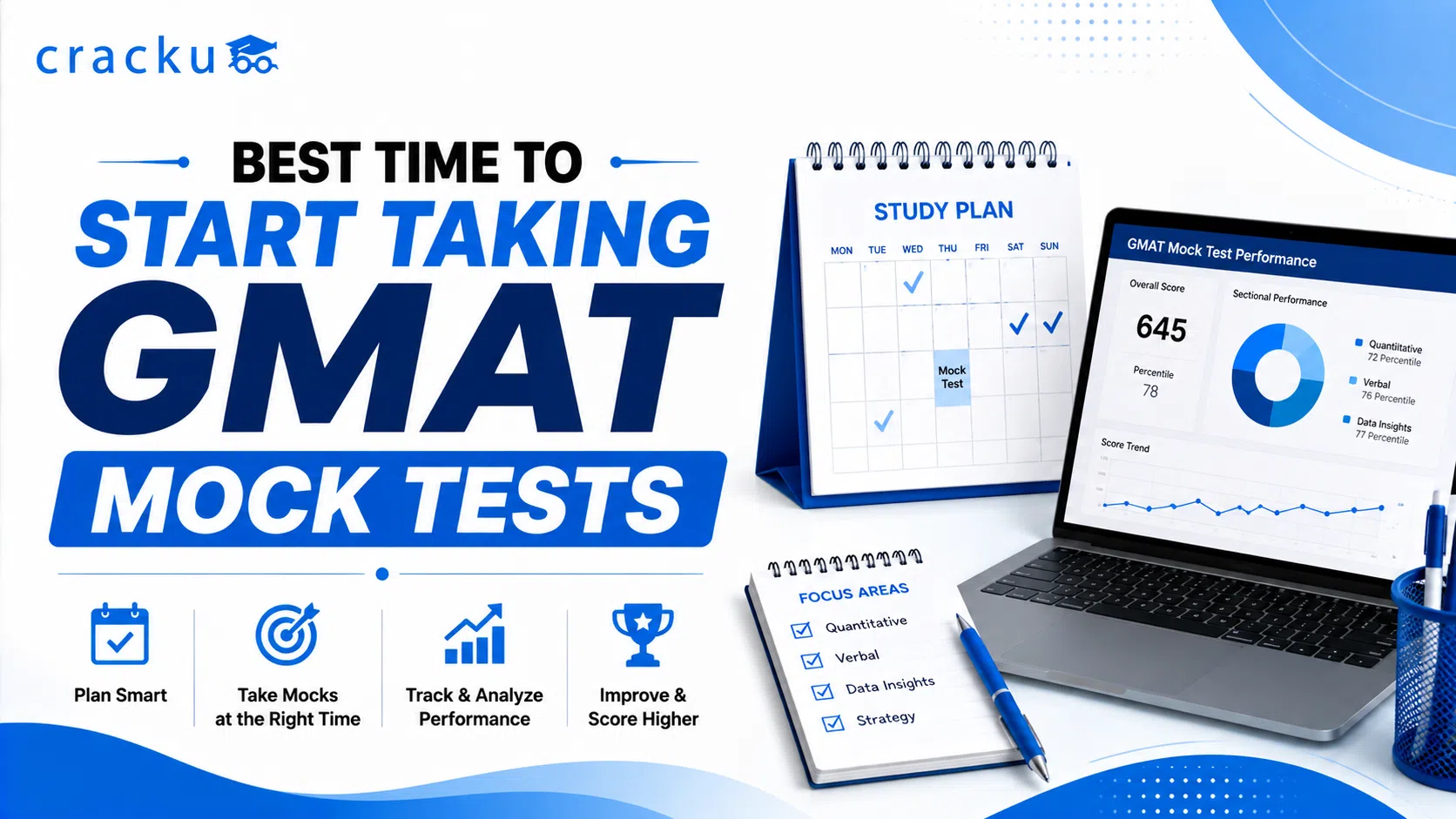
The best time to start taking GMAT mock tests is right after your first full pass through the syllabus. This initial attempt gives an honest reading of your true standing. Do not wait for absolute perfection. Several test topics will naturally feel shaky and unfinished during this specific practice run. Testing now leaves enough weeks to fix those weak areas while the exam date is comfortably far away.
Why Mock Tests Are Crucial for GMAT Preparation
Mock tests are important for GMAT preparation because they force you to experience the real exam's pressure before it actually counts. Reading about the test structure in a book is never the same as sitting through it under strict timing. The experience reveals your true readiness.
- The exam runs for exactly two hours and fifteen minutes across three back-to-back sections. Candidates require stamina practice alongside book knowledge.
- Question difficulty adjusts automatically. The test is question-adaptive, meaning difficulty depends on the answers already given. Pacing decisions practised in a mock train the specific skill the real exam rewards.
- Filling in an answer, even a rushed guess, carries no extra deduction. Every question left unanswered when a section's clock runs out pulls that section's score down. The scoring algorithm punishes incomplete tests. Guessing protects your score from that penalty.
- Candidates choose the order of the three sections and decide whether to take the one optional ten-minute break after the first section or the second. A mock is where that specific choice gets tested rather than guessed on exam day.
- Inside every section, you can bookmark questions and change up to three answers before that section closes. A mock teaches you which questions deserve those three limited changes.
Ideal Mock Test Timeline for GMAT Aspirants
The ideal mock test timeline for GMAT candidates counts backward from your actual test date. The test runs year-round, meaning you book it whenever you are ready. Sitting a full-length GMAT Mock Test under real timing turns an unfamiliar format into a familiar one. This practice directly prepares you for Data Insights. That specific exam section tests graph interpretation and math logic.
Weeks Before Your Test Date | What You Should Be Doing | Mock Test Activity |
Remaining: 10 to 12 weeks | First pass through Quant, Verbal and Data Insights | Short section-wise practice sets only |
Remaining: 7 to 9 weeks | Topic-wise drilling on weak areas | One section-wise and one full-length mock |
Remaining: 4 to 6 weeks | Full syllabus revision complete | Two full-length mocks a week timed at 2 hours 15 minutes |
Remaining: 1 to 3 weeks | Fine-tuning weak sections only | One to two full-length mocks a week |
- A realistic target across the full run-up is 15 to 20 full-length mocks. The count builds up slowly rather than staying flat. You need time to review between attempts. Taking tests back-to-back without analysis completely wastes the practice material.
- The free official starter kit includes two full-length practice exams that run on the exact same scoring algorithm as the real exam. Four more official practice exams can be bought after that, taking the total to six.
Signs You're Ready to Attempt Full-Length GMAT Mock Tests
The clearest signs you're ready to attempt full-length GMAT mock tests appear when every topic has been studied at least once. This includes Quantitative Reasoning, Verbal Reasoning, and Data Insights. This milestone is far less than being confident in all of them. Testing your knowledge early highlights true weaknesses.
- Section-wise practice sets get finished inside that section's own 45-minute limit. Every single question gets answered completely before time runs out.
- The major question types within each section feel familiar enough that every minute goes straight into solving. The instructions are already recognizable before the section even starts.
- Focus holds steady through one full 45-minute section from start to finish. The real exam runs three of these back-to-back. Mental fatigue sets in quickly. Building stamina prevents careless errors in the final hour.
- Basic errors, like calculation slips in Quant or misreading a Data Insights table, have already started dropping. Section-wise practice scores improve as these simple errors disappear.
How to Analyze Your GMAT Mock Tests
Knowing how to analyze your GMAT mock tests matters because the total score says very little on its own. Give every single mock a full review before sitting the next one. Treat that review as part of the mock rather than as optional extra work. The review is where actual improvement happens.
What to Check After Every Mock | How to Check It | Why It Matters |
The three section scores | Read sections separately on the 60 to 90 scale | Sections carry equal weight in the 205 to 805 total score |
Time spent against the limit | Count open questions when the 45-minute clock stops | Shows if pacing caused the low score |
Wrong versus unanswered questions | Keep two separate counts | Blanks pull the score down directly |
Question types marked wrong | Group mistakes by type rather than by broad section | Repeating patterns point to a weak spot needing revision |
- Write down exactly why each mistake happened during the test. Was it a concept still only half-learned? It might also be a passage read too fast or a guess made once time started running short.
- Notice when the same reason keeps showing up across three or four mocks. That specific topic needs direct revision, not another full mock added on top of it. Repeated mistakes signal a core misunderstanding. Drilling the concept fixes the root issue.
- Redo every wrong question from scratch before reading any provided explanation. Solving it entirely on your own is what confirms the gap has successfully closed.
Common Mistakes Students Make While Starting GMAT Mock Tests
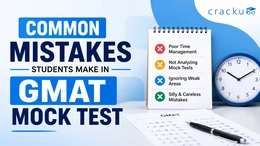
The common mistakes students make while starting GMAT mock tests are almost always habits rather than gaps in knowledge. These specific errors repeat across most early attempts. Catching one of these habits early inside a mock is usually enough to fix it completely.
- Starting full-length mocks only in the final two weeks of preparation. This leaves just a handful of days to fix whatever weakness the very first mock uncovers. Time runs out too fast at this stage. Early testing gives you room to pivot your study plan.
- Racing through a whole section on guesswork instead of checking the pace at set points. Most students misinterpret the resulting low score as a content gap, even though pacing was the actual problem.
- Skipping the optional ten-minute break in every practice run. Sitting all 135 minutes straight on exam day without break practice causes candidates to lose focus in the last section.
- Reading only the total score after a mock finishes. A completely weak section stays hidden behind a total score that otherwise looks fine.
- Leaving several questions blank when a section's time runs out. Many candidates accept the time penalty, but unanswered questions pull the score down far more than filling them in with quick guesses would have.