
Join Our JEE Preparation Group
Prep with like-minded aspirants; Get access to free daily tests and study material.
Sign in
Please select an account to continue using cracku.in
↓ →
Join Our JEE Preparation Group
Prep with like-minded aspirants; Get access to free daily tests and study material.
If $$A = \begin{pmatrix} \cos\theta & -\sin\theta \\ \sin\theta & \cos\theta \end{pmatrix}$$, then the matrix $$A^{-50}$$ when $$\theta = \frac{\pi}{12}$$, is equal to:
We start with the rotation matrix
$$A \;=\; \begin{pmatrix}\cos\theta & -\sin\theta\\[4pt] \sin\theta & \cos\theta\end{pmatrix}.$$
A well-known property of rotation matrices is the power formula
$$A^{n}\;=\;\begin{pmatrix}\cos(n\theta) & -\sin(n\theta)\\[4pt] \sin(n\theta) & \cos(n\theta)\end{pmatrix},$$
valid for every integer $$n$$ (positive, negative, or zero). This can be proved by simple mathematical induction or by identifying the matrix with the complex number $$\cos\theta+i\sin\theta$$ and using De Moivre’s theorem.
For a negative exponent we simply write
$$A^{-n}=A^{\,(-n)}=\begin{pmatrix}\cos(-n\theta) & -\sin(-n\theta)\\[4pt] \sin(-n\theta) & \cos(-n\theta)\end{pmatrix}.$$
In the present problem we need $$A^{-50}$$ with $$\theta=\dfrac{\pi}{12}.$$ Substituting the given value of $$\theta$$, we obtain the combined rotation angle:
$$-50\theta \;=\;-50\left(\dfrac{\pi}{12}\right) \;=\;-\dfrac{50\pi}{12} \;=\;-\dfrac{25\pi}{6}.$$
To bring this angle into a more familiar range, we reduce it modulo $$2\pi$$:
$$-\dfrac{25\pi}{6} \;=\;-\left(\dfrac{24\pi}{6}+\dfrac{\pi}{6}\right) \;=\;-4\pi-\dfrac{\pi}{6}.$$
Because a rotation by any integer multiple of $$2\pi$$ leaves the matrix unchanged, the term $$-4\pi$$ can be discarded, leaving
$$-4\pi-\dfrac{\pi}{6}\equiv -\dfrac{\pi}{6}\pmod{2\pi}.$$
Hence
$$A^{-50} =\begin{pmatrix} \cos\!\left(-\dfrac{\pi}{6}\right) & -\sin\!\left(-\dfrac{\pi}{6}\right)\\[8pt] \sin\!\left(-\dfrac{\pi}{6}\right) & \cos\!\left(-\dfrac{\pi}{6}\right) \end{pmatrix}.$$
Next we recall the exact trigonometric values for $$\dfrac{\pi}{6}$$:
$$\cos\!\left(\dfrac{\pi}{6}\right)=\dfrac{\sqrt3}{2}, \qquad \sin\!\left(\dfrac{\pi}{6}\right)=\dfrac12.$$ Because cosine is an even function and sine is an odd function, we have
$$\cos\!\left(-\dfrac{\pi}{6}\right)=\cos\!\left(\dfrac{\pi}{6}\right)=\dfrac{\sqrt3}{2},$$ $$\sin\!\left(-\dfrac{\pi}{6}\right)=-\sin\!\left(\dfrac{\pi}{6}\right)=-\dfrac12.$$
Substituting these values gives
$$A^{-50} =\begin{pmatrix} \dfrac{\sqrt3}{2} & -\!\left(-\dfrac12\right)\\[8pt] -\dfrac12 & \dfrac{\sqrt3}{2} \end{pmatrix} =\begin{pmatrix} \dfrac{\sqrt3}{2} & \dfrac12\\[8pt] -\dfrac12 & \dfrac{\sqrt3}{2} \end{pmatrix}.$$
On comparing with the options, we observe that this matrix matches Option A exactly.
Hence, the correct answer is Option A.
Was this solution helpful?
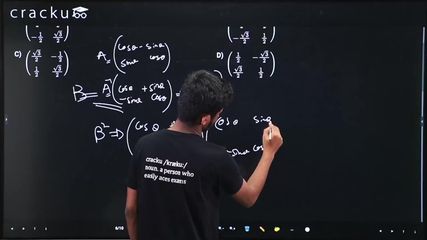
Click on the Email ☝️ to Watch the Video Solution
Create a FREE account and get:
_1.webp)

Educational materials for JEE preparation

Ask our AI anything

AI can make mistakes. Please verify important information.
AI can make mistakes. Please verify important information.
