
Join Our JEE Preparation Group
Prep with like-minded aspirants; Get access to free daily tests and study material.
Sign in
Please select an account to continue using cracku.in
↓ →
Join Our JEE Preparation Group
Prep with like-minded aspirants; Get access to free daily tests and study material.
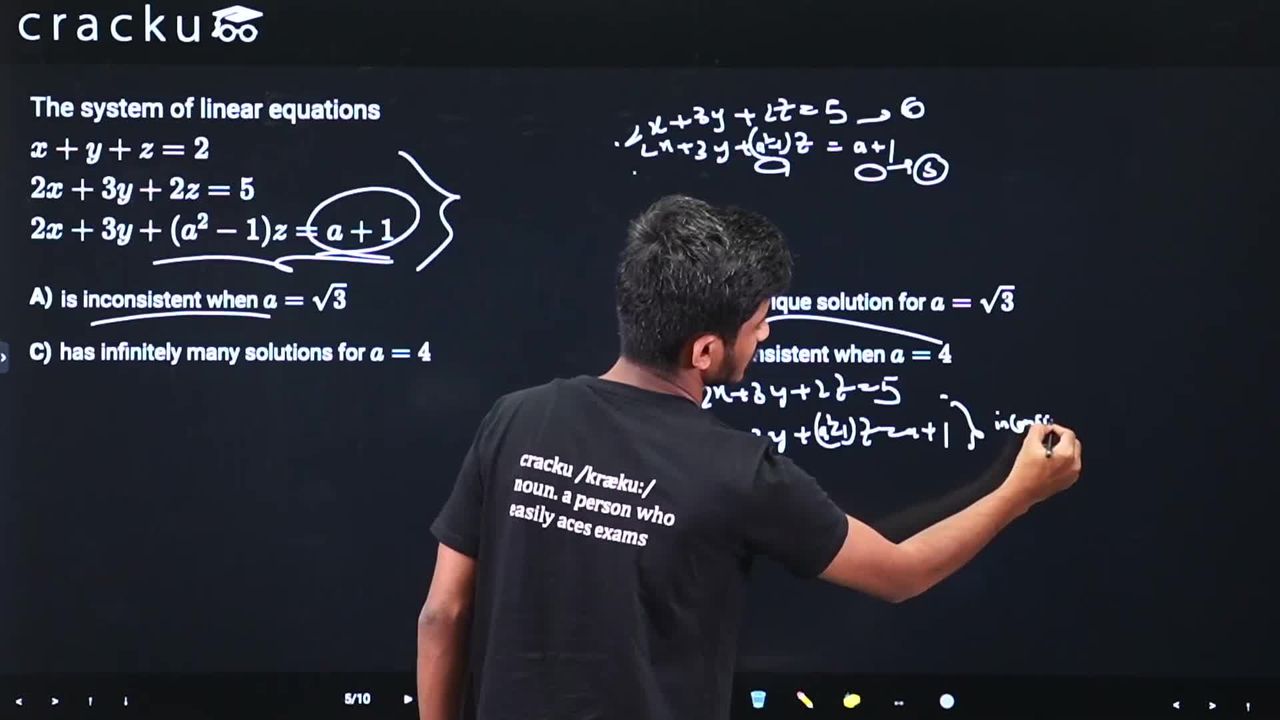
The system of linear equations
$$x + y + z = 2$$
$$2x + 3y + 2z = 5$$
$$2x + 3y + (a^2 - 1)z = a + 1$$
We have the three simultaneous linear equations
$$x + y + z = 2$$
$$2x + 3y + 2z = 5$$
$$2x + 3y + (a^2 - 1)z = a + 1$$
To test consistency, we write the augmented matrix of the system:
$$\begin{bmatrix} 1 & 1 & 1 & \big| & 2\\ 2 & 3 & 2 & \big| & 5\\ 2 & 3 & a^2 - 1 & \big| & a + 1 \end{bmatrix}$$
Now we perform elementary row operations. First, eliminate the $$x$$-term from the second and third rows by replacing $$R_2$$ and $$R_3$$ with $$R_2 - 2R_1$$ and $$R_3 - 2R_1$$ respectively.
Doing the calculation for the second row:
$$\begin{aligned} R_2 - 2R_1 &:&\; (2-2\cdot1,\; 3-2\cdot1,\; 2-2\cdot1\;|\; 5-2\cdot2)\\ &= (0,\;1,\;0\;|\;1) \end{aligned}$$
Doing it for the third row:
$$\begin{aligned} R_3 - 2R_1 &:&\; (2-2\cdot1,\; 3-2\cdot1,\; (a^2-1)-2\cdot1\;|\; (a+1)-2\cdot2)\\ &= (0,\;1,\; a^2-3\;|\; a-3) \end{aligned}$$
The matrix is now
$$\begin{bmatrix} 1 & 1 & 1 & \big| & 2\\ 0 & 1 & 0 & \big| & 1\\ 0 & 1 & a^2 - 3 & \big| & a - 3 \end{bmatrix}$$
Next, eliminate the $$y$$-term from the third row by replacing $$R_3$$ with $$R_3 - R_2$$:
$$\begin{aligned} R_3 - R_2 &:&\; (0,\;1-1,\; (a^2-3)-0\;|\; (a-3)-1)\\ &= (0,\;0,\; a^2-3\;|\; a-4) \end{aligned}$$
So the reduced matrix is
$$\begin{bmatrix} 1 & 1 & 1 & \big| & 2\\ 0 & 1 & 0 & \big| & 1\\ 0 & 0 & a^2 - 3 & \big| & a - 4 \end{bmatrix}$$
At this stage we analyse the third row:
$$0x + 0y + (a^2 - 3)z = a - 4$$
If the coefficient $$(a^2-3)$$ is non-zero, we can solve for $$z$$ uniquely and the system is consistent. However, if $$(a^2-3)=0$$ while the right-hand side is non-zero, we get $$0 = \text{non-zero}$$, an impossibility, rendering the system inconsistent.
Set the coefficient equal to zero:
$$a^2 - 3 = 0 \;\;\Longrightarrow\;\; a = \pm\sqrt{3}$$
For $$a = \sqrt{3}$$ the right-hand side of the third row becomes
$$a - 4 = \sqrt{3} - 4 \neq 0$$
giving the contradictory statement $$0 = \sqrt{3}-4$$. Hence the system is inconsistent when $$a=\sqrt{3}$$.
For completeness, note that $$a=-\sqrt{3}$$ also makes the coefficient zero, and the right-hand side becomes $$-\sqrt{3}-4\neq0$$, giving another contradiction. But among the options given, only $$a=\sqrt{3}$$ is listed.
When $$a = 4$$, on the other hand, the coefficient is $$(4^2-3)=13\neq0$$, so we can find $$z = \dfrac{4-4}{13}=0$$, then $$y=1$$ from the second row, and finally $$x=1$$ from the first row; thus the system has a unique solution and is perfectly consistent.
Therefore the only statement that holds from the options is that the system is inconsistent when $$a = \sqrt{3}$$.
Hence, the correct answer is Option A.
Was this solution helpful?
Click on the Email ☝️ to Watch the Video Solution
Create a FREE account and get:
_1.webp)

Educational materials for JEE preparation

Ask our AI anything

AI can make mistakes. Please verify important information.
AI can make mistakes. Please verify important information.
