
Join Our JEE Preparation Group
Prep with like-minded aspirants; Get access to free daily tests and study material.
Sign in
Please select an account to continue using cracku.in
↓ →
Join Our JEE Preparation Group
Prep with like-minded aspirants; Get access to free daily tests and study material.
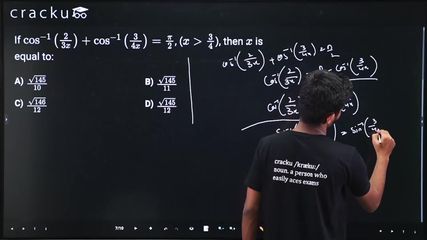
If $$\cos^{-1}\left(\frac{2}{3x}\right) + \cos^{-1}\left(\frac{3}{4x}\right) = \frac{\pi}{2}$$, ($$x > \frac{3}{4}$$), then $$x$$ is equal to:
We are given the equation
$$\cos^{-1}\!\left(\frac{2}{3x}\right)\;+\;\cos^{-1}\!\left(\frac{3}{4x}\right)\;=\;\frac{\pi}{2},\qquad x\;>\;\frac{3}{4}.$$
To remove the inverse-cosine symbols, we recall a standard trigonometric fact:
Formula stated first. If $$\cos^{-1}u+\cos^{-1}v=\frac{\pi}{2}$$ with $$0\le u\le1$$ and $$0\le v\le1,$$ then
$$u^{2}+v^{2}=1.$$
We justify this briefly. Write $$A=\cos^{-1}u$$ and $$B=\cos^{-1}v,$$ so that $$A+B=\frac{\pi}{2}.$$ Taking cosine on both sides,
$$\cos(A+B)=\cos\!\left(\frac{\pi}{2}\right)=0.$$
Using the cosine addition formula $$\cos(A+B)=\cos A\cos B-\sin A\sin B,$$ we have
$$u\;v-\sqrt{1-u^{2}}\;\sqrt{1-v^{2}}=0.$$
Thus
$$u\,v=\sqrt{1-u^{2}}\;\sqrt{1-v^{2}}.$$
Squaring both sides yields
$$u^{2}v^{2}=(1-u^{2})(1-v^{2}) =1-u^{2}-v^{2}+u^{2}v^{2},$$
and cancelling $$u^{2}v^{2}$$ from both sides gives the promised relation
$$u^{2}+v^{2}=1.$$
Now we identify
$$u=\frac{2}{3x},\qquad v=\frac{3}{4x}.$$
We substitute these into $$u^{2}+v^{2}=1.$$
First compute $$u^{2}$$ and $$v^{2}:$$
$$u^{2}=\left(\frac{2}{3x}\right)^{2}=\frac{4}{9x^{2}},$$
$$v^{2}=\left(\frac{3}{4x}\right)^{2}=\frac{9}{16x^{2}}.$$
Adding them,
$$u^{2}+v^{2} =\frac{4}{9x^{2}}+\frac{9}{16x^{2}} =\frac{4\cdot16+9\cdot9}{144\,x^{2}} =\frac{64+81}{144\,x^{2}} =\frac{145}{144\,x^{2}}.$$
Setting this equal to $$1$$ (by the identity just derived) we obtain
$$\frac{145}{144\,x^{2}}=1.$$
Now isolate $$x^{2}:$$
$$x^{2}=\frac{145}{144}.$$
Taking the positive square root (because $$x>\frac{3}{4}>0$$),
$$x=\frac{\sqrt{145}}{12}.$$
We compare with the listed choices and find that this value matches Option D.
Hence, the correct answer is Option D.
Was this solution helpful?
Click on the Email ☝️ to Watch the Video Solution
Create a FREE account and get:

Educational materials for JEE preparation

Ask our AI anything

AI can make mistakes. Please verify important information.
AI can make mistakes. Please verify important information.
