
Join Our JEE Preparation Group
Prep with like-minded aspirants; Get access to free daily tests and study material.
Sign in
Please select an account to continue using cracku.in
↓ →
Join Our JEE Preparation Group
Prep with like-minded aspirants; Get access to free daily tests and study material.
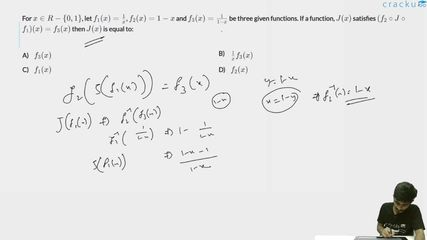
For $$x \in R - \{0, 1\}$$, let $$f_1(x) = \frac{1}{x}$$, $$f_2(x) = 1 - x$$ and $$f_3(x) = \frac{1}{1-x}$$ be three given functions. If a function, $$J(x)$$ satisfies $$(f_2 \circ J \circ f_1)(x) = f_3(x)$$ then $$J(x)$$ is equal to:
We have three given functions defined for all real numbers with $$x \neq 0,\,1$$:
$$f_1(x)=\dfrac{1}{x}, \qquad f_2(x)=1-x, \qquad f_3(x)=\dfrac{1}{1-x}.$$
According to the statement, the function $$J(x)$$ must satisfy
$$(f_2 \circ J \circ f_1)(x)=f_3(x).$$
The symbol “$$\circ$$” denotes composition, so
$$(f_2 \circ J \circ f_1)(x)=f_2\bigl(J(f_1(x))\bigr).$$
Substituting the explicit expression of $$f_1(x)$$, we get
$$f_2\!\left(J\!\left(\dfrac{1}{x}\right)\right)=f_3(x).$$
Next, we write down the formulas that will be used:
• For every real number $$z$$ (with the necessary domain restrictions) we have $$f_2(z)=1-z.$$
• By definition, $$f_3(x)=\dfrac{1}{1-x}.$$
Applying the first formula with $$z=J\!\left(\dfrac{1}{x}\right)$$ we obtain
$$1-J\!\left(\dfrac{1}{x}\right)=\dfrac{1}{1-x}.$$
Now we isolate the expression containing $$J$$ by transposing terms:
$$J\!\left(\dfrac{1}{x}\right)=1-\dfrac{1}{1-x}.$$
To remove the complex fraction, we combine the terms on the right-hand side. First, we rewrite the rightmost fraction with a common denominator:
$$1=\dfrac{1-x}{1-x},$$
so
$$1-\dfrac{1}{1-x}=\dfrac{1-x}{1-x}-\dfrac{1}{1-x}=\dfrac{1-x-1}{1-x}=\dfrac{-x}{1-x}.$$
In the numerator we factor out $$-1$$ and simultaneously switch the order in the denominator to keep the overall value unchanged:
$$\dfrac{-x}{1-x}=\dfrac{x}{x-1}.$$
Thus we have obtained
$$J\!\left(\dfrac{1}{x}\right)=\dfrac{x}{x-1}.$$
To rewrite the result directly in terms of the input variable of $$J,$$ let us set
$$t=\dfrac{1}{x}\quad\Longrightarrow\quad x=\dfrac{1}{t}.$$
Replacing every occurrence of $$x$$ by $$1/t$$ in the last equation yields
$$J(t)=\dfrac{\dfrac{1}{t}}{\dfrac{1}{t}-1}.$$
We simplify this fraction step by step. The numerator is $$1/t$$. The denominator simplifies as follows:
$$\dfrac{1}{t}-1=\dfrac{1-t}{t}.$$
Hence,
$$J(t)=\frac{\dfrac{1}{t}}{\dfrac{1-t}{t}}.$$
Dividing one fraction by another is equivalent to multiplying by the reciprocal of the denominator, so
$$J(t)=\dfrac{1}{t}\times\dfrac{t}{1-t}=\dfrac{1}{1-t}.$$
But the right-hand side is precisely the definition of $$f_3(t).$$ Therefore, for every allowed value of $$t,$$
$$J(t)=f_3(t).$$
Removing the dummy variable $$t$$ and returning to the standard notation, we conclude
$$J(x)=f_3(x).$$
Hence, the correct answer is Option A.
Was this solution helpful?
Click on the Email ☝️ to Watch the Video Solution
Create a FREE account and get:
_1.webp)

Educational materials for JEE preparation

Ask our AI anything

AI can make mistakes. Please verify important information.
AI can make mistakes. Please verify important information.
