
Join Our JEE Preparation Group
Prep with like-minded aspirants; Get access to free daily tests and study material.
Sign in
Please select an account to continue using cracku.in
↓ →
Join Our JEE Preparation Group
Prep with like-minded aspirants; Get access to free daily tests and study material.
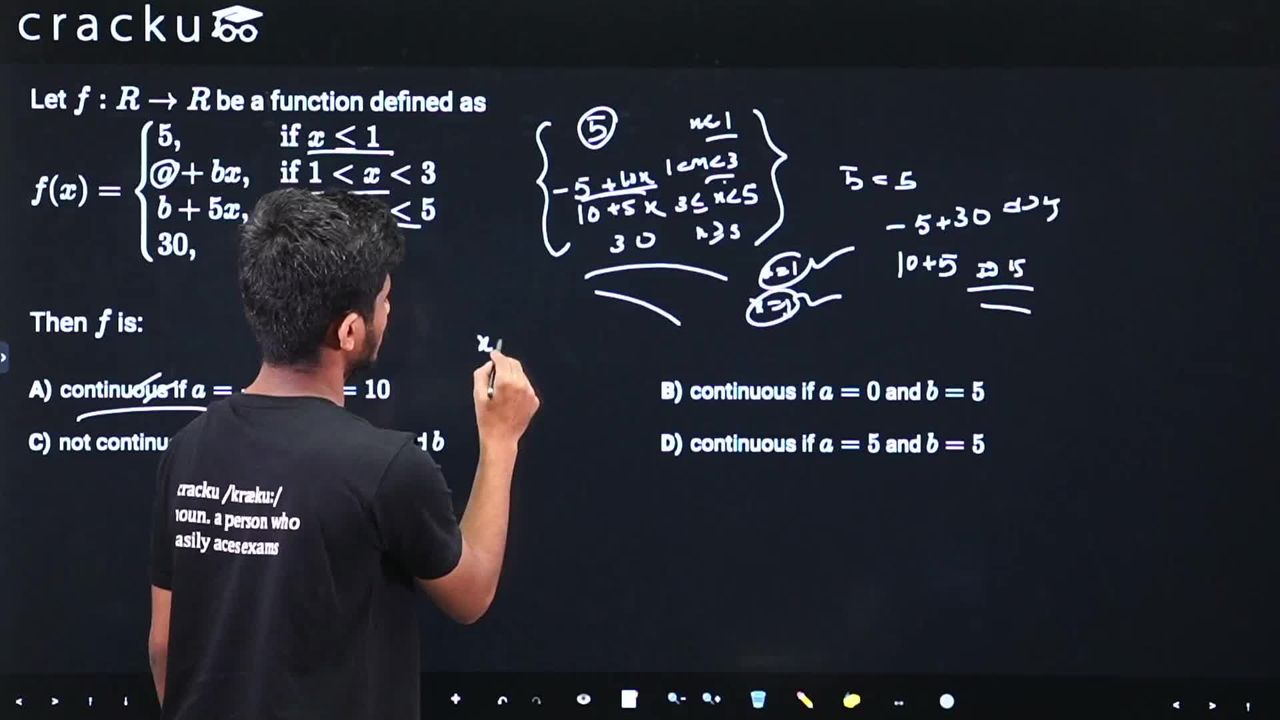
Let $$f: R \to R$$ be a function defined as
$$f(x) = \begin{cases} 5, & \text{if } x \leq 1 \\ a + bx, & \text{if } 1 < x < 3 \\ b + 5x, & \text{if } 3 \leq x < 5 \\ 30, & \text{if } x \geq 5 \end{cases}$$
Then $$f$$ is:
We first recall the definition of continuity at a point. A real-valued function $$f(x)$$ is continuous at a point $$x=c$$ if and only if the following three quantities are equal:
$$\lim_{x\to c^-}f(x),\qquad \lim_{x\to c^+}f(x),\qquad f(c).$$
The given function is piece-wise and therefore can fail to be continuous only at those points where the rule changes. These points are $$x=1,\;x=3,\;x=5.$$ Everywhere else each branch is a polynomial or a constant, which is automatically continuous. So we check continuity only at these three points.
1. Continuity at $$x=1$$
For $$x\le 1$$ we have $$f(x)=5,$$ so
$$f(1)=5.$$
For $$x>1$$ but still less than $$3$$ the relevant branch is $$f(x)=a+bx.$$ Thus
$$\lim_{x\to1^+}f(x)=a+b(1)=a+b.$$
The left-hand limit is
$$\lim_{x\to1^-}f(x)=5.$$
Setting the three quantities equal, we obtain our first condition:
$$a+b = 5.\qquad (1)$$
2. Continuity at $$x=3$$
The limit from the left (using the branch $$a+bx$$) equals
$$\lim_{x\to3^-}f(x)=a+b(3)=a+3b.$$
The limit from the right and the actual value at $$x=3$$ both use the branch $$b+5x$$ (because $$3\le x<5$$):
$$\lim_{x\to3^+}f(x)=b+5(3)=b+15,$$
and
$$f(3)=b+15.$$
Equating these gives the second condition:
$$a+3b = b+15.\qquad (2)$$
3. Continuity at $$x=5$$
The limit from the left (branch $$b+5x$$) is
$$\lim_{x\to5^-}f(x)=b+5(5)=b+25.$$
The limit from the right and the value at the point come from the constant branch $$30$$ (because $$x\ge5$$):
$$\lim_{x\to5^+}f(x)=30,\qquad f(5)=30.$$
Setting them equal yields our third condition:
$$b+25 = 30\;\;\Longrightarrow\;\;b = 5.\qquad (3)$$
4. Solving the system
We substitute $$b=5$$ from (3) into the earlier conditions.
From (1):
$$a + 5 = 5\;\;\Longrightarrow\;\;a = 0.$$
From (2):
$$a + 3(5) = 5 + 15$$
$$a + 15 = 20$$
$$a = 5.$$
Thus the same symbol $$a$$ must simultaneously be $$0$$ and $$5,$$ which is impossible. The three continuity equations cannot be satisfied together for any real choice of $$a$$ and $$b.$$ Therefore the function cannot be made continuous on the entire real line.
Hence, the correct answer is Option C.
Was this solution helpful?
Click on the Email ☝️ to Watch the Video Solution
Create a FREE account and get:
_1.webp)

Educational materials for JEE preparation

Ask our AI anything

AI can make mistakes. Please verify important information.
AI can make mistakes. Please verify important information.
