
Join Our JEE Preparation Group
Prep with like-minded aspirants; Get access to free daily tests and study material.
Sign in
Please select an account to continue using cracku.in
↓ →
Join Our JEE Preparation Group
Prep with like-minded aspirants; Get access to free daily tests and study material.
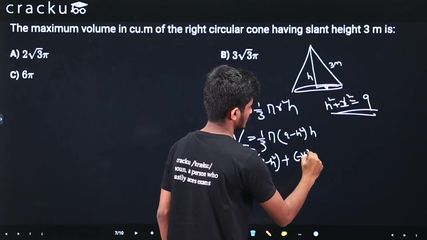
The maximum volume in cu.m of the right circular cone having slant height 3 m is:
For a right circular cone the three basic elements - radius $$r$$ of the base, vertical height $$h$$, and slant height $$l$$ - are joined by the Pythagoras relation
$$l^{2}=r^{2}+h^{2}.$$
Here the slant height is fixed at $$l=3\text{ m}$$, while $$r$$ and $$h$$ can vary subject to the above constraint.
The volume $$V$$ of a cone is given by the standard formula
$$V=\frac{1}{3}\pi r^{2}h.$$
Because $$h$$ must satisfy $$h^{2}=l^{2}-r^{2}$$, we first express $$h$$ in terms of $$r$$:
$$h=\sqrt{l^{2}-r^{2}}=\sqrt{3^{2}-r^{2}}=\sqrt{9-r^{2}}.$$
Substituting this expression for $$h$$ in the volume formula we obtain
$$V(r)=\frac{1}{3}\pi r^{2}\sqrt{9-r^{2}}.$$
Since $$l$$ is fixed, the only variable in this expression is $$r$$. We now find the value of $$r$$ that maximises $$V(r)$$ by differentiating with respect to $$r$$ and equating the derivative to zero.
Let us write
$$V(r)=\frac{\pi}{3}\;f(r),\qquad\text{where}\quad f(r)=r^{2}(9-r^{2})^{1/2}.$$
Differentiating $$f(r)$$ using the product rule:
$$\frac{d}{dr}\bigl[r^{2}(9-r^{2})^{1/2}\bigr] =2r(9-r^{2})^{1/2}+r^{2}\left(\frac{1}{2}\right)(9-r^{2})^{-1/2}(-2r).$$
Simplifying the second term first:
$$r^{2}\left(\frac{1}{2}\right)(9-r^{2})^{-1/2}(-2r)= -\,\frac{r^{3}}{(9-r^{2})^{1/2}}.$$
Hence
$$f'(r)=2r(9-r^{2})^{1/2}-\frac{r^{3}}{(9-r^{2})^{1/2}}.$$
For a critical point we set $$f'(r)=0$$. Multiplying through by $$(9-r^{2})^{1/2}$$ clears the denominator and keeps the sign of the equation unaltered because the square root is positive:
$$2r(9-r^{2})-r^{3}=0.$$
Taking the common factor $$r$$ out:
$$r\left[2(9-r^{2})-r^{2}\right]=0.$$
Since $$r=0$$ would give zero volume, we discard it and solve the bracketed equation:
$$2(9-r^{2})-r^{2}=0\quad\Longrightarrow\quad18-2r^{2}-r^{2}=0$$ $$\Longrightarrow\;18-3r^{2}=0$$ $$\Longrightarrow\;r^{2}=6\quad\Longrightarrow\quad r=\sqrt{6}\text{ m}.$$
With $$r=\sqrt{6}$$ we compute $$h$$ from $$h=\sqrt{9-r^{2}}$$:
$$h=\sqrt{9-6}=\sqrt{3}\text{ m}.$$
Now we substitute $$r$$ and $$h$$ back into the volume formula to get the maximum volume:
$$V_{\max}=\frac{1}{3}\pi r^{2}h =\frac{1}{3}\pi\,(6)\,(\sqrt{3}) =2\sqrt{3}\,\pi\;\text{cubic metres}.$$
(A check of endpoint values, $$r\to0$$ or $$r\to3$$, gives zero volume, confirming that the critical point indeed yields the maximum.)
Hence, the correct answer is Option 1.
Was this solution helpful?
Click on the Email ☝️ to Watch the Video Solution
Create a FREE account and get:
_1.webp)

Educational materials for JEE preparation

Ask our AI anything

AI can make mistakes. Please verify important information.
AI can make mistakes. Please verify important information.
