
Join Our JEE Preparation Group
Prep with like-minded aspirants; Get access to free daily tests and study material.
Sign in
Please select an account to continue using cracku.in
↓ →
Join Our JEE Preparation Group
Prep with like-minded aspirants; Get access to free daily tests and study material.
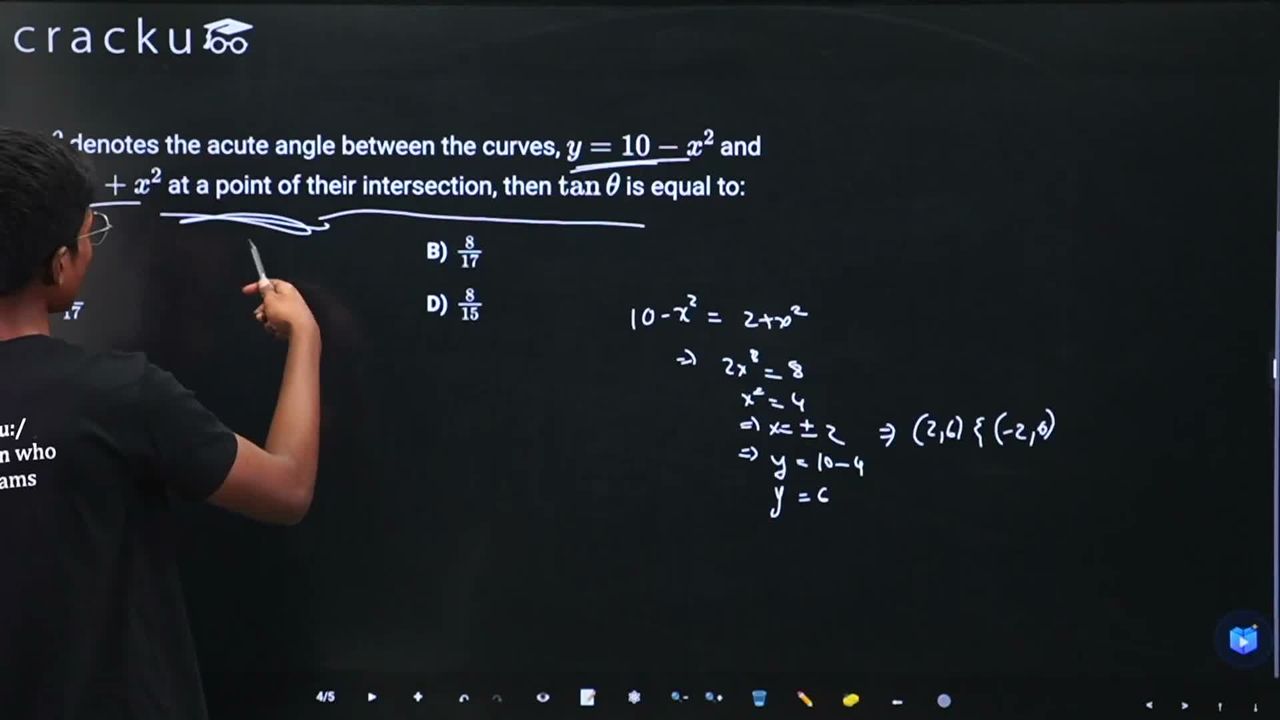
If $$\theta$$ denotes the acute angle between the curves, $$y = 10 - x^2$$ and $$y = 2 + x^2$$ at a point of their intersection, then $$\tan\theta$$ is equal to:
First we locate the points where the two curves intersect. At an intersection point both $$y$$-values are the same, so we write
$$10 - x^2 = 2 + x^2.$$
Now we collect all terms on one side:
$$10 - 2 = x^2 + x^2.$$
$$8 = 2x^2.$$
Dividing by $$2$$ gives
$$x^2 = 4.$$
Taking square roots, we obtain the two abscissae
$$x = 2 \quad \text{or} \quad x = -2.$$
We substitute either value back into either original equation to find the common ordinate. Using $$y = 10 - x^2$$, we get
For $$x = 2$$: $$y = 10 - (2)^2 = 10 - 4 = 6.$$ For $$x = -2$$: $$y = 10 - (-2)^2 = 10 - 4 = 6.$$
Thus the curves meet at the two points $$(2,\,6)$$ and $$(-2,\,6).$$
The acute angle between the curves at an intersection is the acute angle between their tangents. Hence we compute the slopes (derivatives) of each curve.
For $$y = 10 - x^2$$ we differentiate to get
$$\frac{dy}{dx} = -2x.$$
For $$y = 2 + x^2$$ we differentiate to get
$$\frac{dy}{dx} = 2x.$$
We now evaluate these derivatives at the intersection points.
At $$x = 2$$: First curve slope $$m_1 = -2(2) = -4,$$ Second curve slope $$m_2 = 2(2) = 4.$$
At $$x = -2$$: First curve slope $$m_1 = -2(-2) = 4,$$ Second curve slope $$m_2 = 2(-2) = -4.$$
In either case the pair of slopes is $$-4$$ and $$4$$, merely interchanged, so the magnitude of the angle between the tangents is the same.
The formula for the tangent of the angle $$\theta$$ between two lines with slopes $$m_1$$ and $$m_2$$ is
$$\tan\theta = \left|\frac{m_2 - m_1}{1 + m_1 m_2}\right|.$$
Substituting $$m_1 = -4$$ and $$m_2 = 4$$, we have
$$\tan\theta = \left|\frac{4 - (-4)}{1 + (-4)(4)}\right|.$$
Simplifying step by step,
$$\tan\theta = \left|\frac{4 + 4}{1 - 16}\right| = \left|\frac{8}{-15}\right| = \frac{8}{15}.$$
Because we have taken the absolute value, the result is positive and already corresponds to the acute angle (i.e. an angle < $$90^\circ$$).
Thus
$$\tan\theta = \frac{8}{15}.$$
Hence, the correct answer is Option D.
Was this solution helpful?
Click on the Email ☝️ to Watch the Video Solution
Create a FREE account and get:
_1.webp)

Educational materials for JEE preparation

Ask our AI anything

AI can make mistakes. Please verify important information.
AI can make mistakes. Please verify important information.
