
Join Our JEE Preparation Group
Prep with like-minded aspirants; Get access to free daily tests and study material.
Sign in
Please select an account to continue using cracku.in
↓ →
Join Our JEE Preparation Group
Prep with like-minded aspirants; Get access to free daily tests and study material.
Match the List I with List II:
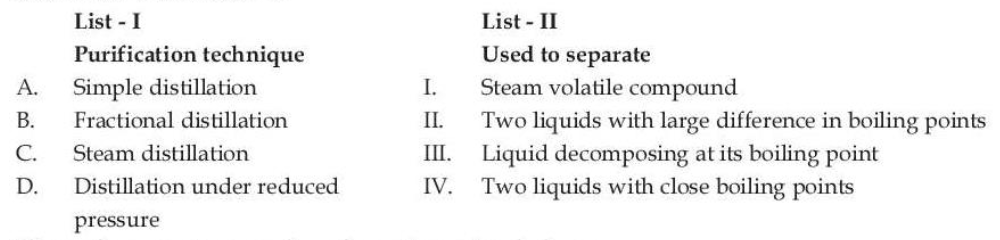
Choose the correct answer from the options given below:
Simple distillation is used to separate liquids having a large difference in their boiling points (generally greater than (25,\text{K})) or to separate a volatile liquid from a non-volatile impurity. Hence,
$$A\rightarrow II.$$
Fractional distillation is employed for the separation of liquids whose boiling points are close to each other. The fractionating column provides repeated vaporization and condensation, improving the separation. Hence,
$$B\rightarrow IV.$$
Steam distillation is used for compounds that are steam-volatile and immiscible with water. Such compounds distil at temperatures lower than their normal boiling points. Hence,
$$C\rightarrow I.$$
Distillation under reduced pressure (vacuum distillation) is used for liquids that decompose at or below their normal boiling points. Lowering the external pressure lowers the boiling point and prevents decomposition. Hence,
$$D\rightarrow III.$$
Therefore, the correct matching is
$$A-II,;B-IV,;C-I,;D-III.$$
Was this solution helpful?
Click on the Email ☝️ to Watch the Video Solution
Create a FREE account and get:
_1.webp)

Educational materials for JEE preparation

Ask our AI anything

AI can make mistakes. Please verify important information.
AI can make mistakes. Please verify important information.
