
Join Our JEE Preparation Group
Prep with like-minded aspirants; Get access to free daily tests and study material.
Sign in
Please select an account to continue using cracku.in
↓ →
Join Our JEE Preparation Group
Prep with like-minded aspirants; Get access to free daily tests and study material.
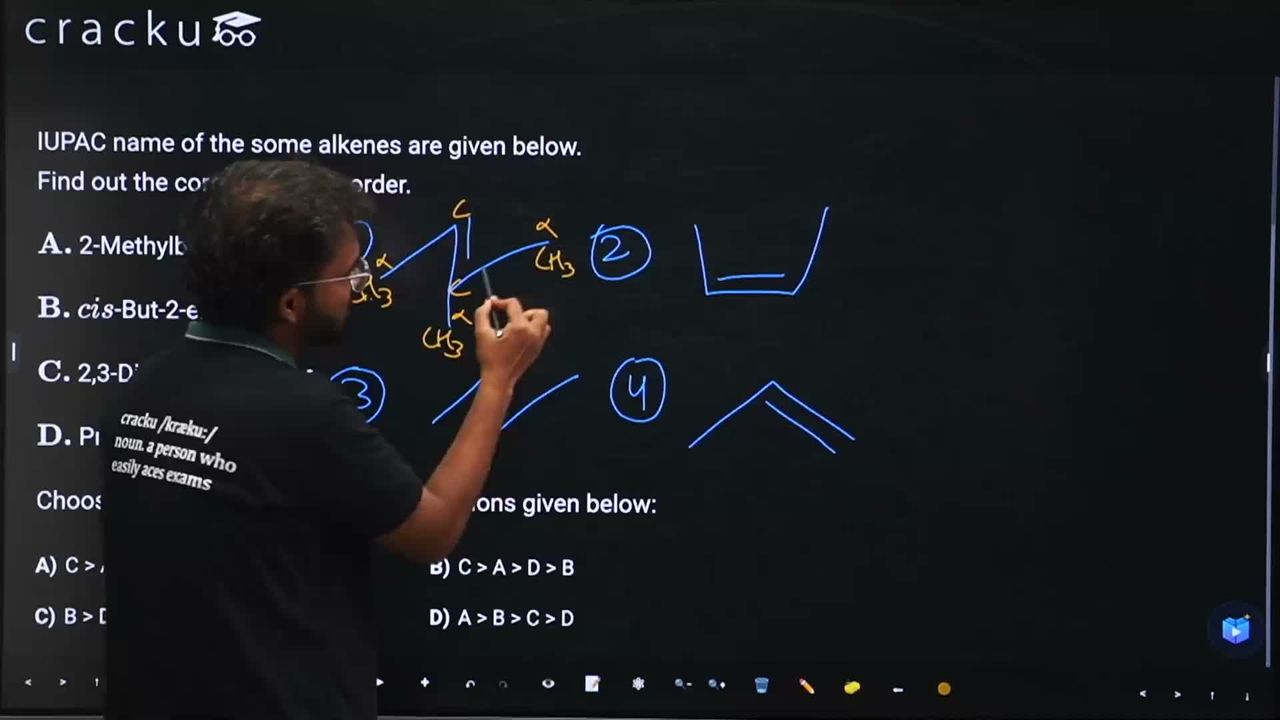
IUPAC name of the some alkenes are given below.
Find out the correct stability order.
$$\textbf{A.}$$ 2-Methylbut-2-ene
$$\textbf{B.}$$ $$\textit{cis}$$-But-2-ene
$$\textbf{C.}$$ 2,3-Dimethylbut-2-ene
$$\textbf{D.}$$ Prop-1-ene
Choose the correct answer from the options given below:
The stability of alkenes is largely governed by hyperconjugation. According to NCERT, greater the number of (\alpha)-hydrogens attached to the carbon atoms adjacent to the double bond, greater is the number of hyperconjugative structures and hence greater is the stability of the alkene.
For 2-methylbut-2-ene ((CH_3-C(CH_3)=CH-CH_3)), the double bond is adjacent to three methyl groups. Therefore, the total number of (\alpha)-hydrogens is
$$3+3+3=9.$$
For cis-but-2-ene ((CH_3-CH=CH-CH_3)), the double bond is adjacent to two methyl groups, giving
$$3+3=6$$
(\alpha)-hydrogens.
For 2,3-dimethylbut-2-ene (((CH_3)_2C=C(CH_3)_2)), the double bond is adjacent to four methyl groups. Hence, the number of (\alpha)-hydrogens is
$$3+3+3+3=12.$$
For prop-1-ene ((CH_3-CH=CH_2)), the double bond is adjacent to only one methyl group, so the number of (\alpha)-hydrogens is
$$3.$$
Since alkene stability increases with the number of (\alpha)-hydrogens, the order of stability is
$$C>A>B>D.$$
Hence, the correct order is C > A > B > D.
Click on the Email ☝️ to Watch the Video Solution
Create a FREE account and get:
_1.webp)

Educational materials for JEE preparation

Ask our AI anything

AI can make mistakes. Please verify important information.
AI can make mistakes. Please verify important information.


