
Join Our JEE Preparation Group
Prep with like-minded aspirants; Get access to free daily tests and study material.
Sign in
Please select an account to continue using cracku.in
↓ →
Join Our JEE Preparation Group
Prep with like-minded aspirants; Get access to free daily tests and study material.
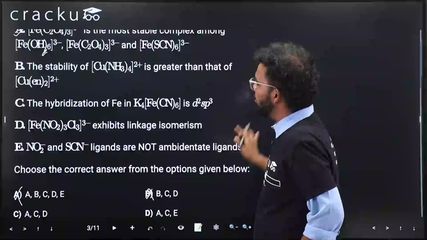
Identify the correct statements from the following
$$\textbf{A.}$$ $$[\text{Fe}(\text{C}_2\text{O}_4)_3]^{3-}$$ is the most stable complex among $$[\text{Fe}(\text{OH})_6]^{3-}$$, $$[\text{Fe}(\text{C}_2\text{O}_4)_3]^{3-}$$ and $$[\text{Fe}(\text{SCN})_6]^{3-}$$
$$\textbf{B.}$$ The stability of $$[\text{Cu}(\text{NH}_3)_4]^{2+}$$ is greater than that of $$[\text{Cu}(\text{en})_2]^{2+}$$
$$\textbf{C.}$$ The hybridization of Fe in $$\text{K}_4[\text{Fe}(\text{CN})_6]$$ is $$d^2sp^3$$
$$\textbf{D.}$$ $$[\text{Fe}(\text{NO}_2)_3\text{Cl}_3]^{3-}$$ exhibits linkage isomerism
$$\textbf{E.}$$ $$\text{NO}_2^{-}$$ and $$\text{SCN}^{-}$$ ligands are NOT ambidentate ligands
Choose the correct answer from the options given below:
To identify the correct statements, we analyze each claim based on the principles of coordination chemistry.
Statement A states that $$[Fe(C_2O_4)_3]^{3-}$$ is the most stable complex among the listed ones. The ligand $$C_2O_4^{2-}$$ (oxalate) is a bidentate chelating ligand that forms stable chelate rings with the metal ion. Due to the chelate effect, complexes containing chelating ligands are significantly more stable than those containing comparable monodentate ligands such as $$OH^-$$ or $$SCN^-$$. Therefore, Statement A is correct.
Statement B claims that the stability of $$[Cu(NH_3)_4]^{2+}$$ is greater than that of $$[Cu(en)_2]^{2+}$$. Here, $$NH_3$$ is a monodentate ligand, whereas ethylenediamine ($$en$$) is a bidentate chelating ligand. Owing to the chelate effect, $$[Cu(en)_2]^{2+}$$ is more stable than $$[Cu(NH_3)_4]^{2+}$$. Hence, Statement B is incorrect.
Statement C states that the hybridization of iron in $$K_4[Fe(CN)_6]$$ is $$d^2sp^3$$. In this complex, iron is in the $$+2$$ oxidation state with electronic configuration $$3d^6$$. Since $$CN^-$$ is a strong field ligand, it causes pairing of electrons in the $$3d$$ orbitals, allowing the complex to utilize two inner $$3d$$ orbitals for hybridization. Therefore, the hybridization is indeed $$d^2sp^3$$, making Statement C correct.
Statement D claims that $$[Fe(NO_2)_3Cl_3]^{3-}$$ exhibits linkage isomerism. The ligand $$NO_2^-$$ is an ambidentate ligand and can coordinate through either the nitrogen atom (nitro form) or the oxygen atom (nitrito form). Hence, the complex can exhibit linkage isomerism, and Statement D is correct.
Statement E states that $$NO_2^-$$ and $$SCN^-$$ are not ambidentate ligands. This is incorrect because both ligands possess two possible donor atoms. The $$NO_2^-$$ ion can bind through nitrogen or oxygen, while the $$SCN^-$$ ion can bind through sulfur or nitrogen. Thus, both are classic examples of ambidentate ligands, making Statement E incorrect.
Therefore, the correct statements are A, C, and D.
Was this solution helpful?
Click on the Email ☝️ to Watch the Video Solution
Create a FREE account and get:
_1.webp)

Educational materials for JEE preparation

Ask our AI anything

AI can make mistakes. Please verify important information.
AI can make mistakes. Please verify important information.
