Sign in
Please select an account to continue using cracku.in
↓ →

Join Our JEE Preparation Group
Prep with like-minded aspirants; Get access to free daily tests and study material.
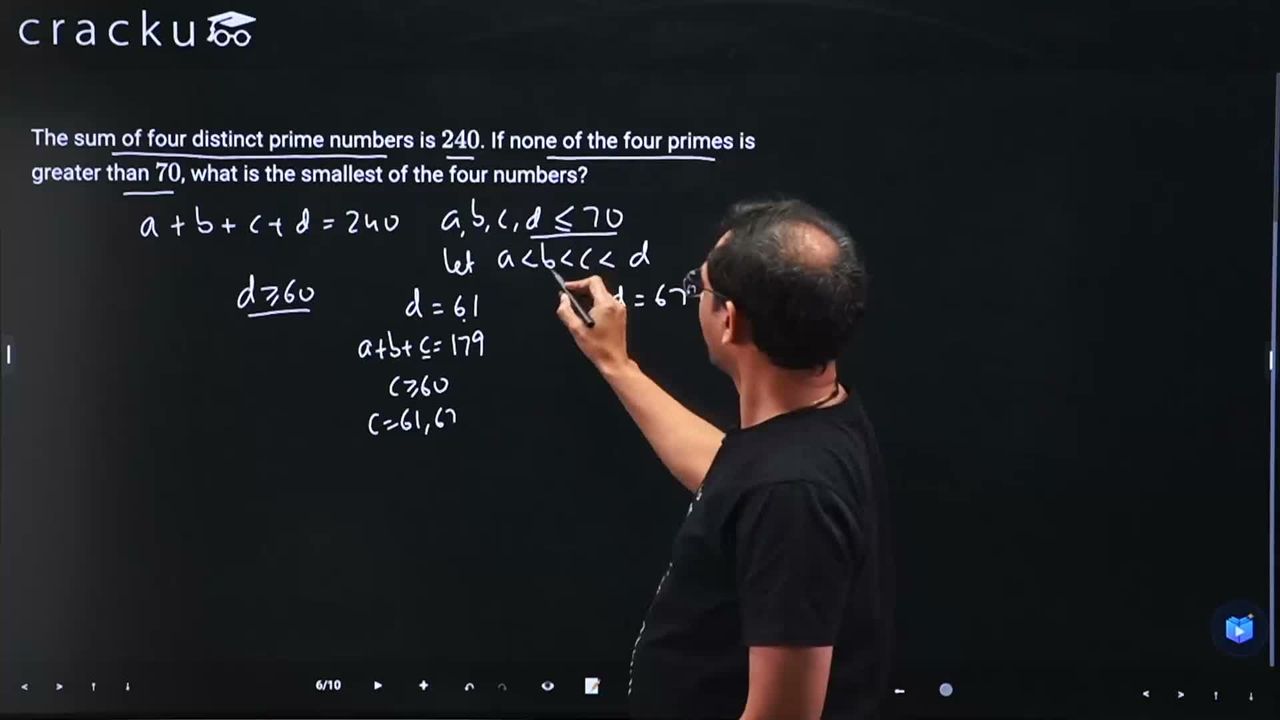
The sum of four distinct prime numbers is $$240$$. If none of the four primes is greater than $$70$$, what is the smallest of the four numbers?
Correct Answer: 53
All primes other than $$2$$ are odd. If $$2$$ were one of the four primes, then $$2+\text{(odd)}+\text{(odd)}+\text{(odd)}$$ would be odd, while the required sum is $$240$$ (even). Hence none of the four primes is $$2$$; all four primes are odd.
List of odd primes not exceeding $$70$$ (in increasing order): $$3,\,5,\,7,\,11,\,13,\,17,\,19,\,23,\,29,\,31,\,37,\,41,\,43,\,47,\,53,\,59,\,61,\,67$$.
Let the four distinct primes be $$p_1 \lt p_2 \lt p_3 \lt p_4 \le 70$$ with $$p_1+p_2+p_3+p_4 = 240$$.
To make $$p_1$$ as small as possible, make the other three primes as large as possible (but still distinct and $$\le 70$$). The three largest distinct primes $$\le 70$$ are $$67, 61, 59$$ whose sum is $$67+61+59 = 187$$.
Therefore $$p_1 + 187 = 240 \;\;\Longrightarrow\;\; p_1 = 240-187 = 53$$.
Check: $$53,\,59,\,61,\,67$$ are all primes $$\le 70$$ and $$53+59+61+67 = 240$$. Thus the choice $$p_1 = 53$$ is attainable, and any smaller prime fails (because even using the three largest permissible primes does not reach $$240$$).
Hence the smallest of the four numbers is 53.
Was this solution helpful?
Click on the Email ☝️ to Watch the Video Solution
Book Free CAT Mentorship
Get personalized CAT strategy from a 99%iler
500+ students mentored
OTP Verification
Enter the 6-digit code sent to your phone
Booking Summary
Enter OTP
Didn't receive the OTP?
_1.webp)

Predict your JEE Main percentile, rank & performance in seconds

Educational materials for JEE preparation

Ask our AI anything

AI can make mistakes. Please verify important information.
AI can make mistakes. Please verify important information.
 91- 6303239042

