Sign in
Please select an account to continue using cracku.in
↓ →

Join Our JEE Preparation Group
Prep with like-minded aspirants; Get access to free daily tests and study material.
How many positive integers $$𝑛 ≤ 100$$ are divisible by all positive integers $$𝑖$$ such that $$i^{3} ≤ 𝑛 $$?
Correct Answer: 26
Let $$n$$ be a positive integer not exceeding $$100$$.
For every such $$n$$ consider the set of divisors that are demanded by the question:
All positive integers $$i$$ with $$i^{3}\le n \quad\Longleftrightarrow\quad 1\le i\le\sqrt[3]{n}\,.$$
Denote $$k=\left\lfloor\sqrt[3]{n}\right\rfloor$$ (the greatest integer whose cube is at most $$n$$). Then $$n$$ must be divisible by each of $$1,2,\dots ,k$$, i.e. by their least common multiple
$$L_k=\operatorname{lcm}(1,2,\dots ,k).$$
Because $$n\le100$$, $$k$$ can only be $$1,2,3,4$$ (since $$5^{3}=125>100$$). We examine each possible $$k$$.
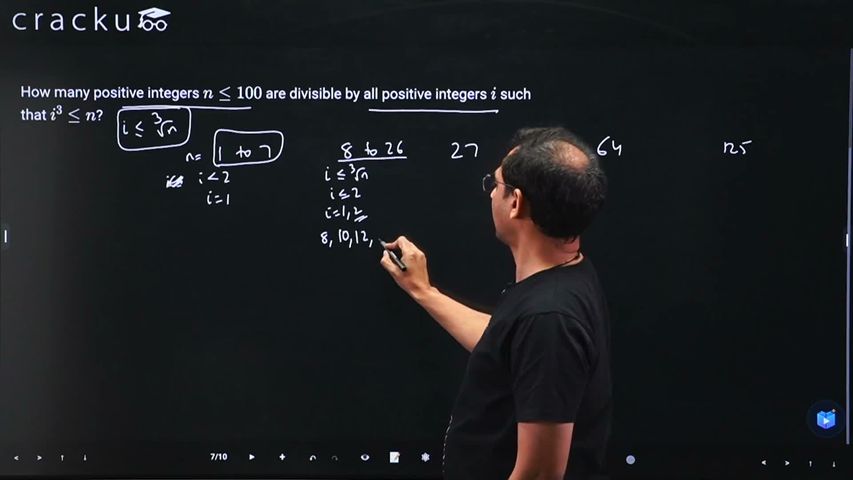
Case 1: $$k=1$$Range of $$n$$: $$1^{3}\le n\le2^{3}-1\;\Longrightarrow\;1\le n\le7$$.
$$L_1=\operatorname{lcm}(1)=1$$, so every $$n$$ in this range works.
Count = $$7$$.
Range of $$n$$: $$2^{3}=8\le n\le3^{3}-1=26$$.
$$L_2=\operatorname{lcm}(1,2)=2$$, so $$n$$ must be even.
Even numbers between $$8$$ and $$26$$:
$$8,10,12,14,16,18,20,22,24,26$$ ⇒ Count = $$10$$.
Range of $$n$$: $$3^{3}=27\le n\le4^{3}-1=63$$.
$$L_3=\operatorname{lcm}(1,2,3)=6$$, so $$n$$ must be a multiple of $$6$$.
Multiples of $$6$$ in $$[27,63]$$:
$$30,36,42,48,54,60$$ ⇒ Count = $$6$$.
Range of $$n$$: $$4^{3}=64\le n\le100$$ (upper bound of the problem).
$$L_4=\operatorname{lcm}(1,2,3,4)=12$$, so $$n$$ must be a multiple of $$12$$.
Multiples of $$12$$ in $$[64,100]$$:
$$72,84,96$$ ⇒ Count = $$3$$.
Adding the counts from all cases:
$$7+10+6+3 = 26.$$
Hence, the number of positive integers $$n\le100$$ that satisfy the given condition is 26.
Was this solution helpful?
Click on the Email ☝️ to Watch the Video Solution
Book Free CAT Mentorship
Get personalized CAT strategy from a 99%iler
500+ students mentored
OTP Verification
Enter the 6-digit code sent to your phone
Booking Summary
Enter OTP
Didn't receive the OTP?
_1.webp)

Predict your JEE Main percentile, rank & performance in seconds

Educational materials for JEE preparation

Ask our AI anything

AI can make mistakes. Please verify important information.
AI can make mistakes. Please verify important information.
 91- 6303239042

