Sign in
Please select an account to continue using cracku.in
↓ →

Join Our JEE Preparation Group
Prep with like-minded aspirants; Get access to free daily tests and study material.
Let $$𝑁$$ be the coefficient of $$x^{2025}$$ in the expansion of $$(x+1)(x^{2}+3)(x^{4}+5)(x^{8}+7)....(x^{1024}+21)$$. What is the remainder when $$𝑁$$ is divided by $$100$$?
Correct Answer: 35
The expansion is
$$(x+1)(x^{2}+3)(x^{4}+5)(x^{8}+7)\dotsm(x^{1024}+21).$$
There are $$11$$ factors. In general, the $$k^{\text{th}}$$ factor is
$$(x^{2^{k}} + (2k+1)), \qquad k = 0,1,2,\dots ,10.$$
While forming a particular term we either pick $$x^{2^{k}}$$ (with coefficient $$1$$) or the constant $$(2k+1)$$ from the $$k^{\text{th}}$$ factor. Hence:
• If we pick $$x^{2^{k}}$$ from a factor, the power $$2^{k}$$ is added to the total exponent.
• If we pick the constant, the factor contributes a multiplicative constant $$(2k+1)$$ to the coefficient.
Thus, to obtain $$x^{2025}$$ the set of chosen exponents must satisfy
$$\sum_{k\in S} 2^{k} = 2025,$$
where $$S$$ is the set of indices from which we selected $$x^{2^{k}}$$. Because powers of two are unique, this representation is the binary expansion of $$2025$$.
Write $$2025$$ in binary:
$$2025 = 1024 + 512 + 256 + 128 + 64 + 32 + 8 + 1$$
Corresponding indices:
$$S = \{10,\,9,\,8,\,7,\,6,\,5,\,3,\,0\}.$$
The remaining indices $$\{1,2,4\}$$ are those from which we must take the constant terms. Therefore the required coefficient is
$$N = (2\cdot 1 + 1)\,(2\cdot 2 + 1)\,(2\cdot 4 + 1) = 3 \times 5 \times 9 = 135.$$
We need the remainder of $$N$$ modulo $$100$$:
$$135 \equiv 35 \pmod{100}.$$
Hence the remainder is 35.
Was this solution helpful?
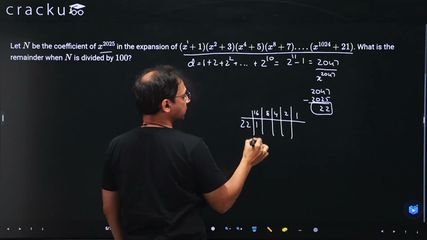
Click on the Email ☝️ to Watch the Video Solution
Book Free CAT Mentorship
Get personalized CAT strategy from a 99%iler
500+ students mentored
OTP Verification
Enter the 6-digit code sent to your phone
Booking Summary
Enter OTP
Didn't receive the OTP?
_1.webp)

Predict your JEE Main percentile, rank & performance in seconds

Educational materials for JEE preparation

Ask our AI anything

AI can make mistakes. Please verify important information.
AI can make mistakes. Please verify important information.
 91- 6303239042

