Sign in
Please select an account to continue using cracku.in
↓ →

Join Our JEE Preparation Group
Prep with like-minded aspirants; Get access to free daily tests and study material.
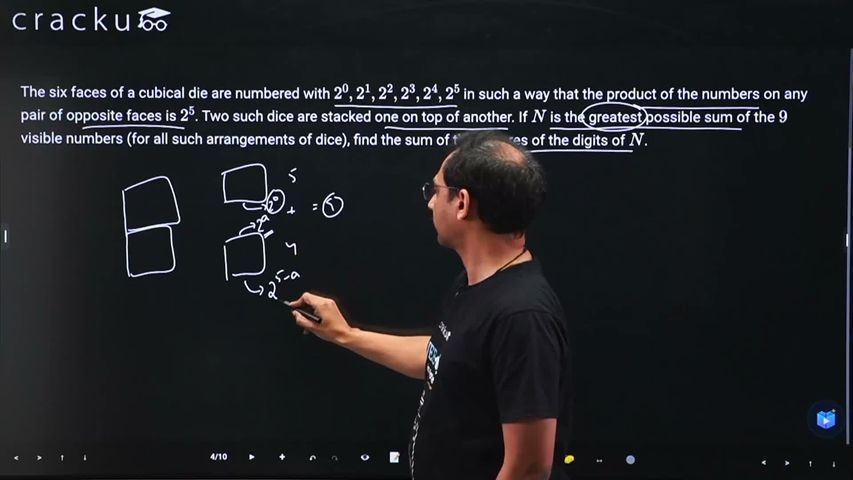
The six faces of a cubical die are numbered with $$2^{0},2^{1},2^{2},2^{3},2^{4},2^{5}$$ in such a way that the product of the numbers on any pair of opposite faces is $$2^{5}$$. Two such dice are stacked one on top of another. If $$𝑁$$ is the greatest possible sum of the $$9$$ visible numbers (for all such arrangements of dice), find the sum of the squares of the digits of $$𝑁$$.
Correct Answer: 11
The six faces of each die bear the numbers $$1,2,4,8,16,32$$ because $$2^{0}=1,\,2^{1}=2,\dots ,2^{5}=32$$.
For every die the product of the numbers on opposite faces equals $$2^{5}=32$$, so every opposite pair must be one of
$$(1,32),\;(2,16),\;(4,8).$$
When two dice are stacked:
Case 1: bottom die
• Its bottom face is hidden by the table.
• Its top face is hidden by the upper die.
⇒ The two hidden faces are opposite faces of the same die.
Case 2: top die
• Its bottom face is hidden by contact with the lower die.
• Its top face is visible.
⇒ Its bottom face and top face are opposite faces.
Total faces of two dice = 12.
Visible faces = 4 (sides of lower) + 4 (sides of upper) + 1 (top of upper) = 9.
Hidden faces = 3.
The sum of the six numbers on one die is $$1+2+4+8+16+32 = 63$$, so for two dice the total of all 12 numbers is $$126$$.
To maximise the sum of the 9 visible numbers we must minimise the sum of the 3 hidden numbers.
Hidden faces of the bottom die
They are opposite, so they must be an element of the set $$\{(1,32),\,(2,16),\,(4,8)\}$$.
Their possible sums are $$33,18,12$$ respectively.
The minimum is $$12$$, achieved by choosing the pair $$(4,8).$$
Hence the bottom and top faces of the lower die should bear $$4$$ and $$8$$ (order irrelevant).
Hidden face of the top die
Choose the smallest available number for the hidden bottom face.
• If we hide $$1$$, its opposite (the visible top face) must be $$32$$.
• Hiding $$2$$ would force $$16$$ on the top face, which is worse both for minimising the hidden sum and for maximising the visible sum.
Therefore we hide $$1$$ and make the top face $$32$$.
Thus the three hidden numbers are $$4,8,1$$ whose sum is $$13$$.
Maximum possible visible sum $$N = 126 - 13 = 113.$$
The digits of $$113$$ are $$1,1,3$$. Sum of the squares of these digits $$1^{2}+1^{2}+3^{2}=1+1+9 = 11.$$
Hence the required answer is 11.
Was this solution helpful?
Click on the Email ☝️ to Watch the Video Solution
Book Free CAT Mentorship
Get personalized CAT strategy from a 99%iler
500+ students mentored
OTP Verification
Enter the 6-digit code sent to your phone
Booking Summary
Enter OTP
Didn't receive the OTP?
_1.webp)

Predict your JEE Main percentile, rank & performance in seconds

Educational materials for JEE preparation

Ask our AI anything

AI can make mistakes. Please verify important information.
AI can make mistakes. Please verify important information.
 91- 6303239042

