Sign in
Please select an account to continue using cracku.in
↓ →
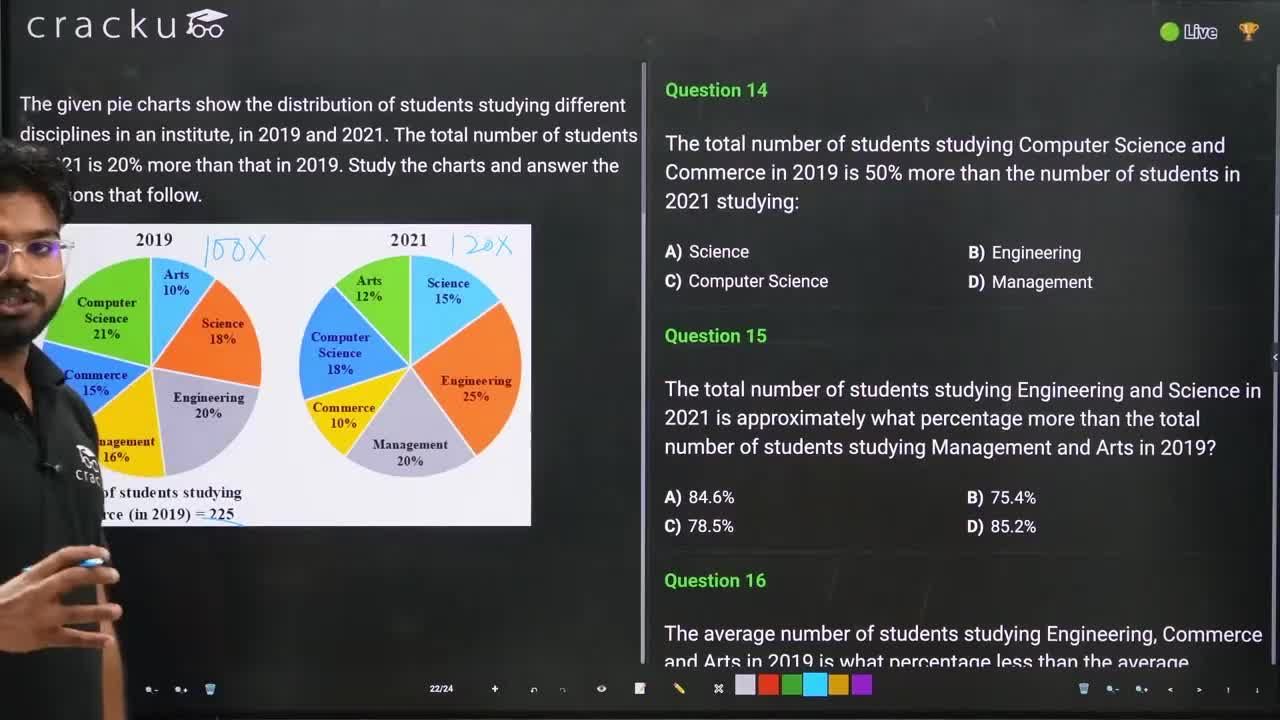
The given pie charts show the distribution of students studying different disciplines in an institute, in 2019 and 2021. The total number of students in 2021 is 20% more than that in 2019. Study the charts and answer the questions that follow.

The total number of students studying Engineering and Science in 2021 is approximately what percentage more than the total number of students studying Management and Arts in 2019?
The required figure is given below:
Let the total number of students in 2019 be $$x$$.
Number of Commerce students = $$15\%\ of\ x=225$$ (given)
$$x=1500$$
Number of students in 2021 increased by 20% as compared to 2019.
Total number of students in 2021 = $$1500\times\left(1+20\%\right)=1800$$
In 2019,
Number of students in Computer Science = 21% of 1500 = 315
Number of students in Arts = 10% of 1500 = 150
Number of students in Science = 18% of 1500 = 270
Number of students in Engineering = 20% of 1500 = 300
Number of students in Management = 16% of 1500 = 240
Number of students in Commerce = 225 (given)
In 2021,
Number of students in Computer Science = 18% of 1800 = 324
Number of students in Arts = 12% of 1800 = 216
Number of students in Science = 15% of 1800 = 270
Number of students in Engineering = 25% of 1800 = 450
Number of students in Management = 20% of 1800 = 360
Number of students in Commerce = 10% of 1800 = 180
Total number of students studying Engineering and Science in 2021 = (450 + 270) = 720
Total number of students studying Management and Arts in 2019 = (240+150) = 390
Difference = 720 - 390 = 330
Percentage = $$\ \dfrac{330}{390}\times100=84.61\%$$
Hence, the number of students studying Engineering and Science in 2021 is 84.61% more than the number of students studying Management and Arts in 2019.
$$\therefore\ $$ The required answer is A.
Was this solution helpful?
Click on the Email ☝️ to Watch the Video Solution
Book Free CAT Mentorship
Get personalized CAT strategy from a 99%iler
500+ students mentored
OTP Verification
Enter the 6-digit code sent to your phone
Booking Summary
Enter OTP
Didn't receive the OTP?
Start your IIM journey with the right preparation and crack CAT 2026.

Educational materials for JEE preparation

Ask our AI anything

AI can make mistakes. Please verify important information.
AI can make mistakes. Please verify important information.
 91- 6303239042


