Sign in
Please select an account to continue using cracku.in
↓ →
Study the following information carefully to answer the given questions.
A, B, C, D, E, and F are arranged around a circular table.
* C and D are placed such that they are equidistant to A. They are also placed at an equal distance to B.
* E is placed second to the left of A.
* Only one pair of adjacent alphabets are seated opposite to each other.
Numbers from 1 to 6 are assigned starting from A in the clockwise direction.
According to the first statement, A and B must be opposite each other for C and D to be equivalent to both A and B.
Since A and B are already adjacent to each other, the other pairs must not be adjacent to each other. It is also given that E is second to the left of A , and F has to be second to the right of A.
There is only one possible arrangement for C and D that satisfies the condition of adjacent letters not being opposite each other. This can be given by the figure below,
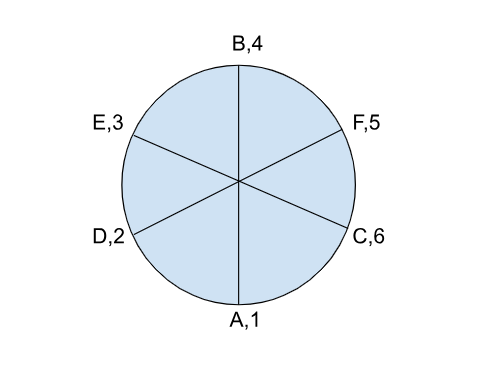
The only pairs from the options that are opposite to each other are C and E.
Hence, the correct answer is option D.
Was this solution helpful?
Book Free CAT Mentorship
Get personalized CAT strategy from a 99%iler
500+ students mentored
OTP Verification
Enter the 6-digit code sent to your phone
Booking Summary
Enter OTP
Didn't receive the OTP?
Start your IIM journey with the right preparation and crack CAT 2026.

Educational materials for CAT preparation

Ask our AI anything

AI can make mistakes. Please verify important information.
AI can make mistakes. Please verify important information.
 91- 6303239042


