Sign in
Please select an account to continue using cracku.in
↓ →
 CAT WhatsApp Group
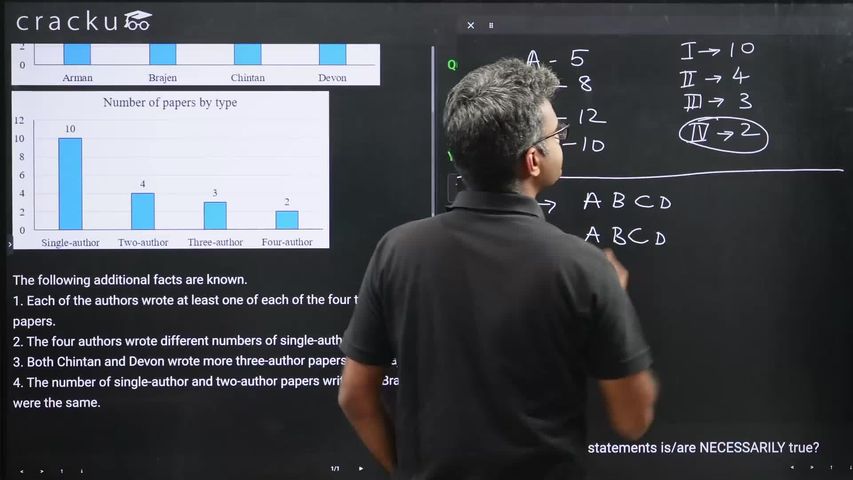
The following charts depict details of research papers written by four authors, Arman, Brajen, Chintan, and Devon. The papers were of four types, single-author, two-author, three-author, and four-author, that is, written by one, two, three, or all four of these authors, respectively. No other authors were involved in writing these papers.
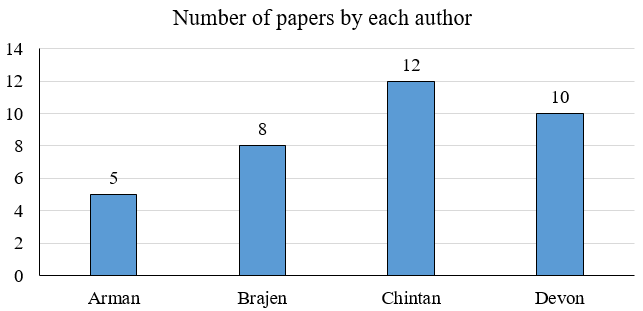
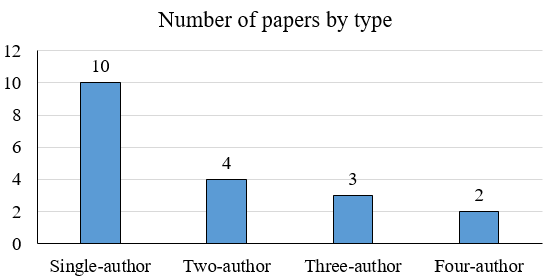
The following additional facts are known.
1. Each of the authors wrote at least one of each of the four types of papers.
2. The four authors wrote different numbers of single-author papers.
3. Both Chintan and Devon wrote more three-author papers than Brajen.
4. The number of single-author and two-author papers written by Brajen were the same.
What was the total number of two-author and three-author papers written by Brajen?
Correct Answer: 4

If all the two-author-type books are counted for both authors separately, then we get the sum to be 4 * 2 = 8.
If all the three-author-type books are counted for all three authors separately, then we get the sum to be 3 * 3 = 9.
If all the four-author-type books are counted for all four authors separately, then we get the sum to be 4 * 2 = 8.
We are given that there are 2 four-author books, so there are exactly two books for each that are of the four-author type.
Putting the values in the table, we get,
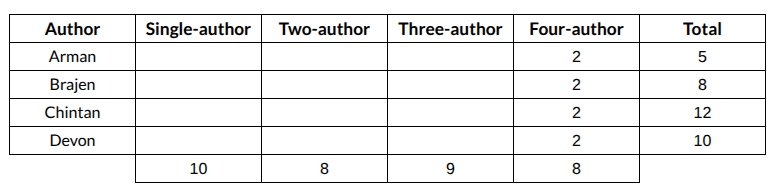
We are given that each author has at least one book of each type. In the case of Arman, there are three books left to be assigned, and there are 3 types of books left, so each of them has to be equal to 1 for the above condition to be satisfied.
In the case of Brajen, we are told that he had an equal number of single-author and two-author books.
Case 1: If the equal number is 1, then the three-author type books become 4, and we are given that both Chintan and Devon had more three-author books than Brajen, which is not possible in this case, as both of them combined will be left with 5 books together and whaterver we split 5 books there wont be a case of both of them having more books than Brajen.
Case 2: If the equal number is 2, then the three-author type books become 2, and we are given that both Chintan and Devon had more three-author books than Brajen, which is possible in this case, as both of them combined will be left with 6 books together and the only way to split 6 books such that both of them are greater than 2 is to split them into 3, 3 and it is the only possible way.
Case 3: If the equal number is greater than or equal to 3, then the three-author type books become 0 or negative, which can directly be eliminated, as we are given that all authors wrote at least 1 book of each type.
So, we can eliminate both cases 1 and 3, and we will be left with the case of Brajen having 2 books each of Single-author, Two-author, and Three-author types. Chintan and Devon have three books each of the three-author type.
Filling up the table with these values, we get,
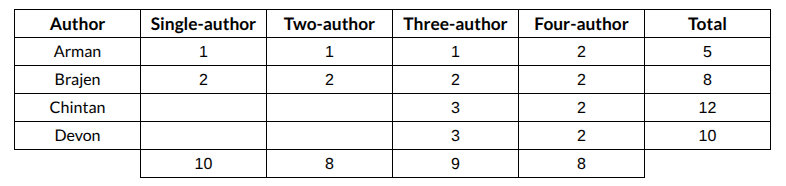
We are given that each author has a different number of single-author type books. The only possibilities for the single-author books of Chintan and Devon are 3 and 4 in some order.
If the single-author books of Chintan are 3, then the double-author books of Chintan become 4, the single-author books of Devon become 4, and the double-author books of Devon become 1.
If the single-author books of Chintan are 4, then the double-author books of Chintan become 3, the single-author books of Devon become 3, and the double-author books of Devon become 2.
Placing both possibilities in the table, we get,
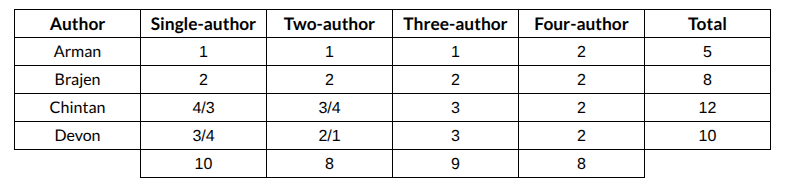
The total number of two-author and three-author papers written by Brajen = 2 + 2 = 4.
Hence, the correct answer is 4.
Was this solution helpful?
Click on the Email ☝️ to Watch the Video Solution
Create a FREE account and get:
Book Free CAT Mentorship
Get personalized CAT strategy from a 99%iler
500+ students mentored
OTP Verification
Enter the 6-digit code sent to your phone
Booking Summary
Enter OTP
Didn't receive the OTP?
Start your IIM journey with the right preparation and crack CAT 2026.

Educational materials for CAT preparation

Ask our AI anything

AI can make mistakes. Please verify important information.
AI can make mistakes. Please verify important information.
 91- 6303239042