Sign in
Please select an account to continue using cracku.in
↓ →

Join Our JEE Preparation Group
Prep with like-minded aspirants; Get access to free daily tests and study material.
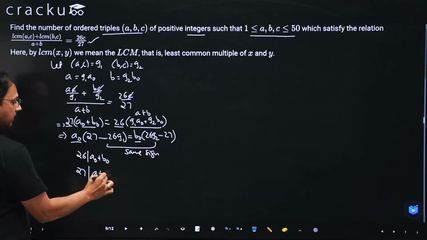
Find the number of ordered triples $$(𝑎, 𝑏, 𝑐)$$ of positive integers such that $$1 \le 𝑎, 𝑏, 𝑐 \le 50$$ which satisfy the relation
$$\frac{lcm(a,c)+lcm(b,c)}{a + b} = \frac{26c}{27}$$.
Here, by $$lcm(𝑥, 𝑦)$$ we mean the $$LCM$$, that is, least common multiple of $$𝑥$$ and $$𝑦$$.
Correct Answer: 40
The relation to be satisfied is
$$\frac{\operatorname{lcm}(a,c)+\operatorname{lcm}(b,c)}{a+b}=\frac{26c}{27}\qquad (1)$$
Write $$\operatorname{lcm}(u,v)=\dfrac{uv}{\gcd(u,v)}.$$
Let $$d=\gcd(a,c),\;e=\gcd(b,c).$$
Then
$$\operatorname{lcm}(a,c)=\dfrac{ac}{d},\qquad \operatorname{lcm}(b,c)=\dfrac{bc}{e}.$$
Substituting in (1) and clearing the denominator $$a+b$$ gives
$$27\!\left(\dfrac{ac}{d}+\dfrac{bc}{e}\right)=26c(a+b).$$
Because $$c\gt0$$, divide by $$c$$ to obtain
$$27\!\left(\frac{a}{d}+\frac{b}{e}\right)=26(a+b). \qquad (2)$$
Write $$a=d\,x,\;b=e\,y\; (x,y\in\mathbb{Z}^{+}).$$ Substituting in (2)
$$27(x+y)=26\bigl(dx+ey\bigr).\qquad (3)$$
Rearrange (3) to
$$x\,(27-26d)+y\,(27-26e)=0.\qquad (4)$$
With $$x,y\gt0$$, the two coefficients in (4) must have opposite signs. Hence exactly one of $$d,e$$ equals $$1$$ and the other is at least $$2$$.
Case 1: $$d=1,\;e\ge2$$Equation (4) becomes $$x+(\,27-26e\,)y=0\Rightarrow x=(26e-27)\,y.$$ Take the smallest positive solution $$x_0=26e-27,\;y_0=1$$ and write the general solution $$x=k(26e-27),\;y=k\;(k\in\mathbb{Z}^{+}).$$ The corresponding $$a,b$$ are
$$a=x=k(26e-27),\qquad b=e\,y=ek.$$
Require $$a,b\le50$$.
Since $$26e-27\ge25$$ for $$e\ge2$$, the inequality $$a\le50$$ forces $$e=2$$ and $$k=1,2$$. The choice $$k=2$$ gives $$a=50$$, $$b=4$$, but then $$\gcd(50,c)=1$$ (needed because $$d=1$$) is impossible for any even $$c$$. Hence only $$k=1$$ remains, giving
$$a=25,\;b=2,\;e=2,\;d=1.$$
Now $$d=1\Rightarrow\gcd(a,c)=1,$$ and $$e=2\Rightarrow 2\mid c,\;\gcd\!\bigl(b,c\bigr)=2$$. Thus $$c$$ must be even ($$2\mid c$$) and not divisible by $$5$$ (so that $$\gcd(25,c)=1$$). Among $$1\le c\le50$$ there are $$25$$ even numbers; five of them (10,20,30,40,50) are divisible by 5. Therefore there are $$25-5=20$$ admissible values of $$c$$.
Hence Case 1 contributes $$20$$ ordered triples $$\bigl(a,b,c\bigr)=(25,2,c).$$
Case 2: $$d\ge2,\;e=1$$By symmetry of (4) we get $$y=x(26d-27).$$ Taking $$x=k,\;y=k(26d-27)$$ produces
$$a=d\,x=dk,\qquad b=y=k(26d-27).$$
Again require $$a,b\le50$$.
With $$d\ge2$$ we must have $$d=2$$ (otherwise $$b\gt50$$). For $$d=2$$ we get $$a=2k,\;b=25k$$. The condition $$b\le50$$ forces $$k=1,2$$, but $$k=2$$ would give $$b=50$$ and $$\gcd(50,c)=1$$ (needed because $$e=1$$) impossible when $$a$$ is even. Thus only $$k=1$$ is feasible, giving
$$a=2,\;b=25,\;d=2,\;e=1.$$
Now $$d=2\Rightarrow\gcd(a,c)=2$$, so $$c$$ must be even; $$e=1\Rightarrow\gcd(b,c)=1,$$ so $$c$$ must be coprime to $$25$$. Exactly the same description as in Case 1 (even & not divisible by 5) applies, giving again $$20$$ admissible values of $$c$$.
So Case 2 also contributes $$20$$ ordered triples $$\bigl(a,b,c\bigr)=(2,25,c).$$
No other choices of $$(d,e)$$ can satisfy (4), hence no further solutions exist.
Total number of ordered triples $$=20\;(\text{from }25,2,c)+20\;(\text{from }2,25,c)=40.$$
Therefore the required number of ordered triples is 40.
Was this solution helpful?
Click on the Email ☝️ to Watch the Video Solution
Book Free CAT Mentorship
Get personalized CAT strategy from a 99%iler
500+ students mentored
OTP Verification
Enter the 6-digit code sent to your phone
Booking Summary
Enter OTP
Didn't receive the OTP?
_1.webp)

Predict your JEE Main percentile, rank & performance in seconds

Educational materials for JEE preparation

Ask our AI anything

AI can make mistakes. Please verify important information.
AI can make mistakes. Please verify important information.
 91- 6303239042

