Sign in
Please select an account to continue using cracku.in
↓ →

Join Our JEE Preparation Group
Prep with like-minded aspirants; Get access to free daily tests and study material.
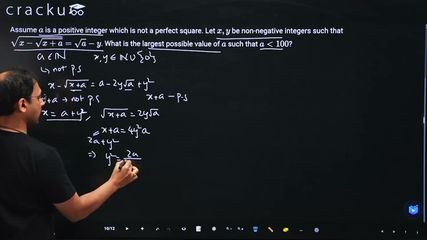
Assume $$𝑎$$ is a positive integer which is not a perfect square. Let $$𝑥, 𝑦$$ be non-negative integers such that $$\sqrt{x-\sqrt{x+a}} = \sqrt{a} - y$$. What is the largest possible value of $$𝑎$$ such that $$𝑎 < 100$$?
Correct Answer: 91
The given relation is
$$\sqrt{x-\sqrt{x+a}}=\sqrt{a}-y,$$
where $$a$$ is a positive integer that is not a perfect square and $$x,y$$ are non-negative integers.
Both square-roots must be real, so
$$x-\sqrt{x+a}\ge 0 \quad\text{and}\quad \sqrt{a}-y\ge 0.$$
Hence $$y\le\sqrt{a}.$$
Square the equation once:
$$x-\sqrt{x+a}=a-2y\sqrt{a}+y^{2}. \; -(1)$$
Isolate the remaining root and square again. From (1)
$$\sqrt{x+a}=x-a-y^{2}+2y\sqrt{a}.$$
Square a second time:
$$x+a=(x-a-y^{2}+2y\sqrt{a})^{2}.$$
Write the right side as “rational part + irrational part”:
Let $$s=\sqrt{a}$$ (irrational because $$a$$ is not a perfect square).
Put $$A=x-a-y^{2}\,(\text{rational}), \; B=2ys\,(\text{contains }s).$$
Then
$$x+a=A^{2}+4y^{2}a+4Ay\,s.$$
The left side $$x+a$$ is purely rational, so the coefficient of the irrational term $$s$$ must vanish:
$$4Ay=0.$$
Case 1: $$y\gt0$$Then $$A=0\;\Rightarrow\;x=a+y^{2}.$$
Put this in $$x+a=4y^{2}a$$ obtained above to give
$$2a+y^{2}=4ay^{2}\;\Rightarrow\;y^{2}=\dfrac{2a}{4a-1}.$$
Because $$4a-1>2a$$ for every positive $$a$$, the right side is <1, contradicting $$y\gt0$$ (an integer).
Hence no solution exists when $$y\gt0$$.
Equation (1) becomes $$x-\sqrt{x+a}=a.$$ Rearrange and square only once (no irrational term now):
$$x-\sqrt{x+a}=a\;\Longrightarrow\;(x-a)^{2}=x+a.$$
Expand and collect terms in $$x$$:
$$x^{2}-(2a+1)x+a(a-1)=0.$$
The discriminant must be a perfect square for $$x$$ to be integral:
$$\Delta=(2a+1)^{2}-4a(a-1)=8a+1.$$
Therefore $$8a+1=m^{2}$$ for some odd integer $$m$$, and
$$a=\dfrac{m^{2}-1}{8}.$$
List all odd $$m$$ that keep $$a\lt 100$$ and give non-square $$a$$:
$$\begin{array}{c|c} m & a=\dfrac{m^{2}-1}{8}\\\hline 3 & 1\;(\text{square, reject})\\ 5 & 3\\ 7 & 6\\ 9 & 10\\ 11& 15\\ 13& 21\\ 15& 28\\ 17& 36\;(\text{square, reject})\\ 19& 45\\ 21& 55\\ 23& 66\\ 25& 78\\ 27& 91\\ 29&105\;(\gt100,\text{ stop}) \end{array}$$
The admissible values of $$a$$ below 100 are
$$3,\,6,\,10,\,15,\,21,\,28,\,45,\,55,\,66,\,78,\,91.$$
The largest among them is $$a=91$$.
Hence the greatest possible value of $$a$$ satisfying the given condition is
91.
Was this solution helpful?
Click on the Email ☝️ to Watch the Video Solution
Book Free CAT Mentorship
Get personalized CAT strategy from a 99%iler
500+ students mentored
OTP Verification
Enter the 6-digit code sent to your phone
Booking Summary
Enter OTP
Didn't receive the OTP?
_1.webp)

Predict your JEE Main percentile, rank & performance in seconds

Educational materials for JEE preparation

Ask our AI anything

AI can make mistakes. Please verify important information.
AI can make mistakes. Please verify important information.
 91- 6303239042

