
Join Our JEE Preparation Group
Prep with like-minded aspirants; Get access to free daily tests and study material.
Sign in
Please select an account to continue using cracku.in
↓ →
Join Our JEE Preparation Group
Prep with like-minded aspirants; Get access to free daily tests and study material.
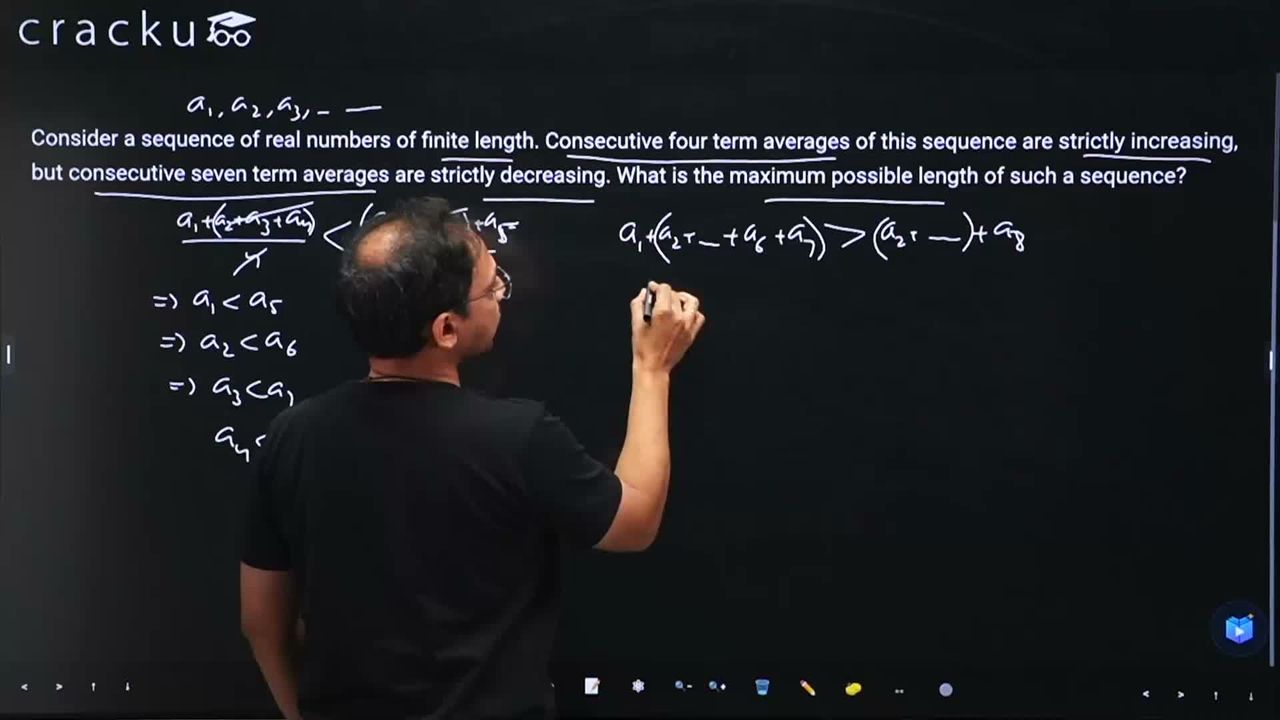
Consider a sequence of real numbers of finite length. Consecutive four term averages of this sequence are strictly increasing, but consecutive seven term averages are strictly decreasing. What is the maximum possible length of such a sequence?
Correct Answer: 10
Let the finite sequence be $$a_1,a_2,\dots ,a_n$$.
Denote the sliding four-term averages by $$S_k=\dfrac{a_k+a_{k+1}+a_{k+2}+a_{k+3}}{4},\;1\le k\le n-3$$.
Because these averages are strictly increasing,
$$S_{k+1}\gt S_k \;\Longrightarrow\; a_{k+1}+a_{k+2}+a_{k+3}+a_{k+4}\gt a_k+a_{k+1}+a_{k+2}+a_{k+3} \;\Longrightarrow\; a_{k+4}\gt a_k \quad -(1)$$
Similarly, let the seven-term averages be $$T_k=\dfrac{a_k+a_{k+1}+\dots +a_{k+6}}{7},\;1\le k\le n-6.$$ Because these are strictly decreasing,
$$T_{k+1}\lt T_k \;\Longrightarrow\; a_{k+1}+a_{k+2}+\dots +a_{k+7}\lt a_k+a_{k+1}+\dots +a_{k+6} \;\Longrightarrow\; a_{k+7}\lt a_k \quad -(2)$$
Thus, for every admissible index $$k$$ we have the pair of inequalities
$$a_{k+4}\gt a_k,\qquad a_{k+7}\lt a_k.$$
Case 1: $$n\ge 11$$ (we shall derive a contradiction).
Consider the eleven indices in the order
$$1,\;8,\;4,\;11,\;7,\;3,\;10,\;6,\;2,\;9,\;5.$$
Using (1) and (2) successively we obtain the strict chain
$$\begin{aligned} a_1 &\gt a_8 &&\bigl(\text{from }(2)\text{ with }k=1\bigr)\\ a_8 &\gt a_4 &&\bigl((1)\text{ with }k=4\bigr)\\ a_4 &\gt a_{11} &&\bigl((2)\text{ with }k=4\bigr)\\ a_{11}&\gt a_7 &&\bigl((1)\text{ with }k=7\bigr)\\ a_7 &\gt a_3 &&\bigl((1)\text{ with }k=3\bigr)\\ a_3 &\gt a_{10} &&\bigl((2)\text{ with }k=3\bigr)\\ a_{10}&\gt a_6 &&\bigl((1)\text{ with }k=6\bigr)\\ a_6 &\gt a_2 &&\bigl((1)\text{ with }k=2\bigr)\\ a_2 &\gt a_9 &&\bigl((2)\text{ with }k=2\bigr)\\ a_9 &\gt a_5 &&\bigl((1)\text{ with }k=5\bigr) \end{aligned}$$
Finally, applying (1) with $$k=1$$ gives $$a_5\gt a_1$$, so altogether we have
$$a_1\gt a_8\gt a_4\gt a_{11}\gt a_7\gt a_3\gt a_{10}\gt a_6\gt a_2\gt a_9\gt a_5\gt a_1,$$
a strict cycle of inequalities that is impossible for real numbers. Hence no sequence can satisfy the given conditions when $$n\ge 11$$, and therefore
$$n\le 10.$$
Case 2: Construction of a sequence of length $$10$$ that fulfils the requirements.
Take
$$a_1=10,\; a_2=20,\; a_3=30,\; a_4=0,\; a_5=12,\; a_6=22,\; a_7=35,\; a_8=8,\; a_9=15,\; a_{10}=25.$$
Check the nine inequalities that must hold:
Four-term type (1):
$$a_5\gt a_1\;(12\gt10),\;
a_6\gt a_2\;(22\gt20),\;
a_7\gt a_3\;(35\gt30),\;
a_8\gt a_4\;(8\gt0),$$
$$a_9\gt a_5\;(15\gt12),\;
a_{10}\gt a_6\;(25\gt22).$$
Seven-term type (2):
$$a_8\lt a_1\;(8\lt10),\;
a_9\lt a_2\;(15\lt20),\;
a_{10}\lt a_3\;(25\lt30).$$
All conditions are satisfied, so a length-10 sequence exists.
Combining Case 1 and Case 2, the maximal possible length of the sequence is
10.
Was this solution helpful?
Click on the Email ☝️ to Watch the Video Solution
Book Free CAT Mentorship
Get personalized CAT strategy from a 99%iler
500+ students mentored
OTP Verification
Enter the 6-digit code sent to your phone
Booking Summary
Enter OTP
Didn't receive the OTP?
_1.webp)

Predict your JEE Main percentile, rank & performance in seconds

Educational materials for JEE preparation

Ask our AI anything

AI can make mistakes. Please verify important information.
AI can make mistakes. Please verify important information.

