Sign in
Please select an account to continue using cracku.in
↓ →

Join Our JEE Preparation Group
Prep with like-minded aspirants; Get access to free daily tests and study material.
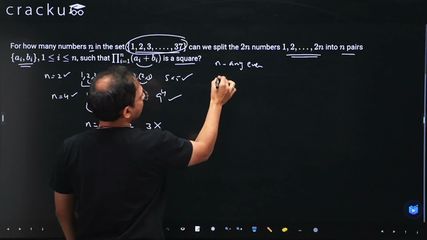
For how many numbers $$𝑛$$ in the set $$\left\{1,2,3,....,37\right\}$$ can we split the $$2𝑛$$ numbers $$1, 2, … , 2𝑛$$ into $$𝑛$$ pairs $$\left\{a_{i},b_{i}\right\},1 \le i \le n$$, such that $$\prod_{i=1}^{n}(a_{i}+b_{i})$$ is a square?
Correct Answer: 36
Let $$n$$ range over $$\{1,2,3,\dots ,37\}$$. For each admissible $$n$$ we must divide the integers $$1,2,\dots ,2n$$ into $$n$$ unordered pairs $$\{a_i,b_i\}$$ in such a way that the product $$\displaystyle\prod_{i=1}^{n}(a_i+b_i)$$ is a perfect square.
We treat three separate cases.
Case 1: $$n=1$$The only pairing is $$\{1,2\}$$ whose sum is $$3$$, so the product is $$3$$, which is not a square. Hence $$n=1$$ does not work.
Case 2: $$n$$ even \big($$n=2m$$ with $$m\ge 1$$\big)Pair each integer with its “mirror image’’ about $$2n+1$$: $$\{1,2n\},\ \{2,2n-1\},\dots ,\{n,\,n+1\}.$$ Every pair has the same sum $$1+2n=2n+1,\;2+2n-1=2n+1,\;\dots ,n+(n+1)=2n+1.$$ Thus
$$\prod_{i=1}^{n}(a_i+b_i)=(2n+1)^n.$$
Because the exponent $$n=2m$$ is even, each prime factor of $$2n+1$$ occurs an even number of times, so the product is a perfect square. Therefore every even $$n$$ (that is, $$n=2,4,6,\dots ,36$$) satisfies the requirement.
Case 3: $$n$$ odd and at least $$3$$ \big($$n=2k+1$$ with $$k\ge 1$$\big)Step I - fix the first six numbers.
Pair the numbers $$1$$ to $$6$$ as
$$\{1,5\},\quad \{2,4\},\quad \{3,6\}.$$
The corresponding sums are
$$6,\;6,\;9,$$
and their product is
$$6\cdot6\cdot9=36\cdot9=18^2,$$
already a perfect square.
Step II - handle the remaining numbers.
After removing $$1$$ through $$6$$, the numbers left are
$$7,8,9,\dots ,2n.$$
Their count is $$2n-6=2(2k+1)-6=4(k-1),$$ which is a multiple of $$4$$ because $$k-1$$ is an integer.
Split them into consecutive blocks of four:
$$\bigl(7,8,9,10\bigr),\ \bigl(11,12,13,14\bigr),\ \dots$$
In each block $$\bigl(x,x+1,x+2,x+3\bigr)$$ form the two pairs
$$\{x,x+3\},\qquad \{x+1,x+2\}.$$
Both pairs have the same sum $$x+(x+3)=x+1+(x+2)=2x+3.$$ Hence the contribution of this block to the overall product is $$(2x+3)\times(2x+3)=(2x+3)^2,$$ a perfect square.
Step III - combine everything.
The product from Step I is a square, and every four-number block from Step II contributes another square.
The product of several perfect squares is again a perfect square, so the required condition is fulfilled for every odd $$n\ge 3$$ (that is, $$n=3,5,7,\dots ,37$$).
Combining all three cases:
• $$n=1$$ fails. • All other $$n\in\{1,2,\dots ,37\}$$ succeed.
Therefore the number of values of $$n$$ that work is $$37-1 = 36.$$
Final Answer: 36
Was this solution helpful?
Click on the Email ☝️ to Watch the Video Solution
Book Free CAT Mentorship
Get personalized CAT strategy from a 99%iler
500+ students mentored
OTP Verification
Enter the 6-digit code sent to your phone
Booking Summary
Enter OTP
Didn't receive the OTP?
_1.webp)

Predict your JEE Main percentile, rank & performance in seconds

Educational materials for JEE preparation

Ask our AI anything

AI can make mistakes. Please verify important information.
AI can make mistakes. Please verify important information.
 91- 6303239042

