Sign in
Please select an account to continue using cracku.in
↓ →

Join Our JEE Preparation Group
Prep with like-minded aspirants; Get access to free daily tests and study material.
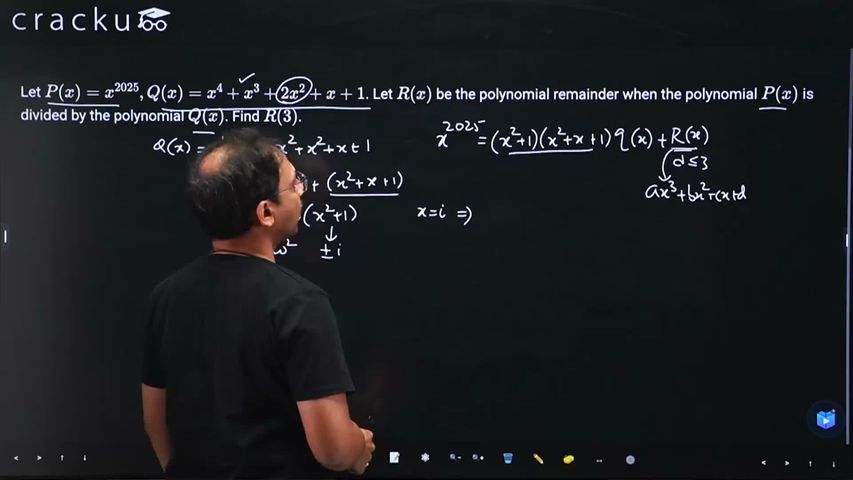
Let $$P(x) = x^{2025},Q(x) = x^{4} + x^{3} + 2x^{2} + x + 1$$. Let $$𝑅(𝑥)$$ be the polynomial remainder when the polynomial $$𝑃(𝑥)$$ is divided by the polynomial $$𝑄(𝑥)$$. Find $$𝑅(3)$$.
Correct Answer: 53
We have to find the remainder $$R(x)$$ when $$P(x)=x^{2025}$$ is divided by $$Q(x)=x^{4}+x^{3}+2x^{2}+x+1$$ and then evaluate $$R(3)$$.
1. Factorise the divisor
Notice that
$$(x^{2}+1)(x^{2}+x+1)=x^{4}+x^{3}+2x^{2}+x+1=Q(x).$$
Hence $$Q(x)$$ splits into two coprime quadratic factors
$$A(x)=x^{2}+1,\qquad B(x)=x^{2}+x+1.$$
Because they are coprime, the Chinese Remainder Theorem (CRT) lets us determine the unique remainder of degree at most 3 from its residues modulo $$A(x)$$ and $$B(x).$$
2. Remainder of $$P(x)$$ modulo $$A(x)=x^{2}+1$$
Inside the quotient ring $$\mathbb{R}[x]/(x^{2}+1)$$ we have $$x^{2}\equiv-1,$$ so the powers of $$x$$ repeat every 4:
$$x^{0}\equiv1,\;x^{1}\equiv x,\;x^{2}\equiv-1,\;x^{3}\equiv -x,\;x^{4}\equiv1,\ldots$$
Since $$2025=4\cdot506+1,$$
$$x^{2025}\equiv x^{1}\equiv x\pmod{x^{2}+1}.$$
Therefore
$$r_{1}(x)=x.$$
3. Remainder of $$P(x)$$ modulo $$B(x)=x^{2}+x+1$$
Inside $$\mathbb{R}[x]/(x^{2}+x+1)$$ we have $$x^{2}\equiv -x-1,$$ which gives
$$x^{3}\equiv1.$$
Hence the powers of $$x$$ repeat every 3:
$$x^{0}\equiv1,\;x^{1}\equiv x,\;x^{2}\equiv -x-1,\;x^{3}\equiv1,\ldots$$
Because $$2025=3\cdot675,$$
$$x^{2025}\equiv x^{0}\equiv1\pmod{x^{2}+x+1}.$$
Thus
$$r_{2}(x)=1.$$
4. Construct the remainder $$R(x)$$ of degree $$\le3$$
Let
$$R(x)=ax^{3}+bx^{2}+cx+d.$$
It must satisfy simultaneously
$$R(x)\equiv x\pmod{A(x)},\qquad R(x)\equiv1\pmod{B(x)}.$$
Case 1: Modulo $$A(x)=x^{2}+1$$
Use $$x^{2}\equiv-1,\;x^{3}\equiv -x:$$
$$R(x)\equiv a(-x)+b(-1)+cx+d=(-a+c)x+(-b+d).$$
To match $$x,$$ we need
$$-a+c=1,\qquad -b+d=0\;\Rightarrow\;d=b.$$
Case 2: Modulo $$B(x)=x^{2}+x+1$$
Use $$x^{2}\equiv -x-1,\;x^{3}\equiv1:$$
$$R(x)\equiv a + b(-x-1)+cx+d=(c-b)x+(a-b+d).$$
To match the constant $$1,$$ we need
$$c-b=0\;\Rightarrow\;c=b,\qquad a-b+d=1.$$
From $$c=b$$ and $$d=b$$, the last equation becomes $$a=1.$$ Plugging $$a=1$$ into $$-a+c=1$$ yields $$c=2,$$ hence $$b=c=2$$ and $$d=2.$$
Therefore $$R(x)=x^{3}+2x^{2}+2x+2.$$
5. Evaluate $$R(3)$$
$$R(3)=3^{3}+2\cdot3^{2}+2\cdot3+2=27+18+6+2=53.$$
Hence the required value is 53.
Was this solution helpful?
Click on the Email ☝️ to Watch the Video Solution
Book Free CAT Mentorship
Get personalized CAT strategy from a 99%iler
500+ students mentored
OTP Verification
Enter the 6-digit code sent to your phone
Booking Summary
Enter OTP
Didn't receive the OTP?
_1.webp)

Predict your JEE Main percentile, rank & performance in seconds

Educational materials for JEE preparation

Ask our AI anything

AI can make mistakes. Please verify important information.
AI can make mistakes. Please verify important information.
 91- 6303239042

