Sign in
Please select an account to continue using cracku.in
↓ →

Join Our JEE Preparation Group
Prep with like-minded aspirants; Get access to free daily tests and study material.
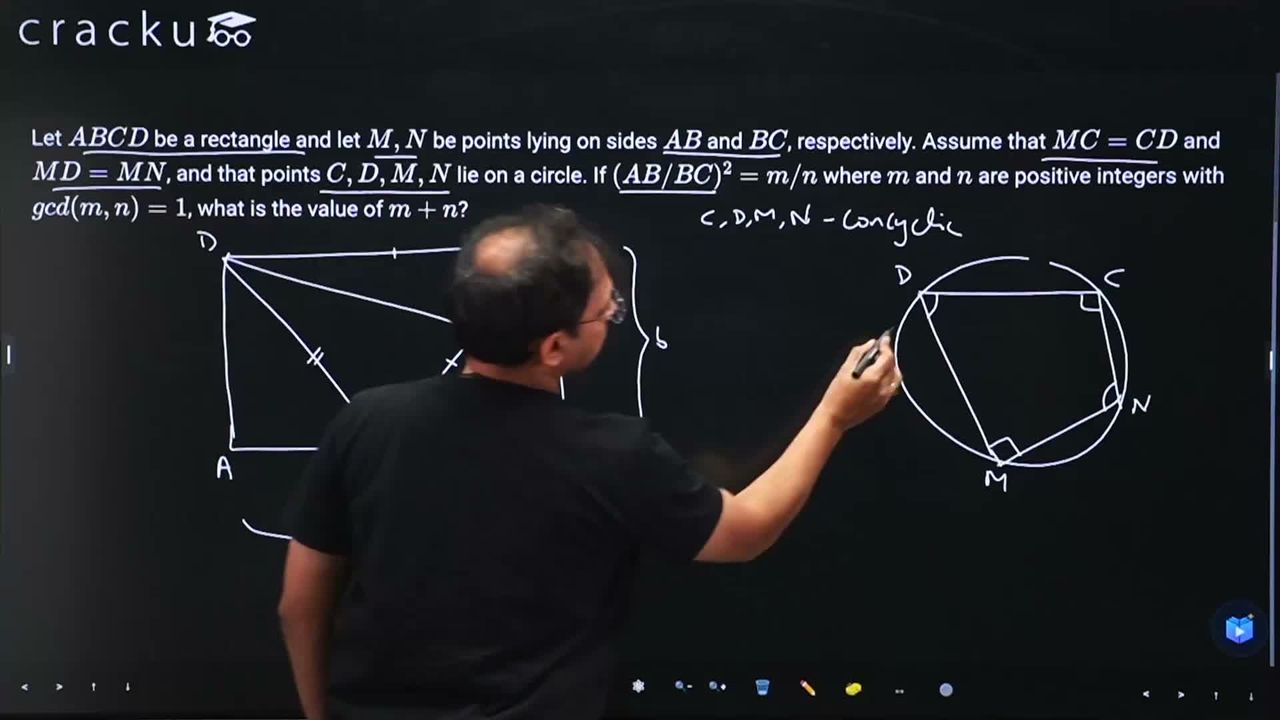
Let $$𝐴𝐵𝐶𝐷$$ be a rectangle and let $$𝑀, 𝑁$$ be points lying on sides $$𝐴𝐵$$ and $$𝐵𝐶$$, respectively. Assume that $$𝑀𝐶 = 𝐶𝐷$$ and $$𝑀𝐷 = 𝑀𝑁$$, and that points $$𝐶, 𝐷, 𝑀, 𝑁$$ lie on a circle. If $$(AB/BC)^{2} = m/n$$ where $$m$$ and $$n$$ are positive integers with $$gcd(𝑚, 𝑛) = 1$$, what is the value of $$𝑚 + 𝑛$$?
Correct Answer: 03
Let the rectangle be $$ABCD$$ with $$A(0,0),\;B(b,0),\;C(b,c),\;D(0,c)$$.
Thus $$AB=b$$ and $$BC=c$$.
Take $$M(x,0)$$ on $$AB$$ and $$N(b,y)$$ on $$BC$$ with $$0\lt x\lt b,\;0\lt y\lt c$$.
Step 1: Using $$MC = CD$$
$$MC^{2} = (b-x)^{2}+c^{2},\quad CD^{2}=b^{2}$$
$$(b-x)^{2}+c^{2}=b^{2}\;\Rightarrow\;c^{2}=2bx-x^{2}\;-(1)$$
Step 2: Using $$MD = MN$$
$$MD^{2}=x^{2}+c^{2},\quad MN^{2}=(b-x)^{2}+y^{2}$$
$$x^{2}+c^{2}=(b-x)^{2}+y^{2}\;\Rightarrow\;y^{2}=4bx-x^{2}-b^{2}\;-(2)$$
Step 3: Circle through $$C,D,M$$
Because $$C(b,c)$$ and $$D(0,c)$$ have the same $$y$$-coordinate, the perpendicular bisector of $$CD$$ is the vertical line $$x=\dfrac{b}{2}$$.
Hence the centre of the circle is $$\left(\dfrac{b}{2},\,k\right)$$ for some $$k$$.
Equal radii to $$D$$ and $$M$$ give
$$\left(\dfrac{b}{2}\right)^{2}+(k-c)^{2}=\left(\dfrac{b}{2}-x\right)^{2}+k^{2}$$
$$\Rightarrow\;2ck-c^{2}=bx-x^{2}\;-(3)$$
Step 4: Point $$N$$ is concyclic
$$N(b,y)$$ lies on the same circle, so
$$\left(\dfrac{b}{2}\right)^{2}+(y-k)^{2}=\left(\dfrac{b}{2}\right)^{2}+(k-c)^{2}$$
$$\Rightarrow\;(y-k)^{2}=(k-c)^{2}$$
Rejecting $$y=c$$ (which would force $$N=C$$ and violate $$MC=CD$$), take $$y=2k-c\;-(4)$$.
Step 5: Eliminate $$k,y$$ and solve
From (3): $$k=\dfrac{3bx-2x^{2}}{2c}$$.
Substitute this in (4): $$y=\dfrac{bx-x^{2}}{c}$$.
Insert $$y$$ in (2):
$$\left(\dfrac{bx-x^{2}}{c}\right)^{2}=4bx-x^{2}-b^{2}$$.
Use (1) to replace $$c^{2}$$ and let $$t=\dfrac{x}{b}\;(0\lt t\lt 1)$$.
With $$c^{2}=b^{2}(2t-t^{2})$$, the equality becomes $$\dfrac{t^{2}(1-t)^{2}}{2t-t^{2}}=4t-t^{2}-1$$ $$\Longrightarrow\;-2t\left(2t^{2}-4t+1\right)=0$$ $$\Rightarrow\;2t^{2}-4t+1=0$$ $$\Rightarrow\;t=1-\dfrac{\sqrt{2}}{2}\;\;(\text{the root }0\lt t\lt1).$$
Step 6: Compute $$(AB/BC)^{2}$$
$$\left(\dfrac{AB}{BC}\right)^{2}=\left(\dfrac{b}{c}\right)^{2}=\dfrac{1}{2t-t^{2}}.$$
For the obtained $$t$$,
$$2t-t^{2}=0.5=\dfrac12$$
$$\therefore\;\left(\dfrac{AB}{BC}\right)^{2}=2=\dfrac{2}{1}.$$
Thus $$m=2,\;n=1,\;m+n=3$$.
Answer: 03.
Was this solution helpful?
Click on the Email ☝️ to Watch the Video Solution
Book Free CAT Mentorship
Get personalized CAT strategy from a 99%iler
500+ students mentored
OTP Verification
Enter the 6-digit code sent to your phone
Booking Summary
Enter OTP
Didn't receive the OTP?
_1.webp)

Predict your JEE Main percentile, rank & performance in seconds

Educational materials for JEE preparation

Ask our AI anything

AI can make mistakes. Please verify important information.
AI can make mistakes. Please verify important information.
 91- 6303239042

