Sign in
Please select an account to continue using cracku.in
↓ →
 CAT WhatsApp Group
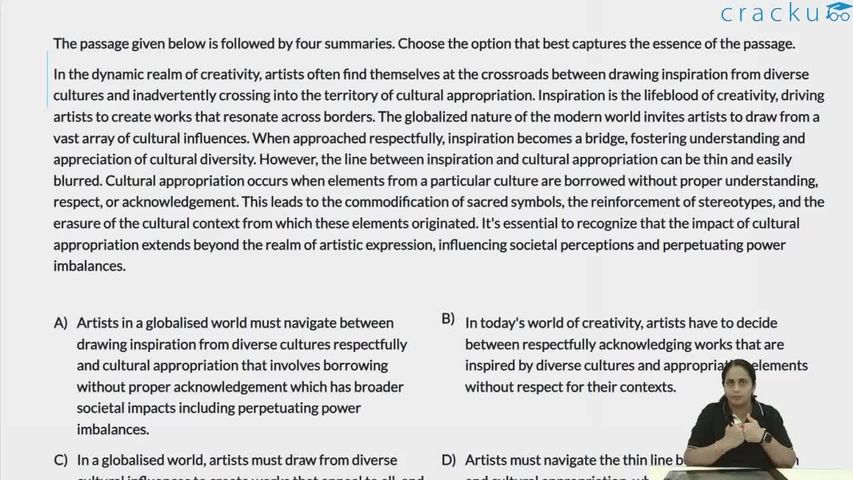
The passage given below is followed by four summaries. Choose the option that best captures the essence of the passage.
In the dynamic realm of creativity, artists often find themselves at the crossroads between drawing inspiration from diverse cultures and inadvertently crossing into the territory of cultural appropriation. Inspiration is the lifeblood of creativity, driving artists to create works that resonate across borders. The globalized nature of the modern world invites artists to draw from a vast array of cultural influences. When approached respectfully, inspiration becomes a bridge, fostering understanding and appreciation of cultural diversity. However, the line between inspiration and cultural appropriation can be thin and easily blurred. Cultural appropriation occurs when elements from a particular culture are borrowed without proper understanding, respect, or acknowledgement. This leads to the commodification of sacred symbols, the reinforcement of stereotypes, and the erasure of the cultural context from which these elements originated. It's essential to recognize that the impact of cultural appropriation extends beyond the realm of artistic expression, influencing societal perceptions and perpetuating power imbalances.

The passage talks about a key issue in modern art: a globalised world lets artists find inspiration in many cultures, but this also brings the risk of cultural appropriation. The author explains that respectful and thoughtful inspiration can help people appreciate other cultures. On the other hand, cultural appropriation is not just borrowing, but borrowing without understanding, respect, or acknowledgement, which can lead to commodification, stereotypes, and bigger problems in society, like reinforcing power imbalances. Based on this, let's consider each option individually.
Option A clearly shows both sides of the argument. It mentions the global context, separates respectful inspiration from appropriation that lacks acknowledgement, and highlights the passage’s focus on bigger social issues like power imbalances. This matches the passage’s main points well.
Option B points out the main difference between respectful inspiration and appropriation, but it is too general. It treats the issue as just a matter of “deciding” and leaves out the effects of appropriation and its impact on society, which are key parts of the passage.
Option C gets the author’s view wrong by suggesting that drawing from different cultures 'always' results in instances of both inspiration and cultural appropriation. The passage does not say this is inevitable. Instead, it says appropriation depends on how the borrowing happens. Also, "artists must draw from diverse cultural influences " is a bit strong, and it is also not implied in the passage.
Option D doesn't present the complete argument, as it does not mention the global context or the idea of wider power imbalances, so it is a bit more limited in scope compared to the passage.
Overall, option A is the best choice because it covers the global context, the ethical difference between inspiration and appropriation, and the wider social effects the author talks about.
Click on the Email ☝️ to Watch the Video Solution
Create a FREE account and get:
Book Free CAT Mentorship
Get personalized CAT strategy from a 99%iler
500+ students mentored
OTP Verification
Enter the 6-digit code sent to your phone
Booking Summary
Enter OTP
Didn't receive the OTP?

Educational materials for CAT preparation

Ask our AI anything

AI can make mistakes. Please verify important information.
AI can make mistakes. Please verify important information.
 91- 6303239042