Sign in
Please select an account to continue using cracku.in
↓ →

Join Our JEE Preparation Group
Prep with like-minded aspirants; Get access to free daily tests and study material.
Complex numbers $$x, y, z$$ satisfy the following system of equations:
$$x^2 + y^2 + z = xy$$
$$x + y^2 + z^2 = yz$$
$$x^2 + y + z^2 = xz$$
Determine the sum of all distinct possible values of $$\left| (x^2 - y)(y^2 - z)(z^2 - x) \right|$$.
Correct Answer: 12
Subtracting the equations in pairs gives $$(x - y)(x + y - z - 1) = 0$$ together with its two cyclic versions, and if $$x, y, z$$ were all different the second factors would give $$x + y - z = y + z - x = z + x - y = 1$$, forcing $$x = y = z$$, a contradiction. If all three equal $$t$$, then $$2t^2 + t = t^2$$ gives $$t = 0$$ or $$t = -1$$, with moduli 0 and 8. If exactly two are equal, say $$x = y = t$$ and $$z = u \ne t$$, then $$u = 1$$ and $$t^2 = -1$$, and the product is $$(-1 - t)(-2)(1 - t) = 2(1 - t^2) = 4$$. The distinct moduli are $$0, 4, 8$$, whose sum is 12.
Was this solution helpful?
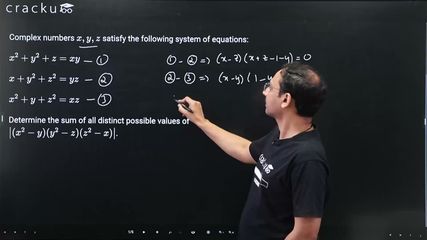
Click on the Email ☝️ to Watch the Video Solution
Book Free CAT Mentorship
Get personalized CAT strategy from a 99%iler
500+ students mentored
OTP Verification
Enter the 6-digit code sent to your phone
Booking Summary
Enter OTP
Didn't receive the OTP?
_1.webp)

Predict your JEE Main percentile, rank & performance in seconds

Educational materials for JEE preparation

Ask our AI anything

AI can make mistakes. Please verify important information.
AI can make mistakes. Please verify important information.
 91- 6303239042

