Sign in
Please select an account to continue using cracku.in
↓ →

Join Our JEE Preparation Group
Prep with like-minded aspirants; Get access to free daily tests and study material.
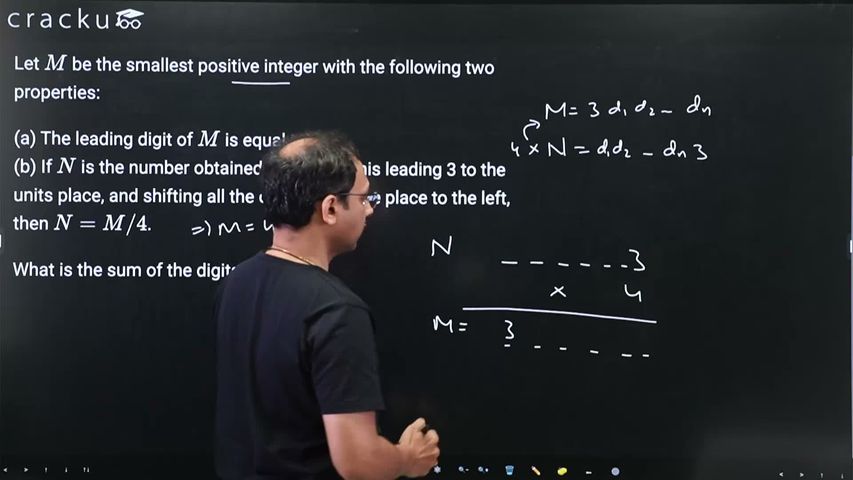
Let $$M$$ be the smallest positive integer with the following two properties:
(a) The leading digit of $$M$$ is equal to 3.
(b) If $$N$$ is the number obtained by moving this leading 3 to the units place, and shifting all the other digits one place to the left, then $$N = M/4$$.
What is the sum of the digits of $$M$$?
Correct Answer: 27
If $$M$$ has $$k$$ digits then $$N = 10(M - 3 \times 10^{k-1}) + 3 = 10M - 3(10^k - 1)$$, and $$N = M/4$$ rearranges to $$M = \frac{4(10^k - 1)}{13}$$. Thus $$10^k \equiv 1 \pmod{13}$$, which first happens at $$k = 6$$, giving $$M = \frac{4 \times 999999}{13} = 307692$$, and indeed $$4 \times 76923 = 307692$$. The digit sum is $$3 + 0 + 7 + 6 + 9 + 2 = 27$$.
Was this solution helpful?
Click on the Email ☝️ to Watch the Video Solution
Book Free CAT Mentorship
Get personalized CAT strategy from a 99%iler
500+ students mentored
OTP Verification
Enter the 6-digit code sent to your phone
Booking Summary
Enter OTP
Didn't receive the OTP?
_1.webp)

Predict your JEE Main percentile, rank & performance in seconds

Educational materials for JEE preparation

Ask our AI anything

AI can make mistakes. Please verify important information.
AI can make mistakes. Please verify important information.
 91- 6303239042

