Sign in
Please select an account to continue using cracku.in
↓ →

Join Our JEE Preparation Group
Prep with like-minded aspirants; Get access to free daily tests and study material.
Let $$N$$ be the number of distinct 8-digit numbers obtained by arranging the six numbers $$0, 1, 2, 3, 10, 23$$, where the first digit of the 8 digit number is not zero. Find the sum of the digits of $$N$$.
Correct Answer: 21
Treating the six given numbers as blocks, there are $$6! - 5! = 600$$ arrangements not beginning with 0, but different arrangements can produce the same 8-digit number. Counting each number once through the representation in which the block 10 is the first occurrence of 10 and the block 23 is the first occurrence of 23, the arrangements breaking these rules number $$\frac{5!}{2} = 60$$ and $$\frac{5! - 4!}{2} = 48$$, with $$\frac{4!}{4} = 6$$ restored by inclusion and exclusion. Hence $$N = 600 - 60 - 48 + 6 = 498$$ and the digit sum is $$4 + 9 + 8 = 21$$.
Was this solution helpful?
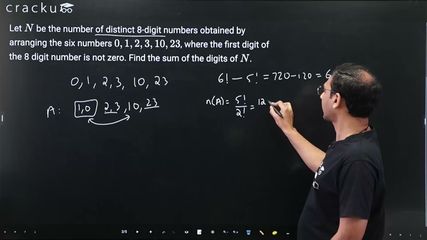
Click on the Email ☝️ to Watch the Video Solution
Book Free CAT Mentorship
Get personalized CAT strategy from a 99%iler
500+ students mentored
OTP Verification
Enter the 6-digit code sent to your phone
Booking Summary
Enter OTP
Didn't receive the OTP?
_1.webp)

Predict your JEE Main percentile, rank & performance in seconds

Educational materials for JEE preparation

Ask our AI anything

AI can make mistakes. Please verify important information.
AI can make mistakes. Please verify important information.
 91- 6303239042

