91- 6303239042


 Group
Group


 Preferred Source

 Google Discover
XAT VALR and DM Topic-Wise Weightage
The Decision Making (DM) and VALR parts of the XAT 2027 are quite important. Reading comprehension, Vocabulary-based questions, Para Jumbles, and Critical reasoning are all included in VALR, with RC and CR predominating. The DM portion, which usually consists of 21 case-based questions, evaluates analytical and ethical decision-making abilities. Comprehending topic-wise weightage facilitates planned and concentrated preparation.
XAT VALR Important Topics & Weightage
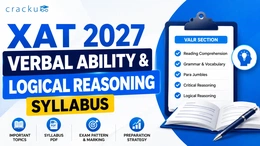
The XAT 2027 Verbal Ability & Logical Reasoning (VALR) section assesses applicants' language proficiency, comprehension, and critical thinking. Candidates can better organize their preparation if they are aware of the key subjects and their expected importance. A detailed summary of the main subjects and the expected number of questions for each is provided below:
Topic Name | Expected Questions |
Reading Comprehension (RC) | 12 - 15 Questions |
Critical Reasoning (Arguments, Inference, Strengthen/Weaken) | 6 - 8 Questions |
Para Jumbles | 1 - 2 Questions |
Fill in the Blanks | 1 - 2 Questions |
Vocabulary (Antonyms/Synonyms/Usage) | 1 - 2 Questions |
Analogy | 0 - 1 Question |
Note: Pay closer attention to Reading Comprehension and Critical Reasoning as they are more important and have a big influence on your final VALR score.
XAT DM Important Topics & Weightage
The XAT decision-making portion includes 21 questions based on caselets that assess analytical thinking, ethical judgment, and problem-solving ability. The caselets show the following approximate topic-wise weightages based on XAT papers from previous years:
XAT DM Important Topics & Weightage | ||
Topic | Approx. Weightage | Remarks |
Ethical Dilemmas | 25-30% | Tests integrity, fairness, and moral judgment |
Business Decision Cases (HR Related) | 20-25% | Includes HR, marketing, operations, and strategy decisions |
Social/Policy Decisions | 15-20% | Covers CSR, governance, and societal impact |
Personal/Managerial Dilemmas | 10-15% | Decisions involving leadership and team management |
Logical/Analytical Cases | 10-15% | Involves reasoning and data-based decisions |
Miscellaneous Situational Judgement | 5%-10% | Rare cases from current affairs or hybrid scenarios |
Note: Each paper in DM includes 21 questions. Weighting is based on trends.
XAT Exam Verbal Ability & Logical Reasoning
The XAT Verbal Ability & Logical Reasoning (VALR) section, which is part of the 170-minute first session, consists of about 26 questions designed to assess comprehension and analytical skills. It emphasizes critical thinking, grammar (fill-in-the-blanks and para jumbles), vocabulary, and reading comprehension (12-15 questions), which includes poetry.
- Essential Elements of XAT VALR Reading Comprehension (RC): Usually 4 to 5 RCs, including questions that test Critical Thinking.
- Critical Reasoning (CR): 5-7 questions about inferences, assumptions, strengthening or weakening arguments, and spotting logical faults.
- Grammar and vocabulary: Para-jumbles, fill-in-the-blanks (two to four blanks), and error correction (prepositions, tenses, idiom use).
- Idioms and Vocabulary: Frequently included in inquiries about vocabulary or sentence correction.
XAT 2026 VALR Topic-Wise Weightage
| Topic Name | No. Of Questions |
| Grammar & Sentence Correction | 2 |
| Fill in the Blanks | 1 |
| Para Jumbles | 2 |
| XAT Cartoons | 1 |
| Critical Reasoning | 3 |
| Reading Comprehension | 17 |
| Total | 26 |
- Read also, XAT Syllabus 2027
XAT Exam Decision Making (DM)
The XAT Decision Making (DM) part is a special high-weightage component (21 questions) that uses caselets to assess critical thinking, ethical judgment, and business acumen. Analysis of scenarios is required to identify balanced, ethical solutions that maximize advantages for all parties. Emphasize logical reasoning, ethical quandaries, and business problems.
Important Features of the XAT Decision Making Structure: Consists of seven caselets (generally), often deals with human resources, business management, and moral quandaries.
Core Focus: Rather than focusing just on academic knowledge, it assesses a candidate's ability to handle unclear, real-life circumstances.
Types of Questions:
- Ethical Dilemmas: Selecting between profit and moral values.
- Organizational Issues: Hiring/firing, resolving team disputes, and organizational reorganization are examples of managerial/HR decisions.
- Logical/facts-Based Cases: Drawing well-informed, logical conclusions from given facts.
- Personal Situations: Evaluating maturity in resolving personal conflicts.
XAT 2026 DM Topic-Wise Weightage
| Topic Name | No. of Questions | |
| Set 1 | MultiKrack Hiring Gen Z's | 3 |
| Set 2 | Talent Retention Trap of Payeasy | 3 |
| Set 3 | Fine Elements Inc.'s Recruitment Dilemma | 3 |
| Set 4 | Mr. Screwvala's and Mr Patel's Conflict | 3 |
| Set 5 | Why MBA & BKSM Controversy | 3 |
| Set 6 | Abirami’s Group Choice | 3 |
| Set 7 | Selvam Tutorials’ Staff Management | 3 |
XAT Marks Distribution for VALR & DM
The Verbal Ability & Logical Reasoning (VALR) and Decision Making (DM) parts of the XAT exam pattern are both heavily weighted in the final result. While DM uses case-based questions to assess analytical thinking and ethical decision-making, VALR concentrates on language and reasoning abilities.
XAT Marks Distribution VALR DM | |||
|---|---|---|---|
Section | Number of Questions | Marks per Question | Total Marks |
Verbal Ability & Logical Reasoning (VALR) | 26 | 1 Mark | 26 Marks |
Decision Making (DM) | 21 | 1 Mark | 21 Marks |
Note: One mark is given for each right answer, and 0.25 marks are subtracted for each wrong answer. A penalty may also be charged for unattempted questions that exceed a certain limit.
XAT 2027 Important Dates
XLRI Jamshedpur is scheduled to conduct the XAT 2027 exam on January 3, 2027 (the first Sunday). Below is an important date:
XAT 2027 Important Dates | |
|---|---|
Event | Expected Date |
Registration Start Date | July, 2026 |
Registration Last Date | Mid-December 2026 |
Admit Card Release | Late December 2026 |
XAT 2027 Exam Date | January 3, 2027 |
Answer Key Release | Second week of January 2027 |
Result Announcement | Last week of January 2027 |
XAT VALR and DM Topic-Wise Weightage : Conclusion
The XAT VALR and Decision Making sections play a crucial role in determining the overall score and percentile. While VALR is heavily dominated by Reading Comprehension, the Decision Making section focuses on analytical thinking and ethical judgment through case-based questions. Understanding the topic-wise weightage allows candidates to allocate their preparation time efficiently and focus on high-scoring areas.
To excel in XAT 2027, aspirants should prioritize RC practice, strengthen reasoning skills, and regularly solve decision-making caselets. A consistent preparation strategy combined with mock test analysis can significantly improve performance and boost overall scores in these critical sections