According to the set, there are 8 tests and each test can have a maximum of 4 marks so any student can get a maximum of 32 marks.
Now, the number of marks received by any student in a test can be 0/1/2/3/4.
We are given information about two students, Ravi and Sumana.
In the first test, they both scored the same marks. Let the marks scored by both is $$x$$.
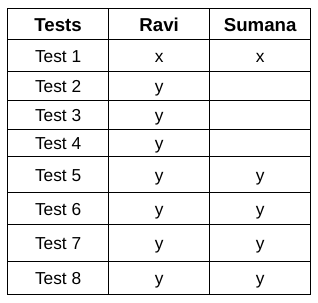
Further, from the second to eighth tests, Ravi scored the exact same non-zero marks. Let the marks scored by Ravi from second to eighth test is $$y$$ where y can be 1/2/3/4. Also, Sumana scored the same marks as Ravi from the fifth test onwards.
With this, we get the following table:
Ravi’s total marks in the first three tests was the same as Sumana’s total marks in the first two tests.
Let the marks of Sumana in the second test be $$z$$.
We are given that, $$x\ +\ 2y=x+z$$
Therefore, we can say, z = 2y.
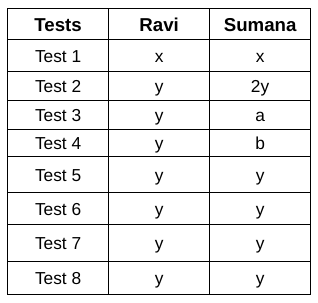
We don't have any other information about their marks in specific tests so let the marks of Sumana in test 3 and test 4 be $$a$$ and $$b$$ respectively.
With this, we have:
At last, we are given that Sumana’s marks in the first test, total marks of the first two tests, and total marks of the eight tests are in a geometric progression.
i.e. x, (x + 2y) and (x + a + b + 6y) are in a geometric progression.
With this, we can infer that x can't be 0 as if x is 0, any number multiplied with it will be 0 and (x+2y) and (x + a + b + 6y) can't be in a geometric progression.
Hence, x can be 1 / 2 / 3 / 4.
Let's try to make all possible geometric progression with this information:
1. (1, 3, 9) when x = 1, y = 1 and a + b = 2
2. (2, 4, 8) when x = 2, y = 1 and a + b = 0
3. (2, 6, 8) when x = 2, y = 2 and a + b = 4
4. (4, 8, 16) when x = 4, y = 2 and a + b = 0
In the question, we need to answer which of the mentioned statements can be true:
A: Ravi scored 4 marks in the third test
y can't be 4 in any of the possible case. Hence, the statement can't be true.
B: Sumana scored 2 marks in the first test
Sumana scored x marks in the first test and x can be 2. Hence, this can be true.
C: Ravi scored 0 marks in the fifth test
y can't be 0 as we discussed above. Hence, this statement can't be true.
D: Sumana scored 3 marks in the second test
Sumana scored 2y in the second test and if 2y = 3, y will be a non integer number which is not possible.
E: Sumana scored 4 marks in the eighth test
y can't be 4 in any of the possible case. Hence, this can't be true.
 91- 6303239042
.png)