Three categories of candidates appear for an admission test: diligent (10%), lazy (30%) and confused (60%). A diligent candidate is 10 times more likely to clear the admission test compared to a lazy candidate.
If 40% of the candidates clearing the admission test are confused, what is the MAXIMUM possible value of the probability of a confused candidate clearing the test?
XAT Probability, Combinatorics Questions
Let us assume that the total number of candidates who appeared for the admission test$$=100k$$
So, as per the data, the number of diligent candidates$$=10k$$
The number of lazy candidates$$=30k$$
and, the number of lazy candidates$$=60k$$
Now, let us assume that the probability of a lazy candidate to clear the test $$=p$$
$$\therefore$$ The probability of a lazy candidate to clear the test $$=10p$$
Let us also assume that the probability of a confused candidate to pass the exam $$=q$$
Now, we know that
Probability of a deligent candidate passing the test,$$10p=\dfrac{\text{No of deligent candidates who passed}}{\text{total deligent candidates who appeared}}$$
or, $$p=\dfrac{\text{No of deligent candidates who passed}}{10k}$$
or, number of the diligent candidates who passed the test $$=10k*10p=100kp$$
Similarly, the number of lazy candidates who passed the test $$=30k*p=30kp$$
and, the number of confused candidates who passed the test $$=60k*q=60kq$$
Now, we are told that 40% of the candidates who clear the admission test are confused.
$$\therefore \dfrac{60kq}{100kp+30kp+60kq}=\dfrac{40}{100}$$
On simplifying this equation, we get:
$$q=\dfrac{13p}{9}$$
Now, in order to maximise $$q$$, we need to maximise $$p$$.
Now we know that the probability of a diligent candidate passing the test, $$10p\leq1$$
or, $$p\leq\dfrac{1}{10}$$
So the maximum value of $$p=\dfrac{1}{10}$$
Now, calculating the maximum value of $$q$$.
Hence, the MAXIMUM possible value of the probability of a confused candidate clearing the test, $$q=\dfrac{13}{90}$$
Hence, option B is correct.
Ronny uses a 5-digit key for a combination lock, where 5 digits need to be entered in a fixed sequence. While he remembers that the 5 digits are 9, 8, 7, 5 and 4, he has forgotten the sequence he uses. He also remembers that the sum of the first three digits is a multiple of 3, and so is the sum of the last three digits. Further, the sum of the last four digits is a multiple of 4.
Which of the following is DEFINITELY FALSE?
The 5 digits which are used in the combination lock are 9,8,7,5 and 4.
The sum of first 3 digits and the last 3 digits are divisible by 3. Hence, we can say that the third digit is common in both the combinations.
The possible groups of 3 digits whose sum is divisible by 3 are (9,8,7),(9,8,4),(9,7,5),(9,5,4).
Out of these 4 possible groups, we have to select two groups which can be used as the first and last 3 digits.
The selection should be done in such a way that both the groups should only have one digit in common.
Example : If we select (9,8,7) and (9,8,4) and let the middle digit be 9, then we will have 8 in both the first 3 digits and the last 3 digits which is only possible for the 3rd digit which is occupied by 9 in this case. Hence, this case is not possible.
So the only possible combinations for the first and last 3 digits are :
Case 1: (9,8,7) and (9,5,4) where the 3rd digit will be 9.
Case 2: (9,8,4) and (9,7,5) where the 3rd digit will be 9.
Now, it is given that the sum of the last 4 digits is divisible by 4.
The possible cases of the above scenario are :
Case 3: (9,8,7,4) where the first digit will be 5.
Case 4: (8,7,5,4)where the first digit will be 9 which is not possible as 9 is fixed as the 3rd digit from Case 1 and 2.
Since, the first digit is 5 and the third digit is 9, the second digit will either be 4 or 7 and the last two digits will be either (8,7) or (8,4)
So, the possible combinations of the lock are 54987, 54978, 57984 and 57948.
Hence, the option which is definitely false is E as no possible combinations has 8 as its 2nd digit.
$$\therefore\ $$ The required answer is E.
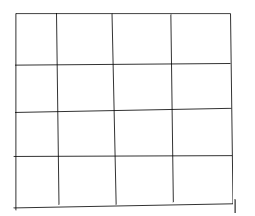
In a computer game, each move requires pressing a button. When the button is pressed for the first time, as a move, the computer randomly chooses a cell from a 4x4 grid of sixteen cells and puts an “X” mark on that cell. When the button is pressed subsequently, the computer randomly chooses a cell from the remaining unmarked cells and puts an “X” mark on that cell. This goes on till the end of the game. The game ends when either all the cells in any one row, or all the cells in any one column, are marked with “X”.
What is the maximum possible number of times a player has to press the button to finish the game?
In a 4*4 gird, If all 4 diagonal cells are ingored and the remaining cells are marked, no row or column will be filled. So, we can mark 12 cells without finishing the game. When we mark the 13th one, the game gets finished.
A local restaurant has 16 vegetarian items and 9 non-vegetarian items in their menu. Some items contain gluten, while the rest are gluten-free.
One evening, Rohit and his friends went to the restaurant. They planned to choose two different vegetarian items and three different non-vegetarian items from the entire menu. Later, Bela and her friends also went to the same restaurant: they planned to choose two different vegetarian items and one non-vegetarian item only from the gluten-free options. The number of item combinations that Rohit and his friends could choose from, given their plan, was 12 times the number of item combinations that Bela and her friends could choose from, given their plan.
How many menu items contain gluten?
The number of item combinations Rohit and his friends could have ordered veg items were $$^{16}C_2$$
And the number of ways they could have ordered non-veg items would be $$^9C_3$$
The total number of item combinations that Rohit and his friends could choose from would then be $$^{16}C_2\times\ ^9C_3$$
Let's denote the number of veg gluten-free items as $$V\sim G$$ and the number of non-veg gluten-free items as $$NV\sim G$$
The total number of ways Bela and her friends could have chosen the items from the menu would then be
$$NV\sim G\times\ ^{N\sim G}C_2$$
We are given that Rohit and his friend's number of combinations were twelve times this value, giving us the relation
$$^{16}C_2\times\ ^9C_3=12\times\ NV\sim G\times\ ^{N\sim G}C_2$$
$$^{16}C_2\times\ ^9C_3=12\times\ NV\sim G\times\ \frac{\left(N\sim G\right)\left(N\sim G\ -1\right)}{2}$$
$$2^4\times\ 3\times\ 5\times\ 7=\ NV\sim G\times\ \left(N\sim G\right)\left(N\sim G\ -1\right)$$
At this point, we need two consecutive numbers on the left-hand side to account for the $$\left(N\sim G\right)\left(N\sim G\ -1\right)$$ on the right-hand side.
We know that $$NV\sim G$$ must be 9 or less; trying to put this value as values from 9 to 1 and get two consecutive digits from the remaining numbers,
The value of $$NV\sim G$$ can be 7, giving the value of $$\left(N\sim G\right)\left(N\sim G\ -1\right)$$ as 16 x 15
OR
The value of $$NV\sim G$$ can be 8, giving the value of $$\left(N\sim G\right)\left(N\sim G\ -1\right)$$ as 15 x 14
In either of these cases, the number of items on the menu not having gluten would be 7+16 = 8+15 = 23
This means that 2 of the items on the menu will not have gluten in them.
Therefore, Option B is the correct answer.
Read the following scenario and answer the TWO questions that follow.
Aman has come to the market with Rs. 100. If he buys 5 kilograms of cabbage and 4 kilograms of potato, he will have Rs. 20 left; or else, if he buys 4 kilograms of cabbage and 5 kilograms of onion, he will have Rs. 7 left. The per kilogram prices of cabbage, onion and potato are positive integers (in rupees), and any type of these vegetables can only be purchased in positive integer kilogram, or none at all.
Aman decides to buy only onion and potato, both in positive integer kilogram, in such a way that the money left with him after the purchase will be insufficient to buy a full kilogram of either of the two vegetables.
If all such permissible combinations of purchases are equally likely, what is the probability that Aman buys more onion than potato?
Let the price of one kg of potato be P, one kg of cabbage be C, and one kg of onion be O.
we are given the equations,
$$5C+4P=80$$ (i)
$$4C+5O=93$$ (ii)
In equation (ii), we get 3 as the unit digit on the right-hand side. This is only possible with 8 + 5 on the left-hand side.
So, the unit place value of C must be 2, which means that C can have values 2, 12, 22, 32, and so on. The value of O must be an odd number.
Using this information in equation (i), we can see that the value of 5C will always have 0 as its unit digit. Meaning that the value of 4P must also have its unit digit as zero.
This would tell that P is a multiple of 5.
4P can then only be 20, 40 or 60 for C to also have a positive integer value.
If P is 5, C would be 12, giving the value of O to be 9
If P is 10, C would be 8, and this is consistent with our criteria that the unit digit of C must be 2
If P is 15, C would be 4, which is again not consistent with the same criteria.
Therefore, the price of one kg of potato would be Rs. 5, one of cabbage would be Rs. 12, and one kg of onion would be Rs. 9
The question says that Aman buys only potatoes and onions. The money left after purchasing these must be less than Rs. 5 so that he cannot buy an additional kg of potatoes.
Now, we can buy a maximum of 10 kg of onions, which would cost us Rs. 90, forcing Aman to buy 2 kg of potatoes to meet the above conditions.
So, the number of kg of opinion bought can vary from 1 to 10, giving us a total of 10 possible scenarios. We need to check where the number of potatoes bought in kg outweighs the onions bought.
We see that when Aman buys 7 kg of onions, he also has to buy 7 kg of potatoes. So only when he buys 10, 9 and 8 kg of onions is the weight of onions bought more than the weight of the potatoes bought.
So, the probability that more onions are bought than potatoes would be $$\frac{3}{10}$$
Therefore, Option A is the correct answer.
A painter draws 64 equal squares of 1 square inch on a square canvas measuring 64 square inches. She chooses two squares (1 square inch each) randomly and then paints them. What is the probability that two painted squares have a common side?
From the given information, we get that it is $$8\ inch\times\ 8\ inch$$ square grid.
Total ways of selecting 2 squares out of 64 in $$^{64}C_2$$.
Two squares with a common side can be selected in the following ways.
(i) Horizontal Pairs.
In the first row, R1, we can select 7 pairs of squares with a common side.
They are (R1C1,R1C2), (R1C2,R1C3),.....(R1C7,R1C8).
It applies to other rows as well.
Hence the total number of squares = $$7\times\ 8=56$$
(ii) Vertical Pairs.
In the first column, C1, we can select 7 pairs of squares with a common side.
They are (R1C1,R2C1), (R2C1,R3C1),.....(R7C1,R8C1).
It applies to other columns as well.
Hence the total number of squares = $$7\times\ 8=56$$
The probability of two painted squares having a common side = $$\frac{56+56}{^{64}C_2}$$ = $$\frac{112}{2016}$$.
Option (A) is correct.
I have five 10-rupee notes, three 20-rupee notes, and two 50-rupee notes in my wallet.
If three notes were taken out randomly and simultaneously, what is the probability that at least 90 rupees were taken out?
The total number of ways of selecting 3 notes from the :
five 10-rupee notes, three 20-rupee notes, and two 50-rupee notes = 10 notes in total.
$$10_{C_3}$$
= 120
The possibilities for the value of the three notes combined is at least 90 :
Rs 50 + Rs 20 + Rs 20 : The possibilities for this selection is :
$$2_{C_1}\cdot3C_2$$. Selection of one Rs 50 note from the two and selection of 2 Rs 20 notes from the three.
Rs 50 + Rs 50 + Rs 10 :
$$\left(2_{C_2}\right)\cdot\left(5_{C_1}\right)$$ : Selection of two Rs 50 notes from the two and selection of 1 Rs 10 notes from the five.
Rs 50 + Rs 50 + Rs 20 :
$$\left(2_{C_2}\right)\cdot\left(3C_1\right)$$ : Selection of two Rs 50 notes from the two and selection of 1 Rs 20 notes from the three.
A total of 6+5+3 = 14 possibilties
The probability is $$\frac{14}{120}$$ = 7/60.
A small store has five units of a new phone model in stock: two white, two black, and one red. Three customers arrive at the shop to buy a unit each. Each one has a pre- determined choice of the colour and will not buy a unit of any other colour. All the three customers are equally likely to have chosen any of the three colours. What is the probability that the store will be able to satisfy all the three customers?
Number of white phones = 2
Number of black phones = 2
Number of red phones = 1
customer 1 will have 3 choices
customer 2 will have 3 choices
customer 3 will have 3 choices
Hence total choices = 3 x 3 x 3 = 27
The cases not possible = BBB, RRR,WWW, RRB,RBR,BRR, RRW,RWR, WRR
Possible cases = 18
Probability = 18/27 = 2/3
Ashok has a bag containing 40 cards, numbered with the integers from 1 to 40. No two cards are numbered with the same integer. Likewise, his sister Shilpa has another bag containing only five cards that are numbered with the integers from 1 to 5, with no integer repeating. Their mother, Latha, randomly draws one card each from Ashok’s and Shilpa’s bags and notes down their respective numbers. If Latha divides the number obtained from Ashok’s bag by the number obtained from Shilpa’s, what is the probability that the remainder will not be greater than 2?
The number of ways of selecting one card from Ashok's bag and other from Shilpa bag = $$40_{C_1}\times\ 5_{C_1}$$ = 200
Now, if the card taken from Shilpa's bag shows 1, then 1 will divide all the numbers on Ashok's card. Hence, the number of ways = 40
If the card taken from Shilpa's bag shows 2, then the remainder will be either 0 or 1. Hence, the number of ways = 40
If the card taken from Shilpa's bag shows 3, then the remainder will be 0, 1 or 2. Hence, the number of ways = 40
If the card taken from Shilpa's bag shows 4, then the remainder will be 0, 1, 2 or 3. So the numbers having 3 as remainder will be rejected. So the number of form 4n+3 will be rejected. Total number of such numbers = $$\frac{\left(39-3\right)}{4}+1$$ = 10
If the card taken from Shilpa's bag shows 5, then the remainder will be 0, 1, 2, 3 or 4. So the numbers having 3 or 4 as remainder will be rejected. So the number of form 5n+3, 5n+4 will be rejected. Total number of such terms = $$\frac{\left(39-3\right)}{4}+1$$ = 10
The numbers left = 40-10 = 30
The total numbers having 5n+3 form = $$\frac{\left(39-4\right)}{5}+1\ =\ 8$$
The total numbers having 5n+4 form = $$\frac{\left(38-3\right)}{5}+1\ =\ 8$$
The numbers left = 40-8-8=24
Hence, the probability = $$\frac{\left(40+40+40+30+24\right)}{200}=\frac{174}{200}=0.87$$
A coin of radius 3 cm is randomly dropped on a square floor full of square shaped tiles of side 10 cm each. What is the probability that the coin will land completely within a tile? In other words, the coin should not cross the edge of any tile.
The radius of the coin is 3 cm.
So, if the coin should not cross the edge, the centre of the coin should at least be 3 cm away from the edge of the tile.
In the given diagram the center of the circle should lie in the blue region. As we can see, the area in which the centre of the coin can fall is a square of side 10-3-3 = 4 cm.
Therefore, the area in which the centre of the coin can fall is 16 square cm.
Area of the tile = 100 square cm.
Required probability = 16/100 = 0.16.
Therefore, option E is the right answer.
In a True/False quiz, 4 marks are awarded for each correct answer and 1 mark is deducted for each wrong answer. Amit, Benn and Chitra answered the same 10 questions, and their answers are given below in the same sequential order.
AMIT T T F F T T F T T F
BENN T T T F F T F T T F
CHITRA T T T T F F T F T T
If Amit and Benn both score 35 marks each then Chitra’s score will be:
Both Amit and Ben scored 35 marks. 4 marks are awarded for a correct answer and 1 mark is deducted for an incorrect answer.
Let the number of questions that Amit got right be 'x'.
=> 4x -(10-x) = 35
5x = 45
x = 9.
Therefore, Amit must have made only 1 mistake. The same must have been the case with Ben too.
The responses given by the 3 persons are as follows:
AMIT T T F F T T F T T F
BENN T T T F F T F T T F
CHITRA T T T T F F T F T T
Amit and Ben have given different responses for question 3 and question 5. Therefore, one of them must be wrong in each of these questions. Also, Amit must have given the correct answer for one of these 2 questions and Ben must have answered the other one correct, since both of them got 9 questions correct.
Let us assume Amit has given an incorrect response for question 3 and Ben has given an incorrect response for question 5.
In this case, Chitra's would have given 4 correct responses (questions 1,2,3, and 9). Chitra's score would have been 4*4 - 6 = 10.
Let us assume Amit has given an incorrect response for question 5 and Ben has given an incorrect response for question 3.
In this case, Chitra's would have given 4 correct responses (questions 1,2,5, and 9). Chitra's score would have been 4*4 - 6 = 10.
Therefore, Chitra's score should have been 10 and hence, option A is the right answer.
A dice is rolled twice. What is the probability that the number in the second roll will be higher than that in the first?
A die is rolled twice.
The number of combinations that can occur = 6*6 = 36.
We have to find the probability of the second roll being higher than the first.
If we select 2 numbers out of the 6 and arrange them in ascending order, then we will obtain the scenario in which the number obtained in the second roll will be greater than the number obtained in the first roll.
2 numbers out of 6 numbers can be selected in 6C2 = 15 ways. The numbers can be arranged in ascending order in only one way.
Therefore, the required probability is 15/36.
Therefore, option C is the right answer.
An institute has 5 departments and each department has 50 students. If students are picked up randomly from all 5 departments to form a committee, what should be the minimum number of students in the committee so that at least one department should have representation of minimum 5 students?
We have to employ the pigeon hole principle to solve this problem.
The maximum number of students who can be picked from each department such that 5 students are not selected from the same department is 4.
Therefore, after 4 students from each department are selected (i.e., 4*5 = 20 students in total), the 21st student selected will be the fifth student to be selected from one of the 5 departments. Therefore, 20+1 = 21 students should be selected in total to ensure that at least five students from one of the departments is selected. Therefore, option C is the right answer.
Ramesh plans to order a birthday gift for his friend from an online retailer. However, the birthday coincides with the festival season during which there is a huge demand for buying online goods and hence deliveries are often delayed. He estimates that the probability of receiving the gift, in time, from the retailers A, B, C and D would be 0.6, 0.8, 0.9 and 0.5 respectively.
Playing safe, he orders from all four retailers simultaneously. What would be the probability that his friend would receive the gift in time?
The probability that his friend receives the gift in time will be when his friend receives even one gift.
That can be calculated as the probability of his friend receiving at least one gift.
The probability that none of the retailers sends in time = $$(1 - 0.6) \times (1 - 0.8) \times (1 - 0.9) \times (1 - 0.5)$$
= $$0.4 \times 0.2 \times 0.1 \times 0.5 = 0.004$$
$$\therefore$$ Probability of his receiving at least one gift = $$1 - 0.004 = 0.996$$
The probability that a randomly chosen positive divisor of $$10^{29}$$ is an integer multiple of $$10^{23}$$ is: $$a^{2} /b^{2} $$, then ‘b - a’ would be:
Number of factors of $$10^{29} = 2^{29} \times 5^{29}$$
= $$30 \times 30 = 900$$
Factors of $$10^{29}$$ which are multiple of $$10^{23}$$
= $$10^6 = 2^6 \times 5^6$$
= $$7 \times 7 = 49$$
=> Required probability = $$\frac{49}{900} = \frac{a^2}{b^2}$$
=> $$\frac{a}{b} = \frac{7}{30}$$
$$\therefore b - a = 30 - 7 = 23$$
Aditya has a total of 18 red and blue marbles in two bags (each bag has marbles of both colors). A
marble is randomly drawn from the first bag followed by another randomly drawn from the
second bag, the probability of both being red is 5/16. What is the probability of both marbles being blue?
Probability of both marbles being red = Probability of red from 1st * probability of red from 2nd
= $$\frac{5}{16}$$
$$\because$$ Each bag has marbles of both colors and probability cannot be greater than 1
=> $$\frac{5}{16} = \frac{5}{8} \times \frac{1}{2}$$
where, probability of red marbles from 1st bag = $$\frac{5}{8}$$
=> Probability of blue marbles from 1st bag = $$1 - \frac{5}{8} = \frac{3}{8}$$
Similarly, Probability of red marbles from 1st bag = $$\frac{1}{2}$$
=> Probability of blue marbles from 2nd bag = $$1 - \frac{1}{2} = \frac{1}{2}$$
$$\therefore$$ Probability of both blue marbles = $$\frac{3}{8} \times \frac{1}{2}$$
= $$\frac{3}{16}$$
Sara has just joined Facebook. She has 5 friends. Each of her five friends has twenty five friends. It is found that at least two of Sara's friends are connected with each other. On her birthday, Sara decides to invite her friends and the friends of her friends. How many people did she invite for her birthday party?
Sarah has 5 friends and each of her 5 friends have 25 friends.
The 5 friends of Sarah have Sarah as one of their 25 friends. Therefore, apart from Sarah the five friends will have 24 friends each.
If no 2 friends know each other, then Sarah will have to invite 5*24 + 5 = 120 + 5 = 125 persons.
Sarah knows that at least 2 of her friends are connected to each other.
Let the 5 friends be A, B, C, D, and E. Let us consider that A and B are friends.
A will be counted twice (first as one among the 5 persons and second as one of the friends of B).
B will also be counted twice (first as one among the 5 persons and second as one of the friends of A).
Subtracting these 2 friends, we can infer that the maximum number of persons that Sarah could have invited to the party is 123.
The minimum number of friends that Sarah could have invited is obtained when all the friends are connected to each other and their friends are also the same. In this case, the five friends will have 20 common friends, will be friends with each other (4) and Sarah (1).
The minimum number of persons Sarah could have invited to the party = 20+5 = 25.
Option B is more appropriate that option C.
Therefore, option B is the right answer.
Six playing cards are lying face down on a table, two of them are kings. Two cards are drawn at random. Let a denote the probability that at least one of the cards drawn is a king, and b denote the probability of not drawing a king. The ratio a/b is
There are 6 cards and 2 out of the 6 cards are kings.
Number of ways of selecting 2 cards = 6C2 = 15 ways.
Number of ways in which 2 cards can be selected such that both of them are King = 2C2 = 1
Number of ways in which 2 cards can be selected such that exactly one of them is a King = 2C1*4C1 = 8
=> a = (1+8)/15 = 9/15
b = 1-(9/15) = 6/15
a/b = 9/6 = 1.5
1.5 > 1.25
Therefore, option E is the right answer.
In a locality, there are ten houses in a row. On a particular night a thief planned to steal from three houses of the locality. In how many ways can he plan such that no two of them are next to each other?
Total number of houses = 10
If first house is robbed, then II is not and if II house is robbed, then III is not and so on.
Thus 2 adjacent houses can never be chosen
So, number of ways in which three houses can be robbed such that no two of them are next to each other.
= $$C^{10 - 2}_3 = C^8_3$$
= $$\frac{8 \times 7 \times 6}{1 \times 2 \times 3}$$
= $$56$$
The scheduling officer for a local police department is trying to schedule additional patrol units in each of two neighbourhoods - southern and northern. She knows that on any given day, the probabilities of major crimes and minor crimes being committed in the northern neighbourhood were 0.418 and 0.612, respectively, and that the corresponding probabilities in the southern neighbourhood were 0.355 and 0.520. Assuming that all crime occur independent of each other and likewise that crime in the two neighbourhoods are independent of each other, what is the probability that no crime of either type is committed in either neighbourhood on any given day?
For northern neighbourhood,
Probability that there is no major crime = $$(1 - 0.418) = 0.582$$
Probability that there is no minor crime = $$(1 - 0.612) = 0.388$$
For southern neighbourhood,
Probability that there is no major crime = $$(1 - 0.355) = 0.645$$
Probability that there is no minor crime = $$(1 - 0.520) = 0.480$$
$$\therefore$$ Probability that no crime of either type is committed in either neighbourhood on any given day
= $$0.582 \times 0.388 \times 0.645 \times 0.480$$
= $$0.069$$
There are four machines in a factory. At exactly 8 pm, when the mechanic is about to leave the factory, he is informed that two of the four machines are not working properly. The mechanic is in a hurry, and decides that he will identify the two faulty machines before going home, and repair them next morning. It takes him twenty minutes to walk to the bus stop. The last bus leaves at 8:32 pm. If it takes six minutes to identify whether a machine is defective or not, and if he decides to check the machines at random, what is the probability that the mechanic will be able to catch the last bus?
As the mechanic has decided to check two machines, thus if he identifies either both defective machines or both non defective, then the probability that he is able to catch the last bus is sum of the two. Thus, the possible outcomes are :
(i) : Both are defective machines, probability = $$(\frac{1}{2})(\frac{1}{3}) = \frac{1}{6}$$
(ii) : First is defective and second is non defective, probability = $$(\frac{1}{2})(\frac{2}{3}) = \frac{1}{3}$$
(iii) : First is non defective and second is defective, probability = $$(\frac{1}{2})(\frac{2}{3}) = \frac{1}{3}$$
(iv) : Both are non defective machines, probability = $$(\frac{1}{2})(\frac{1}{3}) = \frac{1}{6}$$
In the first and last cases, the mechanic would have identified the defective machines in time to catch the bus.
$$\therefore$$ Probability that he is able to catch the last bus = $$\frac{1}{6} + \frac{1}{6} = \frac{1}{3}$$
=> Ans - (D)
In the country of Twenty, there are exactly twenty cities, and there is exactly one direct road between any two cities. No two direct roads have an overlapping road segment. After the election dates are announced, candidates from their respective cities start visiting the other cities. Following are the rules that the election commission has laid down for the candidates:
Each candidate must visit each of the other cities exactly once.
Each candidate must use only the direct roads between two cities for going from one city to another.
The candidate must return to his own city at the end of the campaign.
No direct road between two cities would be used by more than one candidate.
The maximum possible number of candidates is
There are 20 cities and one direct road between any 2 cities.
=> Total number of paths = $${}^{20}C_2$$
= $$\frac{20 \times 19}{1 \times 2} = 190$$
Now, each candidate needed to visit all the cities and then come back to the city he started from
=> Paths taken by each candidate = $$20$$
Let maximum number of candidates = $$n$$
=> $$20 n < 190$$
=> $$n < \frac{190}{20}$$
=> $$n < 9.5$$
$$\therefore$$ Maximum possible number of candidates = $$9$$
The supervisor of a packaging unit of a milk plant is being pressurised to finish the job closer to the distribution time, thus giving the production staff more leeway to cater to last minute demand. He has the option of running the unit at normal speed or at 110% of normal - “fast speed”. He estimates that he will be able to run at the higher speed for 60% of the time. The packet is twice as likely to be damaged at the higher speed which would mean temporarily stopping the process. If a packet on a randomly selected packaging runs has probability of 0.112 of damage, what is the probability that the packet will not be damaged at normal speed?
Let $$p \times \frac{0.34 mt}{mt}$$m packets of milk be prepared in unit time at the normal speed.
Now, at normal speed in $$t$$ time, the number of packets of milk that would be produced = $$mt$$
=> Number of packets of milk produced at fast speed = $$(\frac{110}{100} \times m) + (\frac{60}{100} \times t) = 0.66 mt$$
The target for the supervisor = $$mt$$ packets
Number of packets produced at normal speed = $$mt - 0.66 mt = 0.34 mt$$
Let the probability of a packet being damaged when produced at normal speed = $$p$$
=> Probability that a packet is damaged when produced at fast speed = $$2p$$
The probability that a packet selected at random will be damaged = 0.112
=> $$(p \times \frac{0.34 mt}{mt}) + (2p \times \frac{0.66 mt}{mt}) = 0.112$$
=> $$0.34p + 1.32p = 1.66 p = 0.112$$
=> $$p = \frac{0.112}{1.66} = 0.067$$
$$\therefore$$ Probability that a packet will not be damaged at normal speed = $$1 - 0.067 = 0.93$$
If all letters of the word "CHCJL" be arranged in an English dictionary, what will be the $$50^{th}$$ word?
The alphabetical order = CCHJL
Number of words starting with C = $$4! = 24$$
Number of words starting with H = $$\frac{4 !}{2} = 12$$
Number of words starting with J = $$\frac{4 !}{2} = 12$$
Total words till now = 24 + 12 + 12 = 48
First word starting with L (49th in dictionary) = LCCHJ
Therefore, the 50th word = LCCJH
The chance of India winning a cricket match against Australia is 1/6. What is the minimum number of matches India should play against Australia so that there is a fair chance of winning atleast one match?
Let the number of matches that India needs to play = $$x$$
Now, if $$1 - (\frac{5}{6})^x \geq \frac{1}{2}$$ , we can consider that India has a fair chance of winning the match.
=> $$(\frac{5}{6})^x \leq \frac{1}{2}$$
If, $$x = 3$$, we get $$\frac{125}{216}$$, which is greater than $$\frac{1}{2}$$
If, $$x = 4$$, we get $$\frac{625}{1296}$$, which is less than $$\frac{1}{2}$$
$$\therefore$$ The number of matches that India needs to play must be atleast 4
Frequently Asked Questions
Yes, Probability and Combinatorics is an important topic in XAT Quantitative Ability. Questions from these topics test counting techniques, and analytical problem-solving skills.
XAT may include questions on basic probability, conditional probability, independent events, mutually exclusive events, and probability based on real-life scenarios.
Combinatorics questions in XAT typically cover permutations, combinations, arrangements, selections, counting principles, and distribution-based problems.
Start by understanding the fundamental concepts and formulas. Practice a variety of problems involving counting methods, permutations, combinations, and probability calculations to improve accuracy and speed.
These questions are generally considered moderate to difficult because they require strong conceptual understanding and logical application of formulas. Regular practice can significantly improve performance.