XAT 2026 Question Paper
Read the following passage and answer the THREE questions that follow.
A crucial moderating factor in how people experience comparison is self-esteem. Individuals with high self-esteem are more likely to interpret upward comparison as informative rather than threatening. They are more resilient in the face of others’ success and more likely to believe they can improve. In contrast, people with low self-esteem are more prone to interpret comparison as judgment, reinforcing negative self-views and triggering feelings of inadequacy.
This dynamic creates a self-reinforcing loop. People who already doubt their worth are more vulnerable to upward comparison, which intensifies those doubts. Those with a secure sense of self are more likely to use comparison as a learning tool. The same external stimulus—a colleague’s achievement, a peer’s attractiveness, a friend’s popularity—can have radically different effects depending on internal stability.
Self-esteem also influences how people choose their comparison targets. Research has found that individuals often engage in “selective comparison,” seeking out those who confirm their existing beliefs about themselves. This can become a subtle form of self-sabotage. Someone who feels unworthy may unconsciously seek out targets that reinforce that sense, perpetuating a narrative of inferiority. One of the most promising antidotes to social comparison is temporal comparison—evaluating oneself not against others, but against one’s own past. This strategy has been shown to increase motivation and satisfaction, especially when individuals can see concrete progress.
Temporal comparison activates the same reward circuits as social comparison but avoids the threat systems associated with social ranking. It also reinforces agency: individuals focus on what they can control and improve rather than what others possess. In therapeutic and coaching settings, temporal comparison is often used to help clients build self-efficacy and track growth over time.
Moreover, people who focus on self-improvement rather than social dominance are less likely to fall into cycles of envy or self-pity. They can still use others as inspiration, but they do so without attaching their self-worth to the outcome. This is not to say they never compare—but that they compare with awareness and perspective.
The most skilful approach to comparison may lie not in eliminating it, but in reframing it as feedback. When we interpret comparison as information rather than a verdict, we open the door to learning. Instead of asking, “Am I better or worse?” we can ask, “What can I learn from this?” This shift turns others into teachers rather than rivals.
Psychologists emphasize that the key variable here is mindset. A fixed mindset interprets comparison as a threat. If someone else is better, it means we are worse. A growth mindset sees comparison as a map. If someone else has reached a certain level, it means the path exists. This reframing is not just a cognitive trick. It changes the emotional tone of comparison, making it more likely to inspire than to wound.
Reframing also requires emotional regulation—the ability to notice an initial pang of envy or shame without reacting impulsively. With practice, individuals can learn to pause, reflect, and reinterpret their emotional responses. Over time, this builds resilience and self-trust, allowing comparison to become a catalyst rather than a cage.
XAT 2026 - Question 71
Based on the passage, which of the following options will the author BEST agree with regarding the differences between temporal and social comparison?
XAT 2026 - Question 72
Based on the passage, which of the following will the author MOST agree with?
XAT 2026 - Question 73
Based on the passage, which of the following is NOT true about comparison?

Read the following poem and answer the TWO questions that follow.
Beware of the old newspapers
stacked
on that little three legged stool over there.
Don’t disturb them.
I know it for a fact
that snakes have spawned in between these
sheets.
Don’t even look in that direction.
It’s not because of breeze
that their corners are fluttering.
It’s alive, that nest of newspapers.
New born snakes, coiling and uncoiling,
are turning their heads to look at you.
That white corner has spread its hood.
A forked tongue
shoots out of its mouth.
Keep your eyes closed.
Get rid of the whole goddamn pile if you
want to
in the morning.
XAT 2026 - Question 74
What does the poet BEST convey about old newspapers when he says “that snakes have spawned in between these sheets?”
XAT 2026 - Question 75
Which of the following BEST captures what the poet communicates when he says, “Keep your eyes closed./ Get rid of the whole goddamn pile if you/ want to/ in the morning?”
For the following questions answer them individually
XAT 2026 - Question 76
Match the temple architectural terms in Column A with their descriptions in Column B.
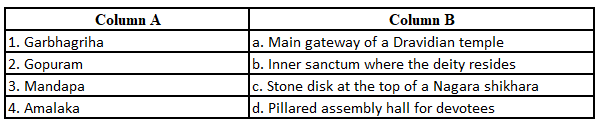
.webp)
XAT 2026 - Question 77
India recently achieved a milestone by placing its heaviest payload ever into orbit using the LVM3-M6 rocket. Which of the following is a satellite, launched as a part of this mission?
XAT 2026 - Question 78
Which of the following is NOT true about octopuses?
XAT 2026 - Question 79
Who won the 2025 Pulitzer Prize for Fiction for the novel "James", a reimagining of "The Adventures of Huckleberry Finn"?

XAT 2026 - Question 80
Which of the following is a comet that flew very close to the Earth in December, 2025?
