 91- 6303239042
Choose the most appropriate option to fill in the blanks of the given sentence.
Numerous criticisms of medical science ______ in recent years, with critics arguing that spurious diseases ______ for the aim of profit.
Sign in
Please select an account to continue using cracku.in
↓ →
Choose the most appropriate option to fill in the blanks of the given sentence.
Numerous criticisms of medical science ______ in recent years, with critics arguing that spurious diseases ______ for the aim of profit.
Option C: Correct.
Understanding the tense here through the sentence is the key.
On the first glance the sentence is talking about an event that has happened in the past (criticisms...in recent years), and the impact of which is continuing to the present as well (critics arguing)
So we know that we have to use a combination of Present perfect and present continuous tense.
The only option that uses the right combination of these tenses in the right sequence is option C.
Choose the most appropriate meaning of the underlined idiomatic expression in the given sentence.
In the mad rush for Western modernity and technological skills, both traditional communities and the urban middle class are busy throwing out the baby with the bathwater.
Option C: Correct.
To answer the question we have to try making literal sense of the idiom used first and then understand its metaphorical sense through that.
To throw baby out with the bathwater, literally presents a picture of a baby being bathed and along with discarding the bathwater the baby is discarded in the process.
This implies- while discarding something unimportant, something important is being discarded as well.
The option that fits this explanation is option C.
Select the option that is related to the third word in the same way as the second wordis related to the first word.
Trembling : Fear :: Frowning : ?
Option D: Correct.
We have to clearly understand the relationship between Tremble: Fear, first.
This relationship indicates a physical action when a certain emotion is felt.
A person "trembles with fear"
So with the action of frowning the most fitting emotion is "displeasure", hence option D is correct.

The given sentence has four underlined phrases. Choose the one that is INCORRECTand the option that gives the grammatically correct phrase.
The 11-hour mandatory rest period for workers in Germany is there to protect workers, originally to make sure factory workers could recover physically between shifts, but the break just necessary for mental regeneration.
Option C: Correct.
In these questions we first scan through and see which phrase sounds incomplete or unfinished, usually that is the sentence that requires correction.
Here the last phrase sounds incomplete, so we scan for options that fix this issue.
"but the break is just as necessary" is the corrected usage for the fourth blank, as mentioned in the option C.
Mobile penetration is very high in India because a mobile phone will be allowing people to communicate instantly and orally, without the need to write messages or take someone’s help to write messages; in such a scenario, the idea of information protection or privacy of data has little scope.
Option A: Correct.
Here we scan through the paragraph and see if there is a phrase that sounds grammatically incorrect.
We see that the entire sentence seems to be composed in present perfect tense.
Hence, the first phrase using future tense appears as an outlier. So we choose the option that fixes this issue and the only such option is A.
Choose the most appropriate words to fill in the blanks of the given sentence.
They said they were not going to ______ any gifts for their ceremony ______ for donations to charities.
Option B: Correct.
Here there are exactly two words used to fill in the blanks to form a meaningful sentence.
We have to first, know the precise meaning of the two words.
Then, understand what the sentence is trying to convey.
And, then place the words.
accept means to take something willingly
except means to exclude something
The sentence is trying to convey that people in question will not be taking any gifts but they will be taking donations.
So accept and except will be used. Hence, option B is correct.

Choose the option that best describes the meaning of the underlined word in the given sentence.
Ehrlich's argument that expanding human populations cannot be sustained on an Earth with finite carrying capacity is irrefutable and, indeed, almost tautological.
Option A: Correct.
Understanding the meaning of the word and then the sentence is the key to the question.
Even if one of them is correctly understood, one may arrive to the right answer.
Irrefutable uses "ir" suffix which means "not", so irrefutable means something that can not be refuted.
So the sentence now means Ehlrich's argument can not be refuted or proven incorrect.
So option A, Indisputable is closest in the meaning.
Choose the most appropriate option to fill in the blanks of the given sentence.
It’s ______ I’ve always admired and envied, across the species spectrum in the animal kingdom: the natural ______ with which creatures move in their ordinary lives.
Option B: Correct.
To answer the most appropriate fit for the sentence we have to first make sense of the sentence with blanks.
By reading the sentence we get an idea that- there is a certain quality about animal kingdom that the author envies and admires.
So we can get a sense through this conclusion that the quality being talked of should be a positive adjective.
The positive adjectives are only in option B- ease and grace.
Hence B is the right choice.
Three of the following sentences in the options form a coherent passage. Choose the option that contains the irrelevant sentence.
Option D: Correct.
The irrelevant sentence will be an outlier, although all the sentences seem to be centered around medicine.
We can first form the clear pair- the first and the second sentence, the sentences are talking about some features of medicine and the connecting word- another feature, ties these sentences together.
Now, we have to check the viability of the remaining two options and see which one fits with the above chosen pair of sentences.
Fourth sentence, speaks about breakthroughs in medicine and compares them with scientific revolutions. This feels out of place because the paired sentence talks about the features of medicine. Hence, sentence D is the odd one.

Select the most appropriate ANTONYM of the underlined word in the given sentence.
From experience we know that the pulp from this plant disintegrates when wet.
Option C: Correct.
We have to decipher the meaning of the word in the question first. The word decipher uses the suffix "dis" which means "not", "away" or "apart". Integrate means to put together or add together, so disintegrate means to pull apart.
The antonym of pull apart can be something that is together and thriving, so flourishing fits the bill here.
Select the most appropriate option to fill in the blanks.
Knowledge ______ animal behaviour and migration is much easier to pass on when woven ______ the narrative of a story brought to life ______ artistic representations.
Option C: Correct.
In this sentence we have to place the correct prepositions in the blank.
Among the options given-
knowledge of/ about can be appropriate
woven into can be appropriate, since there is no weaving across the narratives- no sideways or overhead movement.
brought to life with will be appropriate
Hence option C, fits all the blanks.
Select the option that is related to the third word in the same way as the second word is related to the first word.
Architect : Drawing board :: Painter : ?
Option C: Correct.
Understanding the relationship between Architect and drawing board is the key here, which will help us ascertain the approprite relationship of painter.
An architect works/creates his work on the drawing board, so drawing board is the surface of expression.
Similarly, for the painter the surface of expression is the canvas.

Person : Crowd :: Musician : ?
Option C: Correct.
The relationship between person and crowd is that a person is a singular unit of a crowd.
Similarly, a musician is a singular unit of an orchestra.
Select the most appropriate option to fill in the blanks.
As the ______ of the school, she was ______ responsible for ensuring the students were guided by strict values and ______.
Option C: Correct.
Multiple forms of the same word are used, we have to figure out through the given sentence with blanks that where should the correct noun and the verb be placed.
The verb will fit the second blank since it is describing an action.
Principal is the head of the school and principles are set of moral codes that one follows. The correct placement of these two nouns is dependent upon knowing the right spellings.
Choose the most appropriate option to fill in the blanks of the given sentence.
______ a few moments you will hear the whistling of the wild thrush who nests ______ the trees ______ our house.
Option A: Correct.
Correct use of prepositions has to be made.
Within/ after a few moments can be appropriate
among/ within/ in the trees can be appropriate
near/ by our house can be appropriate
only option A fits the right choice.

The given sentence has four underlined phrases. Choose the one that is INCORRECT and the option that gives the grammatically correct phrase.
Mumbai has a far larger population than Naples, but both cities are places of striking contrasts, of prosperous neighbourhoods narrowly separated entangled by crowded slums and narrow streets.
Option A: Correct.
We have to first skim through the paragraph and try to spot a phrase that may be grammatically or contextually unfit with its preceding or succeeding phrases/ words.
separated entangled by crowded slums, separated and entangled used without punctuation, simply put together, makes no sense. Hence this is the wrong phrase, which can be corrected by option A- separated by a tangle of.
Select the most appropriate ANTONYM of the underlined word in the given sentence.
Relentless advertising campaigns are telling Indian parents that coding is critical because making children code will develop their cognitive skills.
Option A: Correct.
Relentless means repetitive, continuous, too pushy.
The sentence means continuous and pushy advertisements are supporting that coding shall help kids with their cognitive skills.
The word opposite of relentless is intermittent which means spaced, or discontinuous, as shown by the suffix "inter" which shows an interval.
Sentences of a paragraph are given below in jumbled order. Arrange the sentences in the right order to form a meaningful and coherent paragraph.
A. Publishing executives have long described their business as recession-proof; books, after all are relatively cheap compared to other things.
B. While the restrictions of the pandemic have affected business, it is true that a person can watch only so much Netflix, and there aren’t a lot of other options.
C. It is not surprising then that bookstores are performing well; business got a boost when, early in the pandemic, Amazon deprioritised books to focus on medical supplies and household staples.
D. This is because the market for books remained stable after the 2008 recession. However, the challenges in 2020 have been more extreme, with social distancing restrictions at warehouses, vast lockdowns and a rapid economic meltdown.
Option D: Correct.
In this question, it will help us to form pairs and then arrange them appropriately.
Sentence A is a starting sentence expressing a positive opinion, and sentence D begins with the connecting phrase "this is because" and then goes on to explain the reasons behind a likely positive attitude, so A and D can be a likely pair.
Sentence D ends with expressing a challenge with "restrictions" and sentence B begins with a connecting word "while", elaborating on the restrictions and their impact. Hence, B will come after sentence D.
Remaining sentence C summarises and explains a reason for optimism in the initial sentence; hence, C is a fitting last sentence.
Choose the most appropriate option to fill in the blank of the given sentence.
I ______ at least 500 books by the end of the year.
Option C: Correct.
The sentence describes an action being performed in the present and to be completed in the future.
Hence, the future perfect tense will be used.
Option C uses the future perfect tense and is hence right.
Choose the most appropriate option to fill in the blank of the given sentence.
The operator asked the caller to ______ while he transferred the call to the right department.
Option D: Correct.
Knowing the meaning of the phrases is the key to answering this question.
Hold to- to adhere to something
Hold up- delay/ withstand
Hold on- to wait
Hold fast- to grip tightly
Here, hold on is the most fitting choice, since the caller is asked to wait in the sentence.
Choose the most appropriate meaning of the underlined idiomatic expression in the given sentence.
She wanted to submit her artwork in time for the competition but she missed the boat as she had other commitments.
Option C: Correct.
To answer the question, we should first make literal sense of the idiom and then understand its metaphorical sense from that.
“ Missed the boat" literally means being late to catch the boat and thus missing out on an opportunity; this is the most probable meaning.
Select the most appropriate option to fill in the blanks.
While working at the Human Resources Department, Mina was very ______ of not appearing to be ______ enough to her colleagues and the management.
Here, there are exactly two words used to fill in the blanks to form a meaningful sentence.
We must first understand the precise meaning of the two words.
Then, understand what the sentence is trying to convey.
And then place the words.
Conscious means being aware of one's surroundings
Conscientious means the desire to do one's duty well
Hence, option D is correct.
Choose the most appropriate ANTONYM of the underlined word in the given sentence.
This village presents one of many successes of the country’s pledge to eradicate abject rural poverty by the end of 2020.
Trying to make sense of the word through the sentence can help us ascertain its meaning even without knowing its vocabulary.
If a word denotes success in addressing poverty, then it will be removing or reducing poverty.
Hence, eradicate might mean removal or reduction.
According to this conclusion, the right antonym is "promote".
Hence, D is correct.
Sentences of a paragraph are given below in jumbled order. Arrange the sentences in the right order to form a meaningful and coherent paragraph.
A. A recent legislation has ensured that the antiquities trade will be subject to greater oversight, which empowers federal regulators to design measures that would remove secrecy from transactions.
B. Regulators have long worried that the opacity of the antiquities trade, where buyers and sellers are seldom identified, made it an easy way to shroud illicit transfers of money.
C. The law also seeks to end the use of shell companies to conceal the identities of buyers and sellers.
D. Legal experts expect that the new antiquities regulations will flag certain transactions to the authorities, who then determine whether they are suspicious.
We first try to make sense of the passage as a whole from jumbled sentences, then arrange the sequence.
The passage introduces a fear of regulatory authorities about the lack of transparency in the antiquities trade; hence, a recent legislation was introduced to ensure transparency. It then discusses an additional scope of the law and what legal authorities think of its implications.
So, the right sequence framework should be: Introduction of the topic -> immediate steps to address the topic -> comments/opinions on the topic -> an additional point related to the topic.
Option B fits this framework; hence, B is correct.
Choose the option that best describes the meaning of the underlined word in the given sentence.
Travel writing is epistolary in nature: it uses the voyage and the destination as referents to communicate our own evolution of thought.
Knowing the meaning of epistolary is important here.
Epistolary means- in form of letters
Hence, option A is correct
Four options have been given out of which three are alike in some manner and one is different. Select the one that is different.
All the options are prepositions.
Three of them will be used in the same context and one will have a different purpose.
Between, among and of, all three are used to describe position of an object or a person in a geographical or a group setting.
Whereas, and, is a connector conjunction.
Hence, option C is correct.
Choose the most appropriate meaning of the underlined idiomatic expression in the given sentence.
It is difficult to pick new books in a year where there is an embarrassment of riches; one is hampered by the fact that some of the best ones are written by close friends and colleagues.
To answer the question, we should first make literal sense of the idiom and then understand its metaphorical sense from that.
An embarrassment of riches literally means that wealth is embarrassing in a certain context, possibly due to its abundance.
So option B fits closely.
Choose the option that will complete the following paragraph.
Numerous criticisms of medical science have been articulated in recent years. Some critics argue that spurious disease categories are being invented for the aim of profit. Others say that the benefits of most new drugs are minimal and exaggerated by clinical research, and that the harms of these drugs are extensive and typically underestimated by clinical research.
Understanding the paragraph's tone is key to answering this question. The paragraph refers to the negative opinions of critics on the medicine and the medical industry, expressing concerns on diseases and drugs.
Option D should first be evaluated because it begins with a connecting phrase "still others", referring to another segment of critics and highlighting another criticism.
So this fits most perfectly as the follow-up sentence.
Hence, option D is correct.
Choose the most appropriate option to fill in the blanks of the given sentence.
It was quiet and peaceful during the monsoon months, when everything ______ in emerald green, and ______ to meet old friends, in uncrowded spaces.
The sentence is simply describing a past event.
Hence, the appropriate tense to be used here would be the simple past tense.
Therefore, option A is correct.
Sentences of a paragraph are given below in jumbled order. Arrange the sentences in the right order to form a meaningful and coherent paragraph.
A. The program has been criticised for assisting people classified as extremely poor at some point from 2014 to 2016, without adding others who may have fallen on hard times since then.
B. In just five years, China says it has lifted from extreme poverty over 50 million farmers left behind by rapid economic growth in cities.
C. It does very little too for the urban poor people where wages may be higher but workers must pay far more for food and rent.
D. Local government officials identified impoverished households, handed out loans, grants and even farm animals to poor villagers.
We should first identify if there is a pair in the passage by spotting connecting or referencing words. In sentence A, a program is being talked about, and sentence C begins with a referencing word- "It does" very little. Hence, A C is a pair.
As for B and D, B introduces the fact that China has lifted many farmers out of extreme poverty, and D explains the process of identifying poor households, so they naturally form a pair, with B as the first sentence.
Now, since B is introducing a fact and the rest of the sentences are explaining a fact, B is the first sentence.
So, the sequence becomes BDAC.
Hence, option A is correct.
Three of the following sentences in the options form a coherent passage. Choose the option that contains the irrelevant sentence.
We have to spot an outlier. We first make sense of what the extract is talking about- we can understand through at least three sentences that the extract is talking about how heritage buildings are an integral part of the culture and that they should be protected.
Here, sentence B is a clear outlier, as it's unrelated to the topic and discusses something entirely different, pertaining to Catalonian politics.
Hence, option B is correct.
Four options have been given out of which three are alike in some manner and one is different. Select the one that is different.
Here, three words would belong to the same group, and one would be odd.
Hear, touch and smell are sensory activities, and hence are alike.
The mouth is a sensory organ; hence, it is odd.
Therefore, option C is correct.
In the following question four options have been given out of which three are alike in some manner and one is different. Select the one that is different.
Here, three words would belong to the same group, and one would be odd.
A knife, spoon, and fork are all utensils used for eating.
Shears are broad, scissor-like tools typically used in gardening or farming.
On the basis of usage, shears are the odd ones out.
Choose the option that best describes the meaning of the underlined word in the given sentence.
Several inscriptions are etched into the facades of the ancient buildings, warning of fines for trespassing or attempting to surreptitiously occupy the tomb as your own.
Inferring the meaning of the sentence is important here; it states that fines will be imposed if someone trespasses or tries to stealthily occupy the tomb.
Word in place of stealthily is surreptitiously.
In options, secretly means the closest to wrongfully or illegally.
Sentences of a paragraph are given below in jumbled order. Arrange the sentences in the right order to form a meaningful and coherent paragraph.
A. Researchers say that having a priority access line allows people to choose what resource they want to use to get to the front - time or money.
B. Not everyone is enthused about the rise of ‘priority queuing’ or ‘fast-tracking’, which sometimes involves paying an additional fee to jump the main queue.
C. For many people, time is more precious than money, so being able to hand over money in order to save time is a boon.
D. Despite this the concept is spreading worldwide, as queues can effectively be skipped everywhere from airport security to music festivals, with ‘VIP’ passes.
We try to form pairs from the given parajumble, after making sense of what it is trying to convey.
The passage states about priority queuing and how different people have different opinions about it.
Looking at the likely pairs, "not everyone is enthused about....despite this, the concept is spreading worldwide is a likely pair, because of the presence of the right connecting word, "despite" , explaining that despite some people's disappointment with the concept of priority lines, the concept continues to grow worldwide. Hence, BD is a likely pair.
A and C are a pair since sentence A talks about people and sentence C talks about the preferences of those people.
Option A fits this sequence and is therefore correct.
Read the passage given below and answer the questions that follow.
Comprehension:
Every label has its problems — and, as it turns out, an interesting back story. Here's what I learned from talking to many, many experts.
More than half a century ago, the Cold War was just starting. It was Western capitalism versus Soviet socialism. But there was another group of countries. Many of them were former colonies. None of them were squarely in either the Western or the Soviet camp. Thinking of
these three factions, French demographer Alfred Sauvy wrote of "Three Worlds, One Planet" in an article published in ‘L'Observateur’ in 1952. The First World consisted of the US, Western Europe and their allies. The Second World was the so-called Communist Bloc: the Soviet Union, China, Cuba and friends. The remaining nations, which aligned with neither group, were assigned to the Third World.
The Third World has always had blurred lines. "Although the phrase was widely used, it was never clear whether it was a clear category of analysis, or simply a convenient and rather vague label for an imprecise collection of states in the second half of the 20th century and
some of the common problems that they faced," writes historian BR Tomlinson in his essay titled ‘What was the Third World?’, published in 2003 in the ‘Journal of Contemporary History’.
Because many countries in the Third World were impoverished, the term came to be used to refer to the poor world. "This 1-2-3 classification is now out-of-date, insulting and confusing." Who is to say which part of the world is "first"? And how can an affluent country like Saudi Arabia, neither Western nor communist, be part of the Third World? Plus, the Soviet Union doesn't even exist anymore.
And it's not like the First World is the best world in every way. It has pockets of deep urban and rural poverty, says Paul Farmer, co-founder of the nonprofit Partners in Health and a professor at Harvard Medical School. "That's the Fourth World, "Farmer says, referring to parts of the United States and other wealthy nations where health problems loom large.
‘Developing countries’ sounds like it might be a better choice. On the surface, it seems accurate. We're writing about countries that need to develop better health care systems, better schools, better ways to bring water and electricity to people.
(However)… when you think about it, 'developing countries' are quite developed in some respects. In countries where government safety nets are practically nonexistent, people step forward to help out, says Mead Over, who studies the economics of health interventions at the Center for Global Development.
Maybe the solution is to come up with a classification that is based on data. That's how the World Health Organization categorises countries. It uses the term "low-and lower-middle-income countries" or LMIC for short. The LMIC category is based on World Bank statistics that divide countries based on gross domestic product: There are low income, lower middle income, middle income and high income.
The central theme of the passage is the need:
The passage argues that the nomenclature of grouping countries into first, second, and third worlds is outdated and should be revised on a more accurate basis. It provides some facts to substantiate this claim.
Option A fits best in this explanation.
Option B is incorrect because the passage does not advise developed countries.
Option C is incorrect because the passage critiques the nomenclature, which was established by a French demographer and has been followed since then; it does not even mention any stance taken by developed nations on this issue.
Option D is incorrect because the passage is not about narrowing the gap between the first and third world but about the very fact that segregating countries based on this nomenclauture is irrelevant and inaccurate.
We can infer from the passage that the author believes that the 1-2-3 system of classification can be termed as:
The passage mentions many facts to support the claim that the 1-2-3 generalisation of the countries of the world is now out-of-date, insulting and confusing." It highlights how many parts of developed countries also have pockets of poverty, how countries described as third world are affluent, and how the Soviet Union, which was part of the first world, no longer exists.
It later concludes that a possible solution to address this nomenclature is to develop a data-based classification.
Hence, option B, which states that the classification is imprecise, is the best fit given the various anomalies in the basis of the 1-2-3 classification.
The passage suggests that the term ‘developing’ countries:
Spotting the right extract from the passage will help us answer this question.
"(However)… When you think about it, 'developing countries' are quite developed in some respects. In countries where government safety nets are practically nonexistent, people step forward to help out..."
This extract clearly shows that even the term "developing countries" can be misleading, as some can be quite advanced in certain areas due to their personal social welfare systems.
Hence, option C fits best.
Which of the following is NOT one of the reasons cited in the passage for the 1-2-3 classification to be outdated now?
When we review the reasons cited for the 1-2-3 classification being outdated, the reason that the second world is no longer a single bloc of countries is not mentioned.
The passage notes that the Soviet Union no longer exists, but this does not imply that the entire Second World Bloc no longer exists.
Hence, option D is correct.
Which of the following views would the author NOT agree with?
Because many countries in the Third World were impoverished, the term came to be used to refer to the poor world. This extract proves that the author would agree with option A.
(However)… When you think about it, 'developing countries' are quite developed in some respects. This extract demonstrates that the author agrees with option B, that development and development are no longer reflective of today's context.
Second, the author does not agree with the need to re-classify just the second world; the crux of the passage is, in fact, to disband the nomenclature and classifications for all countries, not just a single bloc, and to make them data-driven. Hence, option C is correct.
The author agrees that the term "Third World" carries negative hierarchical connotations.
So option D is also incorrect.
Study the graph and answer the given questions:
Production (in thousands) of two types of vehicles A and B, by a company during 2013 to 2018

The total number of vehicles of type B produced in 2013, 2014 and 2017 is x% of the total number of vehicles of type A produced in 2014, 2015 and 2018. The value of x is closest to:
The number of cars produced by the company are as follows:
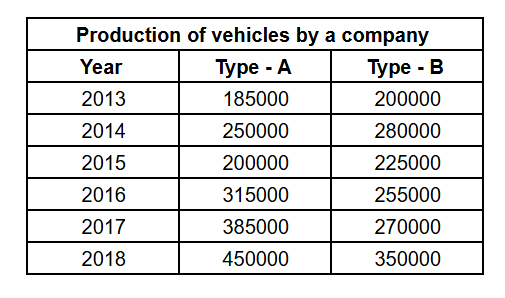
Total number of Type B vehicles produced in 2013, 2014 and 2017 = (200000 + 280000 + 270000) = 750000
Total number of Type A vehicles produced in 2014, 2015 and 2018 = (250000 + 200000 + 450000) = 900000
Total number of Type B vehicles as a percentage of total number of Type A vehicles = $$\ \dfrac{750000}{900000}\times100=83.33\%$$
Hence, total number of Type B vehicles is 83.33% of the total number of Type A vehicles.
$$\therefore\ $$ The required answer is A.
The average number of vehicles of type B produced in 2015, 2016 and 2017 is approximately what per cent less than the number of vehicles of type A produced in 2017?
The number of cars produced by the company are as follows:
Total number of Type B vehicles produced in 2015, 2016 and 2017 = (225000 + 255000 + 270000) = 750000
Average number of Type B vehicles produced in 2015, 2016 and 2017 = $$\ \dfrac{750000}{3}=250000$$
Number of vehicles of Type A produced in 2017 = 385000
Difference between the number of vehicles of Type A produced in 2017 and the average number of Type B vehicles produced = 385000 - 250000 = 135000
Percentage = $$\ \dfrac{135000}{385000}\times100=35.06\%$$
Hence, the average number of Type B vehicles produced in 2015, 2016 and 2017 is 35.06% less than the total number of Type A vehicles produced in 2017.
$$\therefore\ $$ The required answer is C.
90% of the total number of vehicles of type A produced in 2013, 2015 and 2016 is equal to the total number of vehicles of type B produced in the years ______.
The number of cars produced by the company are as follows:
Total number of Type A vehicles produced in 2013, 2015 and 2016 = (185000 + 200000 + 315000) = 700000
90% of the total number of Type A vehicles produced = 700000 $$\times\ $$ 0.9 = 630000
Total number of Type B vehicles produced in 2014 and 2017 = (280000 + 270000) = 555000
Total number of Type B vehicles produced in 2015 and 2018 = (225000 + 350000) = 575000
Total number of Type B vehicles produced in 2015 and 2017 = (225000 + 270000) = 495000
Total number of Type B vehicles produced in 2014 and 2018 = (280000 + 350000) = 630000
Hence, Total number of Type A vehicles produced in 2013, 2015 and 2016 is equal to the total number of Type B vehicles produced in 2014 and 2018.
$$\therefore\ $$ The required answer is D.
The ratio of the total number of vehicles of type A produced in 2016 and 2017 to the total number of vehicles of type B produced in 2014 and 2018, is:
The number of cars produced by the company are as follows:
Total number of Type A vehicles produced in 2016 and 2017 = 315000 + 385000 = 700000
Total number of Type B vehicles produced in 2014 and 2018 = 280000 + 350000 = 630000
Required ratio = $$\ \dfrac{700000}{630000}=\ \dfrac{10}{9}$$
Hence, the total number of Type A vehicles produced in 2016 and 2017 is in the ratio of 10:9 with the total number of Type B vehicles produced in 2014 and 2018.
$$\therefore\ $$ The required answer is D.
In 2019, if the production of vehicles of type A increased by the same per cent as in 2016 over its previous year, then what was the number (in thousands) of vehicles of type A produced in 2019?
The number of cars produced by the company are as follows:
Number of Type A vehicles produced in 2015 = 200000
Number of Type A vehicles produced in 2016 = 315000
Percentage increase = $$\ \dfrac{\left(315000-200000\right)}{200000}\times100=\ \dfrac{115}{2}\%=57.5\%$$
Number of Type A vehicles produced in 2018 = 450000
Number of Type A vehicles produced in 2019 = $$450000\times\left(1+57.5\%\right)=450000\times1.575=708750$$
Total number of Type A vehicles produced in 2019 (in thousands) = 708.75
$$\therefore\ $$ The required answer is A.
Study the graph and answer the given questions:
Percentage profit earned by two companies A and B during 2013 to 2018
_rGcaYa8.png)
If the incomes of companies A and B in 2013 were in the ratio 3 : 4, then the expenditure of company A was what per cent less than that of company B in that year (correct to one decimal place)?
We will assume the incomes of companies A and B in 2013 to be 300 and 400 respectively.
Profit for Company A and B are 45% and 30% respectively.
Profit % = $$\frac{Income\ -\ Expenditures}{Expenditures}\times\ 100$$.
This gives the expenditures of Companies A and B as 206.8 and 307.6 respectively.
Percentage by which A's expenditure is less than B's expenditure = $$\frac{307.6-206.8}{307.6}\times\ 100\ =\ 32.79\%\approx\ 32.8\%$$.
If the expenditure of company A in 2016 was ₹65 crores, then what was the income (in ₹ crores) of the company in the same year?
Profit Percentage for A in 2016 = 75%.
Profit % = $$\frac{income\ -\ \exp enditure}{\exp enditure}\times\ 100$$ where expenditures = 65.
This gives the income = 113.75.
If the profit earned by the company A in 2014 was ₹59.28 crores, then what was the income (in ₹ crores) of the company in the same year?
We are given that Profit is 65% for year 2014.
So, 65% of Expenditures = Profit = 59.28
So, Expenditures of 2014 = 91.2 and Income = Exp. + Profits = 150.48.
If the income of company B in 2015 was ₹108.8 crores, then what was its expenditure (in ₹ crores) in the same year?
Profit % = $$\frac{Income\ -\ Expenditure}{Expenditure}\times\ 100$$
Income is given to us as 108.8 Cr. and Profit % of Company B in 2015 = 70%.
This gives the Expenditure = 64 Cr.
If the expenditure of both companies A and B in 2018 was the same, then what was the ratio of the income of A to the income of B in the same year?
Income = Expenditure*(1+P%).
Let us assume the Expenditures of both companies A and B in 2018 = X.
Income of Company A = 1.35*X and Income of Company B = 1.4*X.
The required ratio = 1.35 : 1.4 = 27:28.
Study the graph and answer the given questions:
Number of Scooters and Motorcycles sold by a dealer during the first six months of the year 2020
_GZERHNN.png)
The average number of scooters sold by the dealer in January, March and April exceeds the average number of motorcycles sold in February and May by:
The average number of scooters sold by the dealer in January, March and April = $$\frac{245+300+325}{3}=290$$
The average number of motorcycles sold in February and May = $$\frac{210+250}{2}=230$$
The difference = 60.
The total number of motorcycles sold by the dealer in January, March and May is what percentage less than the total number of scooters sold in January, March and June (correct to one decimal place)?
The total number of motorcycles sold by the dealer in January, March and May are = 300 + 350 + 250 = 900 and,
the total number of scooters sold in January, March and June = 245 + 300 + 420 = 965.
The required percentage = $$\frac{965\ -\ 900}{965}\times\ 100\ \approx\ 6.7\%$$.
In which of the following months was the percentage increase in the sale of scooters as compared to its previous month below 7.5%?
Percentage increase = $$\frac{Current\ sales\ -\ \Pr evious\ sales}{\Pr evious\ sales}\times\ 100$$.
Percentage increase in sales of scooters in the month of:
February = 14.28%
March = 7.14%
April = 8.33%
May = 7.69%
June = 20%.
The percentage increase is lower than 7.5% for the month of March.
What is the ratio of the total number of scooters sold by the dealer in February and May to the total number of motorcycles sold in April and June?
Total Scooters sold in February and May = 280 + 350 = 630.
Total Motorcycles sold in April and June = 375 + 325 = 700.
The required ratio = 630 : 700 = 9:10.
In July 2020, the sale of scooters increased by the same percentage in June 2020 over the preceding month. What was the number of scooters sold in July 2020?
The sale of scooters increased in June 2020 over the preceding month by $$\frac{420-350}{350}\times\ 100=20\%$$.
The production increased in July 2020 by the same percentage so the production in July 2020 = 1.2*420 = 504.
Study the graph and answer the given questions:
Income and Expenditure of company ABC (in ₹ crores) during 2013 to 2018
_cTJO7tF.png)
What is the ratio of the total income of the company in 2016 and 2018 to the total expenditure in 2013 and 2015?
Total income in 2016 and 2018 = 350 +400 = 750 and,
total Expenditures in 2013 and 2015 = 200 + 350 = 550.
The required ratio = 750:550 = 15:11.
In 2019, if the expenditure of the company increased by the same percentage as in 2018 over its preceding year, then what was its expenditure (in ₹ crores) in 2019?
Percentage of Expenditures increased in 2018 over 2017 = $$\frac{280-250}{250}\times\ 100\ =\ 12\%$$.
Expenditures in 2019 = Increase of 12% over 2018 i.e. 1.12*280 = 313.6.
In which of the following years was the percentage increase in the income of the company below 7%?
Percentage increase in Income = $$\frac{Current\ Income\ -\ \Pr evious\ income}{\Pr evious\ income}\times\ 100$$.
In 2018, the percentage increase in income = $$\frac{400-375}{400}\times\ 100=6.25\%$$ which is less than 7%.
If the ratio of expenditures of the company in 2015 and 2019 was 7 : 9 and the company earned a profit of 20% in 2019, then what was its income (in ₹ crores) in 2019?
We will assume the expenditures in 2015 and 2019 to be 7x and 9x.
Now, expenditure in 2015 = 350 = 7x. This gives x = 50.
So, expenditure in 2019 = 9x = 450 and the company earned a profit of 20% in 2019.
This means that the income will be 1.2*450 = 540.
What is the average profit (in ₹ crores) earned by the company in 2013, 2014, 2015 and 2017?
Total Profits earned in 2013, 2014, 2015 and 2017 = Total Income - Total Expenditures.
==> (250+300+400+375) - (200+240+350+250) = 285.
The average profits = 285/4 = 71.25.
Study the table and graph and answer the given questions:
_L3cz6Ti.png)
Break up (degree wise) of students in terms of specialization in different area (A, B, C, D & E) in an MBA Program
_m3ReElO.png)
The number of students specialising in E is what per cent more than the number of students specialising in C?
The number of students specializing in E = 75.6 degrees and in C = 54 degrees.
The percent by which the number of students specialising in E is more than the number of students specialising in C = $$\frac{75.6-54}{54}\times\ 100\ =\ 40\%$$.
The ratio of total number of male students specialising in B and C to the total number of female students specialising in A, D and E is:
Number of Male students specializing in B = $$\frac{13}{27}\times\ \frac{97.2}{360}\times\ 2400\ =\ 312$$,
Number of Male students specializing in C = $$\frac{7}{15}\times\ \frac{54}{360}\times\ 2400\ =\ 168$$.
Number of female students specializing in A = $$\frac{8}{17}\times\ \frac{61.2}{360}\times\ 2400\ =\ 192$$,
Number of female students specializing in D = $$\frac{3}{10}\times\ \frac{72}{360}\times\ 2400\ =\ 144$$ and,
Number of female students specializing in E = $$\frac{11}{21}\times\ \frac{75.6}{360}\times\ 2400\ =\ 264$$.
The ratio of total number of male students specialising in B and C to the total number of female students specialising in A, D and E is 480 : 600 = 4:5.
The total number of students specialising in A and B exceeds the total number of students specialising in D and E by ‘x’. The value of ‘x’ lies between:
The total number of students specialising in A and B = $$\frac{158.4}{360}\times\ 2400\ =\ 1056$$.
And the total number of students specialising in D and E = $$\frac{147.6}{360}\times\ 2400\ =\ 984$$.
The value of X = 1056 - 984 = 72 i.e. it lies between 70 and 75.
The total number of female students specialising in B and C is what per cent of the total number of students specialising in C and D (correct to one decimal place)?
Total Students specializing in B = $$\frac{97.2}{360}\times\ 2400\ =\ 648$$ and female students = $$\frac{14}{27}\times\ 648=336$$.
Total Students specializing in C = $$\frac{54}{360}\times\ 2400\ =\ 360$$ and female students = $$\frac{8}{15}\times\ 360\ =\ 192$$.
Total female students = 336 + 192 = 528.
Total Students specializing in D = $$\frac{72}{360}\times\ 2400\ =\ 480$$.
Total students specializing in C and D = 480 + 360 = 840.
Required percentage = $$\frac{528}{840}\times\ 100\ =\ 62.85\approx\ 62.9\%$$.
The number of female students specialising in D is approximately what per cent less than the number of female students specialising in E?
The number of female students specialising in D = $$\frac{3}{10}\times\ \frac{72}{360}\times\ 2400\ =\ 144$$ and,
the number of female students specialising in E = $$\frac{11}{21}\times\ \frac{75.6}{360}\times\ 2400\ =\ 264$$.
The percent by which the number of female students specialising in D is less than the number of female students specialising in E = $$\frac{264-144}{264}\times\ 100\ \approx\ 45.5\%$$.
Study the table and answer the given questions:
Data related to the employees of a multinational company ABC in six offices A, B, C, D, E and F
_TUwY4Lr.png)
What is the ratio of the total number of male employees in offices A and D to the total number of female employees in offices B and E?
Male employees in Office A = $$\frac{4}{7}\times\ 1680\ =\ 960$$
Male employees in Office D = $$\frac{6}{13}\times\ 2340=\ 1080$$.
Female employees in Office B = $$\frac{5}{12}\times\ 2160\ =\ 900$$
Female employees in Office E = $$\frac{9}{14}\times\ 2520\ =\ 1620$$.
Required Ratio = (960 + 1080) : (900 + 1620) = 2040 : 2520 = 17:21.
The average number of female employees in offices D, E and F exceeds the number of male employees in office B by ______.
Number of female employees in D = $$\frac{7}{13}\times\ 2340\ =\ 1260$$,
in E = $$\frac{9}{14}\times\ 2520\ =\ 1620$$ and,
in F = $$\frac{15}{28}\times\ 2240\ =\ 1200$$.
The average number of female employees in offices D, E and F = Sum/3 = 1360.
The number of male employees in office B = $$\frac{7}{12}\times\ 2160\ =\ 1260$$.
The required difference = 1360 - 1260 = 100.
If the number of male post graduate employees in office C is 832, then what per cent of the female employees in that office are post graduates (correct to one decimal place)?
Male employees in C = $$\frac{12}{23}\times\ 2760\ =\ 1440$$ and Female employees = 1320.
Total Post graduate employees = 70% of 2760 = 1932 and 832 out of these are male. This gives the number of female post graduate employees = 1100.
Percentage of female employees who are post graduate = $$\frac{1100}{1320}\times\ 100\ =\ 83.33\%$$.
The average number of post graduate employees in offices B, D and E is approximately what per cent of the total number of female employees in offices A, C and F?
Female employees in,
A = $$\frac{3}{7}\times\ 1680\ =\ 720$$
C = $$\frac{11}{23}\times\ 2760\ =\ 1320$$
F = $$\frac{15}{28}\times\ 2240=1200$$.
Total Female employees in A,C and F = 3240.
Post graduate employees in,
B = 0.65*2160 = 1404
D = 0.55*2340 = 1287
E = 0.60*2520 = 1512.
Total Post Graduate employees in B, D and E = 4203 and Average = $$\frac{4203}{3}=1401$$.
Required percentage = $$\frac{1401}{3240}\times\ 100=43.24\%$$.
In which office is the percentage of female employees, with respect to the total number of employees in that office, between 45% and 50%?
Ratio of male to female employees in Office A = 4:3.
From this, the percentage of female employees = $$\frac{3}{4+3}\times\ 100\ =\ 42.85\%$$.
Similarly, the percentage of female employees in:
Office B = 41.67%
Office C = 47.8%
Office D = 53.8%
Office E = 64.2% and,
Office F = 53.5%.
So, the correct option is Office C.
Study the table and answer the given questions:
Number of students enrolled for Vocational Courses (VC) in institutes A, B, C, D and E during 2014 to 2019
_PW41E9g.png)
The ratio of the total number of students enrolled in VC in institutes B, D and E in 2015 to the total number of students enrolled in institute C in 2016, 2017 and 2018 is:
The total number of students enrolled in VC in institutes B, D and E in 2015 = 227 + 242 + 251 = 720 and,
the total number of students enrolled in institute C in 2016, 2017 and 2018 = 750.
The ratio of the total number of students enrolled in VC in institutes B, D and E in 2015 to the total number of students enrolled in institute C in 2016, 2017 and 2018 = 720 : 750 ==> 24:25
The total number of students enrolled in VC in institutes B and D in 2014 and 2016 is what per cent of the total number of students enrolled in 2019 in all the five institutes (correct to one decimal place)?
The total number of students enrolled in VC in institutes B and D in 2014 and 2016 = 222 + 232 + 228 + 258 = 940.
The total number of students enrolled in 2019 in all the five institutes = 256 + 292 + 280 + 310 + 252 = 1390.
The required percentage = $$\frac{940}{1390}\times\ 100\ \approx\ 67.6\%$$.
The total number of students enrolled in VC in institutes B and E in 2017 is what per cent more than the total number of students enrolled in institute D in 2015 and 2016?
The total number of students enrolled in VC in institutes B and E in 2017 are 255 + 285 = 540 and,
the total number of students enrolled in institute D in 2015 and 2016 are 242 + 258 = 500.
The percent by which the total number of students enrolled in VC in institutes B and E in 2017 more than the total number of students enrolled in institute D in 2015 and 2016 = $$\frac{540-500}{500}\times\ 100\ =8\%$$.
35% of the total number of students enrolled in VC in institutes A, B and E in 2019 is 12% more than the number of students enrolled in 2018 in institute ______.
The total number of students enrolled in VC in institutes A, B and E in 2019 = 256 + 292 + 252 = 800.
35% of this total = 280.
280 is 12% more than 250 i.e. the number of students enrolled in 2018 in the institute A.
The average number of students enrolled in VC in institute E in 2014, 2016 and 2017 is equal to the average number of students enrolled in institute B in the years ______.
The average number of students enrolled in VC in institute E in 2014, 2016 and 2017 = $$\frac{249\ +\ 246\ +285\ }{3}=260$$.
The average number of students enrolled in institute B in the years:
Option A = 241.5
Option B = 238.5
Option C = 260
Option D = 240.
The average is equal to the average in Option C.
Study the table and graph answer the given questions:

Distribution (degree wise) of students in five schools A, B, C, D and E

Total number of students (boys and girls) in 5 schools = 5400
40% of the number of students in school B is equal to the number of girls in school ______.
Total number of students in School A = $$\frac{44}{360}\times\ 5400\ =\ 660$$ and number of boys are 220.
thus the number of girls in School A = 440.
Similarly, number of girls in Schools C, D and E are 520, 360 and 558 respectively.
Total number of students in School B = 1395 and 40% of these students is 558.
This is equal to the number of girls in School E.
What is the ratio of the total number of boys in schools B and D to the total number of girls in schools A and C?
Number of Students in School A = 44/360 * 5400 = 660.
Girls in School A = 660 - 220 = 440.
Number of Students in School C = 960.
Girls in School C = 960 - 440 = 520.
Total girls in Schools A and C = 440 + 520 = 960.
Total Boys in Schools B and D = 830 + 450 = 1280.
Required Ratio = 1280 : 960 = 4 : 3.
The average number of girls in schools D and E is approximately what per cent less than the number of students in school C?
Total number of students in D and E = $$\frac{105\ +\ 54}{360}\times\ 5400\ =\ 2385$$.
Total number of girls in D and E = 2385 - (450+1017) = 918.
The average number of girls in schools D and E = 918/2 = 459.
Number of students in C = $$\frac{64}{360}\times\ 5400\ =\ 960$$.
The required percentage = $$\frac{960-459}{960}\times\ 100\ \approx\ 52.2\%$$.
Study the table answer the given questions:
Percentage of marks obtained by six students A, B, C, D, E and F in Different subjects.

The total marks obtained by student B in Mathematics and Hindi is approximately what percentage of the total marks obtained by student E in English, Science, Hindi and Social Studies?
Marks of B in Maths = 0.64*150 = 96 and Marks of B in Hindi = 66.
Total marks of B in Maths and Hindi = 96 + 66 = 162.
Similarly, Total marks of E in English, Science, Hindi and Social Studies = 36+52+48+88 = 224.
Required percentage = $$\frac{162}{224}\times\ 100\ =\ 72.3\%$$.
The average marks obtained by students A, C and D in Mathematics is what per cent less than the total marks obtained by student F in all the five subjects (correct to one decimal place)?
The total marks obtained by A, C and D in mathematics = 80+70+90 = 240%.
Average marks = 240/3 = 80% of 150 = 120.
Total marks obtained by F in all the subjects = 0.84*50 + 0.92*150 + 0.90*80 + 0.84*75 + 0.73*100 = 388.
The required percentage = $$\frac{388\ -\ 120}{388}\times\ 100\ \approx\ 69.1\%\ $$.
If the speed of a boat in still water is a km/h and the speed of the water current is b km/h, then find the value of $$(a^2 + b^2)$$. It is given that the boat covers 3x km against the current in 0.5x hours and 2.4x km with the current in 0.3x hours, where x is a positive irrational quantity.
This is a classic question from boats and streams, where you need to apply the equation of 'speed = distance/time'.
Given that the speed of the boat in still water is a kmph, and the speed of the current is b kmph.
In the instance where the boat goes against the stream (resultant speed is a-b): 0.5x = $$\ \frac{\ 3x}{(a-b)}$$
From this, (a-b) = 6 ........(1)
In the instance where the boat goes along with the stream (resultant speed is a+b): 0.3x= $$\frac{\ 2.4x}{(a+b)}$$
From this, (a+b)= 8 ............(2)
Using the two equations: a=7 and b=1
Hence, the value of $$(a^2 + b^2)$$ is 50.
When two different dice are rolled together, what is the probability that the sum of the numbers coming up on the two dice is 9?
The total number of possibilities the two dice can produce together is 36.
To have 9 as the sum on the two dice, the possible combinations are: (3,6)(6,3)(4,5)(5,4)
Hence, the probability is 4/36, which is 1/9.
The roots of the quadratic equation $$2x^2 - 7x + 2 = 0$$ are:
To know the nature of roots, we need to find the discriminant of the equation.
The discriminant for this equation is $$(-7)^2$$-4(2)(2), which is 49-16= 35.
Now, the discriminant is greater than zero, which means that the roots will be real and distinct. However, $$\sqrt{35\ }$$ is an irrational number, and hence the roots shall be real, unique, and irrational.
Which of the following is a function from A ® B, where A = {1, 2, 3} and B = {2, 3, 4, 5}?
Here, we need to check the options and see which one has one element from A and the other from B in each pair, without having any pair with repetitions or elements from the same set.
Option A has (1,1) contravenes the principle discussed above, as it has two elements from set A.
Option B is correct, as it has one element each from the two sets, and there is no repetition as such.
Option C is incorrect, as the element '4' is repeated twice.
Option D is incorrect because of the same reason that was pointed out for Option A.
Vessels A and B contain mixtures of milk and water. The ratios of milk and water in A and B are 4 : 5 and 3 : 1, respectively. In what ratio should the contents of A and B be drawn and mixed, to obtain a mixture having milk and water in the ratio 3 : 2?
The ratio of milk and water in A is 4:5, and in B is 3:1
Let us assume that in A, the volume of milk and water is 4x and 5x (total volume is 9x).
For B, the volume can be assumed as 3y and y (total volume is 4y).
After mixing A and B, we get the ratio of milk and water as 3:2
This means, $$\frac{\ (4x+3y)\ }{(5x+y)}$$ = $$\ \frac{\ 3}{2}$$
From the above equation, we get$$\ \frac{\ x}{y}$$as $$\ \frac{\ 3}{7}$$
Hence, the volume of A becomes 27, and that of B becomes 28.
This makes the ratio of A and B as $$\ \frac{\ 27}{28}$$.
Find the value of the expression $$(800 + 7n - n^2)$$ where n cm is the length of one diagonal of a quadrilateral whose opposite sides are parallel. The adjacent sides of the quadrilateral are 3 cm and 4 cm in length and the other diagonal is 1 cm in length.
It is said that two opposite sides of the quadrilateral are parallel.
So, it can be Square, Rhombus, Parallelogram, or Rectangle.
It is not square and rhombus because two adjacent sides are unequal(given).
It is not rectangle, because if it is rectangle the diagonal length will be $$\sqrt{\ 3^2+4^2}=5^{ }$$
So, it is a parallelogram.
We know that for a parallelogram $$d_1^2+d_2^2=2\left(a^2+b^2\right)$$.
$$d_1=1$$
a=3
b =4
$$1^2+d_2^2=2\left(3^2+4^2\right)$$.
$$1^2+d_2^2=2\left(3^2+4^2\right)$$.$$1+d_2^2=50\ \Rightarrow d_2^2=49\ \Rightarrow\ d_2=7$$.
The value of the expression $$(800 + 7n - n^2)$$ is $$(800 + 7*7- 7^2)$$=800+49-49=800
Find the value of $$\sqrt{16 + 2\sqrt{55}}$$.
$$\sqrt{\ 16\ +\ 2\sqrt{\ 55}}$$ can be seen as the square root of 16 + $$2\sqrt{\ 55}$$
Now on observing 16 + $$2\sqrt{\ 55}$$, we can see it as an expansion of $$(a+b)^2$$: a being $$\sqrt{11\ }$$ and b being $$\sqrt{5\ }$$.
Hence, we can rewrite the equation as $$\left(\sqrt{\ 11}+\sqrt{\ 5}\right)^2$$ , whose square root is $$\sqrt{\ 11}$$+$$\sqrt{\ 5}$$.
The centres of three circles that touch each other externally form a triangle of sides 21 cm, 22 cm and 23 cm. Find the approximate area of the smallest circle?
Let the sides of the triangle be AB, BC, and AC.
Each of the sides is made of radii of two circles. Let us assume that the radius of the three circles are x, y, and z.
Hence,
x+y= 21 ..............(1)
y+z= 22 ...............(2)
z+x= 23 ................(3)
Now from equation 3, z= 23-x ........... (4)
Substituting equation 4 in equation 2, we get x-y= 1 ...............(5)
Using equation 1 and 5, we get x= 11, y= 10, and z= 12.
The smallest radius is 10 cm, and the area of that circle is $$\pi10^2\ $$, which is approximately 314$$cm^2\ $$
If the second, third and first terms of a geometric progression (GP) form an arithmetic progression (AP), then find the first term of the GP, given that the sum to infinite terms of the GP is 36
Let us take terms of GP as $$a,ar,ar^2$$
then the terms in AP will be $$ar,ar^2,a$$
In that case, $$ar^2=\frac{(a+ar)}{2}$$
$$2ar^2=a+ar$$
On simplifying the equation, we get r = or r = -1/2
r can not be 1 as that will make each term of the GP same which will not make it an infinite GP, so we get r = -1/2
⇒ Also given that sum to infinite terms of the GP = 36
$$\frac{a}{1-r\ }=36$$
plugging r=-1/2 we get
a = 54.
The common root of $$x^2 + 10x + 24 = 0$$ and $$x^2 + 14x + 48 = 0$$ is:
For the common roots, the first approach shall be to find the common points of the two equations and see if it is the root for both of them. If not, then solve the equations independently and check for the common root.
Using the first approach, $$x^2 + 10x + 24$$ = $$x^2 + 14x + 48$$, we get x as -6 for the common point.
On substituting this in each of the equations, we find that it is a root to both the equations, and hence the answer.
The function $$y = \cos x$$ is:
Cos(x) is an even function, because Cos(-x) has the same points that overlap with Cos(x).
A rhombus has a perimeter of 40 cm. The line joining the midpoints of two adjacent sides is 6 cm long. Find the area of the rhombus.
Let's designate x cm as the length of each side of rhombus ABCD. Its perimeter is 4x cm.
Thus, 4x = 40, which leads to x = $$x=\dfrac{40}{4}$$ = 10 cm.
In triangle ABC, L is the midpoint of side AB, and M is the midpoint of side BC, resulting in LM measuring 6 cm.
Applying the similarity criterion in triangles BLM and BAC, we get $$\dfrac{BL}{BA}=\frac{LM}{AC}$$
This simplifies to $$\dfrac{BA}{2BA}=\frac{LM}{AC}$$ , which further simplifies to 1/2 = 6/AC , leading to AC = 12 cm.
Hence, in triangle ABC, the sides are a = 10cm, b = 12cm, and c = 10cm.
The semi-perimeter, s, is calculated as (10+12+10)/2 = 16
The area of triangle ABC is given by $$\sqrt{𝑠(𝑠−𝑎)(𝑠−𝑏)(𝑠−𝑐)\ }$$, which equals$$\sqrt{16\times(16−10)\times(16−12)\times(16−10)\ }$$, which further simplifies to $$\sqrt{16\times6\times4\times6\ }=48cm^2$$
As the rhombus ABCD consists of two congruent triangles ABC, its area equals 2×area of triangle ABC=2×48 cm², resulting in 96cm².
The distance between two points A and B is 84 km. Two persons start at the same time, one travelling from A towards B and the other travelling from B towards A. If their respective speeds are 36 km/h and 27 km/h and they meet at point C between A and B, then find the value of (CA/(CA ‒ CB).
Since the two persons are traveling toward each other, their relative speed will be (36+27)kmph, which is 63kmph.
Now, they will meet at t= $$\ \frac{\ 84}{63}$$ hours, which is $$\ \frac{\ 4}{3}$$ hours.
Now, in $$\frac{CA\ }{(CA‒CB)\ }$$, CA is the distance traveled at a speed of 36 kmph in 't' hours and CB is (84-CA)
In 't' hours, CA= $$36\times\frac{\ 4}{3}$$, which is 48 km.
Similarly, CB= 84-48= 36 km
Putting these values in (CA/(CA ‒ CB), we get the answer as 4.
An unknown sum when compounded annually yields extra interest that is equal to 2401 times of the unknown sum compared to simple interest. If the unknown sum, rate of interest r% and time 2 years is same for compound and simple interest, then find the value of the expression $$\sqrt{50(r + 1)}$$.
Let us assume the unknown sum to be P.
Compound interest for 2 years = $$P\left(1+r\right)^2$$ and simple interest for 2 years = $$2\Pr$$.
The difference between them is equal to $$2401\times\ P$$.
This gives: $$P\left(1+r\right)^2-2\Pr=2401\times\ P$$
==> $$\left(1+r\right)^2-2r=2401$$. After opening the square, we get $$r^2=2401$$ or r = 49.
50(r+1) = 2500 and it's root will be 50 i.e. Option D.
In an equilateral triangle, the orthocentre divides each median in the ratio x : y. If x > y, then fmd x : y.
This is a special property with respect to an equilateral triangle, where its orthocentre and centroid coincide with each other.
Also, we know that the centroid divides the median in a ratio 2:1. Hence, the orthocentre shall divide the median in the same ratio.
Let m and n be two numbers such that their LCM is 196 and their HCF is 7. If the difference between the two numbers is 21. then find the value of $$\sqrt{\frac{m \times n}{7}}$$
This is a direct relation: If the numbers are m and n, their product will equal the product of their LCM and HCF.
Applying the same in this question, m$$\times\ $$n = 196$$\times\ $$7
Putting this in the required expression, we get the answer as $$\sqrt{\ 196}$$, which is 14.
The number of non-negative integral solutions to the equation x + y + z = 14 is:
The direct method to solve the questions for non-negative integral solution is finding the value of
$$n+r-1_{C_{r-1}}$$
Here, n= 14 r=3
Substituting the values, we get $$\ 16_{C_2}$$which is 120.
A person had two plots of land. In each plot, he cultivated maize and barley. The ratio of the area under maize cultivation to that under barley cultivation in the larger plot is 8 : 9. The ratio of the total areas under maize cultivation and barley cultivation in the two plots together is 29 : 33. The ratio of the areas under maize cultivation and barley cultivation in the smaller plot is 13 : 15. The ratio of the area under maize cultivation in the larger plot to that under barley cultivation in the smaller plot is:
Let us assume that the area under maize and barley in the larger plot is 8x and 9x.
Similarly, the area under maize and barley in the smaller part is 13y and 15y.
It is given that the total area under maize and barley (taking both the plots) is in the ratio 29:33.
By this, we get that $$\ \frac{\ 8x+13y}{9x+15y}$$= $$\ \frac{\ 29}{33}$$
This is, 264x+429y=261x+435y, making this as 3x=6y, or x=2y
For the ratio of area under maize (larger plot) to area under barley in smaller plot, we shall substitute the values in 8x:15y
The final ratio is 16y:15y, or 16:15.
Figure description: An equilateral triangle encloses the two circles touching each other externally. Two sides act as common tangent to both the circles, whereas the third side is tangent to the larger circle only.
What will be the ratio of the perimeter of the smaller circle to that of the equilateral triangle in the given figure?
_4vee4Kw.png)
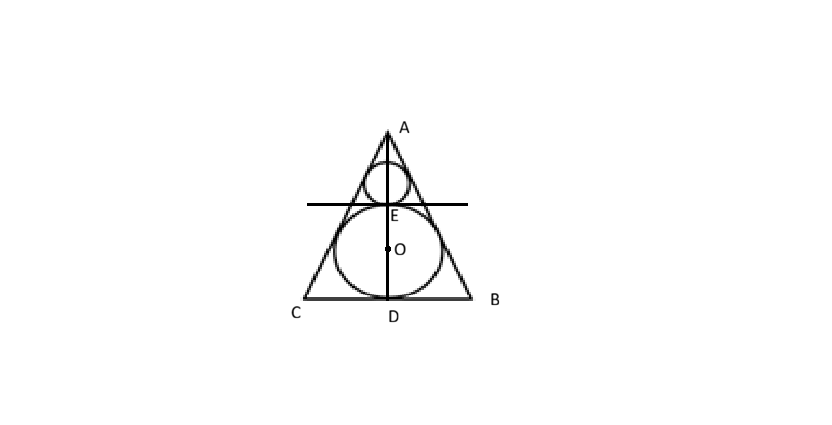
The bigger circle is the incircle of the triangle ABC. We know that incenter of an equilateral triangle is also it's centroid. It means that OD = 1/3rd of AD.
It also implies that OE = OD = AE = 1/3rd of AD.
AE is the median for the smaller equilateral triangle and thus radius of the smaller circle = 1/3rd of AE ==> $$\frac{1}{3}\times\ \frac{1}{3}\times\ AD=\frac{1}{9}\times\ AD$$.
AD = $$\frac{\sqrt{\ 3}}{2}AB$$. This gives the smaller radius = $$\frac{1}{9}\times\ \frac{\sqrt{\ 3}}{2}AB=\frac{\sqrt{\ 3}}{18}\times\ AB$$ and Circumference = $$2\pi\ \times\ \frac{\sqrt{\ 3}}{18}\times\ AB\ =\ \frac{\sqrt{\ 3}\pi\ }{9}\times\ AB$$.
And the perimeter of the triangle = 3AB.
Thus, the required ratio = $$\frac{\sqrt{\ 3}\pi\ }{9}\times\ AB\ \ :\ 3\times\ AB=\ \pi\ :\ 9\sqrt{\ 3}$$.
Two articles are bought at the same price. One is sold at 30% profit and the other is sold at 20% loss. Find the overall profit/loss percentage.
Assume that the cost price of each of the articles as Rs.100. So, the total cost price is Rs.200.
The first article is sold at a profit of 30%, which makes its selling price as Rs.130.
The second article is sold at a loss of 20%, which makes its selling price as Rs.80.
The total selling price is Rs.210, while the total cost price is Rs.200.
Hence, profit% = (10/200) * 100, which is 5%.
If the value of 624 in the base 7 system is equal to 312 in the base k system, then find the value of $$k^2$$
To solve such questions, it is always advisable to convert the number first into decimal (base 10) and then analyse the result.
As per the question, we have 624 in base 7. To convert it into decimal, we do: 6$$\times\ $$ $$7^2$$ + 2$$\times\ $$ 7 + 4$$\times\ $$ 1, which is 312.
This is exactly what we have in the question, which means that the number is 312 in base 10.
Hence, $$10^2$$ = 100
If $$f(x) = 8x^4$$ and $$g(x) = \sqrt[3]{f(x)}$$, then find the value of $$\log_2(fog(64))$$.
To find $$\log_2(fog(64))$$, we shall first find the value of fog(64).
The value of g(64): $$\sqrt[3]{f(64)}$$, where f(64) is $$8^9$$
The cube root of the following expression would be $$8^3$$, which is the value of g(64).
Now, fog(64) is f($$8^3$$), which is $$8^{13}$$.
For the final result, $$\log_2\left(8^{13}\right)$$, which is $$\log_2\left(2^{39}\right)$$ , or 39.
Find the value expression $$\left(750\left(\frac{x^2 + y^2}{xy}\right)\right)$$, where ₹x is the amount when a sum of ₹y is lent at an unknow interest rate for an unknow period compounded quaterly. Also ₹y is the amount when a sum of ₹9x is lent under similar condition as above.
We will assume the interest rate = 4r% pa and the time period to be t years.
$$X\ =\ Y\left(1+r\right)^{4t}$$.
And $$Y=\ 9X\left(1+r\right)^{4t}$$.
Equating value of $$\left(1+r\right)^{4t}$$ from both the equations to get:
$$\frac{X}{Y}=\frac{Y}{9X}$$.
$$Y^2\ =\ 9X^2$$ ==> Y = 3X.
After putting this into the equation, we get: $$750\times\ \left(\frac{9X^2+X^2}{3X^2}\right)=2500$$.
Find the $$12^{th}$$ term of the progression $$S_n$$, where $$S_n = 1 + 3 + 7 + 13 + 21 + 31 + 43....$$
Observing the series shows that the difference between consecutive terms is in and AP. For instance: 3-1=2, 7-3=4, 13-7=6 and so on.
Hence, the general term (when the difference of terms is in an AP) is represented by a$$n^2$$+bn+c, where n is the number of that specific term in the series.
Putting n=1, we get a+b+c=1
Putting n=2, we get 4a+2b+c=3
Putting n=3, we get 9a+3b+c=7
On solving the three equations, a=1, b=(-1), and c=1
To find the $$12^{th}$$ term, we shall put n=12 and substituting the values of a,b, and c in the equation a$$n^2$$+bn+c, we get it as 144-12+1= 133
How much should be paid to Changez when work is completed combinedly by Akbar, Babar and Changez in 2 days, and the total amount paid to the team is 100 Dinars? It is known that Akbar alone can do the work in 10 days, whereas Babar takes 5 days for the completion of the same work.
Let us assume the total work as 10 units.
Now, Akbar alone takes 10 days to complete the work, making his efficiency as 1 unit/day.
Babar takes 5 days to complete the same work, which means his efficiency is 2 units/day.
It is also given that Akbar, Babar, and Changez together take 2 days to complete the work, which means their combined efficiency is 5 units/day.
Therefore, Changez's efficiency would be 2 units/day (excluding Akbar and Babar from the combined efficiency).
Now, the amount shall be distributed to the three in the ratio of their efficiencies, which is 1:2:2 (Akbar, Babar, and Changez).]
This makes Changez's earning as 40 dinars out of the total 100 dinars.
If a person would have walked at 12 km/h instead of 10 km/h, he would have walked 20 km more. The actual distance travelled by him when he walked at the pace of 10 km/h is
Assume that the person traveled for 't' hours.
As per the question (extra distance because of increased speed), 12t-10t = 20, which implies that t = 10 hours.
Hence, the distance traveled by the person in 10 hours at the speed of 10 kmph shall be 100 km.
Ram and Shyaam together complete a task in 45 days and receive ₹13,500. If Shyaam is three times as efficient as Ram, then what is the amount of money he earns in 10 days?
Let us assume that Shyaam does 3x units of work per day, while Ram does x units per day.
In 45 days of working together, they must have done work in the ratio of 3:1 as far as the units of work done are considered. Hence, the amount earned shall also be distributed in a similar ratio.
So out of Rs.13,500, Shyaam would have received $$\left(\frac{\ 3}{4}\right)\times\ 13500$$ for 45 days of work, which is Rs.10,125 for 45 days or Rs.225 per day.
In 10 days, Shyaam would have earned Rs.2250.
Let n be the total count of the 5-digit numbers in the binary system. What is the value of 2n?
In a 5 digit binary number set, there are five places _ _ _ _ _, which shall be filled with 2 numbers (0 or 1).
Hence, for every place, we have two choices. For 5 places, we will have a total of $$2^5$$ choices, making the total count as 32.
This means n= 32. Therefore, 2n= 64.
Find the value of expression.
$$8\left(1 + \frac{1}{2} + \frac{1}{4}.....\infty\right)$$
$$8\left(1 + \frac{1}{2} + \frac{1}{4}.....\infty\right)$$ is an infinite GP (the expression under the brackets) with the first term being 1, and the common ratio being $$\frac{\ 1}{2}$$or 0.5.
For infinite GP with common ratio less than 1, the sum is $$\ \frac{\ a}{(1-r)}$$
Applying the same in this, we get the sum as $$\ \frac{\ 1}{(1-0.5)}$$, which is 2.
Hence, the value of the entire expression is $$8\times2$$, which is 16.
x is directly proportional to 4 more than the square of y. x is 39 when y is 3. What is the value of $$\sqrt{y}$$ when x is 60?
As per the question (assuming the proportionality quotient be 'k'): x = k($$y^2$$+4)
Substituting the given values, 39 = k(9+4), which makes k as 3.
Now, the value of $$\sqrt{\ y}$$ when x is 60: 60 = 3($$y^2$$+4)
From the above equation, $$y^2$$ = 16, which makes y as 4 and the square root of y as 2.
Find x if $$\frac{x}{\sqrt{128}} = \frac{\sqrt{162}}{x}$$.
On cross-multiplying, we get the equation: $$x^2$$ = $$2^{\frac{7}{2}}$$*$$2^{\frac{1}{2}}$$*$$3^{\frac{4}{2}}$$
On solving the same, $$x^2$$ = $$2^4$$*$$3^2$$
This gives the value of x as $$4\times3$$ which is 12.
The solution set of the inequality $$-9y - 5 < 7y + 27$$ is:
Rearranging the inequation, we get 16y>-32, or y>-2
This means the solution set for this inequation is $$(-2, \infty)$$
The number of ways of arranging 10 different books on a shelf such that two particular books are always together is:
Out of the ten books, we need to have a case where a specific pair of two books is always there.
To solve this, the best way is to assume the two books as a single element. This leaves us with nine different elements, where one of them has two books in it.
To arrange nine different elements, we have 9! ways.
Now, it is important to note that the two books considered as a single element can be arranged within themselves as XY or YX (2 ways).
Therefore, we shall multiply the initial result by 2, which makes the total number of ways as 9!$$\times\ $$2.
What must be added to 315654 so that it becomes a multiple of 11?
The shortest method to solve this question is by finding the remainder when 315654 is divided by 11.
By doing so, we find that the remainder is 9, and adding 2 would make it divisible by 11.
Gandhi Sew bridge has a pole that divides the bridge into two parts in a manner such that the ratio of the larger part to the smaller part is m : n. It is found that the ratio of the length of the bridge to the length of the smaller part is six times the ratio of the length of the larger part to the length of the bridge. Find the value of $$\sqrt{25 + mn(m^2 - 4mn + n^2)}$$.
Let us assume the lengths of the larger part of the bridge and the smaller part as mx and nx.
As per the question, $$\ \frac{mx+nx}{nx}$$ = 6$$\times\ $$ $$\ \frac{\ mx}{mx+nx}$$
This means, $$\left(m+n\right)^2$$ = 6mn
Or, $$m^2+n^2$$ = 4mn
Hence, the value of $$m^2+n^2$$ - 4mn = 0, thereby making the value of $$\sqrt{25 + mn(m^2 - 4mn + n^2)}$$ as 5.
Consider a trapezium PQRS in which PQ || RS. Point E internally divides RS in equal parts and PQRE forms a parallelogram. The area of triangle PSE is 37 $$cm^2$$. Find the area enclosed by the shape PQRS.
Here, the height of the parallelogram and the triangle are the same, and also the base is the same. This is because the question states that the PE divided SR into half.
.png)
The area of triangle is 1/2*b*h=1/2*x*h=37 $$\Rightarrow$$ xh=74.
Area of the PQRE is b*h=x*h=74
The total area is 37+74=111 $$cm^2$$.
What is the equation of a straight line that has y-intercept 5 and is perpendicular to a straight line joining (2, -3) and (4, 2)?
The line in question (slope 'a') is perpendicular to a straight line (slope 'b') joining (2, -3) and (4, 2). Hence, a$$\times\ $$b= -1
b= $$\ \frac{\ 5}{2}$$, which makes a= $$\ \frac{\ -2}{5}$$
Hence, the equation of line with slope $$\ \frac{\ -2}{5}$$ is y= $$\ \frac{\ -2}{5}$$x + 5
Two non-intersecting circles, one lying inside the other, are of radii $$r_1$$, and $$r_2$$, and $$r_1$$ > $$r_2$$. If the minimum distance between any two points on their circumferences is s, then the distance between their centres is:
Let 'a' be the radius of the bigger circle where A is its center, while 'b' is the radius of the smaller circle and B is its center.
's' is the distance between their circumference, and D is the distance between the two centers.
Hence, D = a - (b+s)
Tom, Suresh and Adil are capable of finishing a task in 2, 4 and 8 hours, respectively. Suresh takes a magic medicine that increases his power by n times. Suresh works together with Tom and Adil to complete the task in less than 1 hour. Find the value of the expression $$n^2 + 2$$ where n is a positive integer.
Let us assume that the total is 8 units (LCM of 2,4,8).
This means Tom does 4 units/hour, Suresh does 2 units/hour, and Adil does 1 unit/hour.
Now, Suresh's efficiency is increased and becomes 2n units/hour.
Due to this, they all complete the 8 units of work in less than 1 hour.
This means, $$\ \ \frac{\ 8}{5+2n}<1\ $$, or n>1.5
The nearest integer is 2, making the value of $$n^2 + 2$$ as 6
Find x if $$\log_x\left[\log_5(\sqrt{x + 5} + \sqrt{x})\right] = 0$$
$$\log_x\left[\log_5(\sqrt{x + 5} + \sqrt{x})\right] = 0$$
Shifting the 'x' from the base of LHS to the RHS, we get,
$$\log_5(\sqrt{x+5}+\sqrt{x})=x^0\ =\ 1$$
Now, shifting the '5' from the base of LHS to the RHS, we get,
$$\sqrt{\ x\ +\ 5}+\sqrt{x}\ =\ 5^1\ =\ 5$$
$$\sqrt{\ x\ +\ 5}\ =\ 5\ -\ \sqrt{\ x}$$
Squaring on both sides, we get,
$$\ x\ +\ 5\ =\ 25\ +\ x\ -\ 10\sqrt{\ x}$$
$$\ 10\sqrt{\ x}\ =\ 20$$
$$\sqrt{\ x}\ =\ 2$$
$$x\ =\ 4$$
Hence, the correct answer is option C.
P, Q and R gave the following statements:
P - “Either it is day or it is night”.
Q - “It is night”.
R - “It is neither day nor night”.
Of these people, only one is wrong.
What time of the day is it?
Case 1: P is wrong.
According to Q, it is night but according to R, it is neither night nor day which means that they both can't be true together. So, this case is not possible.
Case 2: Q is wrong.
Again, statements of P and R can not exist together, so this case is also not possible.
Case 3: R is wrong.
According to the statements of P and Q, it is night and this conclusion is supported by both the statements.
Thus, the answer is Option D.
Read the given statements and conclusions carefully, and decide which of the conclusions logically follow(s) from the statements.
Statements:
Only creative and innovative people score high on a creativity test.
Rahul scored high on the creativity test.
Conclusions:
I. Rahul is creative.
II. Rahul is innovative.
Since it is given that ONLY creative and innovative people can score high on the test, it is clear that anyone who scores high shall be both creative and innovative. If Rahul has scored high, he shall be both creative and innovative.
Select the number from among the given options that can replace the question mark (?) in the following series.
123, 468, 91011, 121416, 171819, ?
1 2 3 are 3 consecutive numbers.
4 6 8 are alternate numbers.
9 10 11 are consecutive numbers.
12 14 16 are alternate numbers.
17 18 19 are consecutive numbers.
Considering the pattern, the next numbers should be alternate i.e. 20 22 24 and thus the answer is Option B - 202224.
If
‘P + Q’ means ‘P is the daughter of Q’,
‘P - Q’ means ‘P is the mother of Q’,
‘P % Q’ means ‘P is the brother of Q’ and
‘P * Q’ means ‘P is the father of Q’,
then which of the following will show the relationship that ‘A is the sister-in-law of D’?
A - B + C % D means that A is the mother of B and that B is also the daughter of C. It means that A and C are respectively the mother and father of B.
C % D implies that C is the brother of D and A is the wife of C. It means that A is the sister-in-law of D.
Thus, the correct answer is Option A.
Select the term from among the given options that can replace the question mark(?) in the following series.
D5f, n15P, H9j, j11L, L13n, f7H, P17r, ?
The middle number represents the numerical position of the middle letter of the other 2 letters.
The terms start with capital letters alternatively. As the given last term is P17r, the next term shouldn't start with capital letter.
Considering these 2 conditions, only b3D could be the next term.
Select the term from among the given options that can replace the question mark (?) in the following series.
ApD, FwM, KdV, ?, UrN, ZyW
The letters follow a normal additive pattern
1st letter has a patter of +5, 2nd letter has a pattern for +7 and 3rd letter has a pattern of +9.
It means A+5 = F, p+5 = w and D+9 = M.
By following the same pattern in KdV, we get K+5 = P, d+7 = k and V+9 = E i.e. PkE.
Study the given pattern carefully and select the letter that can replace the question mark (?) in it.
_nadLq6p.png)
J corresponds to the sum of 4 upper parts of the left wheel i.e. 1+2+3+4 = 10.
Z corresponds to the sum of 4 lower parts of the left wheel i.e. 5+6+7+8 = 26.
S corresponds to the sum of 4 lower parts of the right wheel i.e. 4+7+2+6 = 19.
So, the letter that should come at ? will be 9+1+3+5 = 18th letter i.e. R.
Select the option that is true regarding the following two statements labelled Assertion (A) and Reason (R).
A: Doctoral scholars are hired as research assistants.
R: Doctoral scholars are given research training.
Both A and R are true, but A needs a reasoning that explains why doctoral fellows are hired as research assistants. However, R merely talks about research training being imparted in doctoral fellows.
In a survey of 300 students of a junior school, it was found that 45% students liked art class, 51% liked sports class, and 64% liked music class. Also, 29% liked art and sports classes both, 25% liked music and sports classes both, and 32% liked art and music classes both. 6% did not like any of the three classes.
What is the number of students who like only one of the three classes?
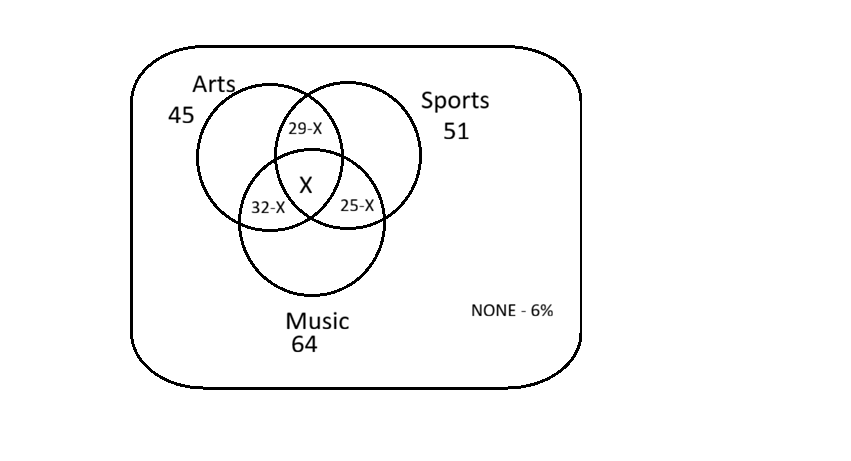
s + 2d + 3t = 45 + 51 + 64 = 160 where "s" represents number of students who like only one of the three classes, "d" represents number of students who like only two of the three classes and "t" represents number of students who like all of the three classes.
s + d + t = 100 - 6 = 94.
By subtracting these equations, we get: d + 2t = 66.
d = 29-X + 32-X + 25-X = 86 - 3X and t = X.
86-3X + 2X = 66 ==> X = 20.
t = 20 and d = 26. This gives s = 94 - 26 - 20 = 48.
So, the students who like only one of the three classes are 48% of the Total number of students i.e. 48% of 300 = 144.
Consider the given statement and decide which of the given assumptions is/are practical with respect to the statement.
Statement:
Since banks are violating the loan lending rules, RBI has decided to impose 5-crore fines on these banks.
Assumptions:
I. Banks have recently started expanding their branches.
II. RBI takes strict actions against banks that violate the rules and regulation implemented by RBI.
From the given information, only Statement II is practical and can be inferred.
Read the given statements and conclusions carefully. Assuming that the information given in the statements is true, even if it appears to be at variance with commonly known facts, decide which of the given conclusions logically follow(s) from the statements.
Statements:
All dogs are cats.
The cats that are not dogs are rats.
Conclusions:
I. Some rats are cats.
II. All cats are dogs.
III. Every cat is either a dog or a rat
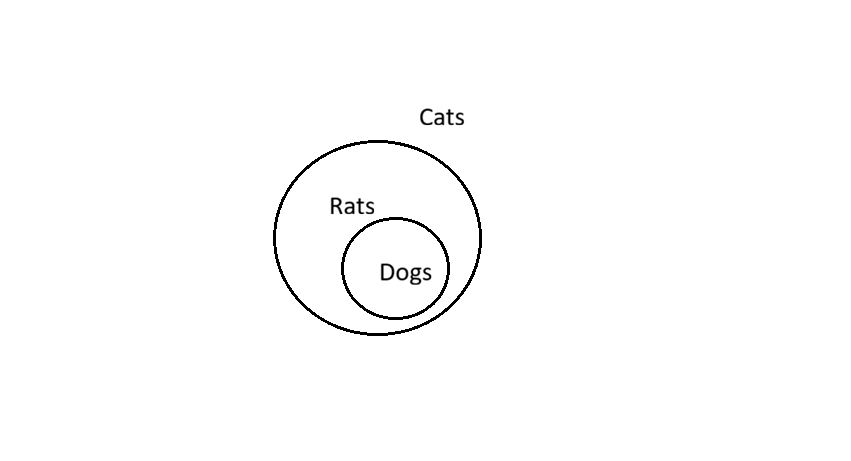
Only Conclusion 1 and 3 follow as conclusion 2 is only one of the possible cases and thus does not always follow.
$$‘P + Q’$$ means $$‘P$$ is the brother of $$Q’$$.
$$‘P - Q’$$ means $$‘P$$ is the sister of $$Q’$$.
$$‘P \times Q’$$ means $$‘P$$ is the father of $$Q’$$.
Which of the following means $$‘C$$ is the son of $$G’$$?
$$G\ \times\ A\ -\ C\ +\ B$$ means that G is the father of A and A is the sister of C.
Also, C + B implies that C is the brother of B. It means that G is father of C and C is a boy which implies that C is the son of G.
Thus, the answer is Option A.
Read the given statements and conclusions carefully, and decide which of the conclusions logically follow(s) from the statements.
Statements:
No girl can dance.
Some girls are singers.
Conclusions:
I. Boys can dance.
II. Some singers can dance.
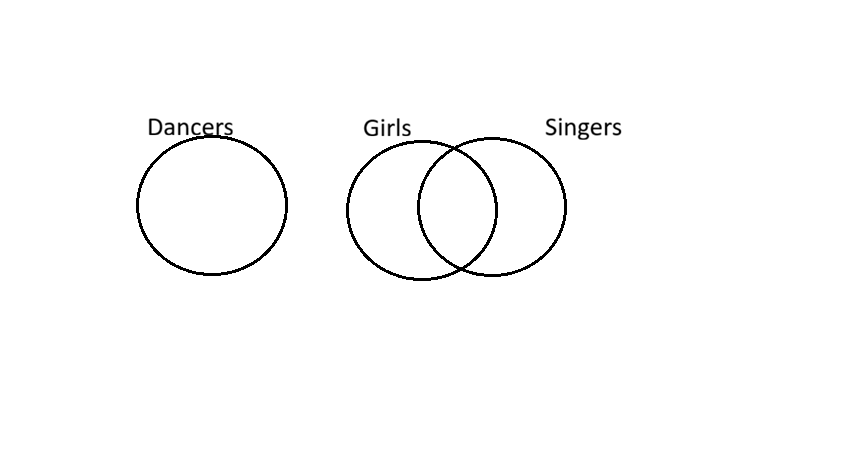
Nether Conclusion 1 nor Conclusion 2 follows.
If
‘A $ B’ means ‘A is the son of B’,
‘A # B’ means ‘A is the sister of B’, and
‘A @ B’ means ‘A is the father of B’,
then which of the following will show the relationship that ‘P is the daughter of Q’?
P # S $ Q @ R implies that P is the sister of S and S is the son of Q.
From this, we can infer that P is the daughter of Q and that's why the correct answer is Option B.
What is the angle between the hour hand and the minute hand of an analogue clock when the time is 5:40 p.m.?
The formula is: $$\ \frac{\ 11}{2}$$ $$\ \times\ $$hour - 30$$\ \times\ $$minutes for the angle.
Keeping hours as 5 and minutes as 40, we get the expression as 220-150, which is 70 degrees.
Pointing to a photograph, a person said, “His mother is the wife of my father’s only son”. How is the speaker related to the person in the photograph?
The statement given is: "His mother is the wife of my father’s only son."
Putting it together, "His mother is the wife of my father’s only son" means "The mother of the person in the photograph is married to my father's only son ."
If the mother of the person in the photograph is married to the speaker, then the person in the photograph is the speaker's brother. Therefore, the speaker, being the brother's sister, is indeed the aunt of the person in the photograph.
Option C) is correct.
Select the figure from among the given options that can replace the question mark (?) in the following series?
_sDNZ9pa.png)
The circles are dotted in this pattern:
First, the dot just above the colored dot is filled.
Then, the dot just left of the colored dot is filled.
Then again, the dot just above the dot is filled, and this pattern continues.
So, in the final figure, a dot on the left side of the colored dot is filled.
Option A) is the correct answer.
Select the term from among the given options that can replace the question mark (?) in the following series.
AsT, cQv, EoX, ?, IkB
The terms are AsT, cQv, EoX, ?, IkB
If you see the first term, that is AsT
First element is A, second element is s and third element is T.
If you see the second term, that is cQv
First element is c, second element is Q and third element is v.
We see that the first element of both terms follows a relation that is first term + 2
A+2 = c (Capital letter turns into the small letter and element is added by 2)
Similarly, for the second element, the relation is the first term - 2
s - 2 = Q (small letter turns into the capital letter and element is subtracted by 2)
Similarly, for the third element, the relation is first term + 2
T + 2 = v (Capital letter turns into small letter and element is added by 2)
So, the term after EoX will be
E + 2 = g
o -2 = M
X +2 = z
Thus, gMz is the correct answer.
Pallavi, Rashmi, Simran, Teesta, Urvashi and Vijaya ran a 16-km marathon.
A) Pallavi beat Rashmi and Vijaya only.
B) Urvashi was beaten by Teesta only.
C) Simran did not come last in the marathon.
D) The bronze medalist completed the marathon in 55 minutes.
E) Rashmi completed the marathon in 63 minutes.
Who won the bronze medal?
Pallavi beat Rashmi and Vijaya only which means that Pallavi got 4th rank and Rashmi and Vijaya got either 5th or 6th rank.
Urvashi was beaten by Teesta only which means that Teesta got 1st rank and Urvashi got the 2nd rank.
The only person left is Simran and the only rank left is 3rd. It means that Simran got the 3rd rank i.e. the Bronze medal.
Read the given statement and conclusions carefully, and decide which of the conclusions logically follow(s) from the statement.
Statement:
It is impolite to interfere in an individual’s personal matter.
Conclusions:
I. It is bad to encroach in someone’s private life.
II. Details regarding a person’s profession don’t come under the purview of one’s personal matter.
Conclusion 1 is a restatement of the main statement, hence a valid conclusion.
Conclusion 2 introduced personal and professional details, which are not covered in the main statement. Hence, an invalid conclusion.
Eight employees of ABZ Corp. are sitting in a conference at a round table, facing the centre. Elanor is third to the right of Chris. Abigail is sitting opposite to Fred and next to Brad. Douglas is second to the left of Elanor. Brad is second to the left of Gabriel.
Which two employees are sitting between Abigail and Elanor?
The final placement will be:
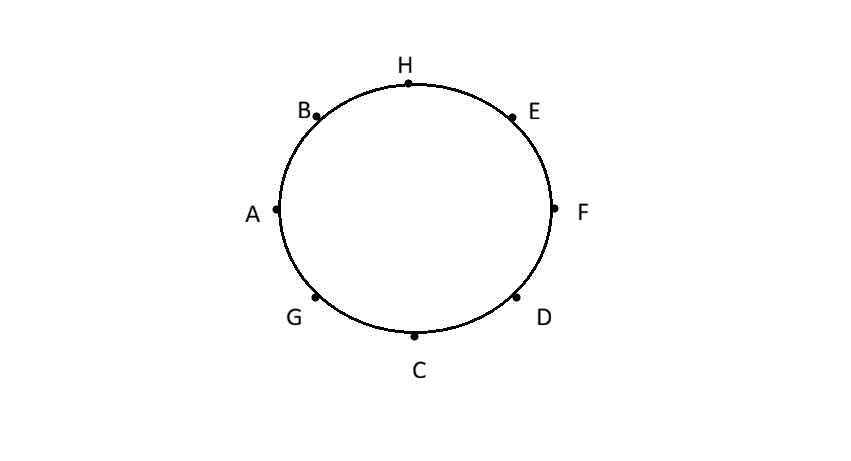
People sitting between A and E are B and H i.e. Brad and Harriet.
What was the day of the week on 14 August 2010?
The day of the week on 14 August 2010 was Saturday. You can find out by using this approach-
You must definitely know what today's date and day are.
Thus, by going backwards, you can find the day of the week on 14th August 2010.
Akash, Bisni, Charu, Dev, Elsa, Fiona and Gaurav sat for their high school examination and their scores were as follows:
a. Bisni always scores more than Dev, who always scores more than Fiona.
b. In any examination, if Charu scores the highest, Elsa scores the least, or if Akash scores the highest, Fiona or Gaurav scores the least.
c. No two students get equal scores.
If Fiona and Akash are ranked 4th and 5th, respectively, which of the following can be true?
An electrical showroom sold televisions, air conditioners and washing machines in a month. It sold 20 air conditioners in the month of December 2020. In the same month, the number of washing machines sold was a quarter of the number of air conditioners sold. The number of televisions sold was the same as the number of air conditioners sold.
(A) The ratio of the different electrical items sold can be calculated.
(B) The number of dishwashers sold can be found out.
Based on the given information, which of the following options is correct?
Let's analyze the given information:
1. 20 air conditioners were sold in December 2020.
2. The number of washing machines sold was a quarter of the number of air conditioners sold, so it would be (1/4)*20 = 5 washing machines.
3. The number of televisions sold was the same as the number of air conditioners sold, which is 20 televisions.
We can find the ratio of the different electrical items sold:
- Air conditioners: 20
- Washing machines: 5
- Televisions: 20
Therefore, Statement A can be determined is correct.
We cannot determine the number of dishwashers sold based on the given information, Statement B can't be determined.
Thus, Option A) is the answer.
Nine students of the basketball team have to go out for an intercollege basketball competition. There are two school jeeps: red jeep and blue jeep, each of which can accommodate five students. However, the following conditions must be met:
(i) Vishakha will always go in the red jeep but does not want Akash to travel with her.
(ii) Two out of three students — Mahak, Riya and Dinesh — will be in one jeep.
(iii) Chahat and Naina will always travel together in a jeep.
(iv) If Anamika and Akash are in the same jeep, then Viraj will also be in the same jeep.
(v) No jeep can have more than five students.
If Mahak and Riya are in the red jeep, how many different combinations of students can travel in the jeeps?
The JKF party was selecting the campaigning team that would manage their campaign during the coming elections. The team is to include two spokespersons, two content writers and two digital managers. The spokespersons may be chosen from Abhay, Bharti, Chhavi and Dhairya; the content writers may be chosen from Eklavya, Farah and Gauri; and the digital managers may be selected from Himanshu, Isha, Jayanti and Keshav.
The following conditions need to be kept in mind before selecting the team:
(i) Neither Farah nor Jayanti can be selected if Abhay is selected.
(ii) If Chhavi is selected, then Jayanti is definitely selected.
(iii) Himanshu and Keshav will always be selected together.
(iv) Isha and Keshav will never be selected together.
Which combination is acceptable?
We will check each option and try to find any condition that makes it invalid; otherwise, that option can't be the answer.
The answer will be the option in which none of the conditions are invalid.
Option A) Chhavi, Dhairya, Eklavya, Gauri, Farah, Isha
We know from statement 2 that if Chhavi is selected, then Jayanti is definitely selected. But here, Jayanti is not selected, so this is incorrect.
Option B) Abhay, Bharti, Eklavya, Gauri, Isha, Keshav
We know from statement 3 that Himanshu and Keshav will always be selected together. But here, only Keshav is selected. Hence, this is incorrect.
Option C) Abhay, Bharti, Eklavya, Farah, Himanshu, Isha
We know from statement 3 that Himanshu and Keshav will always be selected together. But here, only Himanshu is selected. Hence, this is incorrect.
Option D) Bharti, Chhavi, Eklavya, Farah, Jayanti, Isha
All conditions are satisfied in this option.
Thus, Option D) is the correct answer.
In Karian village, truth-tellers always tell the truth and liars always tell lies. Harish approached three villagers, Hiri, Lange and Pora, and asked who among them was the liar.
Following were their replies:
Hiri: I always speak the truth.
Lange: Hiri does not speak the truth.
Pora: Lange does not tell lies.
If one of them is a liar but the other two tell the truth, who among them is the liar?
Let us assume Lange is the Liar => The other two are truthful. But Pora's statement is a lie => Contradiction => Lange is not the Liar.
Let us assume Pora is the Liar => The other two are truthful. But Lange's statement is a lie => Contradiction => Pora is not the Liar.
=> When Hiri is the liar, we don't find any contradictions in the statements of the 3 people=> Hiri is the Liar.
Anamika, Ankita, Vaishali and Litika play two instruments each, the guitar, tabla, piano and violin. Ankita and Vaishali do not play the piano. Anamika and Litika do not play the tabla. Violin is not played by Ankita and Litika.
Who plays the guitar if each instrument is played by only two girls?
Using the given conditions we can get a grid like this.

We are told each girl plays two instruments => We know what Ankita and Litika will be playing.

=> Guitar is played by Ankita and Litika.
Among five people, Rakesh is one and half times taller than Tarun, and Shyam is one and half times taller than Karan. If Pawan is half the height of Shyam and twice the height of Rakesh, who is the tallest of them all?
Let us denote people by the first letter of their names.
=> Let's say the height of T is 'x' => Height of R is 1.5x
=> Let's say height of K is 'y' => Height of S is 1.5y
Given that Pawan is half the height of Shyam and twice the height of Rakesh
=> 1.5y/2 = 3x => y = 4x
=> The heights of the people are R = 1.5x, T = x, S = 1.5y = 6x, K = 4x, P = 3x
=> S, i.e. Shyam is the tallest
=> Option-A
An analogue clock shows 3:00 p.m. Through how may degrees will the hour hand rotate when the clock shows 10:00 p.m.?
The hour hand moves through 7 hours.
If it covers 360 degrees in 12 hours, then in 7 hours, it will cover => 360/12 * 7 = 210 degrees.
=> Option-B
800 local trains am every day between P and S in one direction. Q. R. U. V and T are different junctions. The cost (in ₹ ) of travelling on the train between different stations is given on the arrows in the figure shown. Each train takes the least expensive route between P and S.
_UxBTBRC.png)
Which route will the first 400 trains take on any given day?
As given in the question, the trains take least expensive route between P and S.
The least expensive route between P and S is P - U - S and thus the answer is Option C.
The passage below is accompanied by a set of questions, Please choose the best answer to each question:
Comprehension:
The criteria for selecting an IT Head for a company are as given.
The candidate:
1. must be a Computer Science graduate with at least 60% marks.
2. must have secured at least 60% in the screening test.
3. must be between the age group of 25 to 35 years as on 1 January 2021.
4. should have a work experience of at least 5 years as an IT Administrator.
If a candidate fulfils criteria 1 and 4 but does not meet criteria 2 and 3 but is a Red Hat certified professional, then she/he should be referred to the HR Manager. If a candidate fulfils criteria 1 and 2 but does not meet criteria 3 and has worked as an IT Administrator for at least 1 year, she/he may be referred to the HR Head. Without any assumptions, based on the given criteria, you have to take a decision for candidates whose profiles have been given in the questions.
Himang was born on 18 February 1990 and is a Computer Science graduate with 68% marks. He has been working as an IT administrator for the last 6 years and secured 65% in the screening test. What decision would you take for Himang?
As Hemang fulfills all the 4 criteria, he is to be directly appointed as the IT Head.
Vandita was born on 21 October 1997 and is a Red Hat certified professional. She has scored 65% in B.Sc. Computer Science and 60% in the screening test. She has a work experience of two years in the IT department of a reputed company. What decision would you take for Vandita?
As Vandita fulfills only criteria 1 and 2 and has not worked as an IT administrator, she is not to be appointed a the IT Head.
Pankaj, a Red Hat certified professional, has been working as an IT Administrator in a reputed organisation for the last three years. He was born on 8 July 1998, and secured 65% in both his graduation in Computer Science as well as in the screening test. What decision would you take for Pankaj?
Pankaj fulfils criteria 1 and 2 but does not meet criteria 3 and has worked as an IT Administrator for last 3 years so he will be referred to the HR Head.
Devika is a Computer Science graduate who secured 63% in her graduation and 54% in her screening test. She has been working in a reputed organisation as an IT Administrator for the last 6 years. Devika is a Red Hat certified professional who was born on 30 January 1985. What decision would you take for Devika?
Devika fulfills Criteria 1 and 4 and is a Red Hat certified professional so she should be referred to the HR Manager.
Read the given statements and conclusions carefully, and decide which of the conclusions logically follow(s) from the statements.
Statements:
Some artists are actors.
All actors are dancers.
Conclusions:
A. Some artists are dancers.
B. No actor is an artist.
We shall go on testing each of the options:
1. Some artists are dancers: Since some artists are actors and all actors are dancers, we know that the artists who are actors (who in turn are dancers) shall be dancers. Hence, the conclusion is valid.
2. No actor is an artist: This contradicts the first statement in the question. Hence, an invalid conclusion.
The passage below is accompanied by a set of questions, please choose the best answer to each question:
Comprehension:
The COVID lockdown period saw a rise in the sales of bicycles. In the month of September 2020, the sale was twice that of November 2020. The sale of bicycles in September and December 2020 was the same. The sale of bicycles in October 2020 was double that of December 2020. The number of bicycles sold in November 2020 was 2197.
What is the percentage of bicycles sold in November 2020?
Let's take the number of bicycles sold in November to be x
September had twice the number of bicycles sold, so 2x bicycles were sold in September.
December and September had the same number of bicycles sold, so December also sold 2x bicycles.
October sold double that of December, so there were 4x bicycles sold in October.
The final data is:
September:2x
October: 4x
November: x
December: 2x
The total number of bicycles sold was 9x
The percentage of bicycles sold in November would then be $$\frac{1x}{9x}\times\ 100=11.11\%$$
Therefore, Option C is the correct answer.
How many bicycles were sold in October 2020?
Let's take the number of bicycles sold in November to be x
September had twice the number of bicycles sold, so 2x bicycles were sold in September.
December and September had the same number of bicycles sold, so December also sold 2x bicycles.
October sold double that of December, so there were 4x bicycles sold in October.
The final data is:
September:2x
October: 4x
November: x
December: 2x
we are given the value of x to be 2197 and are asked to find the value of 4x
Which would be $$4\times\ 2197=8788$$
Therefore, Option A is the correct answer.
Read the given statements and conclusions carefully. Assuming that the information given in the statements is true, even if it appears to be at variance with commonly known facts, decide which of the given conclusions logically follow(s) from the statements.
Statements:
All meteors are asteroids.
All planets are asteroids.
Conclusions:
I. Some planets are meteors.
II. No planet is a meteor.

Let's take a look at the conclusions:
(1) Some planets are meteors
This might or might not be true depending on whether the overlapping area of meteors and planets is empty.
(2) No planet is a meteor
This, too, might or might not be true depending on whether the metros' overlapping areas have at least one element.
Looking at the statements together, if the overlapping area is empty, then conclusion 2 is true, and if it is not empty then conclusions 1 is true.
So, only one of the conclusions 1 and 2 can be true.
Therefore, option A is the correct answer.
Consider the given statement and decide which of the given assumptions is/are correct.
Statement:
Students who waste paper will have to plant ten trees daily.
Assumptions:
I. There is a shortage of trees in the environment.
II. Unless students are taught the significance of trees, they will not stop paper wastage.
The main statement talks about students wasting paper and the need to plant trees.
Hence, we can say that there is a shortage of trees as the students are made to plant them.
However, we cannot say that this will teach them the significance of paper. This might be a mere compensatory step. Hence, 1 is implicit, and 2 is not.
Start your IIM journey with the right preparation and crack CAT 2026.

Educational materials for CAT preparation
 Share
Share