 91- 6303239042
What is the primary/main focus of this article?
Sign in
Please select an account to continue using cracku.in
↓ →
Study the passages below to answer the questions that follow each passage.
Passage-I
India needs an effective safety case regulatory regime. There are over 1,900 major accident hazard (MAH) control units or facilities in India. There are also thousands of registered hazardous factories below MAH criteria.
There are numerous factories in unorganised sectors storing and handling hazardous chemicals, posing serious and complex risks to people, property and the environment. Major chemical and petrochemical disasters, killing many, have occurred almost every year since the 1984 Bhopal gas leak disaster.
In addition to the loss of lives;these disasters have eroded the manufactured, human and natural capital base of the Indian economy. Adverse impacts to the banking and finance sector are also significant. Insurers and underwriters can potentially become insolvent if disasters of the scale of the Bhopal gas leak were to occur.
India should formulate and implement a comprehensive safety case legislative framework. At present, various elements of safety are dispersed in various rules that have become antiquated, when compared to current industry best practice and community expectations. India should consolidate the intent and the principles underpinning various Acts and Rules relevant to MAH control units, and develop a self-contained and an integrated legislative framework.
There are also Acts and Rules organised by the Petroleum and Explosive Safety Organisation (PESO) and the Oil Industry Safety Directorate (OISD) that lie outside the realm of MAH Rules. There is a need to bring together the best elements from these acts and rules to develop a cohesive regulatory framework.
The control rules do not explicitly consider safety management systems, while major accidents that have been occurring invariably point towards systemic failures at the facilities. The control rules must define what constitutes a safety management system and demonstrate how key requirements are being met. Implementing these reforms and measures will be critical to achieving process safety excellence. Process safety excellence is a key differentiator to competitive advantage in global markets as it can lead to consistently high quality and rehab supplies. It can also restore public confidence in safety governance and encourage collaboration and partnership with local communities on industrial and spatial safety planning.
At present, safety audits are primarily focused on occupational safety and health issues and lack sufficient technical rigour. The audit scope, and methodology should be expanded to include auditing of major incident event scenarios and controls identified and assessed for each scenario. The audits should seek evidence on performance assurance of safety controls. Investigative and technical rigour should be enhanced in the inspections that are being undertaken by the inspectorate. There should be a national capacity building programme for inspectors in process safety, incident investigation, and auditing and inspections. Universities and professional institutions should contribute to the long-term skill development of inspectorates.
To 'achieve drastic reductions in the frequency and number of major accidents, India should transform its safety regulatory system and build professional capacities within the inspectorate. As a side benefit, this will also enable its strong and vibrant chemical and petrochemical industry to become world-class, both in market and safety performance.
What is the primary/main focus of this article?
The article discusses the frequent occurrence of major industrial accidents in India and systemic failures in the current safety regulations. It focuses on the need for a comprehensive safety case legislative framework, improved safety audits, and capacity building for inspectors to transform the safety regulatory system. This is captured in Option C.
Option A: This is mentioned, but it is not the main focus of the article.
Option B: The passage states that India lacks a comprehensive and effective safety case regulatory regime. So, this is incorrect.
Option D: The focus is not on the safety record but on the systemic failures contributing to these accidents.
Why should India formulate and implement a comprehensive safety legislative framework?
Option D is the correct answer.
All the options are discussed as issues in the passage.
Option A: The passage states that recurring industrial disasters cause loss of lives and erode the manufactured, human, and natural capital of the economy.
Option B: The article mentions that improving safety regulations can restore public confidence in safety governance and promote collaboration with local communities.
Option C: The passage also mentions that achieving process safety excellence is a competitive advantage in global markets, leading to high-quality and reliable supplies.
According to the author, currently our MAH rules are
The passage states that India's current safety regulations are fragmented and outdated. It explains that various elements of safety are scattered across different rules, which have become antiquated compared to current industry best practices and community expectations. The passage also advocates for the consolidation of these scattered rules into a cohesive, integrated, and self-contained framework, indicating that the current system lacks these qualities. This is captured in Option B.
Option A: This is incorrect. The passage states that rules are fragmented and need to be consolidated.
Option C: This is also incorrect. The passage states that the current rules do not align with community expectations.
Option D is also incorrect. The passage states that the current rules do not define safety management systems or properly assess major accident risks.

In the opinion of the author, what needs to be done to transform our safety regulatory system?
Option D is the correct answer.
The passage suggests multiple steps to transform India’s safety regulatory system, including:
Option A: The passage states that India should consolidate fragmented safety regulations into a comprehensive and integrated safety case legislative framework.
Option B: The passage mentions the need for better safety audits, expanding their scope beyond occupational safety to include major incident scenarios and performance assurance of safety controls. It also emphasizes the training of inspectors in process safety, incident investigation, and auditing.
Option C: The passage states that current control rules do not consider safety management systems, even though systemic failures have led to major accidents. It also emphasizes the necessity to define what constitutes a safety management system and to ensure compliance.
According to the author, presently our safety audit systems
The passage states that current safety audits primarily focus on occupational safety and health issues but lack sufficient technical rigour. It also highlights the need to expand audits to cover major incident scenarios, performance assurance of safety controls, and broader process safety issues. This is captured in option C.
Option A: This is incorrect because the passage states that audits do not sufficiently assess major accident scenarios.
Option B: This is also incorrect because the passage says that audits lack technical rigour and need enhancement.
Option D: This is also incorrect because the passage states that the safety management systems are not considered in current rules.
Study the passages below to answer the questions that follow each passage.
Passage II:
A global shift is clearly underway. Many organisations are finding themselves in short supply of the right talent as their operations expand globally. The problem is only going to be exacerbated further over time.
According to a recent research report, in order to sustain economic growth, by 2030, the US will need to add more than 25 million workers and in other western countries, a further 45 million employees will be required. However, due to the uneven quality of education systems, only 25 per cent of Indian professionals are currently considered employable by multinationals. Something must be done in India to ensure our talent is able to take their seat at the table in an increasingly competitive global talent market.
The realisation has dawned on Indian leaders that effective performance management is not only a key to delivering results (perhaps the most powerful HR tool in doing so), but also plays a fundamental role in developing talent in the right direction and promoting employee engagement and retention. Companies are moving away from the ‘competitive assessment’ model and are inching towards a ‘coaching and development’ model of performance management. The competitive assessment model assumes that organisations improve through a process of ‘rigid individualism’ in which employees are ranked and rated against each other, thus driving performance on a comparative basis. The coaching and development model assumes that people perform best through careful selection, then coaching, development and continuous focus on job fit.
Executive coaching, leadership coaching and performance coaching form the crux of all coaching and development models:
Executive coaching reserved for the top tier of the organisation. The purpose of this coaching is to help executives improve both their performance and leadership abilities. It is provided by someone outside the firm who holds an unbiased perspective towards the executive.
Leadership coaching that focuses on helping managers throughout the organisation become better leaders in order to prepare them for the next level of leadership.
Performance coaching is for all employees that focuses on improving employees’ performance in their current jobs. This coaching is frequently, but not always, reserved for those who are, at a minimum, meeting expectations.
Most organisations struggle to effectively leverage performance coaching - senior leaders do it infrequently and managers do not do it well. Further, HR often fails to adequately support it. The most severe performance management challenge is managers’ inability to coach their employees. It has been found that organisations highly effective at teaching managers to engage in on-going coaching and the ones who provide excellent cultural support for coaching, reported significantly higher employee productivity.
A high-impact coaching culture is like a three-legged stool, with leaders, employees, and HR each having important responsibilities to fulfill. HR’s role is to create the environment for coaching, do the needful and then measure the impact. Senior leaders must communicate the importance of coaching through their actions and words. Finally, employees of all levels need to adequately prepare for and actively manage their performance and their development.
In the opinion of the author,
Option D is the correct answer.
All three options are valid as per the passage.
Option A: The passage states that "only 25 per cent of Indian professionals are currently considered employable by multinationals." From this, we can infer that multinationals can employ only a limited number of Indian professionals because of our education system.
Option B: The passage mentions that "many organisations are finding themselves in short supply of the right talent as their operations expand globally," which indicates a shortage of skilled professionals to meet future needs.
Option C: The author mentions that "something must be done in India to ensure our talent is able to take their seat at the table in an increasingly competitive global talent market". From this, we can infer the point that India needs to act to avail this market opportunity.

According to the article, which of the following statements is true?
I. The competitive assessment model focuses only on the comparative performance of employees.
II. Indian leaders consider performance management as a very powerful HR tool.
II. Most Indian companies feel that the competitive assessment model adequately meets the HR needs of their organization.
Statement I: The article states that the competitive assessment model ranks and rates employees against each other, driving performance on a comparative basis. This is true.
Statement II: The article mentions that Indian leaders have realized that performance management is one of the most powerful HR tools for delivering results and developing talent. This is also true.
Statement III: The article mentions that companies are moving away from the competitive assessment model and shifting towards a coaching and development model. This indicates that the competitive assessment model does not meet their needs adequately. This is not true.
Therefore, Option A ) Both I and II is the correct answer.
Which of the following statements is not true?
Option B is the correct answer.
The article states that leadership coaching is aimed at helping managers become better leaders and prepare for the next level of leadership, rather than improving their current performance.
Option A: This is true. The article states that executive coaching is provided by someone outside the firm to maintain an unbiased perspective.
Option C: This is also true. The article mentions that organizations that are highly effective at coaching, report significantly higher employee productivity.
Option D: This is true. The article states that the US needs more than 25 million workers by 2030, and other Western countries will require an additional 45 million employees.
Coaching will be fruitful if
Option C is the correct answer.
The article states that a high-impact coaching culture requires leaders, HR, and employees to each play their part, for coaching to be successful.
The other options are not necessarily true or are incorrect.

An effective performance management system should enable an organization to
As the passage shows, performance management enables an organisation to achieve multiple goals.
plays a fundamental role in developing talent in the right direction and promoting employee engagement and retention....
The competitive assessment model assumes that organisations improve through a process of ‘rigid individualism’...
These extracts validate that all the options are correct. Performance management is an HR tool that has competitive and coaching models, so these points are parts of these models, and hence a part of performance management.
Fill in the blanks.
Ironically,the normally ....... speaker became shy and ..... when confronted with the approbatory stares of her eager audience.
The following sentence tells us that, "Ironically, the normally ....... speaker became shy"
That means the normal state we are looking for is on the opposite end of the spectrum of Shy.
Let us look at the options: D is not relevant, A says quiet, which would be in line with shy, so this can be eliminated as well, and C as well is irrelevant.
The answer is B. Garrulous means excessively talkative and reticent means not revealing one's thoughts easily. This is enough to say for certain that B is the answer.
Although the whole team acted in unison, each member was ......... for a/an ........ of the production process.
Although the whole team acted in unison, each member was ......... for a/an ........ of the production process.
This is the given sentence. We are looking for words that highlight the individuality and the fact that each person on the team was responsible for the success of the show and the production process.
We see that Option B fits this need.
Filling in with option B tells us that while the whole team acted together, each member was responsible for an element in the production process.

The studies of the children were ........ and ......... was the result of it.
We are looking for two words representing cause and effect filling the sentence.
The correct answer is a) neglected, ignorance because neglecting children's studies (not attending to them) logically leads to ignorance (lack of knowledge) as a direct consequence. The other options either lack logical cause-effect relationships or use irrelevant words.
Confused and ......... Gaurav fumbled to make sense of seemingly inconsistent statements, ...... the impatience of his listeners.
First, we are looking for a word that pairs with "Confused". And then a word to complement the act where he could not make sense of his listener's impatience.
The pair of words that make the most sense is incoherent and oblivious. Hence, D is the answer.
Just as a highway automobile accidentleaves lasting marksof spilled coolant, ........ and oil, the smashing together of gigantic land masses releases and redirects fluids that flow, heat, ......... and deposit, leaving an enduring record of their presence.
Analysing the second blank in the sentence, we see that we need to look for a word that complements the sentence in the message that it leaves a lasting impression of the accident.
That means disappearing, and evaporating can be eliminated right away. Paint is not a fluid, at least not when it is part of a car's paint job; hence, it cannot fit into the sentence.
Hence, the answer is antifreeze and drip.

Choose the word which best expresses the meaning of the underlined word in the sentence.
They shunned him because he was a lecherous man always looking for an opportunity to cheat others.
This question is a bit tricky to answer since multiple choices seem to fit. In this context, “lecherous” seems to be used more figuratively, not necessarily referring to lustful behaviour, but rather as a descriptor of a more cunning or manipulative nature. It implies someone with ulterior motives, possibly scheming or deceptive, which aligns with the word “cunning.” Option D would fit well here.
However, note that the primary meaning of "lecherous" is still tied to excessive or inappropriate sexual desire (“lustful”). The cheating aspect could be a secondary implication, but it might not change the core meaning of the word.
Sunil employed my friend only when I agreed to avouch for his honesty.
The word "avouch" means to affirm or assert something. In the given sentence, it can be understood that only after the narrator affirms the honesty of his friend did Sunil employ him.
Option D is a direct synonym of the word and would be the most appropriate choice.
Option A would not fit in the sentence and can be easily eliminated. Options B and C are close and convey a similar sense but do not convey the same message as Avouch.
Therefore, Option D is the correct answer.
They knew by his sophomoric remarks that he was still naive in the field.
In most contexts, "sophomoric" conveys that something is juvenile or lacking in maturity; this makes Option C the correct choice. The sentence implies that the person’s comments (remarks) revealed their lack of maturity or depth, making it clear they were still inexperienced or naive in that area. Option D may seem like a close contender, but ignorance is not inherently the same as immaturity (though the former can sometimes contribute to the latter). Option A mentions "unpalatable", which means unpleasant or disagreeable; this does not fit the given text. Similarly, we can eliminate Option B - "casual" could imply a more informal remark; however, this does not tie in with the judgement of the person being naive (according to the speaker).
Hence, Option C is the best choice.
Each of these questions has a text portion followed by four alternative summaries. Choose the option that best captures the essence of the text.
This decade has heralded the arrival of China and the rise of India on the world stage. Due to global recession, the balance of power is shifting from the West to East. China has already occupied second place in the world’s biggest economies. But India is still struggling with - formidable challenges like crushing poverty of millions, uneven growth, pervasive corruption and crumbling governance. Can we, in all honesty aspire to be a genuine super power?
The provided text illustrates that although India is a rapidly growing economy, it continues to encounter considerable challenges such as poverty, corruption, and inadequate governance, which impede its potential to evolve into a genuine superpower. Option C conveys this effectively.
Option A: The text doesn’t focus on the economic meltdown in the West nor state that Asia has entirely gained power during the recession. It just states that the balance is shifting.
Option B: The text mentions China’s rise to the second-largest economy, but this is not the central point of discussion.
Option D: The passage mentions corruption and poverty as challenges, but it doesn't imply that they are the main hindrances to economic growth. Other broader issues, like uneven growth and governance, are also mentioned.
Get your grammar right! Live in the active voice rather in the passive, thinking more about what you do than about what happens to you. Live in the present tense, facing the duty at hand without regret for the past or worrying about the future. Live in the first person, criticizing yourself rather than finding faults with others.
The given text emphasizes focusing on the present, taking responsibility for your actions, and engaging in self-reflection rather than blaming others or worrying about the past or future. Option B aligns with this central idea, as the passage encourages living in the present and not dwelling on past regrets or future concerns.
Option A: The text does not make a claim that self-introspection is always better than being critical.
Option C: The passage primarily focuses on living in the present and emphasizing the "active voice" rather than simply pursuing earnestness without regard for the outcome.
Option D: This doesn’t capture the main focus on living in the present and self-reflection rather than concentrating on others’ faults.
Alexander technique is a therapy in complementary medicine for improving health by teaching people to move, sit and stand efficiently. It is designed to release unnecessary muscle tension in order to eliminate or reduce the severity of a wide range of disorders like back pain, asthma, repetitive strain, injury and stuttering. Training is carried out in one-to-one sessions under a qualified teacher. The technique was started by F Matthias Alexander in 1890 for his breathing problem and hoarseness.
We observe that among the given choices, Option C best captures the essence of the passage by highlighting: (i) the focus on posture and releasing muscle tension, (ii) the goal of addressing a number of disorders, and (iii) the role of a qualified teacher (mentioned in the text as "one to one sessions under a qualified teacher").
Contrarily, the remaining choices are either incomplete or misleading. For example, while Option A mentions the origin of the technique, it fails to capture the core purpose of the therapy or its application to a wide range of disorders. Option B also misses the focus on posture, muscle tension, etc. and its benefits for various disorders. We can eliminate Option D on similar grounds: though it lists some of the disorders the technique can address, it doesn't explain how the therapy works.
As things stand now, each country's financial system is being sustained and supported by its own government. Governments are primarily concerned with their own economies. This gives rise to financial protectionism, which threatens to disrupt and perhaps destroy global financial markets. So regulations must become international in scope. Otherwise, global financial markets will be destroyed by regulatory arbitrage.
The given passage discusses how each country's financial system is currently supported by its own government, which leads to financial protectionism that threatens global financial markets. The author then argues for the necessity of international regulations to avoid issues like regulatory arbitrage. Option C best captures the recommendation (the need for international oversight) made by the author.
Option A introduces "national sovereignty," which isn't explicitly mentioned in the passage. Governments do prioritize their economies but the core argument is about the need for international regulations, not sovereignty conflicts. Thus, we can eliminate this choice. Similarly, Option B correctly identifies financial protectionism as harmful but misses the main solution (international regulations) and focuses narrowly on globalization’s damage. Option D also mentions countries protecting their interests (a premise) but omits the critical call for international regulations.
Hence, Option C is the best choice.
Leadership is somewhat indefinable quality. It has so many dimensions and attributes. It demands vision, courage, understanding, determination and decisiveness. Integrity, communication skills and openness are the other must have virtues of a leader. It cannot exist devoid of a sense of timing, a capacity to act and above all an ability to inspire. A leader is eventually judged by his mettle in the rises, Those who have left their mark are always winners after overcoming Crises.
The text portrays leadership as a complex quality that requires various attributes, such as vision, courage, integrity, and the ability to inspire. It also mentions that leadership is tested in crises, and those who succeed are remembered. Option A captures this idea.
Option B: This focuses only on influence and goals, which do not cover the other aspects of leadership mentioned in the text.
Option C: This text does not focus on leadership in the context of organisations.
Option D: The text focuses majorly on the qualities of leadership and not the challenges of outcome.
Choose the word which is opposite in meaning of the underlined word in the sentence.
Her impetuous behavior was attributed to her unbringing.
"Impetuous" means acting quickly and without thought, impulsive, or rash.
Option A- Sluggish means slow-moving or lacking energy. This is not the exact meaning of impulsive and thoughtless decision-making.
Option B - Swift means fast or quick, which is not the opposite of impetuous. An impetuous action is not just quick but also unthoughtful.
Option C- Rash means hasty and reckless, which is a synonym of impetuous, not the opposite.
Option D- Sensible means showing good judgment, careful thought, and wisdom, which is the opposite of impetuous (reckless and impulsive).
Therefore, Option D is the correct answer.
There was no altruistic motive that prompted him to help her.
Altruistic refers to showing a disinterested and selfless concern for the well-being of others; unselfish. The opposite of the word is selfish, which is there in Option B.
Option A- Brutal means violent, cruel, or harsh, which is not the direct opposite of altruistic.
Option C- Inhuman means lacking compassion or empathy, which is somewhat the opposite but not the best choice.
Option D- Wicked means evil or morally wrong, which is not the exact opposite of altruistic.
According to a great philosopher magnanimity in a man implies many other qualities.
Magnanimity refers to the state of being generous or forgiving, especially towards a rival or less powerful person. The opposite of magnanimity would be "meanness", which refers to selfishness, stinginess, or a lack of generosity. This is given in Option C.
Option A: Jealousy refers to resentment or envy of others' success or possessions, which is not the opposite of magnanimity.
Option B: Enmity means hatred or hostility toward someone, which is not the direct opposite of magnanimity, as magnanimity is more about generosity than just the absence of hostility.
Option D: Poverty refers to a lack of wealth or resources. Magnanimity is about character and generosity, not material wealth. Therefore, poverty is not the opposite.
Out of the four alternatives, choose the one which can be substituted for the words/sentence.
Large scale departure of people
Option B is the correct answer.
"Exodus" refers to a large-scale departure or migration of people, often used in the context of a mass movement from one place to another.
Option A: Immigration refers specifically to people moving into a country, not a large-scale departure, so it doesn't match the meaning of "departure."
Option C: Piracy refers to attacking and robbing ships, which is unrelated to a mass movement of people.
Option D: Transfer refers to moving something or someone from one place to another, but it's generally used for large-scale human departure.
A short stay at a place
Option A is the correct answer.
"Sojourn" refers to a temporary or short stay at a place, making it the best match for the phrase "a short stay at a place."
Option B: Interlude refers to a break or pause, usually in a performance or event, not a stay.
Option C: Gap refers to a space or break between things. This is not a stay.
Option D: An interval is a short period of time between events or activities, and it need not involve a stay at a location.
Choose the order of the sentences marked A, B, C, D and E to form a logical paragraph.
A. India, on the other hand, would have adequate young manpower to even overtake China after sometime:
B. But, a direct consequence ofthese is a situation where China would not nay enough young workforce to further develop its economy after a few years.
C. China’s population is much larger thanthat of India.
D. As a result, China has been able to check its population growth effectively.
E. However, in the past two decades or so, China enforced strict measures to control its population growth.
We are looking for the ideal sentence to start the paragraph. Let us look at each of the sentences,
A. India, on the other hand, would have adequate young manpower to even overtake China after sometime
With the use of the "on the other hand" shows us that this sentence needs to come later since something else is being compared to India.
B. But, a direct consequence of these is a situation where China would not have enough young workforce to further develop its economy after a few years.
This sentence is talking about a consequence of a particular something and hence cannot be the starting sentence
C. China’s population is much larger than that of India.
This can be a good starting sentence
D. As a result, China has been able to check its population growth effectively.
We need contextual information to understand the use of this sentence
E. However, in the past two decades, China has enforced strict measures to control its population growth.
Again, we need contextual information to understand this sentence.
The paragraph starts with C
C is talking about the fact that the population is much larger than that of India. And E is a direct sentence that provides further information and context about the situation.
D is talking about the direct effect of the actions enforced in setnece E. And sentence B talks about the direct consequence of D.
Hence, the order of the sentences should be
CEDBA
A. Therefore, hiring the services of a coordinator to execute the associated tasks is a good idea.
B. The fact is, a well planned wedding would be a remembrance for a life time.
C. With myriad functions taking place, a wedding ceremony is nothing shortof a theatrical production.
D. Indian weddings are usually elaborate affairs.
E. With many details for each function to be considered, it becomes so important to plan to streamline the process.
Let us understand the central theme of the passage,
The five sentences revolve around the theme of weddings. We are looking for a sequence of sentences that introduce the idea of weddings, highlighting their importance and showcasing the need for a wedding planner.
Let us look at the sentences that can give us this sequence,
A. Therefore, hiring the services of a coordinator to execute the associated tasks is a good idea.
B. The fact is, a well planned wedding would be a remembrance for a life time.
C. With myriad functions taking place, a wedding ceremony is nothing shortof a theatrical production.
D. Indian weddings are usually elaborate affairs.
E. With many details for each function to be considered, it becomes so important to plan to streamline the process.
D is the sentence that introduces the idea of Indian weddings and their importance. C follows it up by showcasing the grand scale of these weddings. E is the next sentence, which talks about the tiny details and how it is important to streamline the process. A fit-in next shows how this streamlining can be done by hiring a wedding planner. And B concludes the paragraph by stating the long-lasting importance of a well-planned wedding.
Hence, the correct order is, DCEAB
A. This is the reason for achieving high academic excellence.
B. All these professors are highly qualified.
C. This university has completed 100 years.
D. Initially, the university had only six departments.
E. Now, it has 100 professors working in 30 departments.
Let us understand the important nouns and phrases in each sentence and try to arrange them sequentially.
reason for success-highly qualified professors-100 year university-initial departments-current status
We are looking for a sequence of sentences that introduces the university, takes you on a journey from the initial status to the current status and how the statute of its professionals leads to success.
C. This university has completed 100 years.
D. Initially, the university had only six departments.
E. Now, it has 100 professors working in 30 departments.
B. All these professors are highly qualified.
A. This is the reason for achieving high academic excellence.
Hence, the correct order of sentences is CDEBA.
A. Presently, we have thirteen IIMs.
B. The first IIM was established in 1961 in Kolkata.
C. At the time of independence, India did not have any management institute of high repute.
D. However, the need to have more IIMs was still felt.
E. Subsequently, a few more IIMs were set up at various locations in India.
Let us try to understand the central theme of the passage. We are looking for a sequence of sentences that clearly introduces the idea of management institutes from a chronological perspective.
At the time of independence, India did not have any management institute of high repute.
Is the first sentence introducing the idea that at the time of independence there was a lack of management institutes.
The first IIM was established in 1961 in Kolkata.
Is the second sentence showing that there was progress made in establishing an institute
However, the need to have more IIMs was still felt.
This sentence carries the sentiment of needing more IIM's.
Subsequently, a few more IIMs were set up at various locations in India.
This sentence clearly shows the action carried out.
Hence, the correct sequence is,
CBDEA
A. The house is quite old and in a bad shape.
B. Through it, I can see an old woman seated in a chair.
C. Far away in a narrow street there is a house.
D. Her face is worn and full of wrinkles.
E. One of the windows is open.
The nouns used in the passage are house-woman-street-face-windows.
We can sequentially arrange these nouns as: There is a street, where there is a house, which has windows, through which there is a woman with a face.
This is the sequential arrangement of nouns that make sense. Let us try arranging the 5 sentences in a way that make sense, while arranging the nouns sequentially.
C. Far away in a narrow street there is a house.
A. The house is quite old and in a bad shape.
E. One of the windows is open.
B. Through it, I can see an old woman seated in a chair.
D. Her face is worn and full of wrinkles.
Hence, the correct order of sentences is CAEBD
Identify the best way of writing the sentence in the context of the correct usage of standard written English.
Let us examine the given choices -
Option A: The sentence starts with the goal ("to reach the destination") but then introduces the action ("followed the route") before explaining the reason ("because he was confused"). This creates a slightly disjointed flow because the cause (confusion) is mentioned after the effect (following the route).
Option B: The phrase "as he became confused" is unnecessarily wordy and indirect. It introduces a causal relationship ("as") but does so in a way that feels less natural than simply stating the man's state of confusion upfront. The phrase "had to follow" implies obligation or compulsion, which is not inherently wrong but adds a layer of meaning that isn’t necessary. The sentence could be more straightforward by simply stating that he followed the route.
Option C: This sentence clearly establishes a simple cause-and-effect relationship between the man's confusion and his action. The cause (confusion) directly leads to the effect (“following the route”), and the sentence is easy to follow. The conjunction "so" efficiently links the cause and effect.
Option D: The phrase "as the man was confused" is inserted awkwardly in the middle of the sentence, breaking the natural flow. This makes the sentence harder to read and less cohesive. Furthermore, see how the sentence starts with "to reach the destination," which is the goal, but then interrupts with the reason for confusion before stating the action. This structure feels less direct and more convoluted.
Hence, between Options B and C, the latter is the better choice.
It appears that the given sentence aims to communicate the idea that under certain conditions (if it is needed or necessary), new words can or should be employed to fully express the intensity or emotion of an exclamation. The key elements here are (i) conditionality (the use of new words is not absolute; it depends on whether it is necessary) and (ii) purpose (the goal is to express the "full force of exclamation"). Let us evaluate the given choices -
Option A: Here, "could be used" is less definitive and slightly informal - it suggests possibility rather than recommendation, which weakens the intended meaning. Furthermore, the conditional phrase ("if required") is awkwardly placed in the middle of the sentence, disrupting the flow and making it less clear.
Option B: This choice corrects the problem with Option A: the phrase "if necessary" is placed at the beginning, making it immediately clear that the use of new words is conditional; this sets up the context. The use of "should be used" conveys a sense of recommendation or appropriateness, which fits well here. The sentence follows a natural order: condition → action → purpose. This structure makes it easy to follow the reasoning:
Option C: The structure here is awkward and confusing. The purpose ("to express the full force of exclamation") is stated first, followed by the condition ("if necessary"), and then the action ("new words will be used"). This disrupts the logical flow and makes the sentence harder to follow. Moreover, "will be used" is overly definitive and does not convey the conditional aspect as effectively as "should be used."
Option D: There seems to be a tense inconsistency here: "are used" is present tense and suggests a general truth or habitual action rather than a conditional recommendation. This makes the sentence less precise and less compelling.
Hence, Option B is the best choice.
The structure ["Neither ... nor ..."] requires parallel construction. In this case, both parts of the sentence should follow the same grammatical pattern. Furthermore, in standard written English, when "Neither" or "Nor" begins a clause, the subject and auxiliary verb are inverted. This is why "does he come" and "does he write" are correct. The inversion ("does he") is necessary for formal writing. Thus, the correct structure would be: "Neither does he [verb] nor does he [verb]." We observe that only Option D reflects this.
The key idea here: Emily’s action (retiring) is interrupted by her observation of someone else’s action (turning to the papers). The sentence should clearly show the cause-and-effect relationship between these two actions. The only sentence that conveys this without any grammatical or logical errors is Option B. The phrase "was hastily retiring" indicates that Emily was already in the process of retiring, but it’s interrupted. The phrase "saw him turn" is a simple past tense verb, showing that the action of her seeing him happened after she had already started retiring. This matches the narrative flow perfectly.
Option A: The placement of "but" is awkward and disrupts the flow of the sentence. It makes it seem like "but" is connecting "Emily" and "saw," which is not the intended contrast.
Option C: This sentence reverses the intended meaning. It suggests that Emily stopped retiring before she saw him turn to the papers, which doesn’t make logical sense. The cause-and-effect relationship is lost.
Option D: This sentence is overly repetitive and awkwardly structured. The repeated use of "and" makes the sentence feel disjointed. Moreover, it suggests that Emily stopped and then went to retire again, which contradicts the original idea that her retiring was interrupted, and she stopped as a result.
Hence, Option B is the best choice.
In standard English, collective nouns such as “jury” are typically treated as singular. The only exception is when the sentence refers to individual members of the jury's actions. Hence, we need to use "was divided", taking jury as a singular noun. And also, "it returned" is to be used instead of "they returned."
Hence, the standard and correct sentence is,
At first the jury was divided in opinion, but finally it returned a unanimous verdict.
Choose the option which best expresses the meaning of the underlined idiom/phrase in the sentence.
Why you should always be the one to cast the first stone?
Option B is the correct answer.
The idiom "cast the first stone" means to be the first to criticize or attack someone. It refers to being the first to make an accusation or a judgment.
The other options are incorrect because "cast the first stone" refers to making an attack or criticism first, not being involved, praising, or simply starting any fight.
While I have a bath, you may chew the cud.
Option A is the correct answer.
"Chew the cud" is an idiom that means to think deeply or reflect on something.
The other options don't capture the meaning of the idiom accurately.
Two coal loading machines, each working 12 hours per day for 8 days, handle 9000 tonnes of coal with an efficiency of 90%; while 3 other coal loading machines at an efficiency of 80% are set to handle 12000 tonnes of coal in 6 days. How many hours per day should each machine
work?
Using, $$\frac{M_1D_1H_1}{W_1}$$ $$=\frac{M_2D_2H_2}{W_2}$$
Let $$t$$ hours per day each machine should work
=> $$\frac{2\times8\times12}{9000}\times90=\frac{3\times6\times t}{12000}\times80$$
=> $$16\times12=12t$$
=> $$t=16$$
$$\therefore$$ The machine should work 16 h/day
=> Ans - (B)
Six pipes are fitted to a water tank. Some of these are inlet pipes and the others outlet pipes. Each inlet pipe can fill the tank in 9 hours and each outlet pipe can empty the tank in 6 hours. On openingall the pipes, an empty tank is filled in 9 hours. The number of inlet pipes is .......
Let number of inlet pipes be $$x$$ and number of outlet pipes = $$(6-x)$$
According to ques,
=> $$\frac{x}{9}-\frac{(6-x)}{6}=\frac{1}{9}$$
=> $$\frac{6x-54+9x}{54}=\frac{1}{9}$$
=> $$15x-54=6$$
=> $$15x=60$$
=> $$x=\frac{60}{15}=4$$
$$\therefore$$ There are 4 inlet pipes.
=> Ans - (A)
A student purchased a computer system and a colour printer. If he sold the computer system at 10% loss and the colour printer at 20%gain, he would not lose anything. But if he sells the computer system at 5% gain and the colour printer at 15% loss, he would lose ₹800 in the bargain. How much did he pay for the colour printer?
Let cost price of color printer = Rs. $$100x$$ and C.P of computer system = Rs. $$100y$$
Case 1 : SP of color printer when sold at 20% profit = Rs. $$120x$$
Similarly, SP of computer system = Rs. $$90y$$
According to ques, => $$100x+100y=120x+90y$$
=> $$10y=20x$$
=> $$y=2x$$ -----------------(i)
Case 2 : SP of color printer at 15% loss = Rs. $$85x$$
SP of computer system = Rs. $$105y$$
=> Loss = $$(100x+100y)-(85x+105y)=800$$
=> $$15x-5y=800$$
=> $$3x-y=160$$
Substituting value from equation (i), => $$x=160$$
$$\therefore$$ Cost Price of color printer = Rs. 16,000
=> Ans - (A)
Suppose that a maximum of 25 gm of salt dissolves in 100 gm of water. Any more salt, if added, remains undissolved and a sediment falls at the bottom. Now, water is evaporated from 1 kg of a 4% solution at the rate of 28 gm per hour. After how long will it start sedimenting approximately?
Since 25 gm of salt can be dissolved in 100 gm of water, 1 gm of salt can be dissolved in 4 gm of water.............. (1)
It is given that the solution of 1000 gm has 4% salt, which means 40 gm of salt and 960 gm of water.
For 40 gm of salt, we need 160 gm of water (from statement 1). If the amount of water goes down further, there will be sedimentation.
Hence, sedimentation shall start right after 800 gm of water has been evaporated (since anything below 160 gm would result in sedimentation).
Time taken to evaporate 800 gm of water is $$\ \frac{\ 800}{28}$$ or approximately 29 hours.
In a defective 6-faced die with numbers 1 to 6 inscribed, the probability of getting an odd number is twice the probability of getting an even number. Find the probability of getting a 2-digit prime number on 2 successive throws of the die.
If 'x' is the probability of rolling 2/4/6, then '2x' will be the probability of rolling any odd number
=> x + x + x + 2x + 2x + 2x = 1 => x = 1/9
Two-digit prime numbers that can be formed with 1, 2, 3, 4, 5, 6 are:
11, 13, 23, 31, 41, 53, 61
=> Required probability = 2/9*2/9 + 2/9*2/9 + 1/9*2/9 + 1/9*2/9 + 2/9*2/9 + 1/9*2/9 = 18/81 = 2/9 [No correct option]
The fuel indicator in a car shows $$\frac{1}{5}th$$ of the fuel tank as full. When 22 more litres of fuel is poured into the tank, the indicator rests at three-fourth of the full mark. What is the capacity of the fuel tank?
Let capacity of fuel tank = $$100x$$
According to ques,
=> $$\frac{1}{5}\times100x+22=\frac{3}{4}\times100x$$
=> $$20x+22=75x$$
=> $$75x-20x=55x=22$$
=> $$x=\frac{2}{5}$$
$$\therefore$$ Capacity = $$100\times\frac{2}{5}=40$$ litres
=> Ans - (A)
A sum of money is accumulating at compound interest at a certain rate of interest. If simple interest instead of compound were reckoned, the interest for the first two years would be diminished by ₹20 and that for the first three years by ₹61. What is the sum?
Difference between S.I. and C.I. for two years = $$\frac{Pr^2}{100^2}=20$$ ------------(i)
Difference for three years = $$\frac{Pr^2}{100^2}(3+\frac{r}{100})=61$$ -----------(ii)
Substituting value from equation (i) in equation (ii), => $$20\times(3+\frac{r}{100})=61$$
=> $$3+\frac{r}{100}=\frac{61}{20}=3.05$$
=> $$\frac{r}{100}=3.05-3=0.05$$
=> $$r=5\%$$
Substituting back in equation (i), => $$P\times\frac{25}{100\times100}=20$$
=> $$P=20\times400=Rs.$$ $$8,000$$
=> Ans - (C)
A jar full of milk contains 40% water, A part of this milk is replaced by another containing 19% water and now the percentage of water is found to be 26%. The quantity of milk replaced is ........
By rule of alligation, we have

So, ratio of first and second quantities = 7:14 = 1:2
Thus, Required quantity replaced = $$\frac{2}{3}$$
=> Ans - (A)
A fair coin is tossed repeatedly, If head appears on the first four tosses, then the probability of appearance of tail on the fifth toss is ..........
When the coin is flipped fifth time, there is a chance of getting either head or tail. So, probability of getting head on fifth toss is $$\frac{1}{2}$$. It doesn't depend on first four outcomes.
=> Ans - (A)
The electricity bill of a certain establishment is partly fixed and partly varies with the number of units of electricity consumed. When in a certain month 540 units are consumed, the bill is ₹1800. In another month, 620 units are consumed, and the bill is ₹2040. In yet another month, 500 units are consumed. The bill for that month would be ..........
Let constant amount each month = Rs. $$A$$ and for $$x$$ units consumed it is Rs. $$B$$
=> For a month, total bill = $$A+Bx$$
According to ques, => $$A+540B=1800$$ ------------(i)
and $$A+620B=2040$$ ---------(ii)
Subtracting equation (i) from (ii), => $$80B=240$$
=> $$B=3$$
Substituting above value in equation (i), => $$A=1800-1620=180$$
$$\therefore$$ Bill for 500 units consumed = $$180+(500\times3)=180+1500=Rs.$$ $$1680$$
=> Ans - (A)
A booster pump can be used for filling as well as for emptying a tank. The capacity of the tank is 2400 m$$^3$$. The emptying capacity of the tank is 10 m$$^3$$ per minute higher than its filling capacity and the pump needs 8 minutes lesser to empty the tank than it needs to fill it, What is the filling capacity of the pump?
We are given the information that,
The total capacity of the tank is $$2400m^3$$
The emptying capacity is given to be $$10m^3$$ per minute more than the filling capacity. So, let us consider that the emptying capacity is X+10 and the filling capacity is X.
We are also given that the filling time is 8 minutes more than emptying time.
Drawing up the equations,
$$\frac{2400}{X+10}+8=\frac{2400}{X}$$
$$1=\frac{300}{X}-\frac{300}{X+10}$$
$$1=300\left(\frac{1}{X}-\frac{1}{X+10}\right)$$
$$1=300\left(\frac{10}{X\left(X+10\right)}\right)$$
$$X^2+10X-3000=0$$
$$\left(X+60\right)\left(X-50\right)$$
Since X cannot be negative, X is $$50\ \frac{m^3}{\min}$$
Hence, fillingcapacity is $$50\ \frac{m^3}{\min}$$
A and B walk around a circular track. They start at 8 a.m. from the same point in the opposite directions. A and B walk at a speed of 2 rounds per hour and 3 rounds per hour, respectively. How many times shall they cross each other before 9.30 a.m.?
A and B walk at a speed of 2 rounds per hour and 3 rounds per hour.
They are walking around a circular track.
They started walking at 8:00 a.m from the same point in opposite directions.
In a circular track, when A and B are walking in opposite directions, the net speed = Speed of A + Speed of B.
We assume, A to be at rest, so speed of B will be = 3+2 = 5 rounds per hour.
So, from 8 to 9:30, in one and half hour, the number of rounds taken by B will be = 5*1.5 = 7.5 round.
Since, 7 rounds are completed, therefore, A and B will cross each other 7 times in this duration.
The dimensions of a room are 10 m x 7m x 5 m. There are 2 doors and 3 windows in the room. The dimensions of the doors are 1 m x 3 m. One window is of size 2 m x 1.5 m and the other two windows are of size 1 m x 1.5 m. The cost of painting the walls at ₹3 per m$$^2$$ is ........
The given dimensions of the room are 10 m x 7m x 5 m
l x b x h = 10 x 7 x 5
We know the area of walls is = 2(lh + bh) = 2(10*5 + 7*5)
Hence, the area of the walls = 170 sq m
We have to subtract the area of doors and the windows to get the paintable area
Area of both doors = 2*(1 x 3) = 6 sq m
Area of one window = 2 x 1.5 = 3 sq m
Area of other two windows = 2*(1 x 1.5) = 3 sq m
So, the paintable area = 170 - (6+3+3) = 158 sq m
Given the cost to paint is ₹3 per sq m
So, the total cost is $$158\times3=474$$
There are two bags, one of which contains 3 black and 4 white balls, while the other contains 4 black and 3 white balls. A dice is cast, if the face 1 or 3 turns up, a ball is taken from the first bag and if any other face turns up, a ball is chosen from the second bag. The probability of choosing a black ball is .........
The probability of getting 1 or 3 when die is cast is $$\dfrac{2}{6}=\dfrac{1}{3}$$
The probability of selecting a black from the first bag is $$\dfrac{3}{3+4}=\dfrac{3}{7}$$
So, the probability of getting 1 or 3 and selecting a black ball is = $$\dfrac{1}{3}\times\dfrac{3}{7}=\dfrac{3}{21}$$
Similarly, the probability of getting 2, 4, 5 or 6 when die is cast is $$\dfrac{4}{6}=\dfrac{2}{3}$$
The probability of selecting a black from the second bag is $$\dfrac{4}{4+3}=\dfrac{4}{7}$$
So, the probability of getting 2, 4, 5 or 6 and selecting a black ball is = $$\dfrac{2}{3}\times\dfrac{4}{7}=\dfrac{8}{21}$$
Hence, the total probability of selecting a black ball is = $$\dfrac{3}{21}\ +\dfrac{8}{21}=\dfrac{11}{21}$$
A runs $$1\frac{2}{3}$$ times as fast as B. If A gives B a start of 80 m, how far must the winning post be so that A and B reach it at the same time?
It is given that A runs $$1\frac{2}{3}$$ times as fast as B.
Let us assume B runs at a speed of 6 m/s, so A will run at a speed of 6*5/3 = 10 m/s
We know that A gives B a headstart of 80 m.
We need to find the time at which A and B reach at the same time at winning post.
The difference between their speed (A and B ) = 10-6 = 4 m/s
They will reach the winning post at the same time, when A will be able to reach at position of B by covering the headstart distance.
Total distance = 80 m
A's speed which is more than B to cover the distance of 80 m = 4 m/sec
Time it takes to cover the distance = 80/4 = 20 sec
So, the winning post will be reached by A and B together in 20 seconds.
A will cover the distance = 10*20 = 200 meter
A cistern, open at the top, is to be lined with lead sheet which weighs 27 kg/m$$^2$$. The cistern is 4.5 m long and 3 m wide and holds 50 m$$^3$$. The weight of lead required is ............
Given that the volume of the container is 50, length = 4.5, and breadth = 3.
=> height of the container = 50 / 4.5 * 3 = 3.7 [nearly]
We need to find the surface area of the container [open top]
=> lb + 2(lb + bh) = 69.
Now the weight of lead required = 69 * 27 = 1863 [Option-B].
A cylindrical tub of radius 12 cm contains water up to a depth of 20 cm. A spherical iron ball is dropped into the tub and thus the level of water is raised by 6.75 cm. The radius of the ball is .......
When the ball is dropped in a cylindrical tub, it will displace the water equal to its volume based on Archimedes' Principle, which states that the volume of the displaced fluid is the same as the volume of the object submerged.
We know the radius of the cylinder = 12 cm.
The height of water in the cylinder is increased by 6.75 cm.
We need to find the radius of the spherical ball. (Assume r)
Volume of cylinder = $$\pi R^2H$$
The volume of the cylinders increased because of the iron ball by a height of 6.75 cm
Volume increased = $$\pi R^2H$$ = $$\pi\left(12\right)^26.75$$
The volume of spherical iron ball = $$\dfrac{4}{3}\pi r^3$$
Comparing both,
$$\dfrac{4}{3}\pi r^3$$ = $$\pi\left(12\right)^26.75$$
$$r^3=9\times9\times9$$
r = 9 cm.
What per cent selling price would be 34% of the cost price if the gross profit is 26% of the selling price?
Let us assume the Selling Price = Rs.100
It is given that the gross profit is 26% of the selling price = 26% of 100 = 26
Therefore, Profit = Rs.26
Cost Price = Selling Price - Profit = 100-26 = Rs. 74
34% of the cost price = 74*0.34 = Rs. 25.16
We need to find What per cent selling price would be 34% of the cost price.
That is (25.16/100)*100 = 25.16%
The present worth of a bill due 7 months hence is ₹1200. If the bill were due at the end of $$2\frac{1}{2}$$ years, its present worth would be ₹1016. What is the rate per cent of the bill?
Let us first understand what the questions ask. We are given that the bill has a certain present value, which seems to be reducing over time.
We are given that the bill is 1200 rupees after 7 months and 1016 rupees after 2.5 years. That means the calculation for future value considering the current value of the bill using a rate of bill over the years is being done.
We can write the equation that, Present value equals=$$1200\left(1+\frac{7}{12}\left(\frac{x}{100}\right)\right)$$
We can also write the equation that, Present value equals=$$1016\left(1+2.5\left(\frac{x}{100}\right)\right)$$
Let us equate both these equations by taking x/100 as z
$$1200\left(1+\frac{7}{12}z\right)=1016\left(1+2.5z\right)$$
$$1200+700z=1016+2540z$$
$$184=1840z$$
$$z=0.1$$
$$\frac{x}{100}=0.1$$
$$x=10\%$$
If the ages of P and R are added to twice the age of Q, the total becomes 59. If the ages of Q and R are added to thrice the age of P, the total becomes 68, and if the age of P is added to thrice the age of Q and thrice the age of R, the total becomes 108 What is the age of P?
Let's denote their ages as P, Q and R itself.
We are first told that If the ages of P and R are added to twice the age of Q, the total becomes 59
P+R+2Q=59----1
We are then told that the ages of Q and R are added to thrice the age of P, so the total becomes 68
Q+R+3P=68-----2
At last, we are told that the age of P is added to thrice the age of Q and thrice the age of R, so the total becomes 108
P+3Q+3R=108-----3
This is a linear equation with 3 variables,
Multiplying the second equation with 3 we get,
3Q+3R+9P=204
Subtracting equation 3 from this equation we get,
8P=96
P=12
Subtracting equation 1 from 2 we get, 2P-Q=9
Q=15
Substituting this we get, R=17
Hence, P=12.
If 6 years are subtracted from the present age of Shyam and the remainder is divided by 18, then the present age of his grandson Anup is obtained. If Anup is 2 years younger to Mahesh whose age is 5 years, what is the age of Shyam?
Present age of Mahesh = 5 years
Present age of Anup = 5 - 2 = 3 years
Let present age of Shyam = S
Now,
$$\frac{S - 6}{18} = 3$$
S - 6 = 54
S = 60 years
There are two concentric circular tracks of radii 100 m and 102 m respectively. A runs on the inner track and goes once round the track in 1 minute 30-seconds, while B runs on the outer track in 1 minute 32 seconds. Who runs faster?
Let speed of A and B is 'a' m/s and 'b' m/s respectively.
Circumference of inner track = $$2\pi r = 200\pi$$ m
Circumference of outer track = $$2\pi r = 204\pi$$ mNow,
$$a = \frac{200\pi}{90} = 2.22\pi$$ m/s (Approx)
$$b = \frac{204\pi}{92} = 2.21\pi$$ m/s (Approx)
Hence, A is faster than B.
A man observes that when he movesup distance C metres on a slope, the angle of depression of a point on the horizontal plane from the base of the slope is $$30^\circ$$, and when he moves up a further distance of C metres, the angle of depression of that point is $$45^\circ$$. The angle of inclination of the slope with the horizontal is ..........
Out of 20 consecutive positive integers, two are chosen at random. The probability that their sum is odd is ..........
Out of 20 consecutive positive integers, 10 are even numbers and 10 odd numbers.
Sum is odd when one number of even and other is odd.
Favourable cases = $$10_{C_{1}} * 10_{C_{1}}$$ = 10 * 10
Total cases = $$20_{C_{2}}$$ = 10 * 19
Required probability = $$\frac{10 * 10}{10 * 19} = \frac{10}{19}$$
A man covers a certain distance on a toy train. If the train moved 4 km/hr faster, it would take 30 minutes less. If it moved 2 km/hr slower, it would have taken 20 minutes more, What is the distance covered?
Let the time taken to cover 'D' km with speed S km/h is T hours.
D = ST
$$D = (S + 4) * (T - \frac{30}{60})$$
$$D = ST - \frac{S}{2} + 4T - \frac{4}{2}$$
$$D = D - \frac{S}{2} + 4T - \frac{4}{2}$$
8T - S = 4 ......... (1)
$$D = (S - 2) * (T + \frac{20}{60})$$
$$D = ST + \frac{S}{3} - 2T - \frac{2}{3}$$
$$D = D + \frac{S}{3} - 2T - \frac{2}{3}$$
S - 6T = 2 ......... (2)
From (1) and (2):
T = 3 and S = 20
D = ST = 60 km
Two trains, 130 and 110 metres long, are going in the same direction. The faster train takes one minute to pass the other completely. If they are moving in opposite directions, they pass each other completely in 3 seconds. What is the speed of the faster train?
Let speed of faster and slower train is 'x' m/sec and 'y' m/sec respectibvely.
Now,
130 + 110 = (x - y) * 60
x - y = 4
130 + 110 = (x + y) * 3
x + y = 80
Speed of faster train = $$\frac{4 + 80}{2} = 42$$ m/sec
The average age of all the students of a class is 18 years, The average age of boys of the class is 20 years and that of the girls is 15 years. If the number of girls in the class is 20, then what is the number of boys in the class?
Let total number of boys in the class = B
Now,
Average age of the class = $$18 = \frac{20 * B + 15 * 20}{B + 20}$$
18(B + 20) = 20B + 300
18B + 360 = 20B + 300
2B = 60
B = 30
The total tractors in a State. are 294000, out of which 150000 are made by Mahindra & Mahindra. Out of every 1000: Mahindra tractors, 98 are red in colour, But only 5.3% of the total tractors are red. Find the percentage of non-Mahindrer tractors that are red.
Total tractors = 294000
Mahindra & Mahindra tractors = 150000
Non-Mahindra tractors = 294000 - 150000 = 144000
Total red colour Mahindra tractors = 150000 * $$\frac{98}{100} = 147000$$
Total red colour tractors = 53% of 294000 = 155820
Total red colour Non-Mahindra tractors = 155820 - 147000 = 8820
Required percent = $$\frac{8820}{144000} * 100 = 6.125$$%
A merchant makes a profit of 20% by selling an article. What would be the approx. percentage change in the profit percent had he paid 16% less for it and the customer paid 10% more for it?
Price at which merchant purchased = 100x
Price at which merchant sold = 120% of 100x = 120x
New price at which merchant purchased = 90% of 100x = 90x
New price at which merchant sold = 110% of 120x = 132x
New profit percent = $$\frac{132 - 90}{90} * 100 = 46.67$$%
Difference between profit percents = 46.67 - 20 = 26.67%
Required percent = $$\frac{26.67}{20} * 100 = 133.33$$%
If 15 men or 24 women or 36 boys wah do a piece of work in 12 days, working 8 hours a day, how many men must be associated with 12 women and 6 boys to do another piece of work $$2\frac{1}{4}$$ times as great in 30 days working 6 hours a day?
15 men or 24 women or 36 boys wah do a piece of work in 12 days.
15M = 24W
1W = $$\frac{5}{8}$$M
15M = 36B
1B = $$\frac{5}{12}$$M
Let 'x' men are required.
Now,
$$2\frac{1}{4} * 15M * 12 * 8 = (xM +12W + 6B) * 30 * 6$$
$$\frac{9 * 15M * 12 * 8}{4} = (xM +7.5M + 2.5M) * 30 * 6$$
(x + 10) = 18
x = 8
The horizontal distance between two towers is 60 m. The angular elevation of the top of the taller tower as seen from the top of the shorter one is 30°. If the height of the taller tower is 150 m, the height of the shorter one is ..........

Let height of shorter tower = CD = AB = x
$$\angle ACP = 30^0$$
AP = PB - AB = 150 - x
AC = BD = 60 m
Now,
$$tan30^0 = \frac{AP}{AC}$$
$$\frac{1}{\sqrt3} = \frac{150 - x}{60}$$
$$150 - x = \frac{60}{\sqrt3} = 20\sqrt3$$
$$x = 150 - 20\sqrt3$$
x = 150 - 34.64
x = 115.36 = 116 m
A boat travels upstream from B to A and downstream from A to B in 3 hours. If the speed of the boat in still water is 9 km/hr and the speed of the current is 3 km/hr, what is the distance between A and B?
Let the distance between A and B = 'D' km
Sspeed of the boat in still water =9 km/h
Sspeed of the current =3 km/h
Upstream speed = 9 - 3 = 6 km/h
Downstream speed = 9 + 3 = 12 km/h
Now,
$$\frac{D}{6} + \frac{D}{12} = 3$$
2D + D = 36
D = 12 km
Out of the total production of iron from hematite, an ore of iron, 20% of the ore gets wasted. Out of the remainingiron, only 25% is pure iron If the pure iron obtained in a year from a mine of hematite was 80000 kg, then the quantity of hematite mined in the year is .........
Total amount of ore in a year = 100x
Wasted ore = 20% off 100x = 20x
Remaining ore = 100x - 20x = 80x
Amount of pure iron = 25% of 80x = 80000
20x = 80000
x = 4000
Qquantity of hematite mined in the year = 100x = 400000 kg
A car driver, driving in a fog, passes a pedestrian who was walking at the rate of 2 km/h in the same direction. The pedestrian could see the cat for 6 minutes and it was visible to him up to a distance of 0.6 km. What was the speed of the car?
Let speed of car = 'x' km/h
Effective speed when car and pedestrian travelling in the same direction = (x - 2)
Since the pedestrian could see the car up to a distance of 0.6 km. So, total distance distance = 0.6 km
Now,
$$(x - 2) * \frac{6}{60} = 0.6$$
(x - 2) = 6
x = 8 km/h
A, B and C working together completed a job in 10 days. However, C only worked for the first three days when $$\frac{37}{100}$$ of the job was done. Also, the work done by A in 5 days is equal to the work done by B in 4 days. How many days would be required by the fastest worker to complete the entire work?
Since the work done by A in 5 days is equal to the work done by B in 4 days.
So, time taken by A and B alone to do the work is 5x and 4x respectively.
Time taken by C alone to do the work = C
Now,
$$\frac{10}{5x} + \frac{10}{4x} + \frac{3}{C} = 1$$ ........ (1)
$$\frac{3}{5x} + \frac{3}{4x} + \frac{3}{C} = \frac{37}{100}$$ ...... (2)
From (1) and (2):
$$\frac{7}{5x} + \frac{7}{4x} = 1 - \frac{37}{100}$$
$$\frac{28 + 35}{20x} = \frac{63}{100}$$
x = 5 and C = 30
Time taken by A alone to do the work = 5x = 25 days
Time taken by B alone to do the work = 4x = 20 days
Time taken by C alone to do the work = C = 30 days
Hence, the time required by the fastest worker to complete the entire work = 20 days
Three different containers contain different quantities of a mixture of milk and water, whose measurements are 403 litres, 434 litres and 465 litres. What biggest measure mustbe there to measure all the different quantities exactly?
The volume of three containers are 403 litres, 434 litres and 465 litres.
The biggest measure that can measure all the different quantities exactly = HCF of 403, 434, 465.
403 = 13 * 31
434 = 2 * 7 * 31
465 = 3 * 5 * 31
HCF = 31
Hence, required measure = 31 litres
The radius of the base of a conical tent is 5m. If the tent is 12 m high then the area of the canvas required in making the tent is .........
Radius of conical tent = r = 5 m
Height of conical tent = h = 12 m
Lateral height = $$l = \sqrt{r^2 + h^2} = \sqrt{5^2 + 12^2} = 13$$ cm
Aarea of the canvas required in making the tent = Curved Surface area = $$\pi rl = \pi * 5 * 13 = 65 \pi m^2$$
At a point on level ground, the angle Griensios of a vertical tower is found to be such that its tangent is $$\frac{5}{12}$$. On walking 192 m towards the tower, the tangent of the angle of elevation is $$\frac{3}{4}$$ The height of the tower is ..........

BC = 192 m
$$tan\theta = \frac{AP}{AB + BC}$$
$$\frac{5}{12} = \frac{AP}{AB + 192}$$
5AB + 960 = 12AP .......... (1)
$$tan\alpha = \frac{AP}{AB}$$
$$\frac{3}{4} = \frac{AP}{AB}$$
3AB = 4AP
9AB = 12AP .......... (2)
From (1) and (2):
5AB + 960 = 9AB
AB = 240
From equation (2):
9 * 240 = 12AP
AP = 180 m
In a medical certificate, by mistake a candidate gave his height as 25% more than actual. In the interview panel, he clarified that his height was 5. feet 5 inches, What is the percentage correction madeby the candidate from his stated height to his actual height?
Let actual height = 100x
Stated height = 125% of 100x = 125x
Correction made by candidate from the stated height = 125x - 100x = 25x
Required percent = $$\frac{25x}{125x} * 100$$ = 20%
A manufacturer of a certain item can sell all he can produce at the selling price of ₹60 each. It costs him ₹40 in materials and labour to produce each item ‘and he has overhead expenses of ₹3000 per week in order to operate that plant. The number of units he should produce and sell in order to make a profit of at least ₹1000 per week is ..............
Let the number of units produced = x
Materials and labour cost of 'x' units = 40x
Total cost price = 40x + 3000
Total selling price = (40x + 3000) + 1000 = 60x
20x = 4000
x = 200
Hence, he must produce and sell 200 units.
Study the following information to answer these questions.
A famous museum issues entry passes to all its visitors for security reasons. Visitors are allowed in batches after every one hour. In a day,there are six batches. A code is printed on entry pass which keeps on changing for every batch.
Following is an illustration of pass-codes issued for each batch.:
Batch I: clothes neat and clean liked are all by
Batch II : by clothes neat all are and clean liked
Batch III: liked by clothes clean and neat all are and so on.
If pass-code for the third batch is ‘night succeed day and hard work to for’, what will be the pass-code for the sixth batch?
Each passcode contains 8 words.
For the next batch's passcode, the words of the previous batch's passcode are jumbled in this way.
1st word -> 2nd word
2nd word -> 3rd word
3rd word -> 6th word
4th word -> 7th word
5th word -> 8th word
6th word -> 5th word
7th word -> 4th word
8th word -> 1st word
Given the passcode for the third batch is ‘night succeed day and hard work to for’
So, passcode for
4th batch - ‘for night succeed to work day and hard’
5th batch - ‘hard for night and day succeed to work’
6th batch - ‘work hard for to succeed night and day’
Hence, the answer is Option C.
If ‘visit in zoo should the time day’ is the pass-codes for the fifth batch, ‘ zoo we the should visit day time in’ will be the pass-code for which of the following batches ?
Each passcode contains 8 words.
For the next batch's passcode, the words of the previous batch's passcode are jumbled in this way.
1st word -> 2nd word
2nd word -> 3rd word
3rd word -> 6th word
4th word -> 7th word
5th word -> 8th word
6th word -> 5th word
7th word -> 4th word
8th word -> 1st word
Given ‘visit in zoo should the time day’ is the pass-codes for the fifth batch, so we want to find for which batch the passcode is ‘zoo we the should visit day time in’
We see that "zoo" is the third word in fifth batch's passcode, while it is the first word in other passcode.
As the first word becomes second word in next passcode and second word becomes the third the next passcode.
So, the other passcode is the passcode for 2 batches before 5th i.e. the 3rd batch.
Hence, the answer is Option D.
Sanjay visited the museum in the fourth batch and was issued a pass-code ‘to fast rush avoid not do very run’. What would have been pass-code for him had he visited the museum in the second batch ?
Each passcode contains 8 words.
For the next batch's passcode, the words of the previous batch's passcode are jumbled in this way.
1st word -> 2nd word
2nd word -> 3rd word
3rd word -> 6th word
4th word -> 7th word
5th word -> 8th word
6th word -> 5th word
7th word -> 4th word
8th word -> 1st word
To get the previous pass code replace
1st word -> 8th word
2nd word -> 1st word
3rd word -> 2nd word
4th word -> 7th word
5th word -> 6th word
6th word -> 3rd word
7th word -> 4th word
8th word -> 5th word
Given the passcode for fourth batch is ‘to fast rush avoid not do very run’.
So, passcode for
3rd batch - ‘fast rush do very run not avoid to’
2nd batch - ‘rush do not avoid to run very fast’
Hence, the answer is Option A
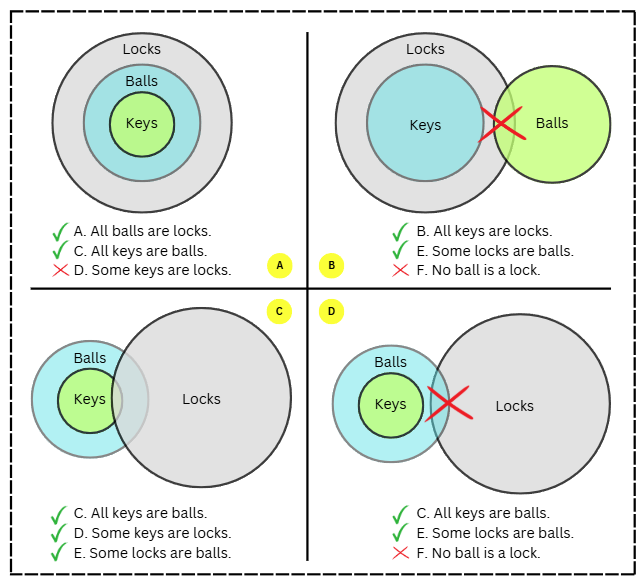
Each of these questions consists of six statements followed by options consisting of three statements put together in a specific order. Choose the option which indicates a valid argument containing logically related statements that is, where the third statement is a conclusion drawn from the preceding two statements.
A. All balls are locks.
B. All keys are locks.
C. All keys are balls.
D. Some keys are locks.
E. Some locks are balls.
F. No ball is a lock.
We can visualise the above as follows -
A. All synopses are poets.
B. Some synopses are mentors.
C. Some Xs are not mentors.
D. All Xs are poets.
E. All synopses are mentors.
F. All synopses are X.
Option A (ACB): Incorrect; "All synopses are poets" and "Some synopses are mentors" only proves some poets are mentors, but cannot confirm that "Some Xs are not mentors" without knowing the relationship between X and the other groups.
Option B (AEC): Incorrect; If all synopses are poets (A) and all synopses are mentors (E), it logically follows that some poets are mentors, but it provides no information to conclude that "Some Xs are not mentors" (C).
Option C (FEC): Incorrect; If all synopses are X (F) and all synopses are mentors (E), then some X must be mentors, which contradicts the conclusion that "Some Xs are not mentors" (C) in a standard logical flow.
Option D (DFA): Correct; If all Xs are poets (D) and all synopses are X (F), then by transitive property, it is logically certain that "All synopses are poets" (A).
Thus, the correct answer is Option D.
Study the following information to answer the questions that follow.
The premises of a bank are to be renovated. The renovation is in terms of flooring. Certain areas are to be floored either with marble or wood. All rooms/halls and pantry are rectangular. The area to be renovated comprisesa hall for customer transaction measuring 23 m by 29 m, branch manager's room measuring 13 m by 17 m, a pantry measuring 14 m by 13 m, a record keeping cum server room measuring 21 m by 13 m and locker area measuring 29 m by 21 m. The total area of the bank is 2000 sq m. The cost of wooden flooring is ₹170 per sq m and the cost of marble flooring is ₹190 per sq. m. The locker area, record keeping cum server room and pantry are to be floored with marble. The branch manager's room andthe hall for customer transaction are to be floored with wood. No other area is to be renovated in terms of flooring.
What is the respective ratio of the total cost of wooden flooring to the total cost of marble flooring?
Hall: 23x29=667sqm(Wood)
Business Manager Office: 13x17=221sqm(Wood)
Pantry: 14x13=182sqm(Marble)
Records: 21x13=273(Marble)
Locker Area: 29x21=609(Marble)
The total cost of Wood flooring will be (667+221)(170)=150960
The total cost of Marble flooring will be (182+273+609)=202160
This in its simplified form is 1887 : 2527
If the four walls and ceiling of the branch manager's room (the height of the room is 12 m) are to be painted at the cost of ₹ 190 per sq m, how much will be the total cost of renovation of the branch manager's room including the cost of flooring?
Branch Manager Office dimension is 13x17 is 221m
We have two walls at 13x12 and two walls at 17x12
Total square area of the four walls is 2(12(13+17))=720sqm
720x190=136800
Flooring is 13x17 which is 221 and the cost of wood is 170 per sqm, so the total cost is 37570
Hence, the overall cost will be, 174370
If the remaining area of the bank is to be carpeted at the rate of ₹ 110 per sq m, how much will be the increment in the total cost of renovation of bank premises?
Hall: 23x29=667sqm(Wood)
Business Manager Office: 13x17=221sqm(Wood)
Pantry: 14x13=182sqm(Marble)
Records: 21x13=273(Marble)
Locker Area: 29x21=609(Marble)
The total is 1952, total bank area is 2000. Remaning is 48.
The rate is 110 per sqm. Total increment in cost will be 48(110)=5280.
What is the percentage area of the bank that is not to be rengvated?
Hall: 23x29=667sqm(Wood)
Business Manager Office: 13x17=221sqm(Wood)
Pantry: 14x13=182sqm(Marble)
Records: 21x13=273(Marble)
Locker Area: 29x21=609(Marble)
The total is 1952 sqm, and the overall bank area is given to be 2000.
The remaining area is 48 sqm, and the percentage will be 48/2000=2.4%
What is the total cost of renovation of the hall for customer transaction and the locker area?
Cost of Hall for customer transactions and the locker area
Hall is 23x2,9 which is 66,7 and it is wood at 170 per sqm; this cost will be 113390
Locker Area 29x21, which is 609, and it is marble at 190 per sqm; this cost will be 115710
The total cost is 229100.
These questions are based on the following letters/number/symbol arrangement. Study it carefully to answer these questions.
A 8 B 6 # 7 H U % 3 $ F V R 2 I @ $$\uparrow$$ 4 1 W E 9 Ⓒ L 5
Which of the following is seventh to the right of fifteenth from the right end?
A 8 B 6 # 7 H U % 3 $ F V R 2 I @ ↑ 4 1 W E 9 Ⓒ L 5
Which of the following is seventh to the right of fifteenth from the right end?
1st term from right end = 5
2nd term from right end = L
..
..
..
15th term from right end = F
7th term to the right of F (15th term from right) = 4
If all the symbols are dropped from the above arrangement which of the following will be eighth from the left end?
A 8 B 6 # 7 H U % 3 $ F V R 2 I @ ↑ 4 1 W E 9 Ⓒ L 5
If all the symbols are dropped from the above arrangement which of the following will be eighth from the left end?
Let us drop all the symbols from above.
A 8 B 6 7 H U 3 F V R 2 I 4 1 W E 9 L 5
We need to find the eighth element from the left end.
1st term from left = A
2nd term from left = 8
..
..
8th term from left = 3
How many such symbols are there in the above arrangement, each of which is immediately followed by a consonant and also immediately preceded by a number?
A 8 B 6 # 7 H U % 3 $ F V R 2 I @ ↑ 4 1 W E 9 Ⓒ L 5
How many such symbols are there in the above arrangement, each of which is immediately followed by a consonant and also immediately preceded by a number?
Vowels = A, E, I, O and U
Consonants = Except Vowels
Let us analyse every symbol with the preceding and succeeding elements.
Our aim is to find the elements of the form : Number Symbol Consonant
6 # 7 = False ( No consonant after symbol)
U % 3 = False ( Vowel before symbol)
3 $ F = True (Number Symbol Consonant)
I @ ↑ = False (Vowel before symbol)
@ ↑ 4 = False (Symbol before symbol)
9 Ⓒ L = True (Number Symbol Consonant)
Hence, two symbols in the above arrangement which is immediately followed by a consonant and also immediately preceded by a number.
How many such numbers are there in the above arrangement each of which is immediately followed by a vowel but not immediately preceded by a number?
A 8 B 6 # 7 H U % 3 $ F V R 2 I @ ↑ 4 1 W E 9 Ⓒ L 5
How many such numbers are there in the above arrangement each of which is immediately followed by a vowel but not immediately preceded by a number?
Vowels = A, E, I, O and U
Consonants = Except Vowels
Let us analyse every symbol with the preceding and succeeding elements.
Our aim is to find the elements of the form : Not a Number, Symbol, Consonant
6 # 7 = False ( Number before symbol)
U % 3 = False ( number after symbol)
3 $ F = False (Number before symbol)
I @ ↑ = False (Symbol after symbol)
@ ↑ 4 = False (Number after symbol)
9 Ⓒ L = False (Number before symbol)
Hence,no symbols in the above arrangement which is immediately followed by a vowel but not immediately preceded by a number.
Three of the following four are alike in a certain way on the basis of their positions in the above arrangement and so form a group. Which is the one that does not belong to the group?
Let us check the pattern in each option.
A) B7#
In the given arrangement A 8 B 6 # 7 H U % 3 $ F V R 2 I @ ↑ 4 1 W E 9 Ⓒ L 5
We see that B = 3rd from left
7 = 6the from left
# = 5th from left
B6#7
So, B = 1st term, 7 = 4th term and # = 3rd term.
B) F2R
If, we look at the sequence FVR2
So, if F = 1st term, 2 = 4th term and R = 3rd term.
C) 95L
If we look at the sequence 9 Ⓒ L 5
So, if 9 = 1st term, 5 = 4th term and L = 3rd term
D) WⒸE
If we look at the sequence W E 9 Ⓒ
W = 1st term, Ⓒ = 4th term but E = 2nd term.
Therefore, Option D is the one that does not belong to the group.
Each of these questions has a statement followed by two conclusions I and II. Consider the statement and the following conclusions. Decide which of the conclusions follows from the statement. Mark answer as
Statement: Until our co oN chieves economic equality, political freedom and democracy would be meaningless.
Conclusions: I. Political freedom and democracy go hand in hand.
II. Economic equality leads to real political freedom and democracy.
Conclusion 1 talks about political freedom and democracy being intertwined, but the main statement implies that these two are merely aftereffects of economic equality. It is not clear that political freedom and democracy shall always go hand in hand. Hence, an invalid conclusion.
Conclusion 2 is actually a restatement, hence valid.
Statement: Good voice is a natural gift but one has to keep practising to improve and excel well in the field of music.
Conclusions: I. Natural gifts need nurturing and care.
II. Even though your voiceis not good, one can keep practising.
Conclusion 1 is a generic statement, and we cannot infer anything just from a statement about music.
Conclusion 2 is correct since the statement mentions that a good voice needs practice as well, which makes it clear that one can practice even without a good voice.
Statement: Domestic demand has been increasing faster than the production of indigenous crude oil.
Conclusions: I. Crude oil must be imported.
II. Domestic demand should be reduced.
Both conclusions are invalid as we can neither say for sure that importing crude oil is the only way out (and not increasing the production), nor we can say that the demand shall be reduced (or they are wrong).
In each of these questions, two statements I & II are given. These may have a cause and effect relationship or may have independent causes or be the effects of independent causes. Read the statements and mark answer as
Statement I: British surgeons have carried out what they claim is the world’s first lung transplant on a 20 year-old woman patient Becky Jones who was suffering from two fungal conditionsin the lungs.
Statement II: Lung transplant patients have never before beenable to have the transplant operation while suffering from aspergillus and multiple fungal balls. Jones is in perfect health and is able to breath freely again.
Both statements elaborate upon the rarity of this transplant but do not show any sign of being in a causal relationship. They probably are effects of a common cause (surgery or illness).
Statement I:. Because of very difficult questions in one of the sections, a sizeable number of students claimed to have failed to clear the cut off of Civil Services Prelim Exams.
Statement II: Government allowed all the stubfeto write the paper again.
S1 talks about a huge number of aspirants failing due to very difficult questions. Hence, the recourse has been given by the government in S2. S1 is the cause, and S2 is the effect.
Statement I: A chaotic situation has Seen created in Delhi Railway Station due to the excessive vehicles parked every where outside the station.
Statement II: Northern Railway has floated a tender to auction parking space in all Railway stations in Delhi and NCR.
Clearly, S1 talks about excessive congestion due to cars, the recourse of which has been given in S2 which is floating a tender.
Shiv visited Ramesh on vacation. In the morning, they both would go for yoga. In the evenings, they would play tennis. To have more fun, they indulge only in one activity per day,i.e., either they went for yoga or played tennis each day. There were days when they were lazy and stayed home all day long. There were 24 mornings when they did nothing, 14 evenings when they stayed at home, and a total of 22 days when they did yoga or played tennis. For how many days Shiv stayed with Ramesh?
Let the number of days they did yoga be x and the number of days they played tennis be y.
The number of days when they stayed home all day was z.
Given that 24 mornings, they did nothing.
In those days, they either played evening tennis or stayed home all day.Hence y+z=24 ---(1)
Fourteen evenings, they stayed at home. So they either did yoga in the morning or stayed home all day x+z=14.----(2)
Now, 22 days, they do yoga or play tennis.x+y=22 ---(3)
From (1), z=24−y
Substituting in (2) x+24−y=14
x−y=−10 ---(4)
(3)+(4) 2x=12 giving x=6y=22−x=16
and z=24−y=8
Hence, the total number of days = x+y+z=6+16+8=30
Number S is obtained by squaring the sum of digits of a two-digit number D. If difference between S and D is 27, then the two digit number D is ............
Let us solve this problem by using the options,
Option A: 24, sum is 6. The square of the sum of the digits is 36, the difference between S and D will be 12.
Option B: 54, the sum is 9. The square of the sum of the digits is 81, the difference between S and D will be 27.
Option C: 34, the sum is 7. The square of the sum of the digits is 49, the difference is between S, and D will be 15.
Option D: 45, sum is 9, Square of the sum of the digits is 81, difference between S and D will be 36.
Hence, Option B is the answer.
The owner of a local jewellery store hired 3 watchmen to guard his diamonds, but a thief still got in and stole some diamonds. On the wayout, the thief met each watchman, one at a time. To each he gave $$\frac{1}{2}$$ of the diamonds he had then, and 2 more besides. He escaped with one diamond. How manydid he steal originally?
We can solve this problem by backtracking.
The thief left with one diamond. So when he met the final guards, he must have given him two more than his half.
If he still had 1, adding 2 equals 3, which must be half of what he had.
When reaching the third guard, the thief had six diamonds; he gave half and then two more, giving five diamonds to the third watchmen.
We have to apply the same logic to the two earlier guards.
When he left the second watchman, he had six diamonds, meaning when approaching the second watchman, he must have had 2(6+2) = 16 diamonds.
When he left the first watchman, he had 16 diamonds, meaning when he approached the first watchman, he must have had 2(16+2) = 36 diamonds.
Therefore, Option B is the correct answer.
Mani, Mita, Lata and John bought a motorbike for $60.00. Mani paid one half of the sum of the amounts paidby the other boys: 'Mita paid onethird of the sum of the amounts paid by the other boys; and Lata paid onefourth of the sum of the amounts paid by the other boys. How much did John have to pay?
Let's take the amount paid by Mani, Mita, Lata and John to be a, b, c and d, respectively.
we know that a+b+c+d=60 ...(1)
We are given that a = (b+c+d)/2
Replacing this in (1) we get 3a=60, giving $$a$$ equals 20
b+c+d=40 ...(2)
Next, we are given that b = (a+c+d)/3
a+c+d = 3b
c+d = 3b-20
Substituting this in (2), we get:
4b-20=40
b=15
Giving c+d = 25 ....(3)
Finally we are given that c=(a+b+d)/4
20+15+d=4c
d=4c-35
Substituting this in (3), we get:
5c-35=25
5c=60
c=12
Giving d=13
Therefore, Option B is the correct answer.
Read the following Information to answer these questions.
Ankit is decorating his room and trying to arrange six paintings on the east and west walls in his room. The paintings are each multicolour representations of one of the letters of the alphabets E, H, M, O, R, T. Ankit does not want the three letters on each wall to make any common English word. Also, the colours of O and E do not look good next to each other, nor do T and O go well together.
If Ankit puts E, H and M on the east wall, which of the following must be true?
Given Ankit puts E, H and M on the east wall, so, R, O and T are on the west wall.
Given T and O go well together
So, O cannot be in the centre of the west wall.
Hence, the answer is Option B
If Ankit’s mother is coming to visit and he decides to celebrate the visit by having his paintings spell “MOTHER”, starting with the leftmost painting on the east wall and going around the room, which of the following will be false?
Spelling "MOTHER" starting with the leftmost painting on the east wall and going around the room, we get
M O T
| | |
R E H
So, M is opposite R
O is opposite E
and T is opposite H
Hence, Option D "T is opposite R" is false.
Which of the following is not possible ?
H, M and R cannot be on the same wall because the remaining paintings T, E and O cannot be placed together.
Hence, the answer is Option C, H, M and R to be on the same wall.
If Ankit trades his M painting for another O painting just like the one he has now, which of the following must be false?
We know that the colours of O and E do not look good next to each other.
Hence, if both O are opposite to each other in the middle, the E paining will have to come next to O paining, which is not possible.
Hence, the answer is Option A, O can be on opposite walls in the middle.
Read the following information to answer these questions.
(i) There is a group of seven persons A, B, C, D, E, F and G.
(ii) There are four males, three females, two married couples and three unmarried persons in the group.
(iii) The seven persons are seated in a row on the bench.
(iv) Their professions are engineer, teacher, doctor, psychologist, businessman, architect and student.
(v) B is not married and another person, the psychologist, is the most intelligent.
(vi) The engineer is married to the teacher, who is the least intelligent of the group.
(vii) D is an architect. He is sitting on the leftmost corner.
(viii) The student is sitting on the rightmost corner of the bench.
(ix) The doctor is married to C. C is the second most intelligent of the group followed by her husband.
(x) The least intelligent of the group is Sitting on the immediate right of D, followed by the most intelligent.
(xi) There are as many more intelligent persons than the engineer as there are less intelligent.
(xii) On the bench followed by D, there are three females sitting in succession.
(xiii) The psychologistis a female.
(xiv) The student is more intelligent than the architect, who is more intelligent than only one person, F.
(xv) Neither A nor G is a female.
Who is sitting on the immediate right of D?
Most Intelligent - 1, Least Intelligent - 7
Given D is an Architect, B is not married, and another person, a Psychologist, is the most intelligent in the group.
Psychologist - 1
The doctor is married to C. C is the second most intelligent of the group followed by her husband.
C - 2
Doctor - 3
Also given the engineer is married to the teacher, who is the least intelligent of the group.
Teacher - 7
There are as many more intelligent persons than the engineer as there are less intelligent.
Engineer - 4
The student is more intelligent than the architect, who is more intelligent than only one person, F.
Student - 5
Architect - 6
So, F is a teacher with the least intelligence.
Hence, C has to be the remaining one i.e. businessman
Neither A nor G is a female.
The psychologist is a female.
Till now we have
We know the married couples are Businessman - Doctor and Engineer - Teacher,
So, D, who is an architect has to be unmarried.
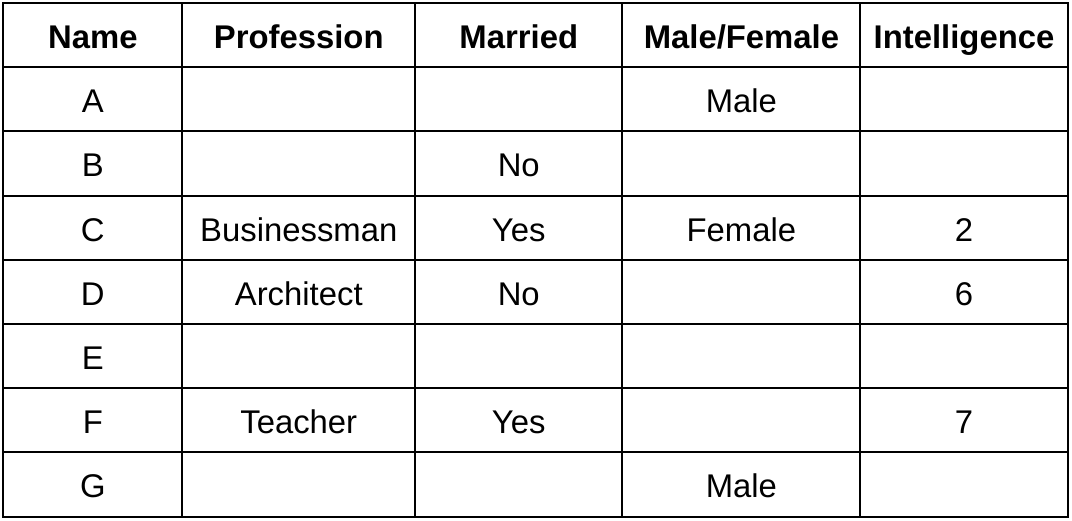
Now as B is not the Psychologist, and Psychologist is a Female, so the only person who can be the Psychologist is E.
We know she is not married.
Hence, the remaining A and G have to be married.
As both are males, F the teacher has to be female.
So, the only unmarried profession remaining is Student, which has to be B,
Also, the student has an intelligence of 5 and will be a male as all females are already counted for.
The final table we have is
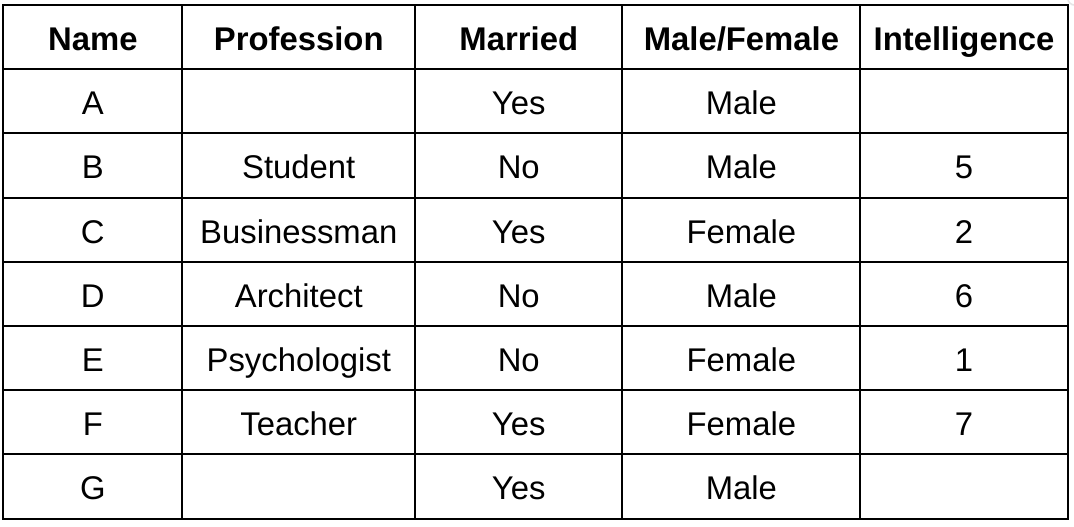
Now given that the Architect i.e. D is in the leftmost corner, followed by the least intelligent i.e. F followed by the most intelligent i.e. E, the Psychologist.
We're also told that on the bench followed by D, there are three females sitting in succession, so the only remaining female i.e. C should be sitting next to E.
Also, The student i.e. B is in the right most corner

A can be Engineer or Doctor and vice versa for G.
They both will sit together in some way.
We can see from the final formation that F is sitting to the immediate right of D.
Which two are sitting together?
Most Intelligent - 1, Least Intelligent - 7
Given D is an Architect, B is not married, and another person, a Psychologist, is the most intelligent in the group.
Psychologist - 1
The doctor is married to C. C is the second most intelligent of the group followed by her husband.
C - 2
Doctor - 3
Also given the engineer is married to the teacher, who is the least intelligent of the group.
Teacher - 7
There are as many more intelligent persons than the engineer as there are less intelligent.
Engineer - 4
The student is more intelligent than the architect, who is more intelligent than only one person, F.
Student - 5
Architect - 6
So, F is a teacher with the least intelligence.
Hence, C has to be the remaining one i.e. businessman
Neither A nor G is a female.
The psychologist is a female.
Till now we have
We know the married couples are Businessman - Doctor and Engineer - Teacher,
So, D, who is an architect has to be unmarried.
Now as B is not the Psychologist, and Psychologist is a Female, so the only person who can be the Psychologist is E.
We know she is not married.
Hence, the remaining A and G have to be married.
As both are males, F the teacher has to be female.
So, the only unmarried profession remaining is Student, which has to be B,
Also, the student has an intelligence of 5 and will be a male as all females are already counted for.
The final table we have is
Now given that the Architect i.e. D is in the leftmost corner, followed by the least intelligent i.e. F followed by the most intelligent i.e. E, the Psychologist.
We're also told that on the bench followed by D, there are three females sitting in succession, so the only remaining female i.e. C should be sitting next to E.
Also, The student i.e. B is in the right most corner
A can be Engineer or Doctor and vice versa for G.
They both will sit together in some way.
Hence, Engineer and Doctor are sitting together
The engineer is not more intelligent than
Most Intelligent - 1, Least Intelligent - 7
Given D is an Architect, B is not married, and another person, a Psychologist, is the most intelligent in the group.
Psychologist - 1
The doctor is married to C. C is the second most intelligent of the group followed by her husband.
C - 2
Doctor - 3
Also given the engineer is married to the teacher, who is the least intelligent of the group.
Teacher - 7
There are as many more intelligent persons than the engineer as there are less intelligent.
Engineer - 4
The student is more intelligent than the architect, who is more intelligent than only one person, F.
Student - 5
Architect - 6
So, F is a teacher with the least intelligence.
Hence, C has to be the remaining one i.e. businessman
Neither A nor G is a female.
The psychologist is a female.
Till now we have
We know the married couples are Businessman - Doctor and Engineer - Teacher,
So, D, who is an architect has to be unmarried.
Now as B is not the Psychologist, and Psychologist is a Female, so the only person who can be the Psychologist is E.
We know she is not married.
Hence, the remaining A and G have to be married.
As both are males, F the teacher has to be female.
So, the only unmarried profession remaining is Student, which has to be B,
Also, the student has an intelligence of 5 and will be a male as all females are already counted for.
The final table we have is
Now given that the Architect i.e. D is in the leftmost corner, followed by the least intelligent i.e. F followed by the most intelligent i.e. E, the Psychologist.
We're also told that on the bench followed by D, there are three females sitting in succession, so the only remaining female i.e. C should be sitting next to E.
Also, The student i.e. B is in the right most corner
A can be Engineer or Doctor and vice versa for G.
They both will sit together in some way.
The engineer is not more intelligent than the businessman.
Which of these cannot be a married couple?
Most Intelligent - 1, Least Intelligent - 7
Given D is an Architect, B is not married, and another person, a Psychologist, is the most intelligent in the group.
Psychologist - 1
The doctor is married to C. C is the second most intelligent of the group followed by her husband.
C - 2
Doctor - 3
Also given the engineer is married to the teacher, who is the least intelligent of the group.
Teacher - 7
There are as many more intelligent persons than the engineer as there are less intelligent.
Engineer - 4
The student is more intelligent than the architect, who is more intelligent than only one person, F.
Student - 5
Architect - 6
So, F is a teacher with the least intelligence.
Hence, C has to be the remaining one i.e. businessman
Neither A nor G is a female.
The psychologist is a female.
Till now we have
We know the married couples are Businessman - Doctor and Engineer - Teacher,
So, D, who is an architect has to be unmarried.
Now as B is not the Psychologist, and Psychologist is a Female, so the only person who can be the Psychologist is E.
We know she is not married.
Hence, the remaining A and G have to be married.
As both are males, F the teacher has to be female.
So, the only unmarried profession remaining is Student, which has to be B,
Also, the student has an intelligence of 5 and will be a male as all females are already counted for.
The final table we have is
Now given that the Architect i.e. D is in the leftmost corner, followed by the least intelligent i.e. F followed by the most intelligent i.e. E, the Psychologist.
We're also told that on the bench followed by D, there are three females sitting in succession, so the only remaining female i.e. C should be sitting next to E.
Also, The student i.e. B is in the right most corner
A can be Engineer or Doctor and vice versa for G.
They both will sit together in some way.
All the three mentioned couples are possible.
Which of these represents the correct order of intelligence(in the decreasing sequence)?
Most Intelligent - 1, Least Intelligent - 7
Given D is an Architect, B is not married, and another person, a Psychologist, is the most intelligent in the group.
Psychologist - 1
The doctor is married to C. C is the second most intelligent of the group followed by her husband.
C - 2
Doctor - 3
Also given the engineer is married to the teacher, who is the least intelligent of the group.
Teacher - 7
There are as many more intelligent persons than the engineer as there are less intelligent.
Engineer - 4
The student is more intelligent than the architect, who is more intelligent than only one person, F.
Student - 5
Architect - 6
So, F is a teacher with the least intelligence.
Hence, C has to be the remaining one i.e. businessman
Neither A nor G is a female.
The psychologist is a female.
Till now we have
We know the married couples are Businessman - Doctor and Engineer - Teacher,
So, D, who is an architect has to be unmarried.
Now as B is not the Psychologist, and Psychologist is a Female, so the only person who can be the Psychologist is E.
We know she is not married.
Hence, the remaining A and G have to be married.
As both are males, F the teacher has to be female.
So, the only unmarried profession remaining is Student, which has to be B,
Also, the student has an intelligence of 5 and will be a male as all females are already counted for.
The final table we have is
Now given that the Architect i.e. D is in the leftmost corner, followed by the least intelligent i.e. F followed by the most intelligent i.e. E, the Psychologist.
We're also told that on the bench followed by D, there are three females sitting in succession, so the only remaining female i.e. C should be sitting next to E.
Also, The student i.e. B is in the right most corner
A can be Engineer or Doctor and vice versa for G.
They both will sit together in some way.
All three are correct sequence of decreasing intelligence.
Each of these questions has an assertion (A) and a reason (R). Mark answer as
Assertion (A): There was no country known as ‘Bangladesh’ when India was partitioned in 1947.
Reason (R): ‘Bangladesh’ was a part of Pakistan at the time of partition of India in 1947.
A is true since Bangladesh was made a country in 1971. Before that, it was known as East Pakistan. Hence, Both A and R are true, and R is the correct explanation of A.
Assertion (A) : India should adopt presidential type of government.
Reason (R) : Yes, it will bring political order in the country.
A presidential form of government can indeed bring political stability in certain situations. Hence, both A and R are true, while R being a correct explanation of A.
Assertion (A): States of India should be given autonomy/freedom.
Reason (R): No, because it will encourage separatist tendencies.
It is not clear as to how giving the states more autonomy will increase separatist tendencies. Hence, A is true but R is false.
Assertion (A): Indian National Flag is known as tricolor.
Reason (R): Indian National Flag has three colours.
Tricolor refers to something which has three colors. Hence, both A and R are true, while R is the correct explanation of A.
Each of the following questions is based on a set of propositions I-IV. Select the best answer to each question.
I. All Ps are Q.
II. Some Ps are not Q.
III. Some, but not all, Ps are Q.
IV. No Ps are Q.
Considered only by themselves, which of the following pairs of statements might either both be true or both be false ?
Looking at each statement individually:
Option A: I and II cannot be both true, and hence option A can be eliminated as an option.
Option B: These two statements can be both true and both false.
Option C: These two directly contradict each other and hence can not be both true.
Option D: These are polar opposite statements and can not be both true.
Considered only by themselves, all of the followind pairs of statements might both be false but could not both be true except
We can check preliminarily for the ability of both statements to be true.
Option A: Both of these statements can not be true. If all Ps are Q, then some Ps can not be Q. Hence, this is not our answer.
Option B: This too can not be true; III can not be true if I is true.
Option C: Both of these can again not be true. If I is true, IV cannot be true.
Option D: This is possible; if no Ps are Q (IV), then some Ps are not Q(II).
Therefore, Option D is the correct answer.
Study the following graphs to answer these questions.
Pie-charts below show the percentage of different types of vehicles A, B, C, D, E and F in state in two consecutive years (2015 and 2016).


In the year 2015, the number of vehicles of type A and D together is what per cent of the number of vehicles type F and A together in 2016?
In the year 2015, there were a total of 142,980 vehicles, the number of vehicles of type A and D is 20% and 15% of the total.
Together, it will be 15+20 = 35% of 142,980 = $$\ \frac{\ 35}{100}\times\ 142,980\ =50,043$$
In 2016, F & A together will be 39% of the total ( 18% and 21%)
This will be = $$\ \frac{\ 39}{100}\times\ 186,400\ =72,696$$
Now, the number of vehicles of type A and D together as a percentage of the number of vehicles type F and A together in 2016 will be:
$$\ \frac{\ 50,043}{72,696}\times\ 100\ =68.83\%$$
From 2015 to 2016, in the case of whigh of the following types of vehicles, the change was maximum?
For A:
In 2015, 20% of 142,980 = 28,596
In 2016, 21% of 186,400 = 39,144
Difference = 10,548
For B:
In 2015, 5% of 142,980 = 7149
In 2016, 10% of 186,400 = 18,640
Difference = 11,491
For C:
In 2015, 10% of 142,980 = 14,298
In 2016, 15% of 186,400 = 27,960
Difference = 13,662
For E:
In 2015, 30% of 142,980 = 42,896
In 2016, 26% of 186,400 = 48,464
Difference = 5,568
From this, we can see that C had the maximum difference of 13,662 from 2015 to 2016
What was the difference in the number of B type of vehicles during 2015 and 2016?
Option B is the correct answer,
The number of B type of vehicles in 2015 and 2016 are:
In 2015, 5% of 142,980 = 7,149
In 2016, 10% of 186,400 = 18,640
The difference is 18,640- 7,149 = 11,491
If the number of D type of vehicles in 2015 was 5000, what would have been its approximate percentage in the state?
Option A is the correct answer.
If the number of D-type vehicles in 2015 was 5000, the percentage of them in the state would be:
$$\ \frac{\ 5000}{142980}\times\ 100\ =3.49\%$$
The number of A type of vehicle in 2016 was approximately what per cent of the number of A type of vehicles in 2015?
The number of A type of vehicles in 2015 and 2016 are:
In 2015, 20% of 142,980 = 28,596
In 2016, 21% of 186,400 = 39,144
The number of A type of vehicle in 2016 as a percentage of the number of A type of vehicles in 2015 =
$$\ \ \frac{\ 39144}{28596}\times\ 100\ =136.88\%\ \sim137\%$$
Study the following graphs to answer these questions.
The bar graph below shows the revenue generated by six banks during 2016. The pie chart shows the percentage distribution of revenue earned through different modes.
Interest earned through - Business Loans (P), Home Loans (Q), Personal Loans (R), Auto Loans (S), deposits in other financial institute (T), Changes for providing services (U) and Others (V).


The bank that earned ₹78 crore as interest from home loans in 2016 is ..............
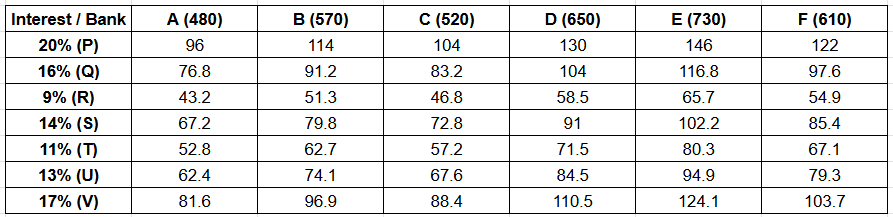
Since we know the revenue for each bank and the split for each, we can make the following table.
78 crores from Q (Home Loans)
We see that A has the closest value at 76.8 crores. Hence, the answer is Bank A.
Out of the total interest earned through business loans, bank A and C earn 45%from small scale industries (SSI) and the rest through cottage industries (CI) whereas B and D earn 55% from SSI and the rest through CI. Which bank earns the least through any of these industries?
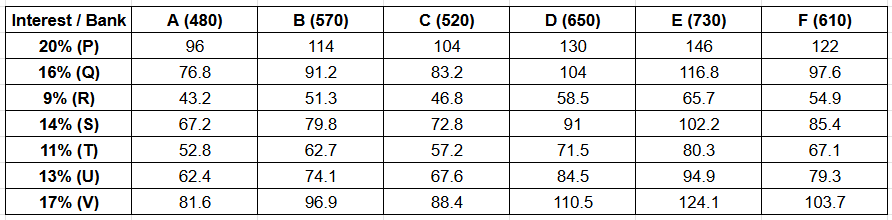
Since we know the revenue of each Bank and the split of the revenue, we can come up with the following table.
Business Loans is P.
A and C are given to have a split of 45% and 55% for SSI and CI
B and D are given to have a split of 55% and 45% for SSI and CI
We want to find the least value for a bank for either of these industries.
The smallest value and the smallest percentage, both are with Bank A
Hence, the answer is Bank A through SSI
The Interests earned through car ( a subset of Auto loan) loan by B, D, E and F are in the ratio 2 : 3 : 3 : 4 and the total interest earned by these four banks for car loan is ₹36 crore. The bank that earned interest which is 8.8% of the interest earned by it through Auto loans is ..............
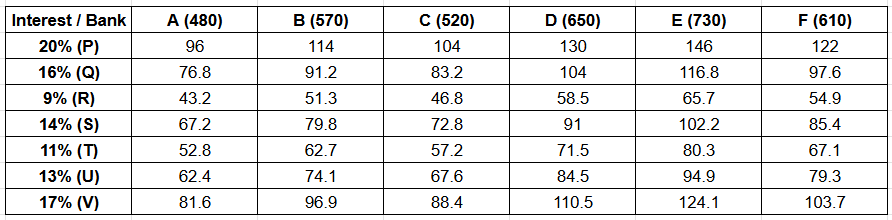
We can draw the following table since we know each bank's revenue and its split.
We are told that 36 crore is the total revenue from the three banks for car loans, and they are in the ratio 2:3:3:4.
B: 6 crores out of 79.8; this is around 7.5%
D: 9 crores out of 91; this is nearly 10%
E: 9 crores out of 102.2; this is 8.8 %
F: 12 crores out of 85.4; this is 14%
Hence, the answer is Bank E.
Bank B and F earn interest by depositing their amounts in the financial institutes X, Y and Z. B earns interest from them in the ratio 2 : 3 : 1 and F in the ratio 4 : 3 : 3. By what percent F's earning from X is more/less than B's earning from X?
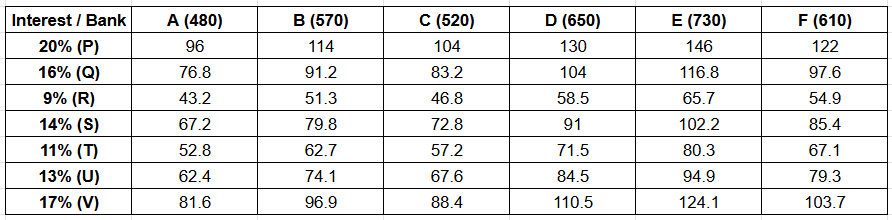
We know the revenue and the split of revenue, we get the following table.
Deposits in Other financial institutions is T. We see that T for B is 62.7 and T for F is 67.1
F is in the ratio 4:3:3 for the three financial institutions
B is in the ratio 2:3:1 for the three financial institutions.
We can say that the interest ratio for each of the three institutions is the same for both banks B and F.
So, we need to find the percentage difference in the principal amount that Is invested.
F it is 4/10 of the 67.1; this equals 26.84
B it is 1/3 of the 62.7; this equals 20.9
F's earnings will be more than B's by, $$\frac{26.81-20.9}{20.9}\times\ 100=28.42\%$$
By what percent is the largest amount eamed by a bank through U and V together more than the least amount through U & V together by any of these banks?
We know the amount of money each bank made and the division of that revenue, we can draw up the following table.
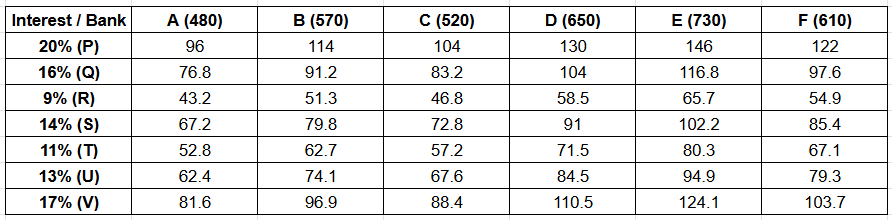
We are asked to find by what percentage the largest amount of money made by a bank through U and V together is greater than the least amount of money made through U and V.
We see that U and V together account for 30% of the total revenue, the largest amount of money made by is E, and least is A
U and V by A is 144
U and V by E is 219
$$\frac{219}{144}=1.52083$$
Hence, the answer is 52.08%
Study the following graph to answer these questions.
The following bar graph shows the revenue generated by three realty firms A, B and C during 2012 to 2016. Each of these firms builds Low Income Group (LIG) apartments, Middle Income Group (MIG) apartments and High Income Group (HIG) apartments.

The firms A, B and C saw rise of 15%, 6% and 9% respectively in 2012 from 2011. Whose revenue was least in 2011?
Firm A, B and C have a revenue of 2350, 4760 and 3870 crores, respectively in 2012.
So, calculating their revenues in 2011
Firm A - Saw a 15% rise
So, Firm A's 2011 revenue is $$\dfrac{2350}{\left(1+\dfrac{15}{100}\right)}=\dfrac{2350}{1.15}=2043.5$$ crores
Firm B - Saw a 6% rise
So, Firm B's 2011 revenue is $$\dfrac{4760}{\left(1+\dfrac{6}{100}\right)}=\dfrac{4760}{1.06}=4490.5$$ crores
Firm C - Saw a 9% rise
So, Firm C's 2011 revenue is $$\dfrac{3870}{\left(1+\dfrac{9}{100}\right)}=\dfrac{3870}{1.09}=3550.5$$ crores
Hence, the least revenue is of Firm A at 2043.5 crores.
In the year 2014 the firms B, A and C invested ₹2011 crore, ₹1600 crore and ₹2300 crore respectively. The difference between maximum and minimum profit per cent in 2014 is ...........
The revenues of Firms A, B and C in 2014 is 3470, 3587 and 3765 crores respectively.
Given Firms A, B and C invested 1600, 2011 and 2300 crores respectively.
So, the profit percentages of the firms are
Firm A - $$\dfrac{3470-1600}{3470}\times100=\dfrac{1870}{3470}=53.9\%$$
Firm B - $$\dfrac{3587-2011}{3587}\times100=\dfrac{1576}{3587}=43.9\%$$
Firm C - $$\dfrac{3765-2300}{3765}\times100=\dfrac{1465}{3765}=38.9\%$$
Hence, the difference between maximum and minimum profit per cent in 2014 is 53.9-38.9 = 15.0%
Hence, the answer is Option C.
By what per cent should C increase its revenue in 2017 to make it 10% more than the average revenue of all the firms in 2016?
The average revenue of all three firms in 2016 is $$\dfrac{4230+4075+3965}{3}=4090$$
Firm C's revenue in 2016 is 3965 cr
As the firm has to make 10% more than the average of 2016, the revenue will be
$$4090\times\left(1+\dfrac{10}{100}\right)=4499$$ crores
Assuming the percentage increase in C's revenue is $$x$$
So, $$3965\times\left(1+\dfrac{x}{100}\right)=4499$$
or, $$\left(1+\dfrac{x}{100}\right)=1.1347$$
$$x=13.47\%$$
Hence, the answer is 13.47%
If the profit earned by A in 2015 is $$\dfrac{1}{6}th$$ of the average of the revenues of A in 2015, B in 2013 and C in 2012, the investment of A in 2015 is ..........
The revenue of A in 2015, B in 2013 and C in 2012 is 3678, 5070, 3870 crores, respectively.
So, the average is $$\dfrac{3678+5070+3870}{3}=4206$$
Given that the profit earned by A in 2015 is $$\dfrac{1}{6}th$$ of this average i.e.
$$\dfrac{4206}{6}=701$$ crores
So, the Investment = Revenue - Profit
or, Investment = 3678 - 701 = 2977 crores.
In 2013, A got 27% of its revenue through LIG housing whereas in the same year B earned 42% of its revenue through MIG housing. Both the companies spent ₹350 crore less than these revenues obtained. The difference in percentage profits thus earned by A and B is .........
Firm A's revenue in 2013 is 3150 crores.
Given 27% of these came from LIG i.e. $$3150\times\dfrac{27}{100}=850.5$$
It spent 350 crores less than this
So, the profit percentage is $$\dfrac{350}{850.5}\times100=41.15\%$$
Similarly,
Firm B's revenue in 2013 is 5070 crores.
Given 42% of these came from MIG i.e. $$5070\times\dfrac{42}{100}=2129.4$$
It spent 350 crores less than this
So, the profit percentage is $$\dfrac{350}{5070}\times100=6.9\%$$
Hence, the difference in profit percentage is 41.15 - 6.9 = 34.24%
So, the answer is Option B.
Study the following graph to answer these questions:
The percentage profits of four leading airliners A, B, C and D for six years 18 shown in the line graph below.

In 2011, company A invested ₹830 crore. Whereas C invested an amount which bears a ratio of 3 : 2 with that of A. The revenue generated by C in 2011 is ...........
In 2011, Company A invested ₹830 crore.
Whereas C invested an amount that bears a ratio of 3 2 with that of A.
Investment done by C = 830*3/2 = 830*1.5 = ₹1245 crore.
The revenue generated by C in 2011 is ...........?
We know Revenue = Investment + Profit
Profit made by C in 2011 = 32% of Revenue
Hence, Profit made by C in 2011 = 1245*0.32 = ₹398.4 crore.
Therefore, the revenue generated by C in 2011 = 1245+398.4 = ₹1643.4 crore
The total revenue generated by all the companies in-2014 is ₹3600 crore. The revenue of C is 30% of the total revenue. The revenue generated by A, B and D in the same year is $$\frac{7}{25}, \frac{2}{5}$$ and $$\frac{8}{25}$$ respectively of the remaining revenue. The maximum investment in that year is made by ...........
The total revenue generated by all the companies in-2014 is ₹3600 crore.
The revenue of C is 30% of the total revenue = 30% of 3600 crore = 1080 crore.
The revenue generated by A, B and D in the same year is $$\frac{7}{25}, \frac{2}{5}$$ and $$\frac{8}{25}$$ respectively of the remaining revenue
Or the ratio is 7:10:8 of the remaining amount of 2520 crore.
Revenue = Investment (100+profit%)
Revenue of A = (7/25)*2520 = 700 crore approx
Revenue of B = (10/25)*2520 = 1000 crore approx
Revenue of D = (8/25)*2520 = 800 crore approx
Percentage profits of A, B, C and D are 32%,30%,33% and 38%.
Investment of A = 700/1.32 = 530.30 crore
Investment of B = 1000/1.3 = 769.32 crore
Investment of C = 1080/1.33 = 812.03 crore
Investment of D = 800/1.38 = 579.79 crore
C makes the maximum investment in that year.
In 2015, companies B and D invested a total amount of ₹946 crore. They earned theif revenues by carrying passengers and goods. The profit earned by B through passenger traffic is 43% of the total profit earned by B and the remaining part through goods traffic. The profit earned by D through goods traffic iis 38% of the total profit earned by it and the remaining part of the profit is through passenger traffic. If the investments made by them are in the ratio 5 : 6, the actual profit of B through goods traffic is ...... than the passenger traffic of D.
In 2015 Airliner C invested: an amount of ₹630 crore, $$\frac{2}{3}$$ of this amount was invested by B. A invested $$\frac{3}{4}$$ of the amount invested by B and D invested $$1\frac{3}{5}$$ of A in the same year. The revenue generated by A and D is .......... than that by B and C.
C invested = ₹630 crore.
B Invested $$\frac{2}{3}$$ of C = 2/3*630 = ₹420 crore.
A invested $$\frac{3}{4}$$ of the amount invested by B = 3/4*420 = ₹315 crore.
D invested $$1\frac{3}{5}$$ of A = 8/5*315 = ₹504 crore.
Revenue = Investment + Profit
Investment of A = 315 crore, Investment of D = 504 crore
Profit of both A and D = 29% of Investment.
Hence, the total revenue of A and D = (315+504)*1.29 = ₹1056.51 crore
Similarly, Revenue of B and C = Investment of B and C + Profit of B and C.
Revenue of B = 420*(1.24) = ₹ 520.8 crore
Revenue of C = 630*(1.29) = ₹ 812.7 crore
Total revenue of B and C = 520.8+812.7 = ₹1333.5 Crore
Difference of Revenue of B and C with A and D = 1333.5-1056.51 = ₹276.99 crore
The revenue generated by A and D is less by ₹276.99 crore than that by B and C.
In 2016, investment made by A is ₹437 crore. B invests 20% more than A, C invests 20% less than B and D invests 20% more than C. If the profit earned by each is the average profit per cent in 2016, who earns least revenue?
Investment made by A = ₹437 crore
B invests 20% more than A = 1.2*437 crore
C invests 205 less than B = 1.2*0.8*437 = 0.96*473 crore
D invests 20% more than C = 1.2*0.96*473 = 1.152*473 crore
If the profit earned by each is the average profit per cent in 2016.If the profit earned by each is the average profit per cent in 2016
That means A, B, C and D earn equal profit percentages.
Revenue = Investment + Profit
Since the profit percentage is same.
The company which invest less will earn less revenue.
Therefore, the least revenue will be of company C.
Study the following graph to answer these questions.
The following table shows the subscriber base of six Direct to Home (DTH)TV service companies with respect to some popular channels aired by them.

Which of the companies shows the maximum percentage difference in the viewership of its channels I and III with respect to channel I?
We need to find the company which has the maximum percentage difference in the viewership of its channels I and III with respect to channel I.
Let us check each and every option individually.
Option A) Company- E
Viewership of Channel I = 57 lakhs
Viewership of Channel III = 1.49 Crore
Difference = 1.49 crore - 57 lakh = 92 lakhs
Difference of I and III with respect to I = 92/57 = 1.61 = 161%
Option B) Company- B
Viewership of Channel I = 1.25 Crore
Viewership of Channel III = 93 lakhs
Difference = 1.25 crore - 93 lakh = 32 lakhs
Difference of I and III with respect to I = 32/125 = 0.256 = 25.6%
Option C) Company- A
Viewership of Channel I = 70 lakh
Viewership of Channel III = 1.2 Crore
Difference = 1.2 crore - 70 lakh = 50 lakhs
Difference of I and III with respect to I = 50/120 = 0.4166 = 41.66%
Option D) Company- F
Viewership of Channel I = 1.86 Crore
Viewership of Channel III = 84 lakhs
Difference = 1.86 crore - 84 lakh = 102 lakhs
Difference of I and III with respect to I = 102/186 = 0.5483 = 54.83%
Hence, it is maximum for the Company E.
Two-fifth of the viewers of channel V of A shifted to channel V of B and E; $$\frac{2}{3}$$ of these to B and the remaining to E. One-fourth of viewer of channel V of C have now started watching channel V of D and F; $$\frac{3}{7}$$ of it D and the rest F. In the new distribution, which of the companies has maximum viewers for channel V?

It is given that Two-fifth of the viewers of channel V of A shifted to channel V of B and E.
Two-fifth of the viewers of channel V of A = 0.4*2.13 = 0.852 crore
$$\frac{2}{3}$$ of these to B and the remaining to E
B = 0.852*2/3 = 0.568 crore
E = 0.284 crore
Remaining viewers of channel V of A = 2.13-0.852 = 1.278 crore
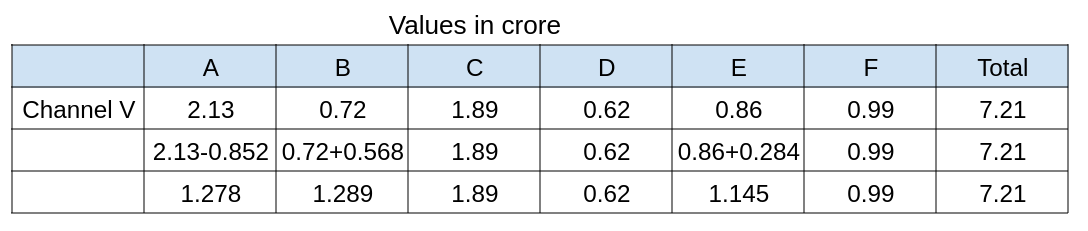
One-fourth of viewer of channel V of C have now started watching channel V of D and F.
One-fourth of viewer of channel V of C = 0.25*1.89 = 0.4725 crore
$$\frac{3}{7}$$ of it D and the rest F
D = 0.4725*3/7 = 0.2025 crore
F = 0.4725*4/7 = 0.27 crore
Remaining viewers of channel V of C = 1.89-0.4725 = 1.4175 crore
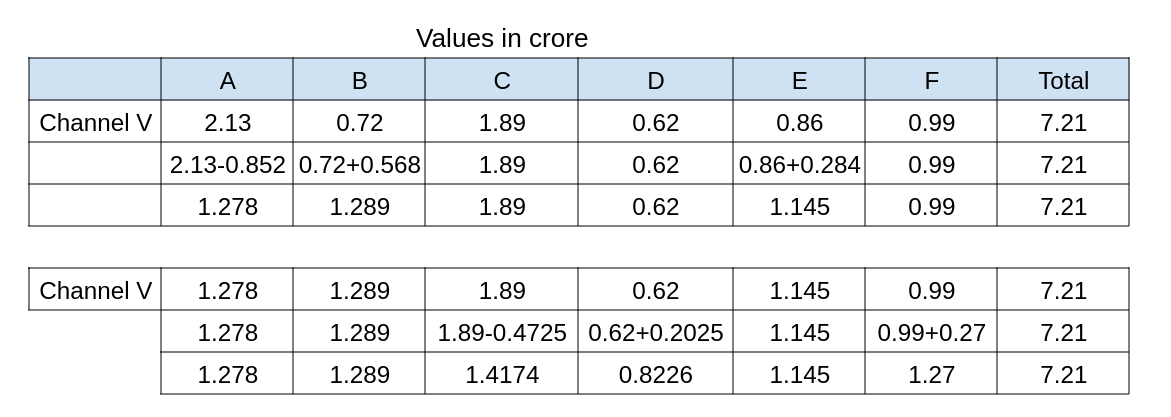
In the new distribution, the company that has the maximum number of viewers for channel V is company C.
The daily revenue generated through advertisment by channel III of companies A, C and F is in the same proportion as the ratio of their viewership. The total amount collected in a day by them is ₹340 crore. The revenue generated by channel II of D which is 8% more than that of channel III of C is .........
The daily revenue generated through advertisment by channel III of companies A, C and F is in the same proportion as the ratio of their viewership.
The ratio of viewership by Channel III of companies A, C and F are = 1.2 crore: 1.36 crore: 0.86 crore
120:136:86 or 30:34:21
The total amount collected in a day by them is ₹340 crore.
The amount collected by channel III of company C will be = $$\dfrac{34}{85}\times340$$ = ₹136 crore.
The revenue generated by channel II of D which is 8% more than that of channel III of C is = 136*0.08 = ₹10.88 crore
Informative programme of channel II of B is watched by 27% of viewers of this channel, rest watch entertainment programmes. If the viewers of informative programmes of channel III of C is less by 35% of viewers of entertainment programmes of channel II of B, then the number of viewers of entertainment programmes of channel III of C is ........... than that of channel II of B.
The informative programme on channel II of B is watched by 27% of viewers of this channel.
The viewers on channel II of B = 1.38 crore
The informative programme on channel II of B is watched by 27% of viewers of this channel= 1.38*0.27 = 0.3726 crore
Rest watch entertainment programmes.
So, entertainment programmes is watched by 1.38*0.73 = 1.0074 crore.
If the viewers of informative programmes of channel III of C is less by 35% of viewers of entertainment programmes of channel II of B.
= 65% of viewers of entertainment programmes of channel II of B
=> 65% of 1.0074 = 0.65481 crore
Then the number of viewers of entertainment programmes of channel III of C is ........... than that of channel II of B.
The number of viewers of entertainment programmes of channel III of C = 0.65481 crore
The number of viewers of entertainment programmes of channel II of B = 1.0074 crore
Difference = 0.65481-1.0074 = 0.35259 crore
Less by 3525900
For paying the fees of the staff and other expenees in a day, channel IV of company A has to pay 14% of its revenue collected of that day. This amount is ₹2500000 more than for channel V of C. The revenve generated per day by channel I of F is twice its viewership figure and is less by 10% than channel IV of A. The amount spent by channel V of C in a day is .........
Study the following graph for answer these questions.
The bar graph shows the performance of 3 political parties A, B and C in terms of votes acquired in the elections in a constituency during 2012- 2016

By what percent is the average number of votes acquired by B more/less than that of A during 2012-2016?
In calculating the average number of votes by the same number (5), we can solve the question using the raw value of total votes as well.
We need to add up the total number of votes of A and B for years 2012-2016.

Party B acquired 2.4 (lakh) votes more than party A.
This, as a percentage, would be $$\frac{2.4}{15.9}\times\ 100\approx\ 15\%$$
Therefore, Option D is the correct answer.
How many more votes are requiredby C in 2017 than in 2016 to make the ratio of votes with A, 3:2, keeping the votes of A same as in 2016 ?
Votes for party A in 2017 are to be taken the same as in 2016, which is 4.15
We want the ratio of C:A to be 3:2, for this, C would require:
$$\frac{C}{4.15}=\frac{3}{2}$$
$$C=6.225$$
C would require 6.225 lakh votes in 2017
In 2016, C got 1.5 lakh votes. Hence, C would need 6.225-1.5 = 4.725 lakh votes.
Therefore, Option B is the correct answer.
By what per cent should votes of B increase/decrease in 2016 to equal its average during the previous 4 years ?

B's total in the first four years would be 3.5+3.1+4+3.9 = 15.5
Giving B's average in the first four years to be $$\frac{14.5}{4}=3.875$$
B's votes in 2016 were 3.8,so B would have needed 0.175 lakh less votes
Which would be $$\frac{0.175}{3.8}\times\ 100\ =\ 4.6\%$$ less than what B got
Therefore, Option D is the correct answer.
In 2015, by what percent should the votes of C increase to exceed the votes of B in the same year by 12% ?
B's votes in 2015 were 3.9
We want C's votes to be 12% more, which would be (1.12)(3.0 = 4.368 lakh votes.
C originally got 2.3 lakh votes in 2015
C would require 4.368-2.3 = 2.068 lakh votes
This is close to the real value itself, so we can guess that the answer would be close to 100 percent.
Upon calculation, we would get: $$\frac{2.068}{2.3}\times\ 100=89.91\%$$
Therefore, Option C is the correct answer.
What per cent votes were acquired by C with respect to the total votes acquired by all the three parties in 2013?

In 2013, all three parties acquired: 2.5+3.1+1.9 = 7.5 lakh votes
Of which $$\frac{1.9}{7.5}\times\ 100=25.33\%$$ of the votes were for C.
Therefore, Option A is the correct answer.
Each of these questions consists of a problem followed by two statements numbered as I and II. Decide whether the data in the statements are sufficient to answer the question. Mark answer as
A citrus fruit grower receives ₹980 for each crate of lemon shipped and ₹1500 for each crate of oranges shipped. How many crates of oranges did the grower ship last week?
I. Last week the numberof crates of lemon that the grower shipped was 20 more than twice the number of crates of orange shipped.
II. Last week the grower received a total of ₹387000 from the crates of lemon and oranges shipped.
Let's take the number of Lemos crates shipped to be $$L$$ and the number of orange crates shipped to be $$O$$.
The total revenue would be $$980L + 1500O$$.
We need to find the value of $$O$$
Taking statement 1 alone:
We get the equation that $$L=2O +20$$
From this additional information alone, we cannot find the value of L or O.
Taking statement 2 alone:
$$980L + 1500O = 387000$$
This is a linear equation and will have many solutions
Taking both the statements together:
We can substitute the value of L as 2O + 20 in the equation we got from the third equation to get the exact value of L and O
In data sufficiency questions, the purpose is to check for the determination of an absolute answer rather than finding the answer. We can leave the solution at this point and mark the answer.
The value of L would not be an integer.
Although we get a non-integer value for the number of crates.
The answer can be determined when both the statements are used together.
Therefore, Option C is the correct answer.
If a total of 84 students are enrolled in two sections of a calculus course, how many of the 84 students are female?
I. $$\frac{2}{3}$$ of the students in Section 1 are female.
II. $$\frac{1}{2}$$ of the students in Section 2 are female.
We are given that both sections have 84 students each. We are not given if both sections have the same number of students or the ratio in which they have the students.
Looking at the statements, each statement gives what fraction of students in one section are female. Still, without calculating the number of students in the sections individually, we cannot determine what fraction of the total number of students would be female.
Let's take the students into sections A and B, respectively.
Taking both the statements together, we would get the total number of students as: $$\frac{2}{3}A+\frac{1}{2}B$$
Hence, both statements together are insufficient to find the total number of female students.
Therefore, Option D is the correct answer.
Company R's annual profit has increased by a constant amount each calendar year since 2009. What was Company R's annual profit in 2015?
I. In 2009, Company R's annual profit was ₹21200000; in 2013, Company R's annual profit was ₹24200000.
II. Company R's annual profit has increased by ₹750000 each year since 2009.
We are told that company R's annual profit has increased by a constant amount each calendar year since 2009. To figure out the annual profit of a company in 2015, we need the profit of company in some year and the constant amount by which the profits are increasing.
I. In 2009, Company R's annual profit was ₹21200000; in 2013, Company R's annual profit was ₹24200000.
We know the annual profit of company in 2009. And we also know the profit of company in 2013.
Because there is a constant increase over each year, the difference between the profits of the company in these two years will four time contant increase.
24200000 - 21200000 = 3000000
$$\frac{3000000}{4}=750000$$
The company's profits in 2015 = company's profits in 2013 + 2*the constant increase.
= 24200000 + 2*750000 = 25700000
So, we can get to the answer by just using statement 1.
II. Company R's annual profit has increased by ₹750000 each year since 2009.
Here, we only have increase in annual profit. But we don't have any information about the profits of company. So, this alone can't give the answer.
Hence, option A is correct.
The figure below shows the shape of a flower bed. If arc QR is a semicircle and PQRS a rectangle with QR > RS, what is the perimeter of the flower bed?

I. The perimeter of rectangle PQRS is 28 feet.
II. Each diagonal of rectangle PQRS is 10 feet long.
Let's take the length of the side of rectangles to be a and b, respectively, such that a>b
Once we find a, we can also find the perimeter of the semi-perimeter since the radius of the semi-circle would be (a/2)
Using statement 1 alone:
This statement gives us that 2(a+b)=28; since we can not find the value of a or b alone, we can not determine the perimeters of the flower bed
Using statement 2 alone:
We get that $$a^2+b^2=100$$, which alone is insufficient in finding the values of $$a$$ and $$b$$.
Using both statements together, we get the following:
$$a+b=14$$ and $$a^2+b^2=100$$
Using the formula, $$\left(a+b\right)^2=a^2+b^2+2ab$$, we can get the value of $$ab$$.
And using these, we can get the value of a-b through
$$\left(a-b\right)^2=\left(a+b\right)^2-4ab$$
Once we have a+b and a-b, we can find the values of a and b individually.
Thus, with both statements taken together, the perimeter can be determined.
Therefore, Option C is the correct answer.
Committee X and Committee Y, which have no common members, will combine to form Committee Z. Does Committee X have more members than Committee Y?
I. The average (arithmetic mean) age of the members of Committee X is 25.7 years and the average age of the members of Committee Y is 29.3 years.
II. The average (arithmetic mean) age of the members of Committee Z will be 26.6 years.
Each of the statements is an independent fact, and we alone cannot make any inference about the number of people in Committees X and Y.
Let us say that the number of people in Committee X is x, and the number in Committee Y is y.
Statement 1 tells us that x people have an average age of 25.7 and y people have an average age of 29.3
This does not tell us anything
Statement 2 tells us that x+y people have an average age of 26.6 years.
Using the two statements together, we can equate it to get the needed equation,
$$25.7x+29.3y=26.6x+26.6y$$
$$2.7y=0.9x$$
$$3y=x$$
Hence, there are three times the number of people in x as in y, which we can find using both statements.
In each of these questions, two quianitties A and B are given: Compare the two quantities and mark answer as
The measures of the angles in triangle P are in the ratio of 2:4:6
The measures of the angles in triangle Q are in the ratio of 1:2:6.
A: The measurements of the largest angle in triangle P
B: The measurements of the largest angle in triangle Q
Let us take a look at both the quantities,
A: Largest angle in Triangle P. angles in triangle P are in the ratio of 2:4:6
This is in the ratio 1:2:3
The largest angle will be $$\frac{3}{1+2+3}\times\ 180=90$$
B: Largest angle in Triangle Q, angles in triangle Q are in the ratio of 1:2:6.
The largest angle will be $$\frac{6}{1+2+6}=\frac{2}{3}\times180=120$$
B is larger.
Two circles with the same radius are blocked inside a rectangle.

A: The area of the shaded region.
B: The area of one and a half circles.
The length of the rectangle is equal to the diameter of two circles or $$4r$$
Similarly, the breadth is equal to the diameter of 1 circle i.e. $$2r$$.
We know the area of rectangle is $$lb=\left(4r\right)\left(2r\right)=8r^2$$
The area of 1 circle is $$\pi r^2$$
Area of both circles combined is $$2\pi r^2$$
So, area of shaded region is $$A=8r^2-2\pi r^2\approx\ 8r^2-6.28r^2=1.72r^2$$
And the area of one and half circle is $$B=\dfrac{3}{2}\pi r^2\approx4.71r^2$$
Hence, B > A.
So, the answer is Option B
Aditi bought X blue colored pencils and Y red ones.
Ajitha bought 15 pencils fewer than two third Of the total number of Pencils that Aditi bought.
A: The number of pencils that Ajitha bought
B: $$\frac{(2X - 45 + 2Y)}{3}$$
The total number of pens with Aditi would be X+Y
Since Ajitha bought 15 less than two-third of Aditi's pens, we can get the number of pens with Ajitha to be $$\frac{2}{3}\left(X+Y\right)-15$$
Upon solving this, we would get:
$$\frac{2X+2Y}{3}-15$$
$$\frac{2X+2Y-45}{3}$$
This is the value of A, this is equivalent to the given value of B.
Therefore, Option C is the correct answer.
The concentration of alcohol in Tequila is half of the concentration in Vodka. A cocktail consists of Tequila, Vodka and water only.
A: The amount of alcohol in a litre of cocktail, which consists of 50% Tequila and 30% Vodka
B: The amount of alcohol in a litre of cocktail, which consists of 30% Tequila and 50% Vodka
A: The amount of alcohol in a litre of cocktail, which consists of 50% Tequila and 30% Vodka
50% of 1L is 500ml, 30% of 1L is 300ml.
Let us keep alcohol concentration in Vodka to be 2x%, tequila will be x%
So, $$\frac{x}{100}\left(500\right)+\frac{2x}{100}\left(300\right)=11x$$
B: The amount of alcohol in a litre of cocktail, which consists of 30% Tequila and 50% Vodka
50% of 1L is 500ml, 30% of 1L is 300ml.
Let us keep alcohol concentration in Vodka to be 2x%, tequila will be x%
So, $$\frac{2x}{100}\left(500\right)+\frac{x}{100}\left(300\right)=13x$$
A box of cards contains 2 blue cards and 2 red ones
A: The minimum number of cards that are needed to be taken out of the box: in order to get two cards with the same colour.
B: The minimum number of cards that are needed to be taken out of the box in order to get two cards with different colours
A is describing a scenario where out of the 4 cards in a box, 2 cards each of one colour. We need to find the minimum number of cards to ensure that there are two cards of the same colour. Let us consider the worse case scenario,
First card is drawn and it is Blue
Second card is drawn and it is Red
The third card that you draw will either be red or blue, guaranteeing two cards of the same colour.
The same principle can be applied to B as well.
Hence, both quantities are equal.
Start your IIM journey with the right preparation and crack CAT 2026.

Educational materials for CAT preparation
 Share
Share