JEE WhatsApp Group



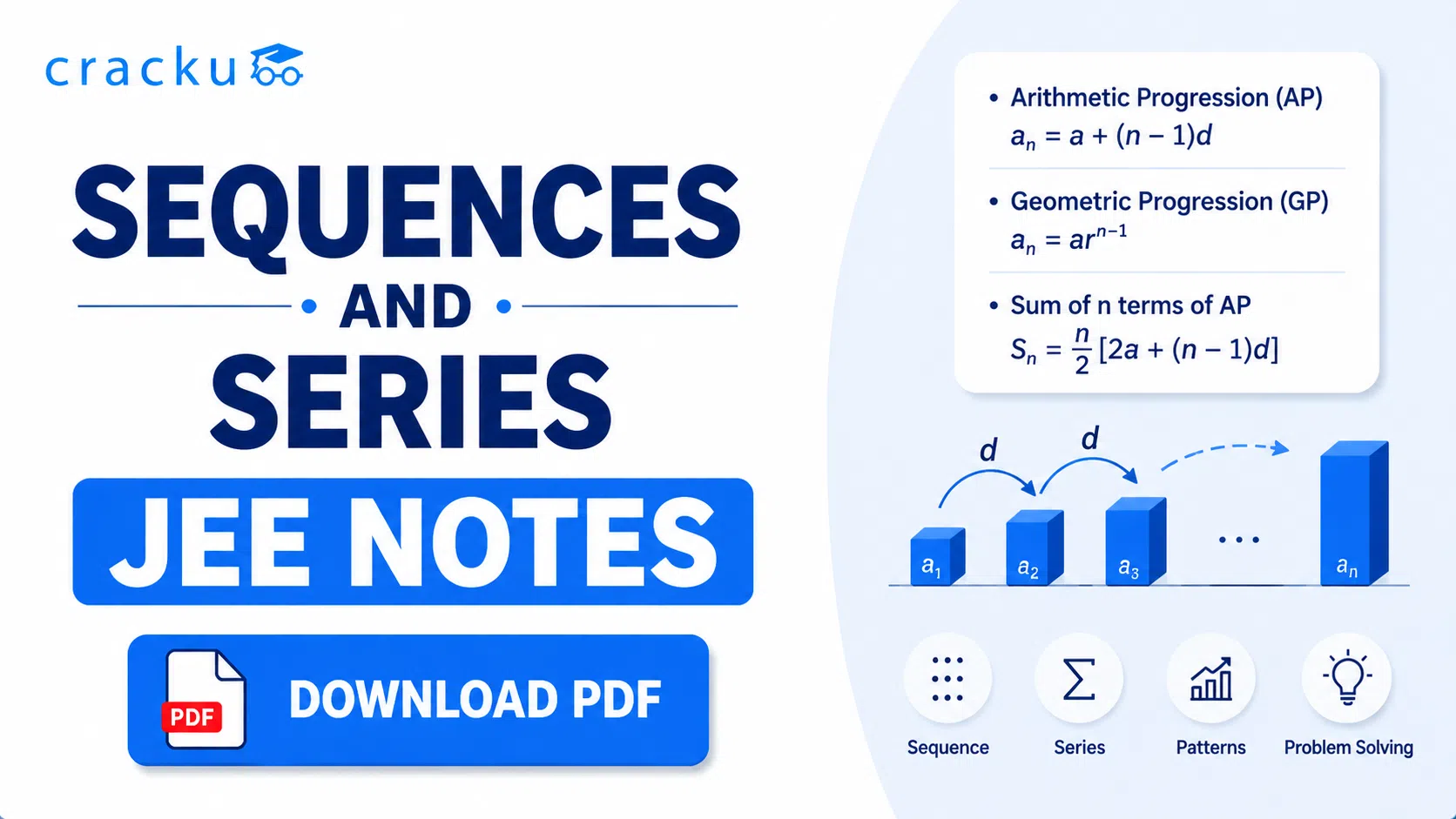
Sequences and Series is one of the important chapters in JEE Mathematics, with applications in topics like binomial theorem, limits, probability and calculus. Practising JEE questions on Sequences and Series helps students understand patterns, progressions and summation techniques. These Sequences and Series JEE Notes cover AP, GP, HP, arithmetico-geometric progression, standard summation formulas, AM-GM-HM inequality, method of differences and telescoping series for quick JEE revision.
Sequences and Series JEE Notes: Important Concepts
Sequence and Series Basics
Sequence: A sequence is an ordered list of numbers where each term follows a specific rule. The terms of a sequence are represented as:
$$a_1,a_2,a_3,\dots,a_n$$
Here, an represents the nth term of the sequence.
Series: A series is formed by adding the terms of a sequence.
$$S_n=a_1+a_2+a_3+\dots+a_n$$
Here, Sn represents the sum of the first n terms.
The relationship between the nth term and the sum of terms is:
$$a_n=S_n-S_{n-1},\quad n\geq2$$
For the first term:
$$a_1=S_1$$
Worked Example: The sum of first n terms of a sequence is:
$$S_n=3n^2+5n$$
Find the nth term.
Using:
$$a_n=S_n-S_{n-1}$$
$$a_n=(3n^2+5n)-[3(n-1)^2+5(n-1)]$$
$$=3n^2+5n-3(n^2-2n+1)-5n+5$$
$$=6n+2$$
Therefore:
$$a_n=6n+2$$
Arithmetic Progression (AP)
An Arithmetic Progression is a sequence in which the difference between consecutive terms remains constant.
Example:
$$2,5,8,11,14,\dots$$
The constant difference is called the common difference.
$$d=a_{n+1}-a_n$$
AP Formulas
For an AP with first term a and common difference d:
| Concept | Formula |
|---|---|
| nth term | $$a_n=a+(n-1)d$$ |
| Sum of n terms | $$S_n=\frac{n}{2}[2a+(n-1)d]$$ |
| Alternative sum formula | $$S_n=\frac{n}{2}(a+l)$$ |
Here, l represents the last term of the AP.
Worked Example: Find the 20th term and sum of the first 20 terms of:
$$3,7,11,15,\dots$$
Here:
$$a=3,\quad d=7-3=4$$
20th term:
$$a_{20}=a+19d$$
$$=3+19(4)=79$$
Sum of first 20 terms:
$$S_{20}=\frac{20}{2}(3+79)$$
$$=10(82)=820$$
Arithmetic Mean and Inserting Means
The arithmetic mean between two numbers is the average of those numbers.
For two numbers a and b:
$$A=\frac{a+b}{2}$$
If n arithmetic means are inserted between two numbers:
The common difference is:
$$d=\frac{b-a}{n+1}$$
The kth arithmetic mean is:
$$A_k=a+\frac{k(b-a)}{n+1}$$
Worked Example: Insert 3 arithmetic means between 4 and 20.
Here:
$$a=4,\quad b=20,\quad n=3$$
Common difference:
$$d=\frac{20-4}{3+1}=4$$
The arithmetic means are:
$$A_1=8,\quad A_2=12,\quad A_3=16$$
The AP becomes:
$$4,8,12,16,20$$
Properties of AP
- If a, b and c are in AP:
- Adding or subtracting the same constant from every term keeps the sequence as an AP.
- Multiplying every term by a constant k changes the common difference to kd.
- Terms equidistant from the beginning and end have the same sum.
- The sum of n terms of an AP is always a quadratic expression in n.
$$2b=a+c$$
JEE Tip: When three numbers are in AP, represent them as:
$$a-d,\ a,\ a+d$$
This representation simplifies many JEE problems quickly.
Geometric Progression (GP)
A Geometric Progression is a sequence in which every term is obtained by multiplying the previous term by a constant value called the common ratio.
Example:
$$2,6,18,54,\dots$$
The common ratio is:
$$r=\frac{a_{n+1}}{a_n}$$
GP Formulas
For a GP with first term a and common ratio r:
| Concept | Formula |
|---|---|
| nth term | $$a_n=ar^{n-1}$$ |
| Sum of n terms | $$S_n=\frac{a(r^n-1)}{r-1},\quad r\neq1$$ |
| Alternative sum formula | $$S_n=\frac{a(1-r^n)}{1-r},\quad r\neq1$$ |
| Sum when r = 1 | $$S_n=na$$ |
Worked Example: Find the 8th term and sum of the first 8 terms of:
$$3,6,12,24,\dots$$
Here:
$$a=3,\quad r=\frac63=2$$
8th term:
$$a_8=3(2)^7$$
$$=384$$
Sum of first 8 terms:
$$S_8=\frac{3(2^8-1)}{2-1}$$
$$=3(255)=765$$
Sum to Infinity of a GP
The sum of an infinite GP exists only when the terms approach zero.
The condition required is:
$$|r|<1$$
The formula for infinite GP is:
$$S_{\infty}=\frac{a}{1-r}$$
If:
$$|r|\geq1$$
the infinite series is divergent and the sum does not exist.
Worked Example: Find the sum of:
$$1+\frac12+\frac14+\frac18+\dots$$
Here:
$$a=1,\quad r=\frac12$$
Since:
$$|r|<1$$
Therefore:
$$S_{\infty}=\frac{1}{1-\frac12}$$
$$=2$$
Geometric Mean and Inserting Geometric Means
The geometric mean between two positive numbers a and b is:
$$G=\sqrt{ab}$$
If n geometric means are inserted between two numbers:
The common ratio is:
$$r=\sqrt[n+1]{\frac ba}$$
The kth geometric mean is:
$$G_k=ar^k$$
Worked Example: Insert 2 geometric means between 3 and 192.
Here:
$$a=3,\quad b=192,\quad n=2$$
Common ratio:
$$r=\sqrt[3]{\frac{192}{3}}$$
$$=\sqrt[3]{64}=4$$
Therefore:
$$G_1=3(4)=12$$
$$G_2=3(4^2)=48$$
The GP becomes:
$$3,12,48,192$$
Properties of GP
- If a, b and c are in GP:
- Multiplying every term by a constant does not change the common ratio.
- The product of terms equidistant from the beginning and end is constant.
- The reciprocals of a GP form another GP with common ratio:
- If all terms are positive, logarithms of GP terms form an AP.
$$b^2=ac$$
$$a_k \times a_{n+1-k}=a_1 \times a_n$$
$$\frac1r$$
JEE Tip: For three numbers in GP, use:
$$\frac ar,\ a,\ ar$$
This simplifies many JEE problems involving products.
Harmonic Progression (HP)
A Harmonic Progression is a sequence whose reciprocals form an Arithmetic Progression.
If:
$$a_1,a_2,a_3,\dots$$
is an HP, then:
$$\frac1{a_1},\frac1{a_2},\frac1{a_3},\dots$$
is an AP.
There is no direct formula for the sum of terms of an HP. Convert the HP into an AP, solve the problem, and then take reciprocals wherever required.
Harmonic Mean
The harmonic mean between two positive numbers a and b is:
$$H=\frac{2ab}{a+b}$$
Worked Example: Find the 5th term of the HP:
$$\frac13,\frac15,\frac17,\dots$$
The corresponding AP is:
$$3,5,7,\dots$$
Here:
$$a=3,\quad d=2$$
5th term of AP:
$$a_5=3+4(2)=11$$
Therefore, the 5th term of HP is:
$$\frac1{11}$$
JEE Tip: Whenever an HP question appears, immediately convert the terms into their reciprocals and solve it as an AP problem.
Arithmetico-Geometric Progression (AGP)
An Arithmetico-Geometric Progression is formed by multiplying corresponding terms of an Arithmetic Progression and a Geometric Progression.
Example:
AP:
$$1,2,3,4,\dots$$
GP:
$$1,r,r^2,r^3,\dots$$
The AGP becomes:
$$1,2r,3r^2,4r^3,\dots$$
The nth term of an AGP is:
$$a_n=[a+(n-1)d]r^{n-1}$$
Sum of AGP
For the series:
$$S_n=a+(a+d)r+(a+2d)r^2+\dots+[a+(n-1)d]r^{n-1}$$
The finite sum can be found using the rS method.
Multiply the equation by r and subtract:
$$rS_n=ar+(a+d)r^2+\dots+[a+(n-1)d]r^n$$
Subtracting:
$$S_n-rS_n$$
gives a simpler expression that can be solved easily.
For an infinite AGP:
$$S_{\infty}=\frac{a}{1-r}+\frac{dr}{(1-r)^2}$$
where:
$$|r|<1$$
Worked Example: Find the sum to infinity of:
$$1+3x+5x^2+7x^3+\dots$$
Here:
$$a=1,\quad d=2,\quad r=x$$
Using AGP formula:
$$S_{\infty}=\frac1{1-x}+\frac{2x}{(1-x)^2}$$
Taking LCM:
$$S_{\infty}=\frac{1-x+2x}{(1-x)^2}$$
Therefore:
$$S_{\infty}=\frac{1+x}{(1-x)^2}$$
JEE Tip: The multiply-and-subtract method is the fastest approach for AGP problems. Multiply the series by r, shift it by one position, and subtract.
Standard Summation Formulas
Some summations occur frequently in JEE Mathematics. These formulas should be memorised for quick problem solving.
| Series | Formula |
|---|---|
| $$1+2+3+\dots+n$$ | $$\sum_{k=1}^{n}k=\frac{n(n+1)}2$$ |
| $$1^2+2^2+3^2+\dots+n^2$$ | $$\sum_{k=1}^{n}k^2=\frac{n(n+1)(2n+1)}6$$ |
| $$1^3+2^3+3^3+\dots+n^3$$ | $$\sum_{k=1}^{n}k^3=\left[\frac{n(n+1)}2\right]^2$$ |
Important Property:
$$\sum k^3=\left(\sum k\right)^2$$
Worked Example: Find:
$$1^2+2^2+3^2+\dots+15^2$$
Using:
$$\sum k^2=\frac{n(n+1)(2n+1)}6$$
For n = 15:
$$=\frac{15(16)(31)}6$$
$$=1240$$
Worked Example: Find:
$$1^3+2^3+3^3+\dots+10^3$$
Using:
$$\sum k^3=\left[\frac{n(n+1)}2\right]^2$$
$$=\left[\frac{10(11)}2\right]^2$$
$$=55^2$$
$$=3025$$
AM-GM-HM Inequality
The AM-GM-HM inequality is one of the most important concepts in Sequences and Series and is frequently used in JEE optimisation problems.
For positive real numbers:
$$AM\geq GM\geq HM$$
For n positive numbers:
$$ \frac{a_1+a_2+\dots+a_n}{n} \geq \sqrt[n]{a_1a_2\dots a_n} \geq \frac{n}{\frac1{a_1}+\frac1{a_2}+\dots+\frac1{a_n}} $$
Equality holds only when:
$$a_1=a_2=a_3=\dots=a_n$$
Relation Between AM, GM and HM
For two positive numbers:
$$AM=\frac{a+b}{2}$$
$$GM=\sqrt{ab}$$
$$HM=\frac{2ab}{a+b}$$
The relation between them is:
$$AM\times HM=GM^2$$
Worked Example: Find the minimum value of:
$$x+\frac1x$$
where:
$$x>0$$
Using AM-GM:
$$\frac{x+\frac1x}{2}\geq\sqrt{x\cdot\frac1x}$$
$$\frac{x+\frac1x}{2}\geq1$$
Therefore:
$$x+\frac1x\geq2$$
The minimum value is:
2
when:
$$x=1$$
Worked Example: If:
$$a+b=10$$
Find the maximum value of:
$$ab$$
Using AM-GM:
$$\frac{a+b}{2}\geq\sqrt{ab}$$
$$5\geq\sqrt{ab}$$
Squaring both sides:
$$ab\leq25$$
Therefore maximum value:
$$ab=25$$
when:
$$a=b=5$$
JEE Tip: Use AM-GM whenever a question asks for maximum product with fixed sum or minimum value of expressions involving reciprocal terms.
Method of Differences
The method of differences is used when the difference between consecutive terms of a sequence follows a known pattern such as an AP or GP.
Steps to solve using the method of differences:
- Find the differences between consecutive terms.
- Identify the pattern formed by the differences.
- Use known summation formulas to find the nth term or sum.
Worked Example: Find the nth term of the sequence:
$$1,3,7,13,21,\dots$$
Find the differences:
$$3-1=2$$
$$7-3=4$$
$$13-7=6$$
$$21-13=8$$
The differences form an AP:
$$2,4,6,8,\dots$$
Here:
$$a=2,\quad d=2$$
The nth term of the original sequence is:
$$a_n=a_1+\sum_{k=1}^{n-1}d_k$$
Therefore:
$$a_n=1+\sum_{k=1}^{n-1}2k$$
Using:
$$\sum k=\frac{n(n+1)}2$$
We get:
$$a_n=1+(n-1)n$$
Therefore:
$$a_n=n^2-n+1$$
Telescoping Series
A telescoping series is a series in which most terms cancel when expanded, leaving only a few terms at the beginning and end.
If:
$$a_k=f(k)-f(k+1)$$
then:
$$\sum_{k=1}^{n}a_k=f(1)-f(n+1)$$
Worked Example: Find:
$$\sum_{k=1}^{n}\frac1{k(k+1)}$$
Using partial fractions:
$$\frac1{k(k+1)}=\frac1k-\frac1{k+1}$$
The series becomes:
$$ (1-\frac12)+(\frac12-\frac13)+(\frac13-\frac14)+\dots+(\frac1n-\frac1{n+1}) $$
All middle terms cancel:
$$=1-\frac1{n+1}$$
Therefore:
$$\sum_{k=1}^{n}\frac1{k(k+1)}=\frac{n}{n+1}$$
Worked Example: Find:
$$\sum_{k=1}^{n}\frac1{k(k+1)(k+2)}$$
Using partial fractions:
$$ \frac1{k(k+1)(k+2)} = \frac12 \left( \frac1{k(k+1)} - \frac1{(k+1)(k+2)} \right) $$
After cancellation:
$$ =\frac12 \left( \frac12-\frac1{(n+1)(n+2)} \right) $$
Therefore:
$$=\frac{n(n+3)}{4(n+1)(n+2)}$$
JEE Tip: Whenever the denominator contains consecutive factors like:
$$k(k+1),\quad k(k+1)(k+2)$$
try partial fractions because such series usually telescope.
Sequences and Series Formula Sheet at a Glance
| Concept | Formula |
|---|---|
| nth term from sum | $$a_n=S_n-S_{n-1}$$ |
| AP nth term | $$a_n=a+(n-1)d$$ |
| AP sum | $$S_n=\frac n2[2a+(n-1)d]$$ |
| Arithmetic Mean | $$A=\frac{a+b}{2}$$ |
| GP nth term | $$a_n=ar^{n-1}$$ |
| GP sum | $$S_n=\frac{a(r^n-1)}{r-1}$$ |
| Infinite GP | $$S_{\infty}=\frac a{1-r},\ |r|<1$$ |
| Geometric Mean | $$G=\sqrt{ab}$$ |
| Harmonic Mean | $$H=\frac{2ab}{a+b}$$ |
| AM-GM-HM Relation | $$AM\geq GM\geq HM$$ |
| AGP nth term | $$a_n=[a+(n-1)d]r^{n-1}$$ |
| Infinite AGP | $$S_{\infty}=\frac a{1-r}+\frac{dr}{(1-r)^2}$$ |
| Sum of natural numbers | $$\sum k=\frac{n(n+1)}2$$ |
| Sum of squares | $$\sum k^2=\frac{n(n+1)(2n+1)}6$$ |
| Sum of cubes | $$\sum k^3=\left[\frac{n(n+1)}2\right]^2$$ |
| Telescoping series | $$\sum[f(k)-f(k+1)]=f(1)-f(n+1)$$ |
JEE Important Points, Common Mistakes and Quick Revision
Important Points JEE Repeatedly Tests
- A sequence is an ordered list of numbers following a fixed rule, while a series is the sum of terms of a sequence.
- For finding terms from a given sum, use:
- In an AP, the difference between consecutive terms remains constant.
- The nth term of an AP is:
- The sum of n terms of an AP is:
- In a GP, the ratio between consecutive terms remains constant.
- The nth term of a GP is:
- The infinite GP formula can only be used when:
- For three numbers in AP, use:
- For three numbers in GP, use:
- For HP problems, convert the terms into reciprocals and solve using AP.
- AM-GM-HM inequality is useful for maximum and minimum value problems.
- Equality in AM-GM occurs only when all terms are equal.
- Use partial fractions whenever consecutive factors appear in denominators because such series often telescope.
- In AGP problems, the rS method is the standard approach.
$$a_n=S_n-S_{n-1},\quad n\geq2$$
$$a_n=a+(n-1)d$$
$$S_n=\frac n2[2a+(n-1)d]$$
$$a_n=ar^{n-1}$$
$$|r|<1$$
$$a-d,\ a,\ a+d$$
$$\frac ar,\ a,\ ar$$
$$AM\geq GM\geq HM$$
Common Mistakes to Avoid
-
Using the infinite GP formula without checking the condition.
The formula: $$S_{\infty}=\frac a{1-r}$$ is valid only when: $$|r|<1$$ -
Confusing AP and GP formulas.
AP uses common difference, while GP uses common ratio. -
Forgetting n+1 gaps while inserting means.
When n means are inserted between two numbers, there are n+1 intervals. -
Using GP sum formula when r = 1.
For: $$r=1$$ use: $$S_n=na$$ -
Applying AM-GM inequality to negative values.
AM-GM requires positive real numbers. -
Forgetting the equality condition in AM-GM.
The maximum or minimum value is achieved only when all terms are equal. -
Searching for a direct HP sum formula.
There is no direct formula for HP summation. Convert HP into AP first. -
Missing cancellation in telescoping series.
Always write the expanded series and identify the surviving terms. -
Confusing arithmetic mean and geometric mean.
Remember: $$AM=\frac{a+b}{2}$$ and: $$GM=\sqrt{ab}$$
Quick Revision Notes for Sequences and Series
- Sequence: An ordered list of numbers following a fixed pattern.
- Series: Sum of terms of a sequence.
- Relation between term and sum: $$a_n=S_n-S_{n-1}$$
- AP: $$a_n=a+(n-1)d$$
- AP sum: $$S_n=\frac n2[2a+(n-1)d]$$
- Arithmetic Mean: $$A=\frac{a+b}{2}$$
- GP: $$a_n=ar^{n-1}$$
- GP sum: $$S_n=\frac{a(r^n-1)}{r-1}$$
- Infinite GP: $$S_{\infty}=\frac a{1-r}$$ where: $$|r|<1$$
- Geometric Mean: $$G=\sqrt{ab}$$
- Harmonic Mean: $$H=\frac{2ab}{a+b}$$
- AM-GM-HM relation: $$AM\geq GM\geq HM$$
- AGP nth term: $$a_n=[a+(n-1)d]r^{n-1}$$
- Sum of natural numbers: $$\sum k=\frac{n(n+1)}2$$
- Sum of squares: $$\sum k^2=\frac{n(n+1)(2n+1)}6$$
- Sum of cubes: $$\sum k^3=\left[\frac{n(n+1)}2\right]^2$$
- Telescoping series: $$ \sum[f(k)-f(k+1)]=f(1)-f(n+1) $$
Problem-solving routine: Start every Sequences and Series problem by identifying the type of progression. Check whether the sequence is AP, GP or HP before applying formulas. Use AM-GM for optimisation problems, the rS method for AGP, and partial fractions for telescoping series. A quick revision of the JEE formula sheet helps recall important formulas during final preparation.
.webp)